6 Mind-Bending Economic Truths That Will Change How You See the World
Introduction: Beyond the Numbers
6 Mind-Bending Economic Truths That Will Change How You See the World
Introduction: Beyond the Numbers
Does the subject of economics bring to mind dry, technical language and “all this money talk”? For many, the field seems abstract and far removed from daily life. Yet, beneath the charts and figures lies a fascinating exercise in philosophy that can make you look at the world in ways you would have never considered before.
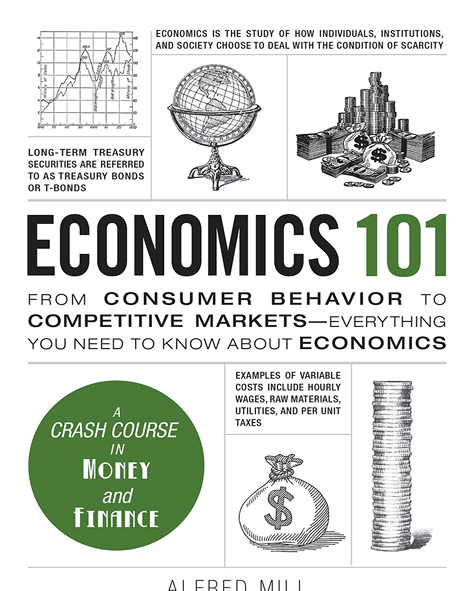
Get ready to have your common sense turned on its head. Economics reveals the hidden connections between seemingly unrelated things, providing a powerful lens for understanding not just markets, but human behavior itself. This article uncovers six economic truths from the book Economics 101 by Alfred Mill that will fundamentally change how you see the world around you. We go in-depth about it in this video https://youtu.be/iqh4uFfmhE8
The List: Surprising Ideas That Explain Our World
1. “Capital” Isn’t What You Think It Is
When most people hear the word “capital,” they think of money. In economics, however, the term has a very different and specific meaning. Economic capital refers to all of the tools, factories, and equipment used in the production process. It is the physical “stuff” used to make other “stuff.”
This distinction can be confusing. As the book Economics 101 notes, you have probably lived a happy life thinking capital was money. But the difference is crucial because it clarifies how an economy truly grows. Investment in the physical capital that makes labor more productive — a factory, new software, or a delivery truck — is what increases a society’s ability to produce goods and services. This distinction is why a country cannot simply print more money to become wealthy; true growth requires investment in the physical and technological tools that amplify its productive power.
2. In Economics, Everyone Is Selfish
One of the most foundational — and controversial — assumptions in economics is that all human behavior is motivated by self-interest. Economists presume that people’s choices are made to maximize their own personal happiness or “utility.”
This view can seem cynical, especially when applied to acts of apparent altruism. For example, an economist analyzing a soldier who jumps on a grenade to save his platoon would frame it as a utility-maximizing decision. To economists, this soldier instantly calculated that the marginal benefit of saving his fellow soldiers outweighed the marginal cost of his life, and jumped on the grenade as an act of utility, maximizing self-interest. While this may feel like a cold explanation, economists use this assumption as a powerful, if simplified, tool to model and predict behavior on a large scale.
However, this assumption is subject to intense criticism, even within the field. As the source text Economics 101 points out, “The failure of most economists to predict the most recent economic downturn seems to support the view that economics ignores human psychology at its own peril.” This has led to a call for the discipline to become “more messy, complex, and organic, like biology,” acknowledging that our motivations are often far more complicated than simple self-interest.
3. Modern Money Is a Shared Illusion
The cash in your wallet and the numbers in your bank account are forms of “inconvertible fiat” money. This means modern currency is intrinsically worthless — it is not redeemable for or backed by a physical commodity like gold. Its value comes from two sources: government decree (the government says it’s money) and our collective faith in the system.
Today’s money is, in essence, an imaginary friend we all agree to believe in. The system works because we all collectively accept that a dollar bill can be exchanged for goods and services. It is backed by nothing more than faith:
Money is debt. The U.S. dollar is a promise to pay from the U.S. Federal Reserve to the holder. You might ask, “A promise to pay what?” The answer is another dollar.
4. Paying Off a Loan Can Destroy Money
Here is a truly counterintuitive idea: the financially responsible act of paying off a loan actually removes money from the economy. This concept is sometimes referred to as the “Money Divider.”
Government printing presses do not create most money; it is created when commercial banks issue loans. When a bank gives you a loan, it creates a deposit in your account, increasing the total money supply. Conversely, when you repay that loan, the process works in reverse. As you pay down the principal, that money is effectively destroyed, shrinking the total money supply. This is why widespread, simultaneous debt repayment during an economic downturn — an act that feels responsible for every individual — can paradoxically deepen a recession by shrinking the money supply just when the economy needs it most.
5. You Can Earn a $4,000 Profit and Still Be Losing Money
To understand this paradox, you must grasp the difference between accounting profit and economic profit. While an accountant subtracts explicit costs (money spent) from revenue, an economist includes another crucial factor: opportunity cost. Opportunity cost is the value of the next-best alternative you sacrifice when making a choice.
Consider a teacher earning $5,000 a month who decides to quit her job to sell snow cones.
Accounting Profit:
- Revenue: $6,000
- Explicit Costs: -$2,000
- Profit: $4,000
Economic Profit:
- Revenue: $6,000
- Explicit Costs: -$2,000
- Opportunity Cost (Salary): -$5,000
- Loss: -$1,000
She has suffered an economic loss of $1,000. This calculation provides a much more realistic assessment, signaling that her resources could be put to better use in her old profession. Economic profit is a far more powerful concept for making real-world life and business decisions.
6. Your SUV Habit Might Affect the Price of Rice in Asia
How might driving an SUV contribute to starvation in Southeast Asia? This question reveals how markets are deeply interconnected, and how actions in one can trigger a chain of unintended consequences across the globe.
The sequence began with high gas prices in the United States, which increased political pressure for alternative fuels. This demand was popular among corn growers, who produce ethanol and successfully lobbied Congress for greater subsidies. This government-backed incentive resulted in more farmland being placed into corn production at the expense of other crops, particularly wheat. With less land dedicated to wheat, its supply decreased and its price rose. As wheat became more expensive, demand for its substitute, rice, surged. This drove the price of rice so high that many people in South and Southeast Asia, where rice is a basic staple, could no longer afford it, leading to starvation. This tragic chain is a powerful example of how decisions made in one part of the world can have unforeseen and devastating impacts elsewhere.
Final Thoughts
As these examples show, economics is far more than just the study of money. It is a framework for understanding the hidden logic that shapes our world, revealing how individual choices, collective beliefs, and market forces interact in complex and often surprising ways. By challenging our everyday assumptions, these principles offer a deeper appreciation for the intricate web of cause and effect that governs our lives.
Now that you’ve seen these hidden connections, what other everyday assumptions will you start to question?
Economics101 #ThunkFusion #NoKappTechBiz #FinancialLiteracy #WealthMindset #OpportunityCost #Macroeconomics #BusinessStrategy #AlfredMill #MoneyManagement #EconomyExplained #InvestingTips
메타데이터
- post_id
- e2a91f42ef3e
- slug
- 6-mind-bending-economic-truths-that-will-change-how-you-see-the-world-e2a91f42ef3e
- url
- https://blog.venturemagazine.net/6-mind-bending-economic-truths-that-will-change-how-you-see-the-world-e2a91f42ef3e
- canonical_url
- https://blog.venturemagazine.net/6-mind-bending-economic-truths-that-will-change-how-you-see-the-world-e2a91f42ef3e
- author_url
- https://medium.com/@svkmsr6
- status
- ok
- fetched_at
- 2026-07-14 10:54:51