Why Does the Variational Quantum Eigensolver (VQE) Matter?
INTRODUCTION
Why Does the Variational Quantum Eigensolver (VQE) Matter?
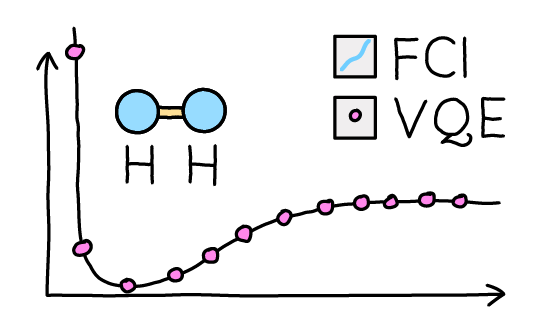
Source: PennyLane
INTRODUCTION
Over the last few years, we have seen quantum computing pop up in the news from time to time. A bold move by humanity to harness the power of quantum mechanics to unlock unimaginable computing power. It has been opening doors to solving problems that are too complex for classical computers. We are currently (as of 2025) in the NISQ (Noisy Intermediate Scale Quantum) era of quantum computing. Our devices have tens to a few hundred qubits (quantum bits) and are easily disrupted by noise. Nonetheless, we can still apply some algorithms to solve complex challenges.
One such challenge is calculating properties of molecules. The Variational Quantum Eigensolver (VQE) is a hybrid quantum-classical algorithm that can help find the lowest energy of a system. In this article, I’ll explain what VQE is, why it’s important, and its real-world significance in quantum chemistry.
WHAT IS THE VARIATIONAL QUANTUM EIGENSOLVER (VQE)?
As mentioned earlier, the VQE is a hybrid quantum-classical algorithm originally developed to solve problems in chemistry on quantum computers (Q-munity). The algorithm uses a trial and error approach to find the lowest energy of a system. It finds the eigenvalue that represents the energy of the system and a “variational” approach is used to narrow down to the lowest eigenvalue.
The beauty of this algorithm is the hybrid nature. The VQE implementation is split between a classical computer and a quantum computer, making it feasible to run the algorithm on current NISQ devices. The VQE assigns the heavy computation part to the classical computer reducing load on the quantum computer. The VQE is well known for its applications in quantum chemistry.
The lowest energy of a system is called its ground state. The ground state is a key indicator of stability and tells us how it will interact in chemical reactions. Classical computers struggle to calculate the ground state energy beyond small systems due to the sheer size of computation required (Phys.org). The VQE leverages the principles of quantum physics to tackle this issue.
WHY IS VQE IMPORTANT?
The VQE is an important algorithm for the current NISQ era of quantum computing (Classiq). Quantum computers today are still small and prone to errors (or ‘noise’) caused by external factors. This makes it harder to run complex algorithms. At a time where quantum computers are still in their development stage, the VQE manages to work with these limitations, producing promising results. The hybrid approach dramatically reduces the need for complex quantum operations **(nature.com)**. Larger quantum computations are replaced with shorter runs combined with classical feedback.
The VQE outperforms classical computations in certain tasks. Classical algorithms calculate molecular energy using a method known as ‘exact diagonalization’. This scales exponentially making it practically impossible to run for larger molecules **(nature.com). The VQE harnesses the power of quantum mechanics to handle these problems more directly. This helps the VQE bypass classical limitations making calculations exponentially faster using quantum approaches. A recent variant of VQE was reported to perform calculations in a few hours that might take months on a classical machine (Phys.org)**.
APPLICATIONS IN QUANTUM CHEMISTRY
The VQE is a key algorithm in studying quantum chemistry. It enables quantum computers to tackle molecular simulations by directly simulating the molecule’s quantum state. The algorithm has proven to be promising in small-scale simulations like calculating the lowest energy in Lithium Hydride and Hydrogen Molecules (Q-munity).
One notable 2025 experiment used a refined VQE approach to map out the dissociation curve of molecular nitrogen (N₂). Essentially, the experiment studied how the energy of an N₂ molecule changes as the two nitrogen atoms are pulled apart. This is a notoriously hard scenario for classical methods to get right as breaking chemical bonds involves complex quantum effects. The VQE-based simulation achieved good agreement with the exact solution and even outperformed several traditional methods in accurately capturing the bond-breaking process. Such results, while on small systems, show the promise that quantum algorithms have in tackling chemistry problems that classical computers find extremely challenging (nature.com).
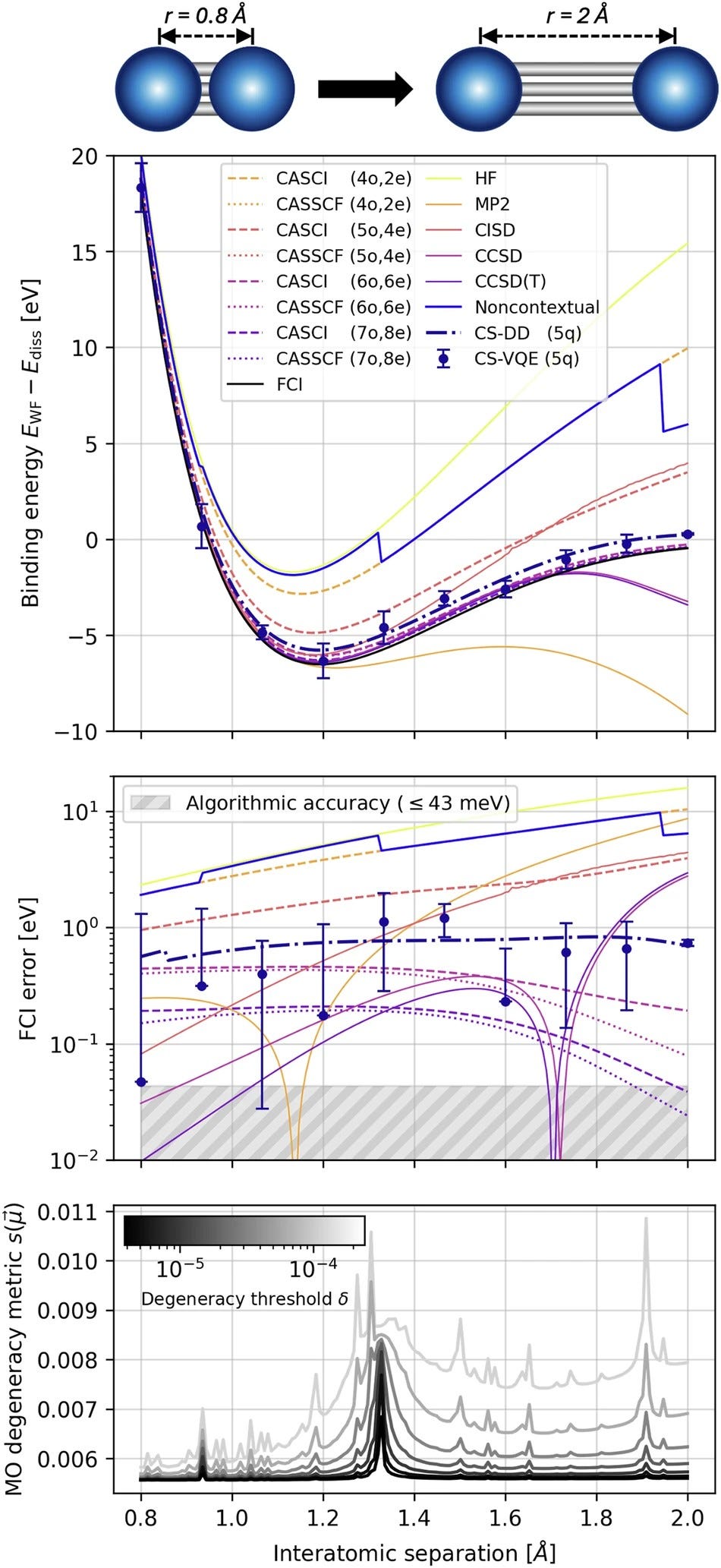
Source: NPJ | Quantum Information
Along with simulating existing molecules, the VQE is a promising approach to help discover new molecules. Evaluating molecular energies helps scientists develop better drugs, catalysts, and materials. The VQE’s ability to model molecular structures is revolutionary for drug discovery. Companies are exploring ways to incorporate the algorithm in studying protein structures and new chemical compounds.
메타데이터
- post_id
- e2b163290bdf
- slug
- why-does-the-variational-quantum-eigensolver-vqe-matter-e2b163290bdf
- url
- https://medium.com/@adityasunke/why-does-the-variational-quantum-eigensolver-vqe-matter-e2b163290bdf
- canonical_url
- https://medium.com/@adityasunke/why-does-the-variational-quantum-eigensolver-vqe-matter-e2b163290bdf
- author_url
- https://medium.com/@adityasunke
- status
- ok
- fetched_at
- 2026-06-14 11:28:49