From Plain English to Test Script in Minutes: How algoQA’s generative AI Engine Works
The most expensive skill in QA is not writing test scripts.
From Plain English to Test Script in Minutes: How algoQA’s generative AI Engine Works
The most expensive skill in QA is not writing test scripts.
It is translation, converting a product requirement written in plain English into a precise, executable, maintainable test script. That translation requires deep technical knowledge, contextual understanding of the application, and significant time investment from a skilled engineer.
For most QA teams, it is where the majority of sprint capacity disappears.
algoQA’s generative AI engine eliminates that translation entirely. Here is exactly how it works — and why the implications go well beyond simple automation.
The Translation Problem Nobody Talks About
When a product manager writes a requirement, they write in business language.
“When a user submits a payment above ₹50,000, the system should trigger a secondary authentication step and log the transaction with a timestamp and user ID.”
To a stakeholder, that may look like a single requirement. To a QA engineer, it represents multiple validation scenarios, boundary conditions, and exception paths that need to be verified.
A senior QA engineer reads that requirement and translates it into structured test cases. They identify what needs to be validated, define the steps to execute, determine the expected outcomes, and account for edge cases that could impact functionality.
That translation process takes time. It relies on experience and judgment. And because it is performed manually, it can introduce interpretation gaps — moments where the understanding of the requirement differs across product, engineering, and QA teams. Those gaps often surface later as missed scenarios, rework, or defects.
This translation layer is one of the most persistent sources of QA effort. Yet most testing tools begin only after the translation has already been completed.
The real opportunity is not simply automating test execution. It is reducing the effort required to convert business requirements into comprehensive, executable tests in the first place.
How algoQA’s generative AI Engine Works
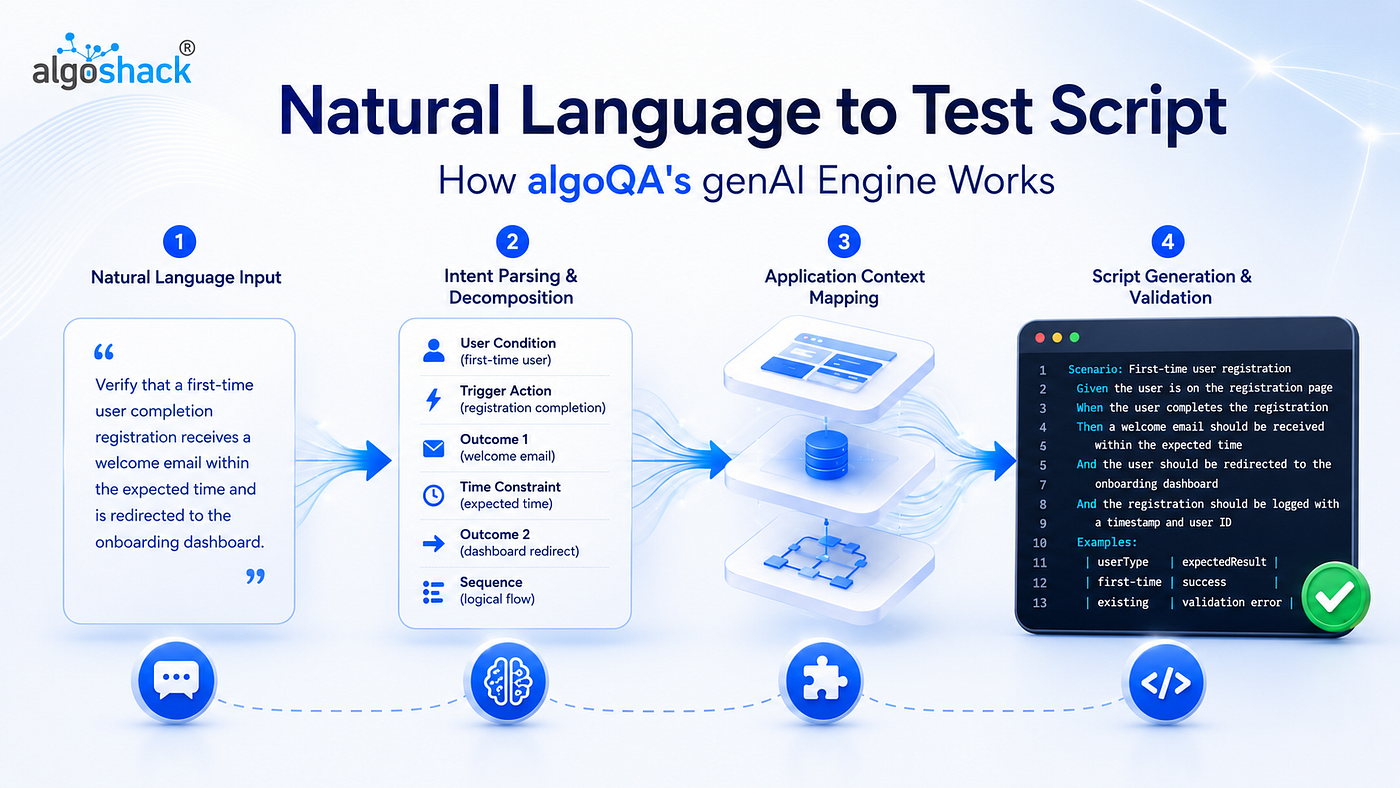
Step 1 — Natural Language Input
A QA engineer, product manager, or business analyst types a requirement in plain English. No special syntax. No structured template. No keyword formatting. Plain conversational language describing the expected application behaviour.
“Verify that a first-time user completing registration receives a welcome email within 30 seconds of account creation and is redirected to the onboarding dashboard.”
That is the input. Users can also add supporting context, such as edge cases or business rules, to help the engine generate more precise test coverage.
Step 2 — Intent Parsing and Decomposition
algoQA’s generative AI engine parses the input and identifies the functional intent — what is being tested — and decomposes it into discrete testable components. In the example above the engine identifies: user state condition (first-time), trigger action (registration completion), expected outcome one (welcome email), time constraint (30 seconds), expected outcome two (dashboard redirect), and the logical sequence connecting them.
This decomposition happens in seconds. What takes a senior engineer several minutes of manual analysis happens automatically — and consistently, without interpretation variance between engineers.
Step 3 — Application Context Mapping
This is what separates algoQA’s generative AI engine from simple text-to-script converters. The engine does not generate a generic test script. It maps the parsed intent against your actual application — its element structure, its navigation flows, and its data models.
Step 4 — Script Generation and Validation
The complete test script is generated — production-grade, framework-compatible, version-controlled. The script is production-ready for your environment — not a template that requires manual customisation before it can run.
It supports BDD and TDD natively. No proprietary scripting language. No vendor lock-in. Scripts are generated in the framework of the customer’s choice.
Total elapsed time from plain English input to executable test script: a matter of minutes.
Why This Changes More Than Just Speed
The speed gain is significant. But the deeper implication is structural.
When test script creation no longer requires a trained QA engineer, the bottleneck in your testing pipeline moves. It does not disappear — but it shifts from technical execution to strategic decision-making.
Product managers can now contribute directly to test coverage — writing requirements in their natural language and generating draft test cases that QA can review and validate. Business analysts can validate acceptance criteria by converting them directly into executable tests before development begins.
This is shift-left testing implemented at the requirement stage — not at the code review stage. It closes the interpretation gap between what was specified and what gets tested before a single line of code is written.
The defect leakage implications are significant. Most production defects trace back to a gap between requirement intent and test coverage. When requirements become test cases directly — that gap closes.
What This Means for Your QA Team
The concern most QA leads raise when they hear about generative AI-driven test generation is the same concern that emerges with every automation advancement: does this replace my engineers?
The answer is consistent with every generation of genuine automation capability: it does not replace engineers. It replaces the least valuable part of their workday.
Writing test scripts from requirements is not the work that requires a QA engineer’s expertise. Understanding which requirements are ambiguous, which edge cases are high-risk, which test coverage decisions have architectural implications — that is the work that requires expertise.
algoQA’s generative AI engine handles the first category. Your engineers own the second. The result is a QA function that operates faster, covers more, and thinks at a higher level simultaneously.
AlgoShack Technologies builds algoQA — an AI-augmented autonomous testing platform with built-in generative AI test script generation. Ranked #27 globally among 900+ test automation companies. 2 published patents. Enterprise NPS: 94. Bootstrapped.
메타데이터
- post_id
- e2b5e339d4fb
- slug
- from-plain-english-to-test-script-in-minutes-how-algoqas-generative-ai-engine-works-e2b5e339d4fb
- url
- https://medium.com/@algoshack/from-plain-english-to-test-script-in-minutes-how-algoqas-generative-ai-engine-works-e2b5e339d4fb
- canonical_url
- https://medium.com/@algoshack/from-plain-english-to-test-script-in-minutes-how-algoqas-generative-ai-engine-works-e2b5e339d4fb
- author_url
- https://medium.com/@algoshack
- status
- ok
- fetched_at
- 2026-07-16 22:47:37