Why Building ZK Rollups Is More Complex Than It Looks
Why does proof generation take nearly 18 minutes for a single transaction batch on a machine running 128GB of RAM and a dedicated GPU?
Why Building ZK Rollups Is More Complex Than It Looks
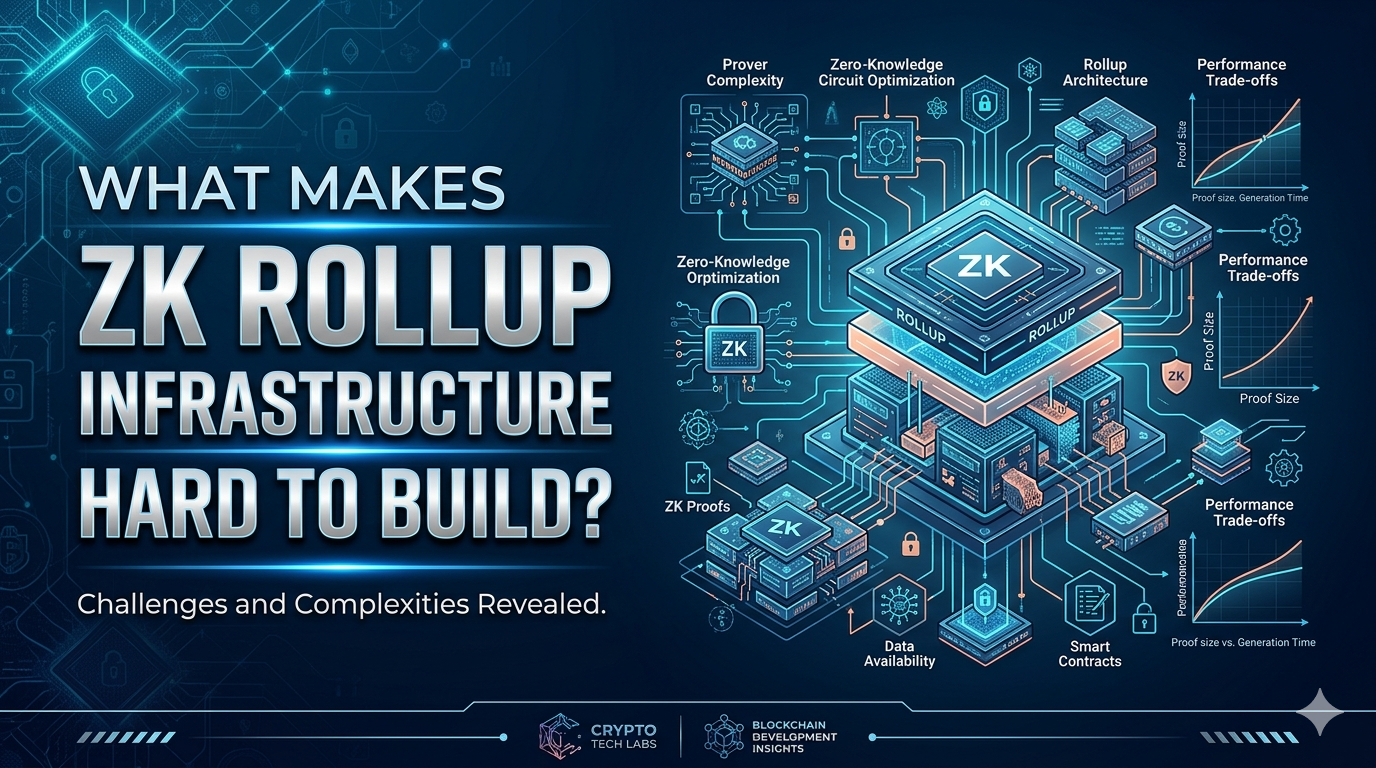
Why Are ZK Rollups Expensive and Complex to Develop?
Why does proof generation take nearly 18 minutes for a single transaction batch on a machine running 128GB of RAM and a dedicated GPU?
Why do enterprises with world-class cryptographers and hundreds of millions in funding still take three to five years to reach mainnet?
Why does one missed constraint in a ZK circuit not crash a system loudly, but silently create a backdoor that nobody notices until real money is gone?
If you’ve been active in the ZK rollup space, or seriously evaluating whether to, these questions probably hit close to home. The pitch is always clean: bundle transactions off-chain, generate a cryptographic validity proof, post it to Ethereum, and you’re done.
Result?
- Costs fall.
- Throughput climbs.
- Security holds.
It fits neatly on a slide deck and sounds inevitable at every conference.
However, the gap between that slide and a production system handling real user funds is where even the best teams get humbled.
- StarkWare spent years moving from academic paper to mainnet.
- Matter Labs burned through hundreds of millions before the zkSync Era could reliably handle DeFi workloads.
- Polygon committed over a billion dollars to ZK technology, and the work is still ongoing.
These aren’t cautionary tales. They’re honest reflections of what this technology actually demands from the people building it.
So what makes ZK rollups genuinely hard, not in theory, but in the trenches?
Here’s the full picture.
Why ZK Rollups Are Gaining Attention in Blockchain Scalability
The momentum behind ZK rollups isn’t hype. The 2026 data makes that clear.
- The broader Layer 2 ecosystem has crossed $48 billion in TVL as of mid-2026. According to eco.com 73 active tracked rollups now collectively secure more than $48 billion in total value locked, a market that has consolidated sharply from the fragmented, incentive-driven landscape of 2023–2024. ZK rollups are carving out a distinct and growing slice of that pie.
- Roll-ups utilizing zero-knowledge proofs have plans to outperform optimistic rollups when it comes to stablecoin volume settlements. The most significant structural change that will occur in 2026 is one where the top ZK rollups will settle more stablecoin volume than all optimistic rollups combined. Stablecoins already constitute over 70% of all L2 transaction volume, making this a race for the most capital-intensive segment of blockchain infrastructure.
- Institutional money is moving in, and naming ZK rails specifically. zkSync Era, through its Prividium subsidiary, is actively targeting Deutsche Bank and UBS for privacy-preserving tokenized asset settlement. Mantle’s ZK-upgraded network hit over $1 billion in Aave lending markets just 19 days after launch in Q1 2026, attracting over $200 million in a single weekend. This is not retail speculation, it’s institutional capital following cryptographic finality guarantees that optimistic rollups structurally cannot offer.
- By 2025, Layer 2 (L2) networks had emerged as Ethereum’s dominant execution layer, processing over 1.9 million transactions per day and contributing nearly 95% of the network’s overall transaction throughput by November 2025. Layer 2 solutions already handle 10 times the transaction volume of Ethereum mainnet, according to The Block. Over 65% of new smart contracts now deploy to L2 networks rather than Ethereum L1, a structural signal that developer gravity has decisively shifted off the base layer, and ZK rollups are the architecture that the most security-conscious of those developers are choosing.
- Transaction fees have dropped to near-zero for everyday users. After EIP-4844 introduced blob data to Ethereum in March 2024, ZK rollup fees for simple transfers fell to single-digit cents on most major networks, roughly a 10x reduction from pre-4844 levels and 50–100x cheaper than Ethereum mainnet. The economic barrier that once kept ZK rollups as a niche tool has effectively been removed.
What Makes ZK Rollups Different From Other Scaling Solutions?
The architectural distinction between ZK rollups and their alternatives isn’t just technical trivia; it has concrete consequences for users and builders.
- ZK rollups prove correctness mathematically, not economically. Optimistic rollups assume transactions are valid unless challenged within a 7-day window. ZK rollups generate a cryptographic validity proof before anything is finalized — no waiting, no trust required.
- Finality is near-instant. Once Ethereum verifies the proof, the transactions are done. Users don’t need to wait days to withdraw funds to Layer 1 — a friction point that has quietly deterred mainstream adoption of optimistic solutions.
- The security model has a different failure mode. Optimistic rollups rely on someone noticing fraud and submitting a challenge. ZK rollups rely on mathematics. If the proof is valid, the state is valid — full stop. There is no “if nobody notices” scenario.
- The trade-off shifts computational burden from verification to generation. Verifying a ZK proof on Ethereum is cheap and fast. Generating one is extraordinarily expensive — and that’s exactly where most of the real complexity lives.
Why Is Cryptographic Proof Generation So Challenging?
Describing proof generation as “just math” is like describing surgery as “just cutting.” Technically accurate, practically misleading.
- Every computation must be translated into arithmetic circuits. Before a ZK proof can be generated, every operation a smart contract performs, every addition, comparison, and storage read must be re-expressed as mathematical constraints in a process called arithmetization. This alone is a specialized discipline.
- Choosing a proof system is a multi-dimensional trade-off. There are two main types: zk-SNARKs (zkSync, Polygon zkEVM, Scroll, Linea), and zk-STARKs (StarkNet). zk-SNARKs result in smaller and faster-verifying proofs, but a trusted setup ceremony is needed, and they use elliptic curve cryptography that is not quantum-resistant. zk-STARKs are slower and need more computational resources, but there is no need for a trusted setup, and they are based on hashes, which makes them safe against quantum computers. There is no clear winner; everything depends on your priorities.
- Writing ZK circuits is a craft with very few practitioners. Efficient ZK circuit design sits at the intersection of academic cryptography and production engineering. The global pool of engineers who can do this well and reliably numbers in the low thousands.
- A single missed constraint can silently break everything. Unlike traditional software, where a bug usually causes visible failure, a constraint error in a ZK circuit can create a backdoor, a way to generate a valid-looking proof for an invalid state. The bug is invisible until it’s exploited.
How Do Prover Systems Create Performance Bottlenecks?
Even after solving the math, the infrastructure required to actually generate proofs at production scale is where most ZK projects quietly struggle.
- The hardware demands are substantial and specific. According to the zkSync Era Boojum prover documentation published between late 2023 and 2025, a configuration with 32 vCPUs, 128GB RAM, and an NVIDIA L4 GPU should generally be capable of running the prover effectively. However, it is important to carefully consider the system’s memory requirements to ensure stable performance. Moreover, you have to bear cloud costs. Polygon zkEVM is even heavier: 128 vCPUs and 1TB of RAM. These are not development machines; they’re industrial-grade proving rigs.
- Proof generation times are measured in minutes, not milliseconds. zkSync Era achieves a median proof time of 1,075 seconds per batch. Polygon zkEVM runs around 311 seconds. For context, processing a batch of roughly 3,895 transactions on zkSync takes nearly 18 minutes of continuous computation before a single proof is ready to be posted to Ethereum.
- Centralized proving creates systemic risk. Matter Labs, the team behind zkSync, uses a centralized proving system, an architecture their own team has described as carrying “limited scale, liveness, and cost” issues. A surge in transaction volume in late 2024 exposed exactly this: the centralized prover became a bottleneck, slowing finality across the entire network. Their answer: decentralizing proof generation across a network of independent operators through Lagrange’s Prover Network was only successfully tested in late 2024, and full integration is still ongoing.
- Recursive proofs compound both power and complexity. Many architectures use recursive proof composition — proofs that verify other proofs — to improve efficiency at scale. Both zkSync Era and Polygon zkEVM convert STARK proofs into SNARKs as part of their pipeline, adding another layer of computation and potential failure points to an already complex system.
Why Is Data Availability Still a Major Concern?
A ZK proof guarantees that computation was done correctly. It says nothing about whether the underlying data can be accessed by anyone who needs it, and that gap is consequential.
- Proof validity and data accessibility are separate problems. Imagine a bank that can prove all its accounting is correct but won’t let you see your own account history. That’s the data availability problem. If a rollup operator withholds transaction data, users may be unable to reconstruct their account state and exit to Layer 1.
- Posting full data to Ethereum was expensive until recently. Before EIP-4844 (Proto-Danksharding) went live in early 2024, posting transaction data to Ethereum was a dominant cost driver for rollups. Data costs for a batch of 2,490 transfers ran as high as $194.53. After EIP-4844 introduced dedicated “blob” space, that cost dropped to $0.000266 — a reduction of over 99%.
- But EIP-4844 didn’t eliminate the trade-off; it shifted it. Different rollups use different data posting strategies. zkSync Era posts state diffs (compressed summaries of what changed) rather than full transaction data, achieving meaningful compression, roughly 88,693 bytes replacing 283,905 bytes of raw data. Polygon zkEVM posts more complete data. Each approach has implications for how much a user can independently verify their own transaction history.
- Off-chain data availability solutions introduce trust assumptions. Alternatives like data availability committees (DACs), small groups of validators who attest that data exists, reduce on-chain costs further but add a layer of trust that partially undermines the security model of a ZK rollup. It’s a pragmatic trade-off, not a clean solution.
What Makes ZK Rollup Development Expensive?
There’s a reason the projects like StarkWare, Matter Labs, and Polygon are doing this well, and they have collectively raised hundreds of millions of dollars. This work is not cheap.
- The talent market is brutally competitive. ZK cryptographers with production experience can command compensation packages that rival top-tier machine learning researchers at major tech companies. Hiring even a small team with genuine expertise takes months and significant capital.
- Auditing ZK circuits is a nascent and expensive discipline. Traditional smart contract auditors lack the mathematical background to meaningfully review ZK circuits. A handful of specialized firms including Veridise, Oxorio, and a few others can do this work, but they have long backlogs and charge accordingly.
- Development timelines routinely exceed estimates. Scroll, despite being one of the most technically sophisticated ZK teams in the world, spent over three years moving from concept to mainnet. StarkNet’s journey from the initial STARK paper to a production network took the better part of a decade.
- Infrastructure costs begin before a single user arrives. Running proving clusters, maintaining testnet infrastructure, and supporting developer tooling requires significant ongoing expenditure, all before any revenue is possible. RaaS platforms like Instanodes charge subscription fees, and that’s the managed, outsourced version of the cost.
- Security vulnerabilities are existential issues, not merely expensive ones. This can be seen from hacks such as the Ronin Bridge exploit that led to the loss of $625 million, the Wormhole exploit, which resulted in a loss of $320 million, and the Nomad Bridge hack, where there was a loss of $190 million.
Why Is Achieving EVM Compatibility Difficult?
It would be fair for developers to try to move their current Ethereum contracts to ZK rollups without modifying them. This might seem like a reasonable request. It isn’t.
- The EVM was designed for correctness, not ZK-provability. Ethereum’s virtual machine includes operations, particularly keccak256 hashing and certain storage access patterns that are deeply unfriendly to ZK proof generation because they require massive circuit complexity to represent. The EVM was built to run correctly on thousands of nodes; it was never designed to be turned into arithmetic.
- EVM compatibility exists on a spectrum, and every position involves sacrifice. Vitalik Buterin defined four types of zkEVM compatibility. Type 1 (like Taiko) achieves full Ethereum equivalence but at the cost of proof generation speed. Type 2 (like Scroll and Linea) provides strong compatibility with some proving optimizations. Type 3 (Polygon zkEVM) modifies a few opcodes for efficiency. Type 4 (StarkNet) abandons EVM entirely in favor of Cairo, a custom language, which is why deploying on StarkNet means rewriting code.
- When Aave deployed on Scroll, it required zero contract modifications. The team reported that the process was identical to deploying on Ethereum mainnet, and the entire integration took hours rather than weeks. That result is impressive but it came at the cost of years of engineering work by the Scroll team to achieve that seamless developer experience.
- Gas semantics don’t map cleanly. Even though the ZK rollups will process the EVM bytecode correctly, the cost of transactions inside the rollup may not match up with the cost according to Ethereum’s gas pricing system.
Why Is Cross-Chain Interoperability Hard to Achieve?
ZK rollups don’t exist in isolation. They need to talk to other chains, other rollups, and the applications that span multiple networks, and that creates another category of problems.
- Verifying a proof from one rollup on another requires both to speak the same language. zkSync, StarkNet, and Polygon zkEVM each use different proof systems, different elliptic curves, and different proving key formats. There is no universal standard for cross-rollup proof verification, not yet.
- Bridges remain the most frequently exploited component in crypto. Of the ten largest DeFi hacks in history, the majority involved cross-chain bridges. ZK-based bridges are more secure in principle because they use cryptographic proofs rather than trusted validators, but the proof verification logic itself becomes a new attack surface.
- Composability, i.e., calling contracts across rollups atomically, is still unsolved. You can move assets between zkSync and Polygon zkEVM, but you cannot atomically execute a trade that touches both in a single transaction. The best current solutions work at the “intent” layer, which includes routing and resolving user intentions off-chain, rather than solving the problem natively at the protocol level.
- Finality mismatches make multi-rollup applications brittle. Different rollups finalize at different speeds: one might post proofs to Ethereum every few minutes, another every hour. An application whose logic spans both must deal with asynchronous, inconsistent state, a notoriously hard problem in distributed systems.
Why Are Businesses Turning to RaaS Solutions?
Given everything above, it shouldn’t surprise anyone that a growing share of organizations are choosing not to build ZK rollups themselves.
- The RaaS market is growing fast precisely because in-house builds are so hard. The valuation of the Rollup-as-a-Service market in 2024 is estimated to be $75.4 million, while the predicted valuation by 2032 is estimated to be $354 million. That growth is a direct reflection of how painful DIY rollup development is.
- Platforms like Caldera, Conduit, Instanodes, and Gelato handle the infrastructure layer end-to-end. They provision sequencers, bridge contracts, data availability routing, and monitoring dashboards. Developers interact with a UI, not raw cryptographic infrastructure.
- The economics of RaaS are compelling. An L3 rollup using managed infrastructure pays around $0.04 per megabyte of settled data, a 99.6% cost reduction compared to posting directly to Ethereum L1. For most applications, the performance difference between a self-built rollup and a well-configured RaaS deployment is negligible against the enormous gap in development time and cost.
Concluding Thoughts
ZK rollups work, and that part is no longer in question. What’s still underappreciated is the weight of what it took to get there, and the weight of what remains. The teams solving this aren’t moving slowly because they’re incompetent; they’re moving carefully because the stakes are real, the math is unforgiving, and the gap between “working prototype” and “trustworthy infrastructure for billions of dollars” is wider than almost any technology narrative in crypto ever admits. Whether you build, partner, or rent through a RaaS provider, that gap deserves your full respect before your first line of code.
메타데이터
- post_id
- e2b8738e023b
- slug
- why-building-zk-rollups-is-more-complex-than-it-looks-e2b8738e023b
- url
- https://medium.com/@monikalath/why-building-zk-rollups-is-more-complex-than-it-looks-e2b8738e023b
- canonical_url
- https://medium.com/@monikalath/why-building-zk-rollups-is-more-complex-than-it-looks-e2b8738e023b
- author_url
- https://medium.com/@monikalath
- status
- ok
- fetched_at
- 2026-07-13 15:30:25




