Your Brain Was Never Meant for This
We live in an age of infinite content, constant noise, and zero pause. And quietly, without most of us noticing, it is wearing the mind…
Your Brain Was Never Meant for This
We live in an age of infinite content, constant noise, and zero pause. And quietly, without most of us noticing, it is wearing the mind down.
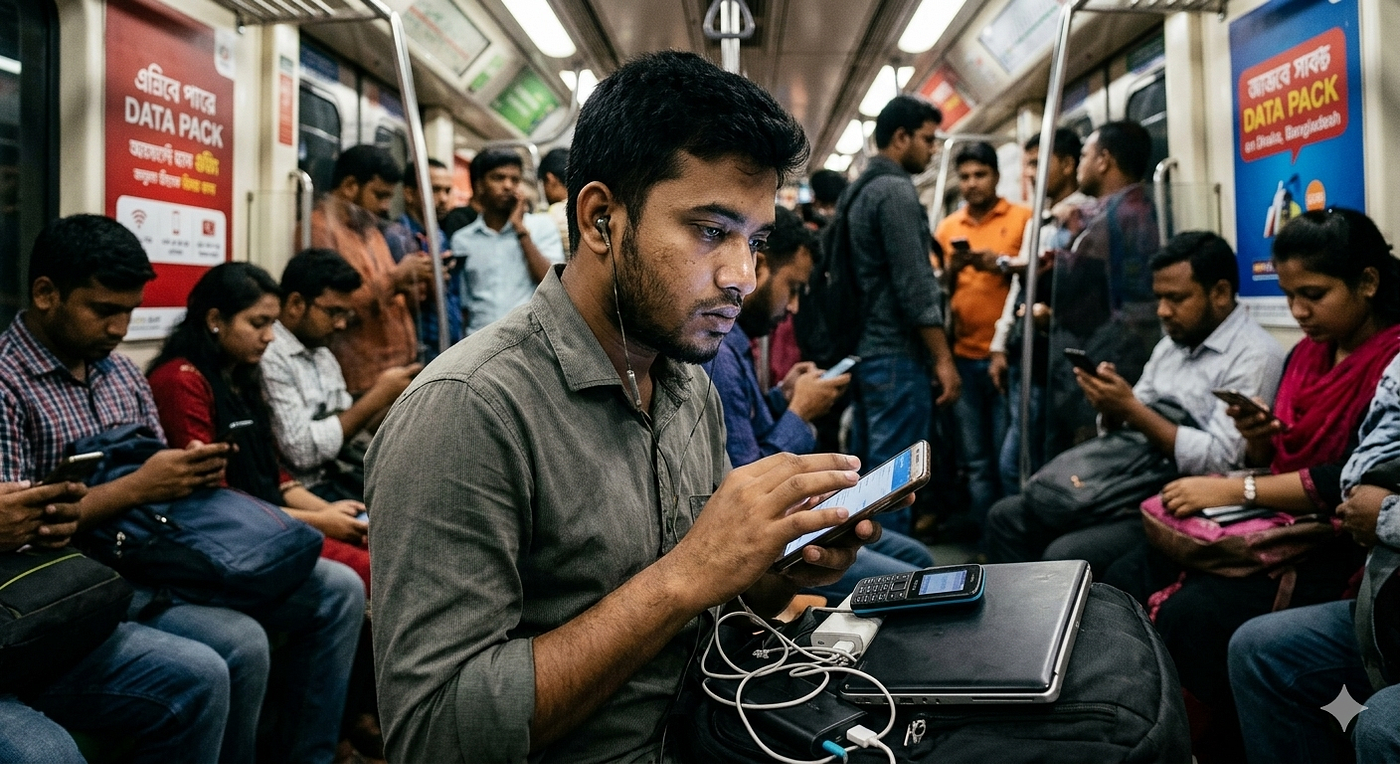
Think about the last time you sat in complete silence — not meditating, not waiting for something, just sitting — with nothing to look at or listen to. For most people, that moment is difficult to recall. Because the modern world has made silence feel strange, even uncomfortable.
This is not a coincidence. It is the consequence of a phenomenon that researchers and psychologists are increasingly calling overstimulation: a state in which the brain receives far more information, far faster, and far more frequently than it is built to handle. And unlike a pulled muscle or a bad cold, overstimulation has no obvious moment of onset. It creeps in gradually, reshaping the way we think, feel, and focus — until one day we realize we cannot sit still without reaching for our phones.
What overstimulation actually means
The human brain is not designed for stillness. It thrives on curiosity, novelty, and engagement. The problem is not stimulation itself — it is the relentless, industrial-scale version of it that modern life delivers around the clock.
Too many inputs, too little rest — and the brain begins to crack under the weight of its own busyness.

And beneath all of these sits a fifth, subtler pattern: behavioural overstimulation. The inability to finish one task before beginning another. The need for background noise just to feel calm. The discomfort of doing only one thing at a time. These habits feel harmless, but they steadily erode the capacity for focused thought.
What it is quietly doing to a generation
The effects are not dramatic. They do not land all at once. But they are consistent, and they compound.
Attention, the foundation of almost everything we value — creativity, learning, connection, craft — is fracturing. Long tasks feel impossible to sustain. The mind drifts mid-sentence, mid-conversation, mid-thought. People find themselves re-reading the same paragraph for the fourth time, wondering where their concentration went.
Boredom, once a benign and even productive state, has become something most people actively flee. The moment there is a gap — a queue, a pause in conversation, a slow minute before sleep — the hand moves to the phone almost involuntarily. Silence has been recast as emptiness rather than space.
Motivation suffers too. When the brain is conditioned to the fast, frictionless rewards of digital content, the slow burn of meaningful work feels disproportionately hard. Procrastination is not laziness — in many cases, it is a brain that has been calibrated to a speed the real world cannot match.
And then there is the exhaustion. A particular kind of tiredness that has nothing to do with physical exertion: the feeling of being drained after a day of doing, by most measures, very little. Mental fatigue from a mind that was never given the chance to rest.
What earlier generations had that we have lost
It is worth noting — without romanticizing the past — that previous generations simply lived at a different cognitive speed. Not because they were wiser or more disciplined, but because their environment offered fewer inputs. Entertainment was limited. Silence was ordinary. Boredom was unavoidable.

The result, for many people who grew up before the smartphone era, was a quieter nervous system. Not necessarily a happier one — but one with more patience, more tolerance for discomfort, and a stronger baseline ability to sit with a single thought for longer than thirty seconds.
This is not an argument against technology
None of this is a case for switching off, going offline, or retreating to some simpler era. Technology has brought extraordinary things, and most people would not trade it away even if they could.
But there is a real and growing mismatch between the speed at which the modern world delivers stimulation and the speed at which the human brain was built to absorb it. That mismatch has consequences. And the first step toward addressing them is simply recognizing what is happening — not as a personal failure of willpower, but as a structural feature of the environment most of us now live inside.
The bottom line
The brain is not broken. It is responding exactly as it was designed to — to novelty, reward, and social signal. The problem is that the modern world has found a way to provide all three in unlimited quantities, with no natural stopping point. What we are living through is not a crisis of character. It is a mismatch between ancient hardware and a very new world — and the first step toward managing it is understanding what is actually going on.
메타데이터
- post_id
- e2bc874ec36e
- slug
- your-brain-was-never-meant-for-this-e2bc874ec36e
- url
- https://medium.com/@suleman15syed/your-brain-was-never-meant-for-this-e2bc874ec36e
- canonical_url
- https://medium.com/@suleman15syed/your-brain-was-never-meant-for-this-e2bc874ec36e
- author_url
- https://medium.com/@suleman15syed
- status
- ok
- fetched_at
- 2026-06-09 15:37:30



