The AI Influencer Business Model
How Creators Are Making $10K-50K/Month with Virtual Personas
The AI Influencer Business Model
How Creators Are Making $10K-50K/Month with Virtual Personas
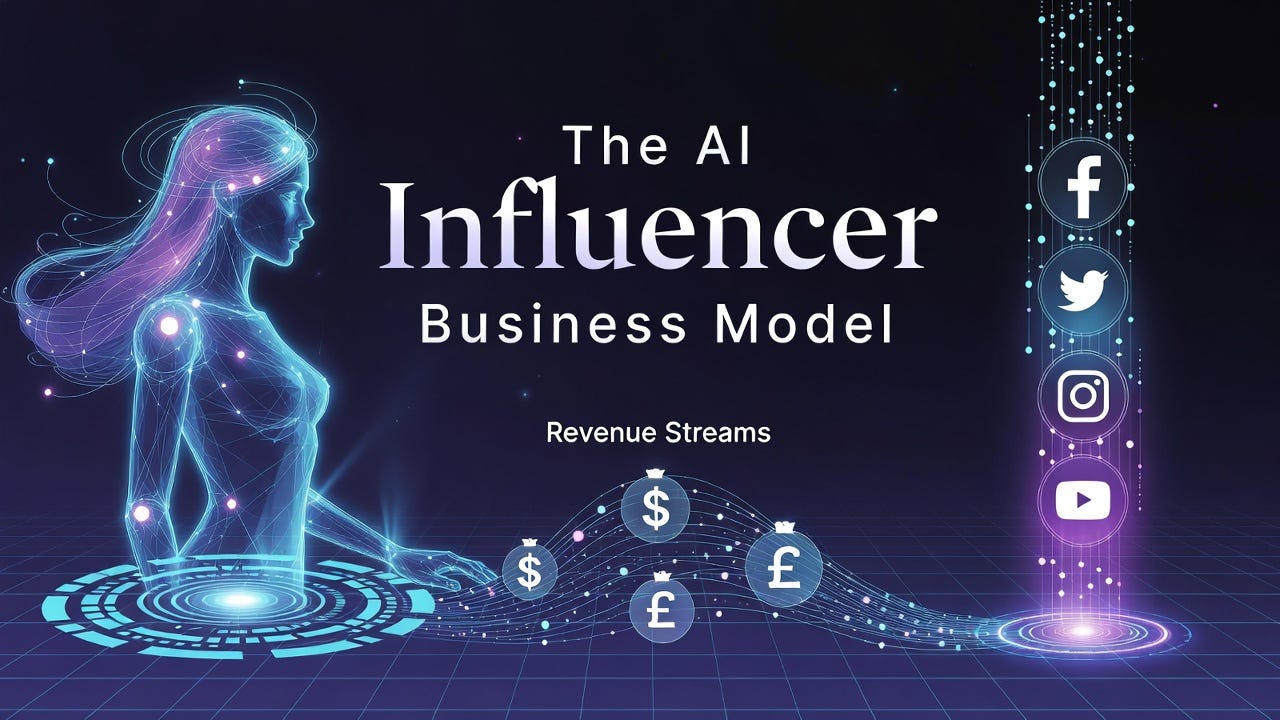
Fanvue hit $65 million in annual recurring revenue this year. Their year-over-year growth is 450%. Forty-five percent of creators on their platform now use AI features to generate content. The top AI creators are pulling $10,000 to $50,000 per month. And the company is projecting over $140 million by the end of 2025.
These are not hypothetical numbers from a pitch deck. This is a real platform with real revenue, and the AI influencer economy is growing faster than most people in tech realize.
My name is Kevin. I co-founded Apatero Studio, where we build AI generation tools for images, video, audio, and 3D. We have spent the last year studying the virtual influencer monetization space because we are building our next product, apatero.ai, to sit right in the middle of it. Here is what we have found about the business models that actually work, the revenue numbers behind them, and where the money is really coming from.
The Market Right Now
The AI influencer business model is not one thing. It is a collection of platforms taking very different approaches to the same core idea: virtual personas that generate revenue through subscriptions, tips, and premium content.
The three largest players tell different stories about what works.
Fanvue is the closest thing to a market leader for AI creator monetization. They operate on an 80/20 revenue split, meaning creators keep 80% of everything they earn. Their platform is structured like OnlyFans but designed for AI-generated characters. Fans subscribe to creators, send tips, and buy locked content. The platform handles payments, content hosting, and discovery.
The numbers worth paying attention to: $65 million ARR, 450% growth, and a projection to hit $140 million. Their average creator earns $500 to $3,000 per month after three to six months on the platform. Top creators, the ones who have figured out the content cadence and fan engagement, reach $10,000 to $50,000 monthly. These are real earnings that real people are withdrawing to their bank accounts.
Candy.ai took a different approach and hit $25 million in ARR in their first year. Their revenue breakdown is informative: 60% comes from subscriptions, 15% from token purchases, and 25% from affiliate marketing. They run at 75% gross margins. That is an incredibly efficient business. No warehouses, no physical products, no shipping, no returns. The product is AI-generated content and conversation, which scales with near-zero marginal cost.
Character.ai built the largest user base at 20 million monthly active users and reached $32 million in ARR. But they are facing lawsuits related to their AI chatbot interactions, and they do not pay creators at all. Their model is purely platform-centric: they own the characters, they own the conversations, creators get nothing. This is relevant because it shows the ceiling of the AI-only approach and the legal risks that come with it.
JanitorAI has a massive community but no monetization for creators whatsoever. Kupid.ai charges $13.99 per month and has around 80,000 users. Neither has figured out the creator economy piece.
Where the Money Actually Comes From

If you strip away the platform names and look at revenue by source, a clear pattern emerges across every profitable virtual influencer platform.
Subscriptions are the foundation. Fans pay a monthly fee to access a creator’s profile, see their content, and get the ability to send messages. This is recurring revenue, which is the lifeblood of any content platform. Subscription prices in the space range from $3.99 to $49.99 per month, with the sweet spot sitting around $9.99 to $19.99 for most creators.
Tips and gifts are the high-margin surprise. Fans tip during conversations, during content reveals, and spontaneously. Tip amounts typically range from $10 to $500. The interesting thing about tips is that they are entirely emotional purchases. A fan does not tip because they calculated the value proposition. They tip because they feel connected to the persona. This is why the quality of conversation matters more than the quality of the AI-generated images.
Premium content is the upsell engine. Locked posts, exclusive photo sets, custom content requests. This is where creators who understand their audience can charge significantly more than their base subscription. A creator with a $9.99 monthly subscription might sell a custom photo set for $50 to $200. When a creator has thousands of subscribers, even a 5% conversion rate on premium content generates serious additional revenue.
The Candy.ai revenue split, 60/15/25, tells you something useful. Subscriptions are the majority, but the token purchases (premium content) and affiliate income combine for 40% of total revenue. A platform that only relies on subscriptions is leaving almost half the potential revenue on the table.
The Creation Tools Gap
Here is the thing that struck us most during our research. Fanvue, the market leader in AI influencer monetization, does not make content creation tools. Their creators generate content elsewhere, on platforms like Stable Diffusion, FLUX, or various AI image generators, and then upload it to Fanvue for monetization.
This means a Fanvue creator’s workflow looks something like this: open an AI image generation tool, create a batch of images for their persona, download them, open Fanvue, upload the images as posts, write captions, set pricing. For video content, the workflow is even more fragmented. Generate the video on one platform, edit it on another, upload to Fanvue.
This disconnect between creation and monetization is not a small inconvenience. It is a fundamental friction point that limits who can participate in the AI influencer economy. You need to be technically proficient enough to operate AI generation tools AND savvy enough to run a monetization platform. Most people are one or the other, not both.
Candy.ai solved this by owning both sides, but only for their own platform characters. They do not let independent creators build and monetize their own personas. It is a closed ecosystem.
This gap, the space between content creation and content monetization for independent AI influencer creators, is the largest unaddressed opportunity in the space. Nobody has built a platform where you create the AI persona, generate all the content, manage fan conversations, and collect payments in a single integrated experience.
Why Subscriptions Plus Tips Plus Premium Content Wins
The platforms that make real money combine all three revenue streams. Here is why each piece matters.
Subscriptions create predictability. A creator with 500 subscribers at $14.99 per month earns $7,495 in recurring revenue before tips or premium content. This is the number that lets people quit their jobs. It is consistent, it is predictable, and it compounds as the subscriber base grows.
Tips create emotional engagement loops. When a fan tips, they feel more invested in the relationship. That investment makes them more likely to renew their subscription, more likely to buy premium content, and more likely to tip again. Tips are not just revenue. They are a retention mechanism.
Premium content creates pricing elasticity. The subscription is a low barrier to entry. Premium content lets creators capture more value from fans who are willing to pay more. A $9.99 subscriber who buys one $50 custom content piece per month is actually a $59.99 per month customer. The subscription gets them in the door. The premium content captures their real willingness to pay.
The math gets interesting at scale. Imagine a creator with 2,000 subscribers at $14.99 per month. That is $29,980 in subscription revenue. If 10% buy one premium piece at $30 per month, that adds $6,000. If average tips across the base are $2 per subscriber per month, that adds $4,000. Total: roughly $40,000 per month. On an 80/20 split, the creator keeps $32,000.
These are not fantasy numbers. Fanvue has creators in this range. The model works because the economics of AI-generated content are fundamentally different from traditional content creation. There is no photoshoot to schedule, no video production crew to hire, no physical location to rent. The content generation cost approaches zero, which means the margins are extraordinary.
Why Human Chatters Beat AI Chatbots
Photo by Ilyuza Mingazova on Unsplash
Character.ai proved that AI chatbots can attract massive user bases. Twenty million monthly active users is nothing to dismiss. But they also proved something else: AI-only chat leads to lawsuits, public backlash, and an inability to monetize individual creators.
The platforms generating the most revenue per user all have one thing in common: real humans are involved in the conversation. Whether it is the creator themselves or a dedicated chatter (someone hired to manage fan conversations on behalf of the creator), the human element is what drives monetization.
Fans do not tip an AI chatbot. They tip a persona they believe is responding to them specifically. They buy premium content because a conversation made them feel seen. They subscribe because the interaction feels personal. The moment a fan realizes they are talking to a generic language model, the emotional connection that drives spending evaporates.
This is not a technology problem that will be solved with better AI. It is a fundamental truth about human psychology and parasocial relationships. People pay for perceived connection. Humans are dramatically better at creating that perception than chatbots.
The AI influencer business model that works is not “AI replaces the person.” It is “AI creates the content, humans create the connection.” The AI handles the expensive, time-consuming part (generating photos, videos, consistent visual identity). Humans handle the cheap but high-value part (conversation, emotional engagement, upselling).
The Agency Model
A development worth watching is the emergence of chatting agencies. These are companies that provide trained chatters to creators who do not want to manage conversations themselves.
On platforms like Fanvue, a creator has two options. They can self-manage, handling all fan conversations themselves or with their own hired chatters, and keep the standard 80% of revenue. Or they can use an agency or platform-managed service, where professional chatters handle conversations, and the creator keeps a smaller percentage, typically 55% to 60%.
The agency model matters because it removes the last friction point. A creator does not need to be good at generating AI content AND good at managing conversations AND available to chat for hours every day. They can focus on content and persona development while the agency handles engagement and monetization.
This is how top creators scale past $10,000 per month. One person cannot maintain engaging conversations with 500 active fans. But a team of three or four chatters working in shifts can. The creator takes a smaller percentage of a much larger pie.
The agency model turns AI influencer creation from a solo hustle into a scalable business. And the agencies themselves become businesses. If you manage chatters for 10 creators averaging $20,000 per month each, your 40% cut is $80,000 monthly.
Ready-Made AI Influencers
Another emerging revenue stream is the sale of pre-built AI influencers. Some platforms now offer “ready-made” personas: a trained AI model (LoRA), a library of generated content, a defined personality and backstory, and sometimes even an established small audience.
These sell for $2,500 to $5,000 as one-time purchases, or they can be rented for a percentage of ongoing revenue, typically 5% to 7.5% plus a free monthly content package.
This is interesting because it completely removes the creation barrier. Someone with no technical skills and no ability to generate AI content can buy a pre-built influencer and start monetizing immediately. They just need to handle conversations, or hire chatters to do it.
The ready-made model is still early. But it points to a future where AI influencers are treated more like franchises than personal brands. Buy a proven persona, plug in chatters, run the playbook, collect revenue.
The Integrated Platform Thesis
After studying every major player in this space, from Fanvue to Candy.ai to Character.ai to smaller platforms like Kupid.ai and CelebMakerAI, we arrived at a thesis.
Nobody has built the integrated platform. Nobody offers AI content creation AND monetization AND chatter management AND fan experience in a single product.
Fanvue has the best monetization. But creators generate content elsewhere. Candy.ai has integrated creation and chat. But it is a closed platform with no independent creators. Character.ai has the users. But no monetization and serious legal problems.
This is what we are building with apatero.ai. The existing platform at apatero.com already handles AI generation, images, video, audio, and 3D. The new platform at apatero.ai will handle the creator dashboard, influencer management, fan subscriptions, chat, payments, and payouts. The two connect through an API: creators on apatero.ai generate content using apatero.com tools without leaving the platform.
The vision is Canva meets OnlyFans, all AI-native. Best-in-class creation tools (that is apatero.com). Monetization platform for the personas (that is apatero.ai). Managed chat services for creators who want hands-off income.
Revenue Projections and Market Size
The numbers in this space are growing fast enough to make projections tricky, but here is what we know.
Fanvue alone is projected to go from $65 million to $140 million in a single year. Candy.ai hit $25 million in year one. The broader AI companion and virtual influencer market is estimated to cross $1 billion in annual revenue within the next two years.
The demographics are clear. The audience skews 18 to 35, predominantly male, comfortable with digital subscriptions, and already spending money on platforms like OnlyFans, Patreon, and Twitch. They are not being converted to a new behavior. They are being offered a new flavor of something they already do.
For individual creators, the economics are better than almost any other digital content model. No inventory. No shipping. No physical product costs. No location dependency. A creator in Albania can build an AI influencer that earns from fans in the US, Europe, Asia, and everywhere else. The cost of content generation is negligible once you have the tools. The only ongoing cost is time, and even that can be delegated to chatters.
This is the closest thing to a purely digital business that exists. And the market is moving from early adopters to early majority faster than most people expect.
What Comes Next
The AI influencer economy is past the “is this real?” phase. Sixty-five million dollars in ARR from a single platform answers that question. The question now is who builds the infrastructure that makes this accessible to the next wave of creators.
The platforms that win will be the ones that solve the full workflow: creation, publishing, conversation, monetization. Not one piece. All of it. Integrated, simple, and designed for people who want to build a business around AI-generated content without becoming technical experts.
That is the gap. That is the opportunity. And it is very much still open.
If you found this breakdown useful, follow for more on the AI creator economy. We are building at apatero.ai and I share what we learn along the way.
메타데이터
- post_id
- e2bfa08c5895
- slug
- the-ai-influencer-business-model-e2bfa08c5895
- url
- https://medium.com/@kgabeci/the-ai-influencer-business-model-e2bfa08c5895
- canonical_url
- https://medium.com/@kgabeci/the-ai-influencer-business-model-e2bfa08c5895
- author_url
- https://medium.com/@kgabeci
- status
- ok
- fetched_at
- 2026-07-11 22:11:18