The Afternoon My 8-Year-Old Started Reading the Ground
It happened behind our apartment building on a damp Tuesday evening.
The Afternoon My 8-Year-Old Started Reading the Ground
It happened behind our apartment building on a damp Tuesday evening.
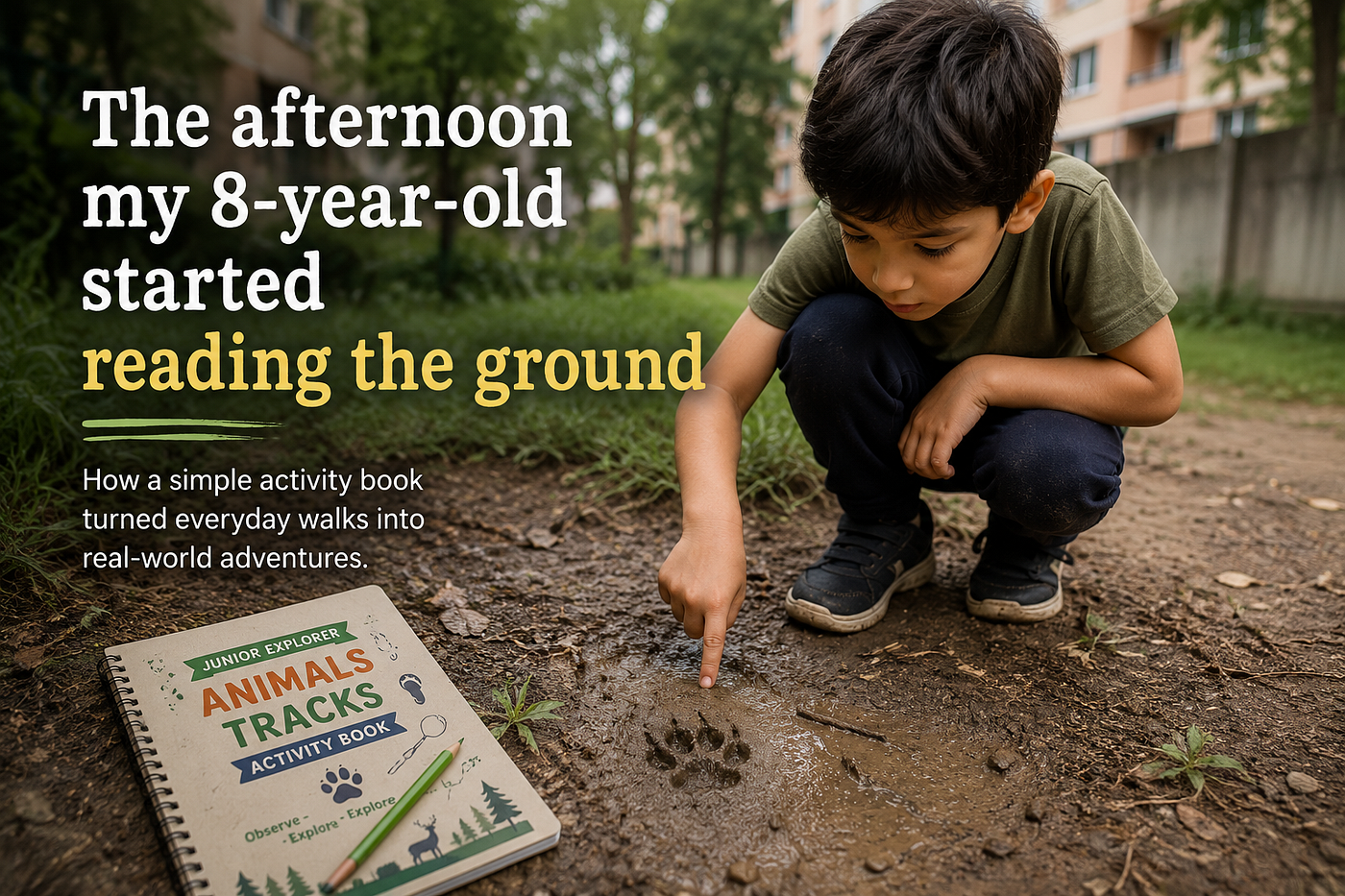
I was already thinking about dinner when I noticed my eight-year-old, Ethan, had stopped walking. He was crouched beside a muddy patch near the fence, knees stained green from the grass, staring at the ground with complete concentration.
“Wait,” he said, holding up a finger. “I think this is a cat.”
I looked down. All I saw was a smudge in the mud.
To Ethan, it was a clue.
Two days earlier, we’d been flipping through the Junior Explorer: Animals Tracks Activity Book. The page that hooked him was a simple tracks chart showing how different animals move and the shapes they leave behind. Until then, our walks had mostly involved me encouraging him to keep moving. Suddenly, he was the one slowing me down.
That evening behind the building, he pointed to the print again.
“See? Four toes. Not a bird.”
I wasn’t convinced he was right. But I was fascinated that he was looking at all.
The thing about animal tracks is that they turn the outdoors into a puzzle.
Before, Ethan knew facts about animals. He could tell you that foxes live in cities and raccoons come out at night. Those were things he’d heard and remembered.
Tracks were different.
Tracks asked a question.
Something was here. What was it?
That’s a much more interesting problem for a child to solve.
The activity book didn’t overwhelm him with information. Instead, it gave him a vocabulary. Paw prints. Tracks. Trails. Signs. Suddenly the ground wasn’t just ground anymore.
It was evidence.
Over the next week, I noticed the change.
Our walk to school got slower.
Not dramatically slower. Just full of interruptions.
“That’s bird poop.”
“That’s probably a dog.”
“No, wait. Maybe not.”
There was something refreshing about the way he was willing to be wrong. He wasn’t trying to sound smart. He was testing ideas.
And that’s what learning often looks like when it’s working.
As parents, we sometimes think we need grand outdoor adventures to get children interested in nature. A national park. A camping trip. A weekend hike.
What I learned is that a muddy patch near home works surprisingly well.
If you want to try it yourself, start simple. Pick a park after rain. Find a muddy edge of a path. Bring a notebook and let your child lead. The tracks reference pages in the activity book are enough to get started, and you can always add notes later using printable worksheets on TinyTreks Tools.
The goal isn’t identifying every track correctly.
The goal is noticing.
That’s the bigger lesson this experience taught me.
The outdoors doesn’t become interesting because it’s wild. It becomes interesting when we learn how to read it.
And the skill of noticing doesn’t stop with animal prints.
It shows up when kids read instructions carefully, notice how friends are feeling, or spot details everyone else walks past.
As we headed home that evening, Ethan glanced back at the muddy patch one last time.
“I wonder where it went,” he said.
For the first time, I wasn’t the one trying to hurry the walk along.
I was wondering too.
If you’d like to try a tracks walk with your own child, here’s the Junior Explorer: Animals Tracks book we used:
메타데이터
- post_id
- e2da732bd07f
- slug
- the-afternoon-my-8-year-old-started-reading-the-ground-e2da732bd07f
- url
- https://medium.com/@tiny-treks/the-afternoon-my-8-year-old-started-reading-the-ground-e2da732bd07f
- canonical_url
- https://medium.com/@tiny-treks/the-afternoon-my-8-year-old-started-reading-the-ground-e2da732bd07f
- author_url
- https://medium.com/@tiny-treks
- status
- ok
- fetched_at
- 2026-07-09 21:48:21