The 3 AI IPO Valuations You Need to Understand Right Now
The biggest tech IPO wave since 2000 ($3.7 trillion)
Open AI | Anthropic | DataBricks | SpaceX | Biggest Tech IPO 2026
The 3 AI IPO Valuations You Need to Understand Right Now
The biggest tech IPO wave since 2000 ($3.7 trillion)
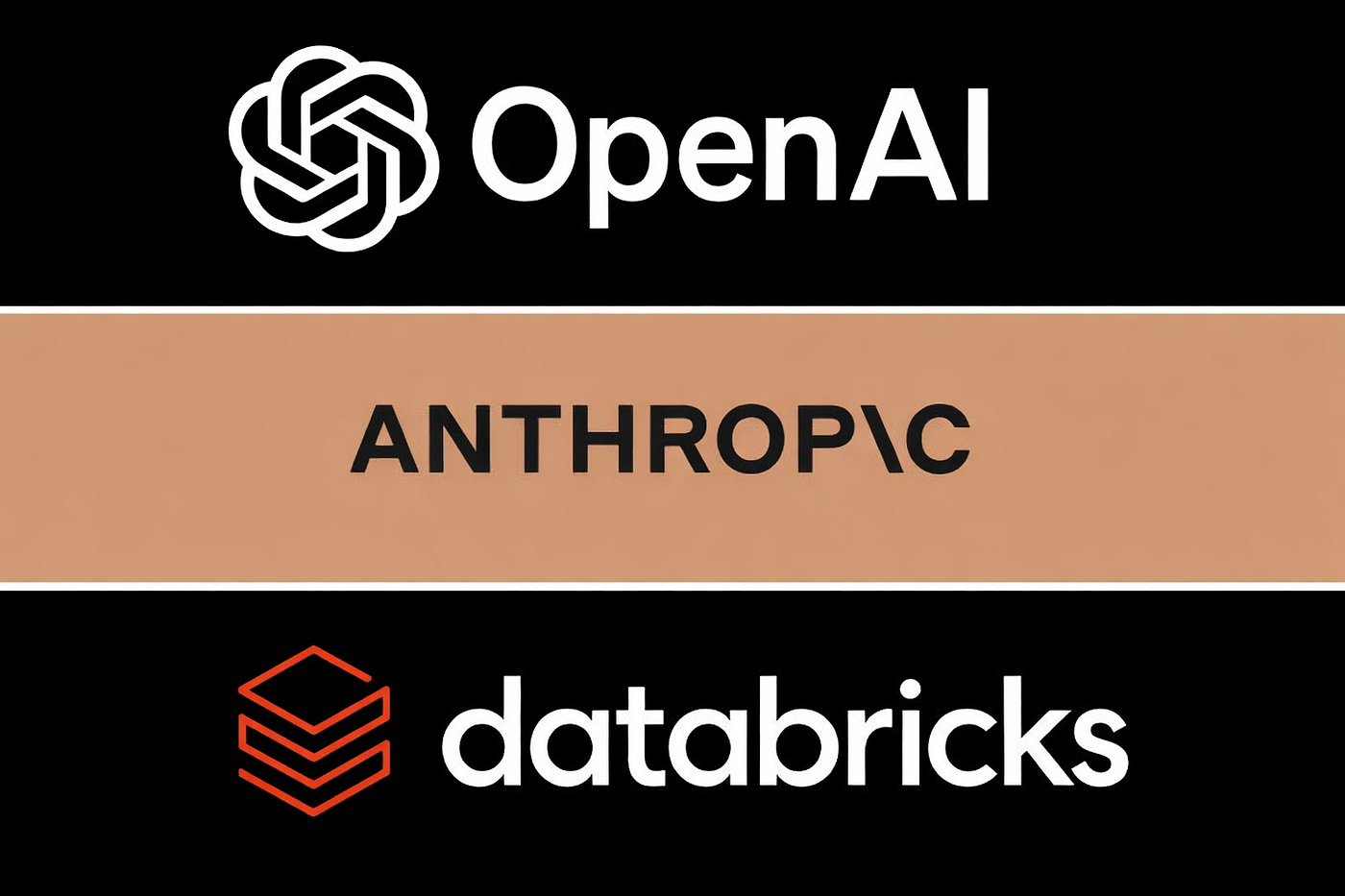
Tech IPO 2026 (Image created by Author)
Read here for FREE
Three private AI companies, each valued near or above $1 trillion, are heading toward public markets within months of each other. That has not happened before, not even in the dot-com era.
This is not a story about AI being exciting. It is a story about what happens when enormous private bets finally face public scrutiny, and what the numbers actually say once you look past the headline figures.
A Quick Map of the Three Companies
Before going deeper, here is the simplest version of what each company does:
- OpenAI makes ChatGPT and the GPT model family. Most people have used it. It is the most recognizable AI product in the world.
- Anthropic makes Claude, an AI assistant and model series used heavily by enterprise customers and developers. Claude Code, their coding-specific tool, has become a major revenue driver.
- Databricks is an enterprise data and AI platform. If OpenAI and Anthropic make the brains, Databricks builds the infrastructure that lets large companies actually use AI on their own data.
They are three different kinds of businesses. That matters when you look at their valuations.
OpenAI: The Big Brand With a Complicated Balance Sheet
OpenAI confidentially filed its S-1 with the SEC on May 22, 2026, targeting a Q4 listing. Goldman Sachs and Morgan Stanley are leading the deal. The valuation range being discussed sits between $852 billion and $1 trillion.
The revenue story is real. OpenAI ended 2025 at roughly $13 billion in annual revenue, grew to about $20 billion by end of 2025, and hit an estimated $25 billion annualized run rate by February 2026. ChatGPT now has over 900 million weekly active users and more than 50 million paying subscribers. The API alone processes over 15 billion tokens per minute.
But here is what the headline numbers do not tell you:
OpenAI lost $1.22 for every $1 of revenue in Q1 2026. The company is projecting $14 billion in losses in 2026 alone and does not expect to reach profitability until around 2029 or 2030. To put that in perspective, the company expects to accumulate roughly $140 billion in operating losses before it becomes cash flow positive.
The valuation being discussed is somewhere between 35x and 45x forward revenue. That is a number that requires everything to go right for many years in a row.
Sam Altman, the CEO who has largely shaped OpenAI’s direction, holds zero equity in the company. His equity line in the cap table reportedly shows “TBD.” That is an unusual situation heading into a trillion-dollar listing.
None of this means OpenAI is a bad business. The growth rate is genuine. Enterprise customers now represent more than 40% of revenue. But for any investor considering buying in at IPO, the question is whether you are paying for what OpenAI is today or for a version of OpenAI that needs to exist by 2030 to justify the price.
Anthropic: The Fastest Revenue Growth in the Group
Anthropic just closed a $65 billion Series H round at a $965 billion post-money valuation on May 28, 2026, making it technically the most valuable private AI company right now, just ahead of OpenAI.
The revenue numbers here are moving faster than almost anyone expected. Anthropic generated roughly $10 billion in annual revenue in 2025. By early 2026, the run rate hit $30 billion. As of the May 2026 funding close, the annualized run rate crossed $47 billion. That is a roughly 5x jump in under six months.
The primary driver of that growth is Claude Code, an AI coding assistant that has become the go-to tool for developers at large companies. Eight of the Fortune 10 are now confirmed Claude customers.
What makes Anthropic’s valuation math different from OpenAI’s:
Anthropic started from a deeply negative gross margin position (roughly negative 94% in 2025) and is now estimated to be approaching 40% gross margin in 2026. That trajectory mirrors how some of the best enterprise software companies in history improved their margins as they scaled. If they hit 77% gross margin by 2028, which some analysts consider achievable, the valuation becomes far easier to justify.
Anthropic was founded in 2021 by Dario Amodei, Daniela Amodei, and several researchers who left OpenAI. Google and Amazon are both major investors and cloud partners. The company has committed large amounts of its raised capital back to AWS and Google Cloud as compute spend, which means the “net new capital” from this latest $65 billion round is meaningfully smaller than the headline number suggests.
The key question investors will face at IPO: the company is still pre-profitability, still burning cash on compute at scale, and the audited financials that a public filing will require have not yet been made public.
Databricks: The One With Actual Positive Cash Flow
Databricks is the quietest name in this group, and arguably the most straightforward one to evaluate.
The company is valued at $134 billion following its December 2025 Series L round. It is generating $5.4 billion in annualized revenue, growing over 65% year over year, and it already has positive free cash flow. Subscription gross margins sit above 80%.
That combination, high growth plus positive cash flow, is genuinely rare for a private company at this scale. Its closest public market competitor is Snowflake, which trades at roughly $58 billion and generates less revenue than Databricks.
The company added $1.8 billion in debt financing in January 2026, and CEO Ali Ghodsi has said Databricks is “IPO-ready” and would not rule out a 2026 listing. The S-1 filing is broadly expected in the second half of 2026.
What Databricks actually does, in plain terms:
Most large companies have enormous amounts of data spread across different systems and cloud environments. Databricks built a platform called the Lakehouse that lets companies bring all of that data together and run analytics, machine learning, and now generative AI on top of it. Customers include banks, healthcare companies, and retailers that need to use AI internally but cannot just feed their proprietary data into a public product like ChatGPT.
AI-specific products at Databricks are already generating $1.4 billion in annualized revenue within that $5.4 billion total. That is not a projection. That is current.
For investors who have grown tired of AI companies that are pre-revenue or burning cash at unsustainable rates, Databricks offers something different: a company that is growing fast and already making money.
The $3.7 Trillion Number and What It Actually Means
When you add OpenAI, Anthropic, Databricks, and SpaceX (which merged with xAI in early 2026) together, their combined private market valuations approach $3.7 trillion. Goldman Sachs projected that 2026 IPO proceeds in the US could hit $160 billion, double the 2025 total.
The last time something like this happened was around 2004 to 2006, when Google’s IPO opened the door to a wave of Web 2.0 listings.
There is an honest comparison being made right now to the dot-com bubble of 2000. The similarities are real: high valuations relative to revenue, enormous capital expenditure being made before profits exist, and a general belief that the technology will reshape everything. The differences are also real: these companies have actual customers, actual revenue, and actual products that people are using every day. The internet was real in 2000. The AI tools people are using right now are also real.
What the comparison to 2000 gets right:
The dot-com era did not fail because the internet was fake. It failed because roughly 95% of the companies built on top of it were not viable businesses at the prices they were sold at. The technology survived. The hype did not.
The question in 2026 is not whether AI works. It does. The question is whether these specific companies, at these specific valuations, can grow into what the market is already pricing in.
Three Different Bets
If you simplify each company down to what kind of investment it actually represents:
OpenAI is a bet on ChatGPT becoming a dominant platform that keeps its lead as competition from Google Gemini and others intensifies. Its search share in AI dropped from about 87% to 65% over the past year as Gemini grew. Revenue is climbing fast. Competition is too.
Anthropic is a bet on the enterprise AI and developer market, where the evidence of adoption is strong right now. The risk is whether margins actually improve fast enough to justify a near-trillion-dollar price before a public listing makes those numbers visible to everyone.
Databricks is a bet on the infrastructure layer of enterprise AI, which is arguably the most defensible position. Companies need a place to put their data before they can do anything meaningful with AI. Databricks is already profitable doing that work.
None of these are easy calls. All three companies are real, growing, and building things that matter. But at $134 billion, $965 billion, and nearly $1 trillion respectively, the pricing already assumes a lot of things going right for a long time.
The S-1 filings, when they come, will be the most useful documents of the year. They will show audited revenue, actual gross margins, and whatever structural agreements (like Microsoft’s reported 20% revenue share with OpenAI) affect future earnings. That is when the real conversation starts.
Until then, the numbers are real. The prices might be too. What is genuinely unknown is whether they meet somewhere in the middle.
메타데이터
- post_id
- e2df04f7cb06
- slug
- the-3-ai-ipo-valuations-you-need-to-understand-right-now-e2df04f7cb06
- url
- https://medium.com/the-ai-studio/the-3-ai-ipo-valuations-you-need-to-understand-right-now-e2df04f7cb06
- canonical_url
- https://medium.com/the-ai-studio/the-3-ai-ipo-valuations-you-need-to-understand-right-now-e2df04f7cb06
- author_url
- https://medium.com/@coustom.no.03
- status
- ok
- fetched_at
- 2026-06-12 18:14:10