Local Residential Proxy Routes for Shopee, Lazada, and SEA Multi-Store Operations
Running many Shopee, Lazada, or Tokopedia stores from the same city is normal for SEA teams, but platforms see a dense cluster of accounts…
Local Residential Proxy Routes for Shopee, Lazada, and SEA Multi-Store Operations
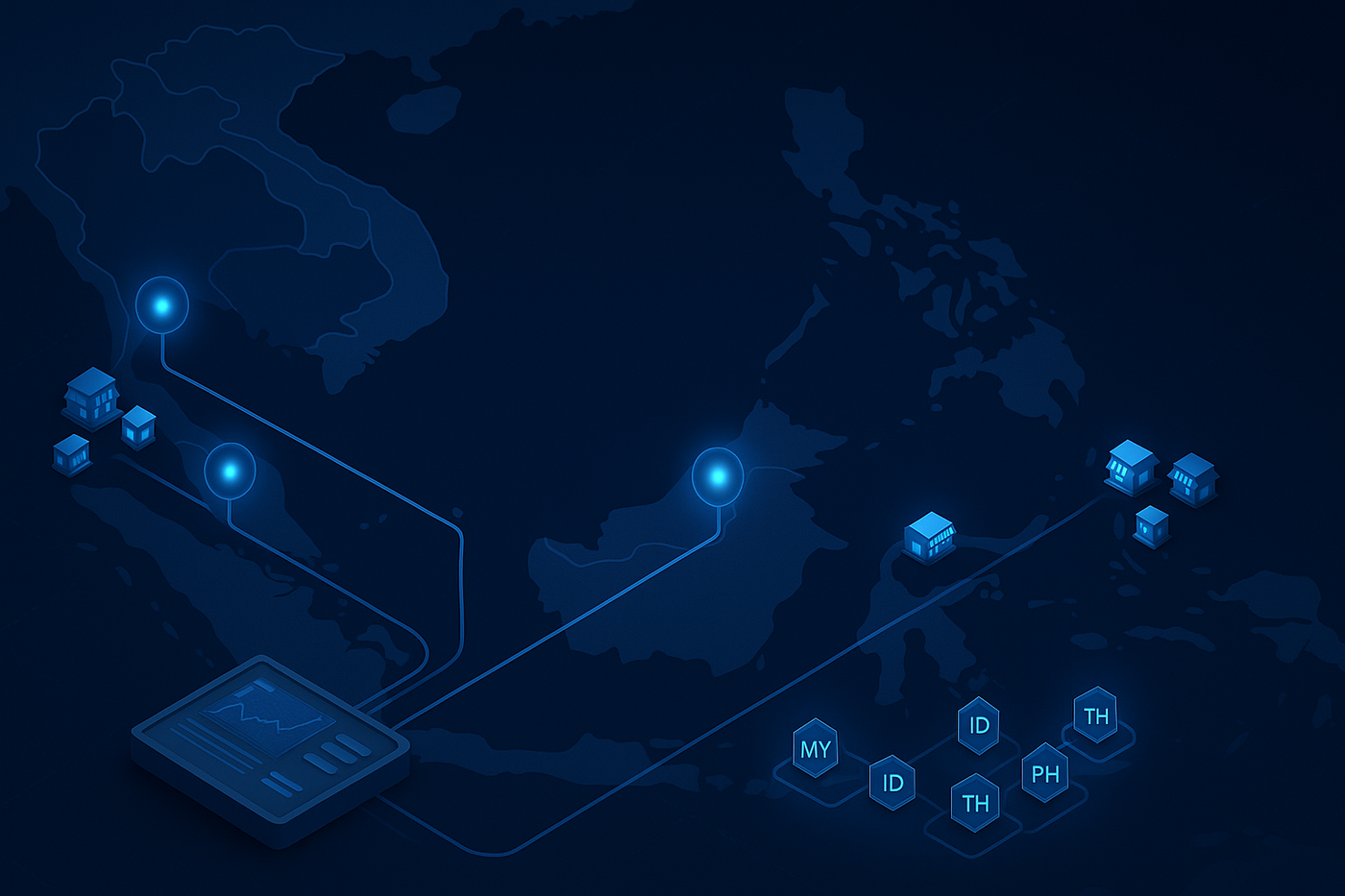
Country-level proxy buckets for SEA multi-store logins at a glance
Running many Shopee, Lazada, or Tokopedia stores from the same city is normal for SEA teams, but platforms see a dense cluster of accounts behind a few IPs. When those routes jump countries or flip ASNs, the pattern starts to look risky. A safer baseline is to fix each store group to a small set of local, stable login paths, often using static residential IP routes, and push all noisy work onto separate channels.
Why cross-country and cross-range logins are fragile in SEA
Platforms like Shopee, Lazada, Tokopedia, Bukalapak, and others are not only checking whether an IP is “clean.” For every login, they can combine several elements:
- Country, region, and sometimes metro area of the IP
- Network type and ASN (home, mobile, corporate, hosting)
- How many accounts share this route over time
- How quickly accounts appear, move devices, or change locations
Problems usually start when a single store shows impossible travel:
- Most days: logins from Jakarta residential or ISP routes
- Today: a burst from Singapore or US hosting IPs
- Tomorrow: a mix of mobile IPs from another country
Each login on its own might be acceptable. In sequence, they form a story that looks like account sharing or automation across borders. Modern risk engines work a lot like bot-management or WAF systems such as Cloudflare Bot Management or AWS WAF: they combine IP, ASN, and behaviour into a single risk score instead of trusting any one signal in isolation.
Local residential or ISP routes do not “whitelist” an account, but they let you enforce a simple rule: each store should appear to live in one country, on a narrow and predictable network footprint.
The hidden risks of “one office, one exit” for many stores
A very common setup across SEA is: one office connection, one outbound IP, dozens of stores. Operationally this is easy. From a platform’s perspective, it is a single noisy node.
Several structural risks follow:
- Account graph collapse All your Shopee, Lazada, and Tokopedia stores appear behind the same public route. If one store is hit for fake engagement, policy abuse, or serious disputes, the risk engine does not see “one bad actor.” It sees a tightly connected cluster of accounts that may share ownership, tools, or operators.
- Verification cascades Once that route is treated as fragile, many accounts tied to it start seeing:
- Frequent OTP or device challenges
- Temporary login holds
- Suspicious activity alerts
Teams in this situation often report OTP prompts several times per week per operator, instead of the occasional check that a typical local merchant might see once a month. Operations time is burned just keeping access alive instead of working on product, pricing, or ads.
3. Portfolio-level enforcement In tougher cases, platforms can down-rank, freeze, or close multiple stores sitting on the same risk cluster. It is safer for them to clamp down on the whole connected group than to bet everything on one store being the only problem.
4. No clear diagnostic signal When every store shares one outbound IP, it becomes hard to tell whether:
- A specific store is failing because of its own metrics, or
- The shared route has simply become too noisy or suspicious
The more stores you stack onto a single IP, the more any risk event becomes “all-or-nothing.” One mistake in a small test shop can end up affecting your entire country portfolio.

From one office exit to separated country clusters with safer routes
Designing country-level local residential buckets
A more resilient approach treats IPs as a network design layer, not a last-minute patch when accounts are already unstable. The goal is simple: give each store a sensible, local story in the logs and keep noisy work away from identity routes.
Providers like MaskProxy that already bundle SEA-focused static residential pools and local ISP routes make this simpler: instead of thinking in raw IP lists, your team can think in routing buckets such as “MY logins” or “ID work pool” and keep those buckets stable over time.
Three practical principles guide this.
1. Split by country first, platform second
For multi-store IP isolation, geography comes first:
MY-IDENTITY/MY-WORKfor MalaysiaID-IDENTITY/ID-WORKfor IndonesiaTH-IDENTITY/TH-WORKVN-IDENTITY/VN-WORKPH-IDENTITY/PH-WORKSG-IDENTITY/SG-WORK
Each bucket is strictly country-specific. A PH store should never suddenly appear from an ID or MY exit because someone used a generic VPN profile.
Inside each country, you can split further by platform when volume grows:
MY-SHOPEE-IDENTITY,MY-LAZADA-IDENTITYID-TOKOPEDIA-IDENTITY,ID-BUKALAPAK-IDENTITY, etc.
The important part is that you never blur country boundaries at the IP layer.
2. Separate “identity routes” from “work routes”
Within every country bucket, distinguish between:
- Identity routes (high trust, low volume)
- Store logins
- Payout and bank changes
- Legal entity and owner details
- High-impact catalog or price changes
- Work routes (higher volume, lower sensitivity)
- Listing updates and bulk uploads
- Daily reporting and analytics
- Search page checks and competitor monitoring
Identity traffic should stay on stable, local residential or ISP nodes. Work traffic can go through a controlled HTTP-based proxy gateway with rate limits and concurrency controls. If a monitoring script misbehaves, it is far better for that issue to stay in the work pool than to contaminate login paths for flagship stores.
3. Fix each store to a small, predictable set of exits
For each store, define:
- One primary local node for daily logins
- One backup node in the same country and similar network class
Avoid letting a single store bounce across a large pool of nodes over a short period. From the platform’s point of view, a store that always appears from a pair of nearby residential routes looks more like a normal merchant than a store that teleports across dozens of exits.
When you operate many stores in a single country, group them into small clusters:
- 3–5 stores per identity node or node pair
- Separate clusters for high-value “main” stores and experimental or new stores
This keeps failures contained: if a test store is hit hard by enforcement, it does not drag down every major shop in that geography.
Example topology for MY, ID, TH, VN, PH, and SG
You can think of your routing setup as three layers.
Layer 1 — Country buckets
Assign separate identity and work buckets per country:
- Malaysia:
MY-IDENTITY,MY-WORK - Indonesia:
ID-IDENTITY,ID-WORK - Thailand, Vietnam, Philippines, Singapore: each with its own identity and work pair
No cross-country sharing is allowed at this layer.
Layer 2 — Node roles inside each bucket
Within MY-IDENTITY, for example:
MY-IDENTITY-NODE-01/02for main Shopee MY storesMY-IDENTITY-NODE-03/04for Lazada MY storesMY-IDENTITY-NODE-05/06for test or experimental stores
Similar patterns can be used in ID for Tokopedia and Bukalapak, and in TH/VN/PH/SG for their dominant platforms.
Layer 3 — Session discipline and tooling
- Each store has its own browser profile or session container.
- That profile is pinned to a specific identity node pair in the correct country.
- Internal tools (for monitoring, reporting, QA) are explicitly configured to use the right country’s work pool, not any identity node.
Teams that move from a single shared exit to this kind of layered topology typically see challenge rates normalize: OTP prompts drop from “multiple times per week per operator” to “occasional checks spread across the month,” and sudden mass lockouts become far less common.
Rollout checklist for SEA multi-store teams
You do not need to rebuild everything at once. A staged rollout makes the change safer and easier to explain internally.
- Audit current logins
- Map each store to its current countries, exits, and tools.
- Note which stores are already stable and which see frequent challenges.
2. Define country buckets
- For each country (MY/ID/TH/VN/PH/SG), create identity and work buckets.
- Decide which platforms and store types belong in each bucket.
3. Assign primary and backup routes to top-value stores
- Start with the stores that drive most of your revenue.
- Give each one a primary and backup identity node in the correct country.
4. Move noisy monitoring into work pools
- Point price checks, catalogue audits, and similar tasks to the proper work buckets.
- Apply sensible rate limits and spacing to avoid bursts from any single node.
5. Track results for 2–4 weeks
- Monitor OTP rates, login errors, and surprise verification checks per store and per node.
- Retire or rotate any node that consistently shows more friction than its peers.

Secure country-level routes turning risky hops into stable flows
SEA platforms are not only checking whether an IP is on a blocklist; they are checking whether each store’s network story looks stable and local. A design based on country-level residential buckets, clear identity vs. work separation, and small, consistent store clusters makes that story simple and predictable.
The most effective change is often not buying more IPs, but defining a routing map and enforcing it — reserving a small, trusted set of local exits for logins and moving heavy monitoring into an unlimited rotating residential pool. Once that foundation is in place, adding new stores or operators becomes a controlled network decision instead of a fresh risk every time.
메타데이터
- post_id
- e2e17446b436
- slug
- local-residential-proxy-routes-for-shopee-lazada-and-sea-multi-store-operations-e2e17446b436
- url
- https://medium.com/@hashdrift/local-residential-proxy-routes-for-shopee-lazada-and-sea-multi-store-operations-e2e17446b436
- canonical_url
- https://medium.com/@hashdrift/local-residential-proxy-routes-for-shopee-lazada-and-sea-multi-store-operations-e2e17446b436
- author_url
- https://medium.com/@hashdrift
- status
- ok
- fetched_at
- 2026-07-21 17:40:28