Revolutionizing Financial Services with AWS AI/ML: A Modern Architecture Approach
The financial services industry is experiencing a profound transformation. Recent advances in AI and machine learning aren’t just another…
Revolutionizing Financial Services with AWS AI/ML: A Modern Architecture Approach
The financial services industry is experiencing a profound transformation. Recent advances in AI and machine learning aren’t just another tech trend — they’re fundamentally changing how financial systems are architected and implemented.
This article presents a practical reference architecture showing how AWS’s AI/ML services integrate into a financial platform. Let’s walk through each component of the architecture diagram to understand how these services work together to create a comprehensive, intelligent financial system.
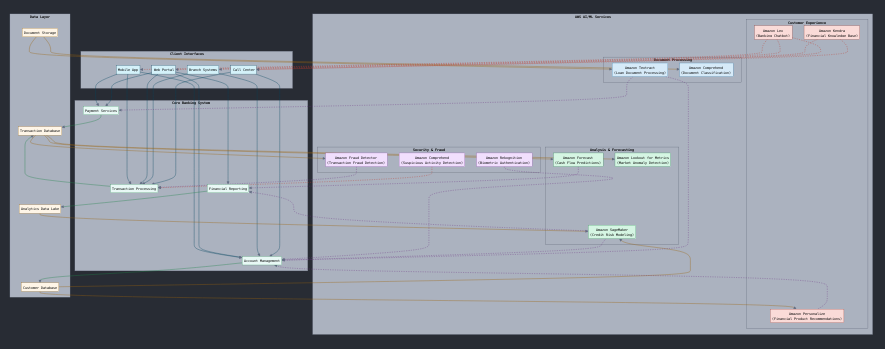
AWS AI/ML-Powered Financial Services Architecture Diagram
Understanding the Architecture: Layer by Layer
The diagram illustrates a four-layer architecture where AWS AI/ML services enhance traditional banking functions. The colored connection lines show how data flows through the system, with solid lines representing primary data flows and dashed lines showing AI feedback loops.
Layer 1: Client Interfaces
At the top of our diagram, we see the client-facing interfaces that customers and staff use to interact with the banking system:
- Mobile App: The primary channel for many customers
- Web Portal: Browser-based access to banking services
- Branch Systems: Tools used by in-branch personnel
- Call Center: Systems supporting customer service representatives
These interfaces connect directly to the core banking system (shown by the solid blue lines), but what makes this architecture special is how they also connect directly to AI services. Notice the dashed red lines from Lex to the Mobile App, Web Portal, and Call Center, and from Kendra to the Call Center and Branch Systems. These connections show how AI enhances the customer experience at the point of interaction.
Layer 2: Core Banking System
The next layer contains the fundamental banking functions:
- Account Management: Handles customer information and account details
- Transaction Processing: Processes financial transactions
- Payment Services: Manages various payment methods
- Financial Reporting: Produces financial statements and reports
In traditional architectures, these components would simply read and write to databases. In our AI-enhanced architecture, they receive intelligence from various AI services (shown by the dashed purple lines). For example, notice how Amazon Fraud Detector feeds back to Transaction Processing, providing real-time fraud prevention.
Layer 3: Data Layer
The foundation of any AI implementation is data, represented in our third layer:
- Transaction Database: Stores financial transaction records
- Customer Database: Contains customer profiles and history
- Document Storage: Houses documents and forms
- Analytics Data Lake: Aggregates data for analysis
Look at the amber colored lines connecting these databases to the AI services above. These connections are critical — they represent the flow of training and inference data that makes AI possible. Without these structured data sources, even the most sophisticated AI services would be ineffective.
Layer 4: AWS AI/ML Services
At the heart of our architecture are the AWS AI/ML services, organized into four functional categories:
Security & Fraud
The purple section in our diagram includes:
- Amazon Fraud Detector: Analyzes transaction patterns to identify suspicious activity
- Amazon Rekognition: Provides facial recognition for secure authentication
- Amazon Comprehend (for fraud): Analyzes text data to detect potential fraud in communications
Notice how Fraud Detector connects back to Transaction Processing, creating a real-time security feedback loop. According to industry reports, financial institutions implementing similar fraud detection systems have reduced fraud losses by up to 67% within six months of deployment.
Customer Experience
The pink section contains:
- Amazon Personalize: Delivers individualized recommendations based on customer data
- Amazon Lex: Powers conversational interfaces for intelligent banking chatbots
- Amazon Kendra: Creates an intelligent search solution for financial information
Follow the dashed red lines from Lex to the client interfaces. This shows how conversational AI directly enhances customer touchpoints. Research indicates that financial institutions implementing recommendation engines similar to Personalize have seen product adoption increase by 30–40% as these systems identify patterns that might otherwise go unnoticed.
Analysis & Forecasting
The green section includes:
- Amazon SageMaker: Enables custom ML model development for credit risk assessment
- Amazon Forecast: Generates time-series projections for cash flow management
- Amazon Lookout for Metrics: Continuously monitors financial metrics for anomalies
Notice how SageMaker connects to both Account Management and Financial Reporting. This dual connection demonstrates how predictive models enhance both operational decisions and business intelligence. Recent case studies show that advanced credit risk modeling with machine learning can simultaneously reduce default rates by over 20% while increasing approval rates by 10–15%.
Document Processing
The blue section contains:
- Amazon Textract: Automates information extraction from financial documents
- Amazon Comprehend (for documents): Classifies and extracts meaning from unstructured documents
The connections from these services to Account Management and Payment Services show how automated document processing streamlines core banking functions. Industry benchmarks reveal that document processing automation in lending workflows can reduce processing times by as much as 60–70%.
Data Flows: The Architecture in Motion
What makes this architecture powerful is how data flows through it. Looking at the diagram’s colored lines:
- Client to Core Banking (solid blue lines): Customer interactions create transactions and account changes
- Core Banking to Data Layer (solid green lines): System operations generate data that’s stored for future use
- Data Layer to AI Services (solid amber lines): Historical data trains and feeds AI/ML models
- AI Services to Core Banking (dashed purple lines): AI insights enhance core banking functions
- AI Services to Client Interfaces (dashed red lines): AI directly improves customer experiences
These connections create multiple feedback loops where AI continually enhances both operations and customer experience. The solid lines represent primary data flows, while the dashed lines show how AI insights flow back through the system.
Implementation Best Practices
When implementing this architecture, several key practices will help ensure success:
- Start small, iterate fast. Begin with one AI service that addresses the most pressing business problem. Looking at the diagram, perhaps start with just Fraud Detector connecting to Transaction Processing.
- Data quality matters. The amber lines from the Data Layer to AI Services depend on clean, well-structured data. Poor quality data leads to poor AI outcomes.
- Human oversight is essential. All the AI services shown should augment human capabilities, not replace them. Design your implementation with this principle in mind.
- Security by design. With so many data flows represented in the diagram, strong governance must be implemented from the beginning.
- Measure business outcomes. For each AI service implemented, track specific metrics showing its business impact.
Regulatory Considerations
A critical aspect not explicitly shown in our diagram is regulatory compliance. Financial institutions must ensure their AI implementations meet strict regulatory requirements. The AWS services in this architecture offer features that support compliance:
- Model explainability features in SageMaker help satisfy regulatory requirements for transparency
- Comprehensive audit trails throughout the system
- Built-in controls and monitoring capabilities
The Path Forward
The architectural approach outlined here isn’t futuristic — it’s achievable today with existing AWS services. Financial institutions that implement similar architectures will be better positioned to:
- Detect and prevent fraud more effectively
- Deliver personalized customer experiences at scale
- Make more accurate risk assessments
- Streamline operations through automation
- Generate deeper business insights
What’s particularly exciting is that this architecture can expand as new AI capabilities emerge. The modular nature of the design allows organizations to add new services or replace existing ones as technology evolves.
Financial services organizations that thoughtfully implement AI/ML, following the architecture patterns shown in this diagram, will be well-positioned to thrive in an increasingly competitive and complex environment.
What has your organization’s experience been with implementing AI in financial systems? Which AWS services have delivered the most value in your context? The conversation continues as the industry collectively explores these transformative capabilities.
메타데이터
- post_id
- e2e5539eae76
- slug
- revolutionizing-financial-services-with-aws-ai-ml-a-modern-architecture-approach-e2e5539eae76
- url
- https://medium.com/@hamidpmp/revolutionizing-financial-services-with-aws-ai-ml-a-modern-architecture-approach-e2e5539eae76
- canonical_url
- https://medium.com/@hamidpmp/revolutionizing-financial-services-with-aws-ai-ml-a-modern-architecture-approach-e2e5539eae76
- author_url
- https://medium.com/@hamidpmp
- status
- ok
- fetched_at
- 2026-08-21 20:41:42




