When the system decides
Keeping your hand on the reins
When the system decides
Keeping your hand on the reins
The story that follows is fictional — a constructed scenario intended to illustrate the kinds of problems business owners can face when implementing AI. The names and company are invented. The failure mode is not.
Paul built his delivery company on a simple premise: some things are too important to be late.
Prescription medications. Legal documents. Medical equipment. The clients who call him aren’t looking for the cheapest option. They’re looking for someone they can trust when the stakes are real.
He has 22 drivers, a solid reputation, and a routing system he spent six months getting right. The software considers distance, traffic, time windows, vehicle type, driver availability. It’s good. He’ll tell you it’s good. Before he put it in, he was doing dispatch by hand, running on gut instinct and a whiteboard that never quite kept up with the volume.
The system was a genuine improvement.
Then came the call from Margaret’s son.
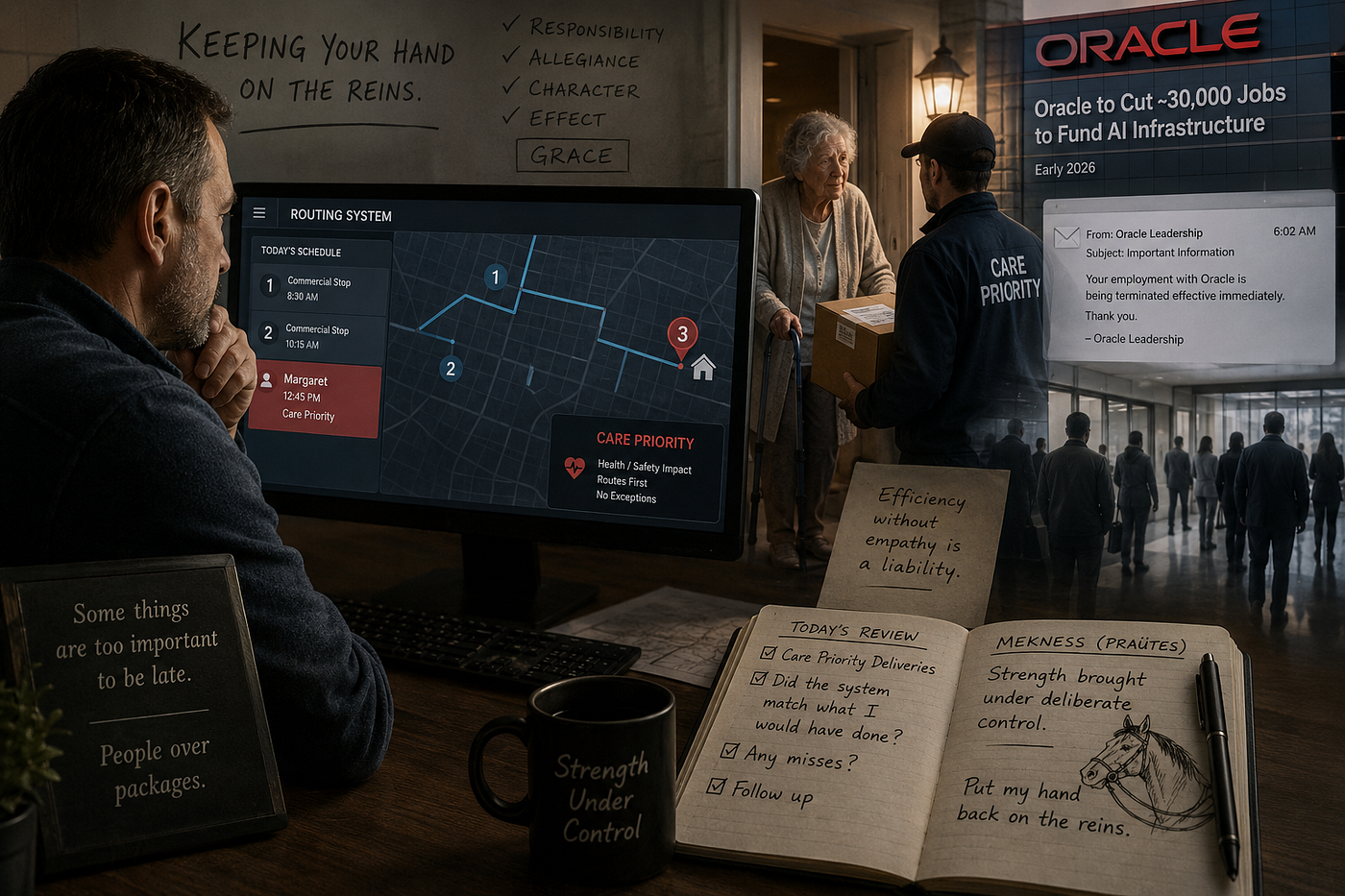
Margaret is 74. She’s a longtime client, a home health situation, and she’s been on the same medication schedule for two years. Her son set up the account when she moved in — standard tier, the way most people do — calls occasionally to check in, always pays on time. Paul knows her file. More to the point, his senior drivers know her — where the spare key is, how to reach her son if she doesn’t answer, that she needs a few extra minutes to get to the door.
On a Tuesday in February, her delivery ran 90 minutes late. The system had routed it third in sequence behind two commercial stops that came in overnight. Both were flagged as standard priority. So was Margaret’s. The algorithm saw equivalent weights and sorted by geography.
Her son called. He wasn’t angry, exactly. But his voice had that careful, controlled tone people use when they’re working hard not to say something worse. “She ran out this morning. She had to skip a dose.”
Paul pulled up the dispatch log. The system had done exactly what he’d configured it to do.
That’s the part that stayed with him.
He’d been reading The Smart Steward — working through the GRACE framework — and the question that kept coming back was Responsibility. Not whether the system had failed. It hadn’t. The question was what he still owned when it ran on his behalf. The answer, he was starting to understand, was everything.
The harder question was Allegiance. He’d built the system to serve his clients. But somewhere along the way, efficiency had become the thing he trusted. Not dishonestly. Not carelessly. Just gradually, the way defaults become decisions.
There’s a word Paul had been thinking about since a conversation at his church’s men’s group a few weeks earlier: meekness.
His instinct, like most people’s, was that meekness meant weak. Passive. The guy who gets run over.
But the discussion had pushed on that. Meekness, properly understood, is strength that stays under control. A surgeon’s hands. A father’s voice with a frightened child. Power that knows when to hold back, when to move carefully, when the situation calls for something the instrument in your hand can’t feel.
Paul’s routing system has no capacity for meekness. It has capacity. Real capacity. It processes variables he can’t hold in his head simultaneously and produces solutions that are, by measurable standards, better than his whiteboard. But it doesn’t know that Margaret’s delivery isn’t equivalent to a commercial stop just because the priority field says the same thing. It can’t feel the difference between a package and a person depending on what’s in it.
That’s not a flaw in the software. It’s a limit. And Paul had slowly, without fully deciding to, handed over more judgment than the system was built to carry.
Here’s what Oracle did in early 2026, in case you want to see this at scale.
The company laid off roughly 30,000 employees. Termination notices arrived by email, signed “Oracle Leadership” (no individual name), sent around 6 a.m., with system access cut immediately. No manager call. No conversation. The rationale, stated plainly in financial filings, was to fund AI infrastructure investment. The company had just posted near-record profits.
The system — the process, the automation, the removal of human judgment from the moment — worked exactly as designed. Efficient. Consistent. Scalable.
And somewhere in that efficiency, 30,000 people woke up to an email instead of a human being.
Paul isn’t Oracle. His situation is nothing like that in scale. But the structure is the same: a leader who built a capable system, trusted it to handle things he used to handle personally, and discovered that the system was optimizing for something measurable while a person bore the cost of what it couldn’t measure.
The AI Integration Grid calls this the Momentum zone, where systems are connected, automated, running with real authority. Getting there is genuinely good. The Grid doesn’t warn you away from Momentum. But it does ask you to bring more oversight as the system gains more reach, not less.
Paul made two changes after Margaret’s call.
The first was technical. He added a third classification tier — “care priority” — for accounts where the delivery has direct health or safety implications, regardless of what the client pays. Care priority routes first, no exceptions, and the system can’t override it without a manual flag from dispatch.
The second change was harder to systematize. He started reviewing the previous day’s care priority deliveries himself, every morning, before anything else. Just checking that what the system did matched what he would have done.
His operations manager thought it was redundant. Paul kept doing it anyway.
He’d give you a practical reason if you asked: the classification field can’t catch everything, and a few minutes of daily review catches what the field misses. That’s true. But there’s something else in it too. An act of attention. A daily reminder that the system works for him, and that some decisions aren’t the system’s to make.
Meekness, someone told him, is what keeps strength from becoming careless.
He thinks about that most mornings around 7:15, scrolling through the log.
A few questions worth wrestling with:
Where in your business has a system gradually taken on decision-making authority you haven’t explicitly given it? The authority doesn’t always arrive as a decision. Sometimes it arrives as a default, a setting you didn’t change, a threshold you set once and forgot.
And when your system makes a call that turns out to be wrong: do you have the visibility to know? Or does the error surface only when a customer calls?
The fruit of the Spirit includes gentleness — the Greek word is praütes, the same word used for a trained horse, for strength brought under deliberate control. Paul’s two changes after Margaret’s call weren’t a retreat from his system. He still uses it. He’s glad he built it. The changes were him putting his hand back on the reins.
That’s available to you too. The question is whether you’re paying enough attention to know where the reins are.
Russ McGuire writes The Smart Steward. Each month I work with a small number of business owners on exactly these types of questions. If that’s you, reach out. I also publish a weekly AI market intelligence newsletter with a strategic and faith-based lens. Find it on Substack at Faithful Intelligence.
A note on GRACE: Earlier issues of The Smart Steward walked explicitly through the GRACE framework — Goods in Tension, Responsibility, Allegiance, Character, Effect — as a tool for faithful discernment. Going forward, GRACE stays in the work, but in the background. In this article, you can find it in Paul’s accountability for what the system does on his behalf (Responsibility), in the question of what was actually driving his trust in the system (Allegiance), and in Margaret bearing the cost of an efficiency decision made without her in view (Effect). The goal was always for GRACE to become a habit of mind rather than a checklist. These stories are an attempt to show what that looks like.
A note on process: This article was developed in collaboration with AI tools — reflecting the very intersection this newsletter explores. The research, theological convictions, and editorial judgment are my own; AI assisted in drafting and refinement.
The Oracle layoff figures are drawn from news coverage in early 2026. The Margaret scenario is fictional, though the failure mode it describes is representative of situations many small business leaders will recognize.
메타데이터
- post_id
- e2e8a49d5cff
- slug
- when-the-system-decides-e2e8a49d5cff
- url
- https://clearpurpose.media/when-the-system-decides-e2e8a49d5cff
- canonical_url
- https://clearpurpose.media/when-the-system-decides-e2e8a49d5cff
- author_url
- https://medium.com/@russ_13760
- status
- ok
- fetched_at
- 2026-06-11 15:16:29