From smugglers to narcos: the “leap” of Galician clans
70 km south of Santiago de Compostela, at the northwestern tip of the Iberian Peninsula, lies a port town called Arcade. One evening in the…
From smugglers to narcos: the “leap” of Galician clans
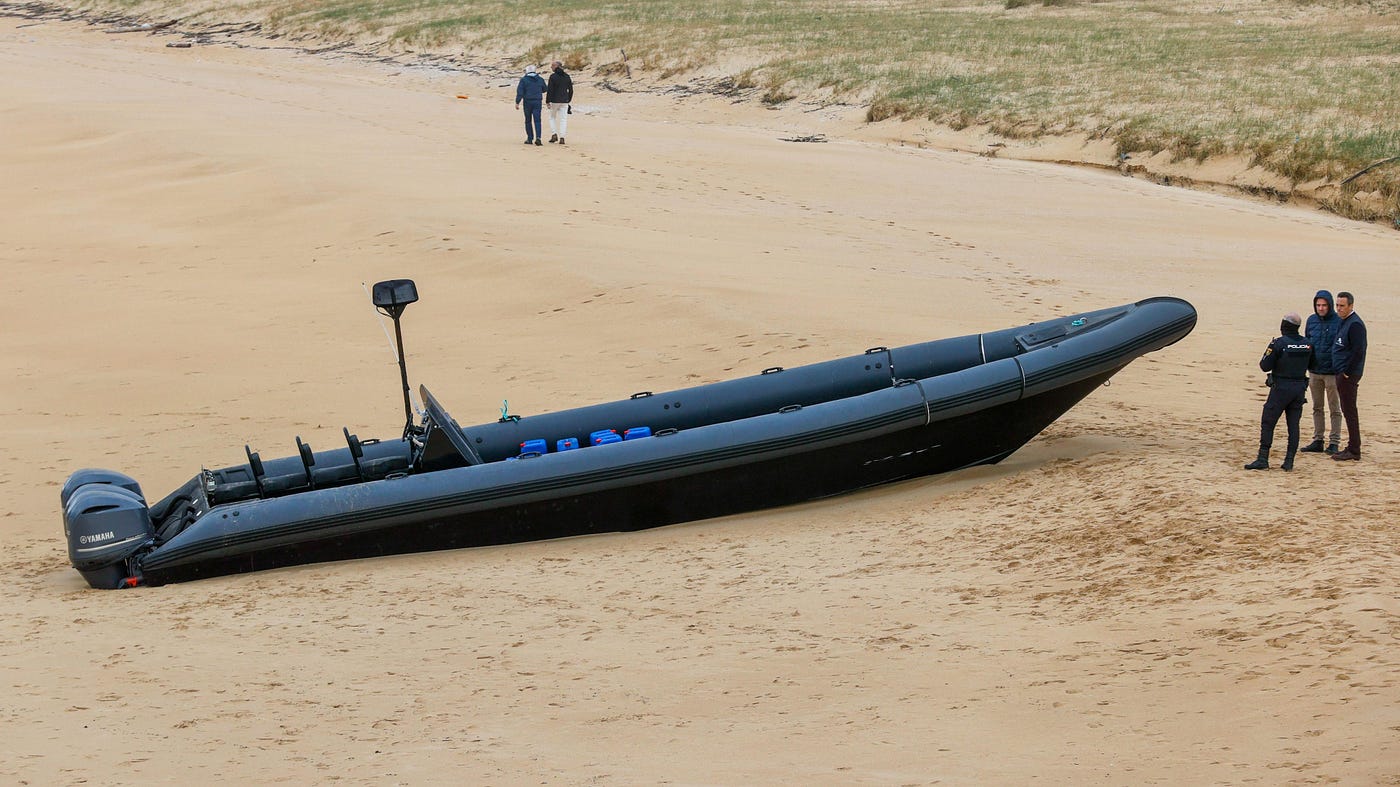
Ultra-fast drug-smuggling boat on the coast between Spain and Portugal. Source: RTVE
70 km south of Santiago de Compostela, at the northwestern tip of the Iberian Peninsula, lies a port town called Arcade. One evening in the early 1990s, a woman is driving by with her father. But when she tries to brake, the car doesn’t respond. Once, twice, three times. The elderly man realizes something is wrong, but the woman keeps her cool and manages to slow down enough to pull the vehicle over. The next day, her mechanic explains that someone had sabotaged her car by draining the brake fluid.
Several years and many miles later, another traffic accident involves a woman. We are in Corvillón, one night in 2001. A mother who is going to pick up her daughter at the exit of a nightclub falls asleep at the wheel. The impact against the wall of the National Police’s Anti- Drug Brigade headquarters proves fatal.
The protagonists of these stories are not just any two women. The first is Carmen Avendaño, spokesperson for Erguete, an association that brings together mothers of young drug addicts in the fight against drug trafficking. The second is Esther Lago, wife of the boss Laureano Oubiña, one of Galicia’s leading tobacco and drug traffickers, and the true mastermind behind his criminal organization.
Carmen and Esther. Nemeses. Opposing sides of the same story: that of Galicia’s rise as a European logistics hub for drugs coming from South America and North Africa.
It’s the story we’re dealing with.
Galicia, smugglers’ paradise
Galicia’s criminal roots run deep into centuries of smuggling. It’s no coincidence: its terrain seems tailor-made for this activity.
With its 1,498 km of rugged, jagged coastline, Galicia has more coastline than Andalusia and the Balearic Islands combined. A geography that’s perfect for hiding and unloading ships full of illicit goods.
Nestled above Portugal, Galicia is culturally close to its southern neighbor, with whom it shares a mountainous border, and is peripheral to the capital, Madrid. From the fall of the Roman Empire to the 1864 Border Treaty, Galicia has found itself in an administrative limbo, with borders unclaimed by either side, free of customs duties, and largely self-governing. Even after the treaty, the border between Spain and Portugal remained porous and left to its inhabitants, a situation that persisted until recent times, allowing organized crime to operate with impunity and almost undisturbed for decades.
Another effect of this partial isolation is that Galicia developed its own language: it is in Galician that the Galician underworld has historically expressed itself, and it is in Galician that the book Fariña by journalist Nacho Carretero — on which this article is largely based — is written.
You’ve likely gathered it by now: Galicia is a region that is perfectly suited for criminal activity. And as they rose to power, the local clans knew how to exploit it to the fullest.
Necessity is the mother of invention
The first time Galicia had to deal with a “hard” border with Portugal was with the advent of Francisco Franco’s dictatorship in 1939. This policy could not have come at a worse time: while Portugal prospered thanks to its colonies, in Galicia — impoverished by the civil war — everything was in short supply, even electricity. Many men then left to work in Castile and Catalonia, while those who remained began an intense smuggling operation of basic necessities: food, soap, medicine, metals, spare parts, and construction materials.
It is the women who take the cows to pasture who are the first to venture into this activity: moving from one islet to another, the pisqueiras transport not only livestock but also goods, and alert one another to the presence of the Civil Guard by shouting made-up names that could very well be epithets for the animals.
Even along the railroad, the Galician population organizes itself: some hang white cloths from their windows to signal that the way is clear; drivers slow down, and others take care of looting the train cars. Only the occasional visits by the authorities from Madrid put this practice on hold.
Smuggling begins to go so well that many men return home and start using boats instead of cows to move goods — a more effective smuggling method. The Civil Guard soon becomes involved in the trafficking, to the point that unless it reaches an agreement with the smugglers, it imposes a fine equal to twice the value of the goods. This drives many to throw their cargo overboard when they are caught.
Business soon followed necessity: part of the smuggled food was resold to the maquis, anti-Franco guerrillas hiding in the mountains, while the tungsten mined in the hills was sold for a fortune to the Nazi army.
Things went even better in the 1950s, when economic relations between Galicians and Portuguese began to rebalance. Non-essential goods were sold as well, and trafficking started to take place in both directions. It also began to professionalize: smugglers no longer needed to steer the boats themselves; they could rely on hired pilots. To prevent theft and fraud, upon delivery, the smugglers gave the pilots a minted piece of aluminum that they could then exchange for real money. The system became so normalized that these aluminum pieces were treated as currency in some small villages on both sides of the border. Even overland, young people in need of money and work were hired to wear full-body armor to smuggle metal between Spain and Portugal aboard buses.
In the 1960s, smuggling reached a new level: as Portugal entered the war against its own colonies, it not only became impoverished but also had to call its citizens to arms. The relationship between the two countries was reversed: now it was Portugal that lacked basic goods, and many wanted to leave the country illegally to avoid conscription. In no time at all, Galician smugglers thus turned into human traffickers.
Entire Portuguese families were taken to Spain under conditions that were more or less dire: at first, it was enough to get them onto a boat; later, as controls intensified, they had to hide in cisterns, under vans, or in the false bottoms of trunks. Once in Galicia, they were hidden in the homes of accomplices until other traffickers took them to their final destination. In some cases, these were scammers who took the money and abandoned the Portuguese in other regions, especially in Asturias and the Basque Country.
While smuggling and human trafficking began to bring some relief to certain Galician families, it was still nothing compared to the bonanza that tobacco would bring.
The age of tobacco lords
During this period, Galician smugglers started to realize that the most profitable commodity — the one worth investing the most effort in — was tobacco. Small and medium-sized smugglers gave way to wholesalers capable of managing warehouses and organizations of hundreds of people, including drivers, transporters, and retailers.
Between the 1960s and 1980s, three leaders in particular rose to prominence: Celso Lorenzo Villa, Vicente Otero, known as “Terito,” and Manuel Diaz Gonzalez, known as “Ligero.” All three made a point of using their wealth to gain support and expand their influence. In addition to systematically bribing the Civil Guard, they began funding local festivals, soccer teams, and political parties, particularly Alianza Popular. They mingled with the local elite (Lorenzo Villa was even married to the daughter of the Civil Guard chief) and employed thousands of local people, steering the entire economy toward tobacco and leaving little room for tourism, aquaculture, and other activities. Terito, for example, maintained a dense network of companies, particularly in transportation, mostly for money laundering, and hired as boat drivers many of those who would later become the bosses of the second generation of major Galician smugglers. His right-hand man, José Manuel “Nené” Barral, even went so far as to be elected mayor.
In short, the big names in smuggling presented themselves — and were perceived — as successful businessmen who benefitted the community. Many children of that era wanted to follow in their footsteps, or had a father whose profession was officially listed as “smuggler.” Ligero, who entered politics after his criminal career, even went so far as to say in an interview that there are no people more honorable than smugglers.
The worst part is that even the law seemed to be on their side. Until 1978, in fact, smuggling was merely an economic offense punishable by fines, which often got lost in the bureaucratic maze of Spain’s young democracy.
On the rare occasions when raids took place, the bosses either managed to escape or were allowed to get away. The operations were more of a show to demonstrate that the Civil Guard was fighting crime than an effort to actually enforce the law.
It wasn’t until 1982 that a law criminalizing smuggling was passed — just as the phenomenon was about to reach its peak.
The leap: from tobacco to drugs
In the early 1980s, the world of smuggling underwent a rapid series of changes that led to what Nacho Carretero calls “the qualitative leap.”
First, the Galician clans stopped buying tobacco from the Portuguese by land and began sourcing it directly from American manufacturers R. J. Reynolds Tobacco Company and Philip Morris by sea. It was the manufacturers themselves who reached out to them, as well as to Greek gangs and the Neapolitan Camorra, to ensure they could sell surplus or defective tobacco shipments.
The delivery method was the same one that would later be used for drugs: mother ships anchored in international waters, were approached by smaller motorboats that quickly and stealthily transported the tobacco boxes ashore. Before docking, accomplices on the mainland cut the power three times in the nearest coastal town to signal that there were no guards. Once they reached the most hidden and inaccessible coves, teams of unloaders quickly emptied the boat and loaded the tobacco onto vans headed for safe hideouts: mussel farms, churches, accomplices’ homes, industrial ships, and holes in the ground.
For these complex logistical operations to succeed, multiple groups often had to collaborate: a lead group and smaller ones for loading and unloading. There was so much work that a second generation of tobacco lords emerged. Among the leading figures were Marcial Dorado Baulde (leader of the Banda de Marcial and famous for his wit despite his lack of education), José Ramón Barreiro Fontán (known as “Sito Carnicero”), and José Ramón Prado Bugallo (known as “Sito Minaco,” Terito’s former top driver and head of ROS SL, the name of his front company), who were often allies.
Other prominent figures from this period include the brothers Manuel and José Luis Charlín Gama (founders of the Charlín family clan), Laureano Oubina Pinereiro (whose organization was, however, effectively run by his second wife, Esther Lago), Luis Falcon Perez, known as “Falconetti,” and Manuel Carballo.
These were men of extremely humble origins who, from a very young age, spent more time sailing boats or smuggling than attending school, and who soon found themselves millionaires.
Even after spending lavishly on villas, cars, women, luxury restaurants, and exclusive nightclubs, they still had too much cash on hand and therefore had to find a way to launder it.
Thus was born the Peseta Connection: intermediaries drove non-stop from Galicia to Geneva with trunks full of bags of cash, paying bribes to border guards. Once in Switzerland, they parked in front of banks and let the employees swap the bags for sacks of gold bars, which are then sent back to Galicia to be hidden or used to buy jewelry on the black market.
This was not an exclusive system: the mafia, African clans, and even Basque ETA terrorists used these routes. This exposed Galician leaders to new criminal networks — it is precisely thanks to a Moroccan middleman that old Charlin discovered hashish.
Although it had been circulating among young Galicians since 1975, Galician smugglers viewed hashish with suspicion. All it took was a couple of test shipments that sold well and with little effort to change their minds: as their Moroccan partners put it, the risk was the same as with tobacco (there were no specific laws for this substance), the effort was less because the packages were smaller, and the profit was greater. Oubiña, too, was seduced by this new product and even established a connection with major producers in Pakistan.
But hashish wasn’t the only new development linked to money laundering. After Switzerland, in fact, the money flew to Panama, where it was invested through various shell companies. A tax haven favored by Colombian cartels as well.
With a soft spot for Caribbean women, Sito Miñaco never missed an opportunity to go check on his investments in Panama. It is on one of these trips that he met his future second wife, Odalys Rivera, the niece of the Minister of Justice, who introduced him to cocaine and the Colombian cartels.
The key contact was a certain Ramon Matta Bellesteros, a trusted associate of none other than Pablo Escobar. The potential for an alliance was immediately apparent to both sides: the Colombians, under pressure from Colombian and U.S. authorities, had an interest in conquering Europe, and Galicia offered a perfect gateway — the same language, de facto impunity, clans with experience in maritime trafficking, and a sophisticated infrastructure already in place. The first trial shipments of cocaine were promptly initiated…and just as quickly put on hold.
A failed setback
In 1984, Pablo Escobar had the Colombian Minister of Justice killed. The crime was too big to go unpunished: the boss was forced to flee to Nicaragua, while his seconds-in-command, Jorge Luis Ochoa Vásquez and José Nelson Matta Ballesteros — interested in doing business with the Galicians — chose Spain: the former went to Madrid (where he also underwent a facial plastic surgery), while the latter went to La Coruña, in Galicia. In both places, they quickly set up front businesses and organized cocaine shipments. But the timing was wrong.
In November of that very year, the judge of Cambados, in Galicia, José Luis Seoane Spiegelberg, with the support of the socialist governor of Pontevedra, Virginio Fuentes, decided to launch the first major operation against tobacco and drug trafficking, dubbed “Macrosumario 11/84.”
The operation turned out to be a colossal failure with disastrous consequences. Virtually all the Galician bosses were alerted to the operation by their contacts within the police and had time to comfortably relocate to Portugal, just a stone’s throw from the border, from where they continued to run their businesses. Under circumstances that remain unclear, the President of the Xunta de Galicia, Xerardo Fernández Albor of Alianza Popular, visited the location where the bosses were staying and, whether willingly or not (we will never know), spoke with them. This meeting had several consequences: Judge Spielberg and Governor Fuentes were removed from the investigation, the former sent to Cantabria, the latter to Castile. The bosses Marcial and Sito Carnicero, on the other hand, ended up turning themselves in to the Carabanchel prison in Madrid.
It was probably no coincidence: there was good company there. In addition to Sito Miñaco, Carabanchel held Ochoa and another Colombian. Their time in prison allowed the Colombians and Galicians to get to know each other better. While the Galicians would all be released within a few weeks, the Colombians would remain in prison for two years, but they would manage to persuade — if not bribe — the Spanish government to deny extradition to the United States and instead be repatriated to Colombia, where they were promptly released.
Of the 93 traffickers tried in Operation Macrosumario, none ever stood trial: the clans paid bail, the trial date was postponed to 1993, and thanks to a 1986 law, the case was dismissed.
Meanwhile, Escobar’s top man in Galicia, Matta Bellesteros, was on the loose, arranging cocaine shipments and laundering the cartel’s money through numerous local businesses, thereby winning the favor of local authorities. Despite the newspaper El País exposing his scheme and the DEA denouncing him from the United States, the Spanish government took no action. The governor of A Coruña even publicly defends Bellesteros, and the secretary of the Socialist Party downplays the matter, saying it was merely a controversy. The path for drug trafficking was cleared.
The golden age (for some)
Between the mid-1980s and the 1990s, as the Cali cartel supplanted the Medellín cartel — which was under too much pressure from the DEA — drug trafficking reached its peak in Galicia.
Four main clans emerged: Marcial’s, Sito Miñaco’s, the Charlins’, and Oubina’s, each of which supported a network of smaller groups with specific roles, such as those led by Falconetti and Carballo. All had highly closed hierarchical organizations, though not necessarily bound by family ties or internal codes. They had no exclusive territory: anyone could unload tobacco and drugs wherever they wanted, and at times they even collaborated.
It is interesting to note that, in public, both Marcial and Oubina would always deny having ventured into cocaine trafficking, the former claiming to have limited himself to tobacco and the latter to hashish — proof that all these trafficking activities coexisted and were extremely profitable.
It is established, however, that Sito Miñaco and the Charlins were involved in cocaine trafficking with the Colombians. During these years, their clans acted as subcontractors: they were tasked with sending a ship to retrieve the drugs in Colombia, transporting them to Europe, and unloading them via motorboats in Galicia (the riskiest phase), before delivering the drugs to the Colombians, who, from Spain, resold them to the rest of Europe: the United Kingdom, Italy, France, the Netherlands, Sweden, Russia, Latvia, Estonia, and Poland.
When maritime trafficking routes were too heavily patrolled and therefore dangerous, the clans resorted to other methods: sometimes they recruited poor, illiterate people, lavishly took them to South America and forced up to 30 kg of drugs into their rectums before putting them on a flight back to Europe to “deliver” the goods and receive payment — provided they didn’t complain.
For every operation, the Galicians had to send a human hostage to Colombia: if the delivery went wrong, the Colombians investigated and, if they deemed it necessary, killed the hostage. This was the case for members of some smaller clans who tried to fool the Colombians.
The major Galician clans had their own fleets of speedboats, but they also occasionally hired impoverished sailors to meet the mother ship on the high seas. With drugs, the packages were smaller and more manageable than with tobacco, so the work was simpler and faster. To unload the goods quickly, local youths — often drug addicts paid in cocaine — were recruited. The drugs were then loaded onto vans and driven with the lights off to hiding places, such as houses, holes in unused land, or barns. Not all hiding places were safe: for example, there is a reported case of a pig that died of a hashish overdose.
In some cases, clans like the Charlins use their network of front companies to transport the drugs all the way to Madrid. Once the delivery was made, the Galician clans got paid in cocaine: the split was usually 70% for the Colombians and 30% for the Galicians, but if the operation was very risky, it could go up to 60–40. Often, the Galicians resold the drugs to the Colombians to get cash rather than having to manage the drugs themselves. Even so, a few kilograms remain in Galicia and are sold retail at half the price charged in Madrid.
Needless to say, the bosses, already millionaires, became even richer. Their ostentation knew no bounds, and investigative journalists probing their affairs were beaten and threatened at home. Like their predecessors, Galician drug lords fund parishes, soccer teams, and political parties of every stripe.
Ordinary people had a choice: take a humble job with few prospects, or work for the clans and get rich quickly. But these choices had consequences.
The resistance
The sheer volume of drugs in circulation, their accessibility, and the normalization of their use led to a veritable epidemic of drug addiction and AIDS among Galician teenagers in the 1980s, to the point that they were referred to as the “lost generation.”
Faced with this social crisis, a group of mothers from the working-class neighborhood of Lavaderos in the city of Vigo, led by Carmen Avendaño, formed an association called “Erguete” (Galician for “rise up”) to raise awareness among families and authorities about the problem of drug addiction and how to address it at both the family and political levels.
At the association’s inaugural press conference in 1986, instead of issuing a general warning against drug trafficking, the women listed by full name the 38 individuals responsible for drug trafficking in their city.
Armed with data, the women held conferences throughout the region, met with local and national politicians and magistrates, and organized demonstrations in front of the bosses’ mansions. Not without risk: as we reported earlier, Carmen Avendaño was the victim of an assassination attempt, and the menacing presence of the bosses or their hitmen was never absent during their events. But after years of effort, things began to change.
In 1988, the governor of Pontevedra also asked the government in Madrid to intervene, and in 1989, an anti-drug investigative unit was established in Galicia.
These efforts culminated in a second major operation, this time kept secret until the very last moment: Operation Necora (“crab”) in 1990, orchestrated by prosecutor Javier Zaragoza and Judge Baltasar Garzón. In addition to the secret organization to prevent the bosses from being tipped off, this operation again relied on the testimony of two informers, Ricardo Portabales and Manuel Fernández Padín, two low ranking affiliates of the Galician clans.
The operation, celebrated by the mothers of Erguete and widely covered by the media, led to the arrest of Oubiña, Marcel Dorado, and the sons of the elder Charlin, as well as dozens of members of their clans. Soon, however, the newspapers exposed corruption and favoritism in the prison where the bosses were held; in court, Portabales’s testimony faltered; and the Galician political elite expressesed its dissatisfaction with the entire operation. At the end of the trial, in 1994, despite 33 convictions, none of them involved the leaders.
Following Operation Necora, drug trafficking continued even more intensely than before. The omertà persisted; the bosses became more discreet and cautious, always speaking in code for fear of being intercepted. In response, Judge José Antonio Vázquez Taín, with the army’s agreement, mobilized customs authorities, the police, and the Civil Guard for maritime operations and managed to carry out a record number of raids. It was not until the beginning of the new century, however, that justice finally prevailed: in 2000, Oubiña was arrested once and for all. In 2001, it was the turn of Charlina, daughter of the elder Charlin and now head of the clan, and in 2003, even Marcel Dorado was caught with cocaine.
But the fall of the historic drug lords meant anything but the end of drug trafficking, especially since Colombian cartels and militias were enjoying a new phase of impunity thanks to the tolerance of neighboring Venezuela.
A new generation
With the historic Galician bosses out of the picture, a new phase began: without their trusted contacts, the Colombians tried to rely on African traffickers, but after suffering heavy losses due to theft and corruption, they turned back to the Galicians. Smaller clans, succeeding the historic ones, agreed on drug transport with the Colombians, but subcontracted speedboat transport and unloading to specialized groups. On the Colombian side, too, there are new players: smaller clans that established themselves when the Cali Cartel began to yield to pressure from the DEA.
The speedboat transport clans, among which the one led by the notorious pilot Manuel Abal Feijóo, alias “Patoco,” stood out, had a fleet of super-powerful motorboats, built specifically to remain at sea for several days and return to shore with a massive cargo. The trafficking thus continued to thrive.
In response, in 2007 the authorities created the Grupo de Respuesta Especial para el Crimen Organizado (GRECO) within the National Police. Weakened by the authorities’ ever- tightening grip and a war between transport clans, Patoco’s group and those of his competitors were brought down during Operation Tabaiba, carried out in 2009 by Taín and finalized by Judge Irene Roura. This operation also introduced a new approach: the clans were dismantled by applying a scorched-earth strategy around them, arresting mechanics, gas station attendants, drivers, and any other more or less direct accomplices.
By early 2010, Galician drug trafficking was once again on its knees. Once again, the Colombians (cartels, FARC, paramilitaries) sought logistical alternatives in Africa and Andalusia, but without success. The Galician clans thus had a new opportunity to rise again, and indeed, demand for their logistical services was growing: even the Italian Camorra, the Bulgarian mafia, and Mexican cartels were turning to them. And so new groups can emerge and thrive in Galicia, to the point that in 2018 Spain passed a law to limit the construction and use of high-speed motorboats, notoriously used by drug traffickers. But where do we stand today?
What about the present day?
Drug trafficking has never left Galicia. Sure, Rotterdam and Antwerp have taken its place as Europe’s main drug hubs, and attention in Spain is now focused on Andalusia, where trafficking and money laundering have gone hand in hand — and in plain sight — for years. But it is precisely the lack of attention — both from the media and the authorities — in Galicia that gives crime room to thrive.
Two very recent examples. On May 17, 2026, in Portugal — where the construction of high- speed motorboats has moved — a law came into effect to align with Spanish legislation on the matter, leading to the seizure of 9 vessels and 400 doses of cocaine, 90,000 liters of fuel, and three auxiliary engines, as well as equipment designed to evade police radar.
Across the border, the Spanish Police Confederation in Galicia recently denounced the alarming resurgence of drug trafficking in the region and the inadequacy of the resources available to law enforcement, both in terms of personnel (“fewer police officers than 15 years ago”) and equipment (“20 years old,” according to their spokesperson) .
If we can learn anything from Galicia, then, it is that downplaying the issue and indifference are the best allies of organized crime, and that only through structural solutions (legal, social, and economic) and constant awareness-raising can we truly hope to combat a phenomenon of this magnitude.
메타데이터
- post_id
- e3220bfb3b89
- slug
- from-smugglers-to-narcos-the-leap-of-galician-clans-e3220bfb3b89
- url
- https://medium.com/@agata-hidalgo/from-smugglers-to-narcos-the-leap-of-galician-clans-e3220bfb3b89
- canonical_url
- https://medium.com/@agata-hidalgo/from-smugglers-to-narcos-the-leap-of-galician-clans-e3220bfb3b89
- author_url
- https://medium.com/@agata-hidalgo
- status
- ok
- fetched_at
- 2026-08-01 20:21:36
