Designing a Realtime Chat System for Massive Scale (100M Users) — Including Live Streaming Chat
Building a realtime chat system for millions of users is not about adding WebSocket and calling it “real-time.”
Designing a Realtime Chat System for Massive Scale (100M Users) — Including Live Streaming Chat
Building a realtime chat system for millions of users is not about adding WebSocket and calling it “real-time.”
At massive scale — 100 million registered users and 10 million active users — the real challenges are not message sending. They are:
- Consistency
- Ordering
- Failure handling
- Regional distribution
- Recovery
- Fanout efficiency
And when you add live streaming chat into the mix, the architecture must evolve further.
This article walks through a practical, production-grade approach to building such a system.
Functional Requirements
Let’s define what the system must support.
- 1:1 chats
- Small & medium groups
- Live streaming chat rooms
- Same user may connect from mobile + web simultaneously.
- Cursor-based retrieval.
- No message loss even after crash.
- Multi-region deployment.
- Regional failover.
- 10M active WebSocket connections.
- Hundreds of thousands of messages per second.
Non-Functional Requirements
These matter more than features at scale:
- Horizontal scalability
- Exactly-once persistence
- At-least-once delivery
- Observability
- Fault tolerance
- Cost efficiency (network dominates at scale)
High-Level Architecture
At massive scale, responsibilities must be separated clearly.
Core Components
- EKS WebSocket Service (connection handling)
- EKS Message Service (ingestion)
- Kinesis (event backbone)
- DynamoDB Global Tables (durable store)
- Redis (regional connection registry)
- Route 53 (regional health routing)
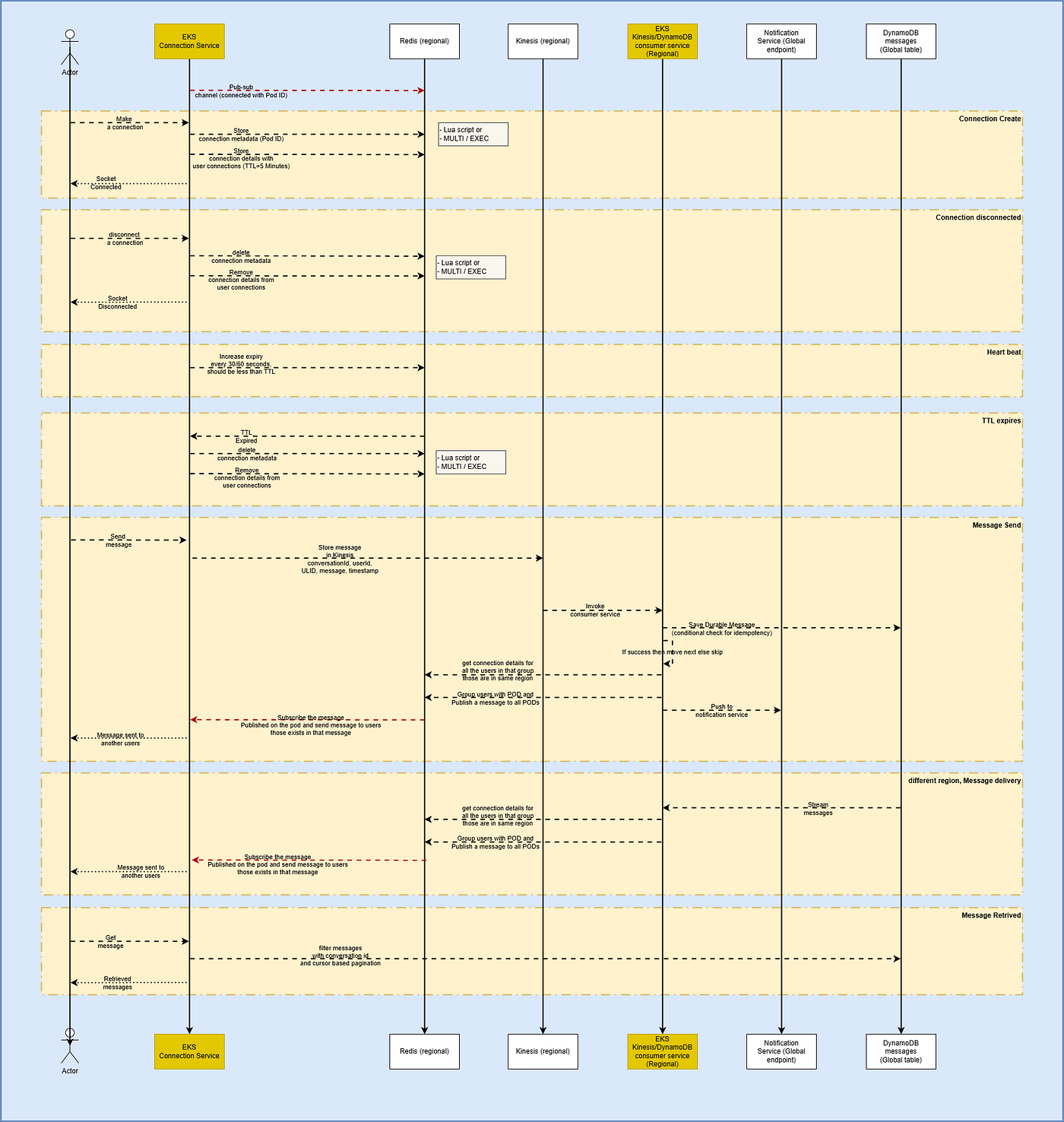
Connection Management at 10M Active Users
Each WebSocket connection is handled by EKS pods.
We store ephemeral connection state in Redis.
Redis Structures
user:{userId}:connections → SET(connectionIds)
connection:{connectionId} → HASH(serverId, region, userId) + TTL
TTL is used for:
- Crash recovery
- Zombie cleanup
- Self-healing state
Connections are distributed randomly across pods to prevent hotspots.
We do NOT colocate users of the same conversation on the same pod.
Log-First Message Ingestion
We do not write directly to DynamoDB.
Instead:
Client → Message Service → KinesisKinesis provides:
- Ordered ingestion per shard
- Replay capability
- Backpressure handling
Exactly-Once Persistence
Kinesis consumer writes to DynamoDB using conditional writes:
ConditionExpression: attribute_not_exists(messageId)This guarantees:
- No duplicate storage
- Idempotent retries
- Stable ordering (using ULID)
Persistence is the source of truth.
Realtime Delivery Model
After successful DynamoDB write:
1️⃣ Same-region WebSocket delivery 2️⃣ Cross-region via DynamoDB Global Table replication
Delivery is at-least-once.
Client performs deduplication using messageId.
Standard Group Chat Fanout
For normal groups (3–5000 users):
Flow:
- Get conversation members from durable store.
- For each user, check Redis for active connections.
- Group connections by
serverId. - Publish one message per serverId.
- Each WebSocket pod sends locally.
This scales perfectly for small and medium groups.
The Live Streaming Chat Problem
Live streaming changes everything.
You may have:
- 100K–500K concurrent viewers
- All in the same chat room
- Messages flowing rapidly
Naively resolving:
For each user in group:
    Lookup connection
does not scale.
Scalable Fanout Strategy for Live Streaming
The optimization is simple:
Instead of resolving per-user at message time, we distribute by server ownership.
Because connections are already distributed across pods:
- Each pod owns a subset of connections.
- Fanout should be distributed by pod.
So instead of:
Send to 500K usersWe:
1️⃣ Determine which pods have active connections for this conversation. 2️⃣ Publish one message per pod. 3️⃣ Each pod delivers locally to its users.
Now fanout cost becomes:
OrderOf(number_of_pods)Instead of:
OrderOf(number_of_users)This is the key to scaling live chat.
Avoiding Over-Engineering
Not every chat system needs ultra-optimized routing.
Most real-world systems are dominated by:
- 1:1 chat
- Small groups
Design for realistic workloads first.
Only optimize live-stream fanout when:
- Group size becomes large.
- Broadcast frequency becomes high.
- Metrics justify the complexity.
Failure & Recovery Model
If a client crashes:
- It reconnects.
- Sends lastSeenMessageId.
- Retrieves missed messages via cursor-based pagination.
Realtime delivery is optimization. Durable storage ensures correctness.
What Really Breaks at 10M Scale?
Not Redis. Not DynamoDB. Not Kinesis.
The real bottlenecks are:
- CPU (TLS encryption during fanout)
- Network egress
- Reconnect storms during regional failures
Observability and autoscaling matter more than micro-optimizations.
Live Streaming at Ultra Scale
If your product includes massive live rooms:
Instead of dynamically resolving 10M users per message,
you can maintain server-level routing metadata per conversation dynamically — so fanout becomes server-based rather than user-based.
This avoids resolving millions of connections during broadcast.
Final Thoughts
Building a chat system for 100 million users is not about WebSocket libraries.
It’s about:
- Separating ingestion from delivery
- Separating durability from transport
- Embracing at-least-once delivery
- Designing for failure
- Scaling horizontally
- Optimizing fanout distribution
Realtime systems are not about perfect delivery.
They are about eventual correctness with minimal latency.
And at massive scale, distribution is everything.
메타데이터
- post_id
- e32d5ef0a7cb
- slug
- designing-a-realtime-chat-system-for-massive-scale-100m-users-including-live-streaming-chat-e32d5ef0a7cb
- url
- https://medium.com/@sonishubham65/designing-a-realtime-chat-system-for-massive-scale-100m-users-including-live-streaming-chat-e32d5ef0a7cb
- canonical_url
- https://medium.com/@sonishubham65/designing-a-realtime-chat-system-for-massive-scale-100m-users-including-live-streaming-chat-e32d5ef0a7cb
- author_url
- https://medium.com/@sonishubham65
- status
- ok
- fetched_at
- 2026-07-13 06:23:13



