How you can win $28,000 with business case competitions. Seriously.
Off the bat, this is not spam or a scam.
How you can win $28,000 in business case competitions. Seriously.
Off the bat, this is not spam or a scam.
N.B. Not SPAM or a SCAM.
I will not be selling you 25 Bitcoin by your nearest convenience store ATM.
I will also not be cleaning your air ducts.
No, this is real, cold, hard TRUTH.
I have won 80% of case competitions that I’ve participated in…as an English student with zero knowledge of business or strategic jargon.
I just kind of took my critical thinking skills, close read the texts, and used creativity to come up with good solutions.
And I started winning immediately — it was beginner's luck that carried over into 28K…Not bad for a foundation in Catcher in The Rye…
Later, upon reflecting, I’ve realized that I had a few key transferable skills that gave me an advantage.
One of my principal advantages was The Satisfaction Barometer.
THE SATISFACTION BAROMETER
I coined this term to represent a barometer that measures frustration and satisfaction.
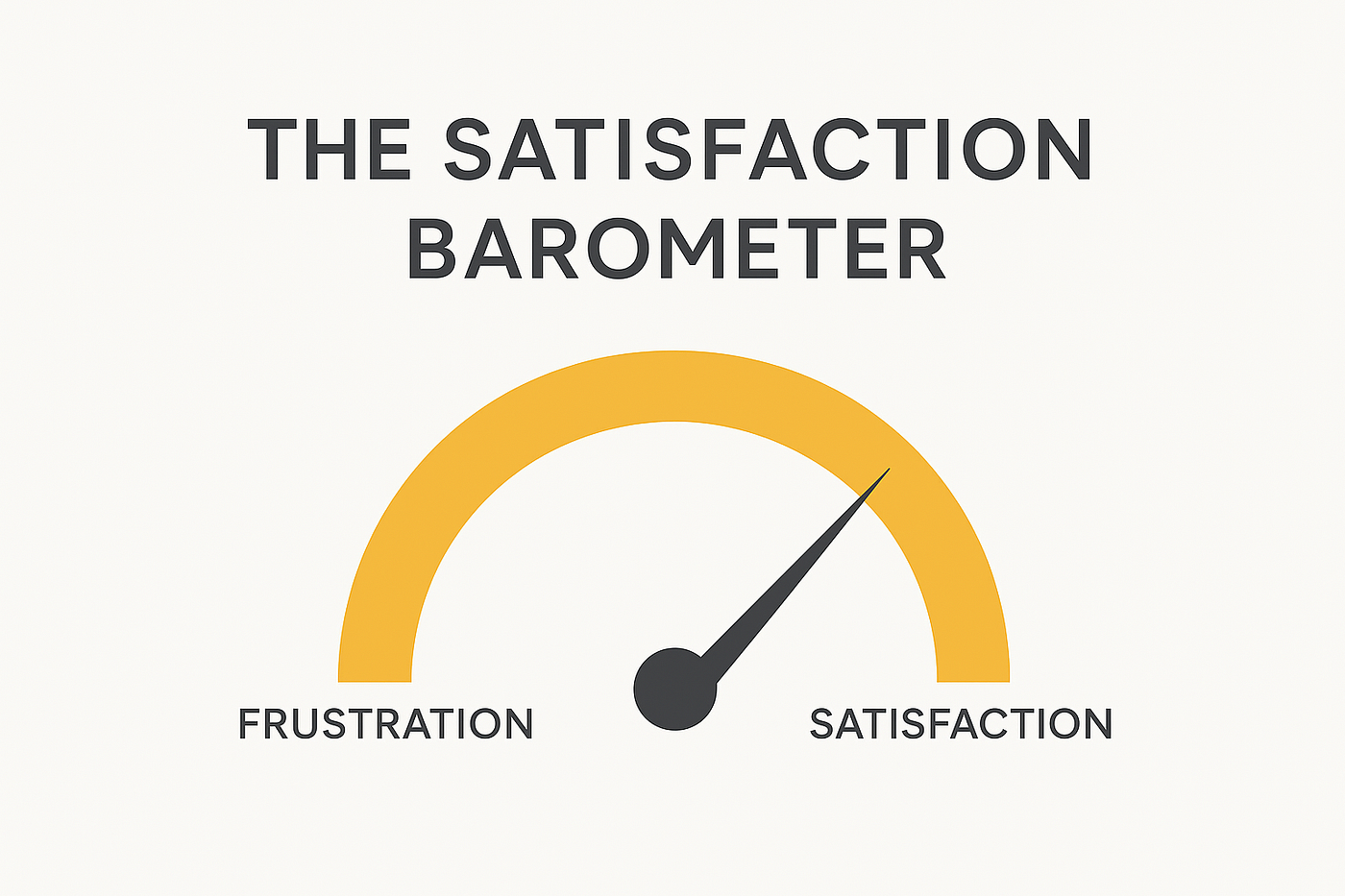
The Satisfaction Barometer is low when you feel frustrated and high when you feel satisfied.
The benchmark for good analysis isn’t when you’ve checked off every box on a list your professor or coach gave you.
It’s when your thinking is complete, coherent, and convincing. And more importantly, when you feel satisfied that it’s complete, coherent, and convincing.
In practice, this means pushing your analysis until you’re confident that:
- You’ve fully understood the problem, and
- The solution you’ve developed feels whole and well-supported.
If only one of those boxes is checked — or worse, neither — you’re not going to get a stellar outcome. Both are essential, and in my experience, both are surprisingly easy to neglect.
Why does this happen? A few reasons: sometimes you don’t realize those are even real requirements. Sometimes you get lazy and settle for the first or second idea that “sort of” works. Sometimes you assume that understanding 80% of the problem is enough to craft a coherent solution. You get the idea.
There are countless reasons people ignore their Satisfaction Barometer. But I’ve noticed one that comes up the most: deep down, most people know when their solution isn’t quite there. Yet, they choose to ignore that little voice.
Consider this chapter your loud, slightly dramatic reminder not to ignore it.
Do. Not. Ignore. The. Satisfaction. Barometer.
This is your best guide throughout the process.
And while you’re at it, don’t ignore other people’s Satisfaction Barometers either. This part is almost as important as the first.
If your teammate seems uneasy or you sense their Satisfaction Barometer is running low, don’t brush it off. Ask questions. Ask why they’re not satisfied. Ask what feels off. That’s how you uncover blind spots and refine your solution until everyone on the team feels aligned and confident.
As my great aunt likes to say,
“Crap always rises to the top, no matter how long it’s been hidden.”
In other words, those small doubts you ignore now will always find their way back to haunt you later.
For example: maybe you didn’t quite understand how manufacturing differs between your domestic market and an overseas Asian market, but you decided to let it slide. It’s late, your team is hungry, and no one wants to stir the pot. You tell yourself, “It’s fine, this will do.”
Fast forward to competition day.
You’ve presented your solution, great.
Then Q&A hits. Uh-oh.
A judge raises their hand and asks about the exact distinction between domestic and Asian manufacturing, pointing out a major hole in your implementation plan.
Damn. That little voice inside of you is screaming loudly now.
You don’t have a great answer. Neither does your team. Your throat tightens, your stomach does its own version of The Biles on Floor, and the bright lights suddenly feel way too bright.
And in that moment, your mind flashes back to that 9 p.m. crossroads two nights ago, the one where you ignored that quiet internal voice because you were tired, hungry, and just wanted to keep the peace.
You didn’t mean any harm (and nothing wrong with getting dinner), but this is exactly how the crap rises.
That faint flicker on your Satisfaction Barometer went unheeded and now you’re realizing just how important it was.
Now, I’ll pause here. You can read more about it in my book** The Satisfaction Barometer,** available on Amazon (ok, at this point, I am trying to sell you something).
However, if you’ve got the principles of the Satisfaction Barometer covered, the next thing you need to consider is building a strong team.
BUILDING YOUR VERSION OF THE AVENGERS
You need a strong team to succeed and win.
Some of you introverts might be tempted to toss you computer across the room right now and curse my name. Lucky for you, I’m one, too.
The good news?
There’s a simple formula for figuring out whether your team fits the “winning team” criteria.
All you need are two people (or one who embodies both): a marketing person and a finance person.
That’s it. If your team includes these two skill sets, you can win.
This doesn’t mean you can’t have two marketing people and one finance person, or even five marketing people and one finance person, but you should have at least one or two people who fit these roles.
It also doesn’t mean someone has to major in finance or be running their own marketing agency. It simply means they have the instincts and skills that align with those two domains.
A marketing person is typically creative, good with words, business-minded, curious about branding, and maybe just a little interested in celebrity gossip (oops). Of course, that’s just a rough outline based on my own personality — marketing people can come in many forms.
A finance person, on the other hand, tends to understand the financial side of business, be comfortable in Excel, know a few formulas, and, most importantly, validate ideas with numbers.
With these two personalities, you’ll have both the problem and the solution covered.
It’s also worth noting that these people don’t have to come from business backgrounds. They can come from almost any discipline, as long as they bring transferable skills.
Beyond these personality types, your team should also demonstrate the following traits:
- Presentation
- Thinking on their feet
- Humour or playfulness
- Curiosity
- Determination
- Teamwork
Team members should feel reasonably comfortable presenting and responding to questions on the spot. Humour, in particular, helps build storytelling and audience connection (more on this later).
The three aspects of the Satisfaction Barometer are curiosity, determination, and teamwork. These elements reinforce each other in powerful ways.
Curiosity drives deeper thinking. It pushes you to keep pulling at threads, asking questions, and analyzing more.
Determination helps you resist the voice that says, “This is good enough.” If your Satisfaction Barometer says it isn’t, then it isn’t.
Teamwork ensures you can keep probing those ideas together. You don’t want frustration or silence to suppress someone’s Satisfaction Barometer. You want everyone to speak up just as freely as you do.
A good team allows for awkward moments, pauses, and disagreements. True teamwork gives everyone the space to raise concerns and, in turn, raise the team’s overall Satisfaction Barometer.
DEVELOPING A CREATIVE SOLUTION
Lastly, building the creative solution is where the real fun begins. This is where you and your team get to imagine possibilities, blend unexpected disciplines, and envision a different future for a company.
This is your playground, the moment your mind gets to jump into the sandbox and build castles with your teammates.
It’s also where you’ll come alive and where you might hit some frustration on the Satisfaction Barometer. The goal is to reach a point where your solution energizes you, where you’re genuinely excited to share it with others (especially the judges).
There’s no single way to ideate. Creativity has many doors; you just need to find which ones open most naturally for you.
Assuming you’re already high on the first part of your Satisfaction Barometer and fully understand the problem, here are a few guiding principles I’ve found invaluable when it comes to ideating solutions.
Accumulate knowledge
As a general rule: the more toys in your sandbox, the more you can build. Sure, you can sculpt sandcastles with your hands, but if you’ve got a bucket and a few molds, those castles will look better and stand taller.
Your “tools” are the ideas, patterns, and information you collect from both related and unrelated fields. The more of these you have, the more innovative and unexpected your solutions can be.
For example, you can bring principles from biology into marketing — imagine launching a honey-focused campaign for ecological preservation, built around the idea that honey is nature’s oldest and most powerful natural preservative. Picture sweeping fields and oceans dripping with honey, glistening under a bright sun; sweet, visual, and memorable.
The link between honey and ecology might not seem obvious at first, but when you’ve stocked your mental library with diverse knowledge (pun intended, “at the tip of your tongue”), those associations form naturally and lead to compelling ideas.
The more you know, the more tools you have, and the more surprising, varied, and delightful your castles will be.
Types of Thinking
Divergent thinking is the process of generating as many ideas as possible. It’s open-ended, imaginative, and more concerned with originality and volume than immediate correctness.
Should you still run a honey-themed campaign for a government brand that’s currently raising tariffs on imported honey? Maybe not. That might attract the wrong kind of attention. But in the divergent phase, that’s fine. You’re not judging ideas yet — you’re letting them flow.
Convergent thinking comes next. It’s the narrowing process — analytical, logical, and evaluative. It’s where you identify which ideas work best, align with the problem, and can actually be implemented.
Maybe the honey campaign doesn’t fit, but the process leads you to a broader concept — say, “nature as a preserver” — which you can adapt into a better, more viable direction.
Divergent thinking expands; convergent thinking refines.
Both are essential — and both can be fun, especially the divergent stage.
…Let’s get Winnie-the-Pooh in on it too.
If you’re curious about how I applied unique literary analysis techniques during case competitions, how to handle Q&A sessions like a pro, or how to apply the Satisfaction Barometer, check out my book:
(It’s totally free until October 11th!)
Always happy to chat! :)
메타데이터
- post_id
- e32d8369ebf8
- slug
- how-you-can-win-28-000-with-buisness-case-competitions-seriously-e32d8369ebf8
- url
- https://medium.com/@vacarciucmichelle/how-you-can-win-28-000-with-buisness-case-competitions-seriously-e32d8369ebf8
- canonical_url
- https://medium.com/@vacarciucmichelle/how-you-can-win-28-000-with-buisness-case-competitions-seriously-e32d8369ebf8
- author_url
- https://medium.com/@vacarciucmichelle
- status
- ok
- fetched_at
- 2026-06-24 13:31:40



