Intra-Articular by Design: Why Allocetra™ Is Delivered Into the Joint
The case for local, intra-articular delivery, and what treating inflammation at the site of disease means for age-related knee…
Intra-Articular by Design: Why Allocetra™ Is Delivered Into the Joint
The case for local, intra-articular delivery, and what treating inflammation at the site of disease means for age-related knee osteoarthritis.

Swallow a pill for a sore knee, and the medicine does not actually go to your knee. It goes everywhere.
It moves through your stomach, your liver, your bloodstream, and the rest of your body. Only a sliver ever reaches the one joint that hurts.
For a disease that lives in a single place, that is a strange way to deliver treatment.
This is the logic behind a deliberate design choice at Enlivex (Nasdaq: ENLV). Its investigational cell therapy, Allocetra™, is injected directly into the knee. Not into a vein. Into the joint itself. Here is why that decision matters.
Osteoarthritis is a local problem
Knee osteoarthritis is neither rare nor fading. According to Enlivex, more than 32 million Americans live with knee osteoarthritis today, and that figure is expected to reach 78 million by 2040.
It is one of the most common and disabling conditions in the world. Yet there is still no approved disease-modifying treatment. Care is largely limited to pain relief, steroid injections, and, eventually, joint replacement surgery.
The everyday cost is easy to picture. A flight of stairs becomes a calculation. Standing up from a chair takes a moment of bracing. For millions of working-age adults, the joint that carries them through the day is the same joint that limits it.
The detail that matters most is where the disease happens. Osteoarthritis is a joint-level condition. Cartilage breaks down, and the joint lining, called the synovium, becomes chronically inflamed. The trouble sits inside a small, enclosed space. You can read more about the disease and its scale on the Enlivex osteoarthritis page.

Source: Enlivex (Nasdaq: ENLV) Phase 2b program announcements, 2026
The delivery route is part of the medicine
If the problem is local, the obvious question is how to get treatment to that local site.
Systemic drugs, the kind you swallow or infuse into a vein, run into a hard ceiling. Peer-reviewed research on intra-articular drug delivery, including a review in the journal Pharmaceutics, reports that less than 2 percent of an oral dose ever reaches the synovial fluid inside the joint. That research notes that raising the joint concentration would mean raising the whole-body dose, which raises the risk of side effects elsewhere.
Intra-articular injection rewrites that math. By placing the therapy directly inside the joint, it raises the local concentration at the cartilage surface while reducing the systemic exposure that drives off-target effects, according to a clinical review of intra-articular injections for knee osteoarthritis.
The route is also familiar to clinicians. The same literature places the risk of a joint infection from an injection at roughly 1 in 10,000, with a brief post-injection flare in about 2 percent of cases.
Local delivery itself is not new. Steroid injections already go into the joint. The difference is what is being delivered. A steroid quiets inflammation for a while and then fades. Allocetra™ is designed to act on the cells that produce the inflammation in the first place, rather than masking the signal they send.
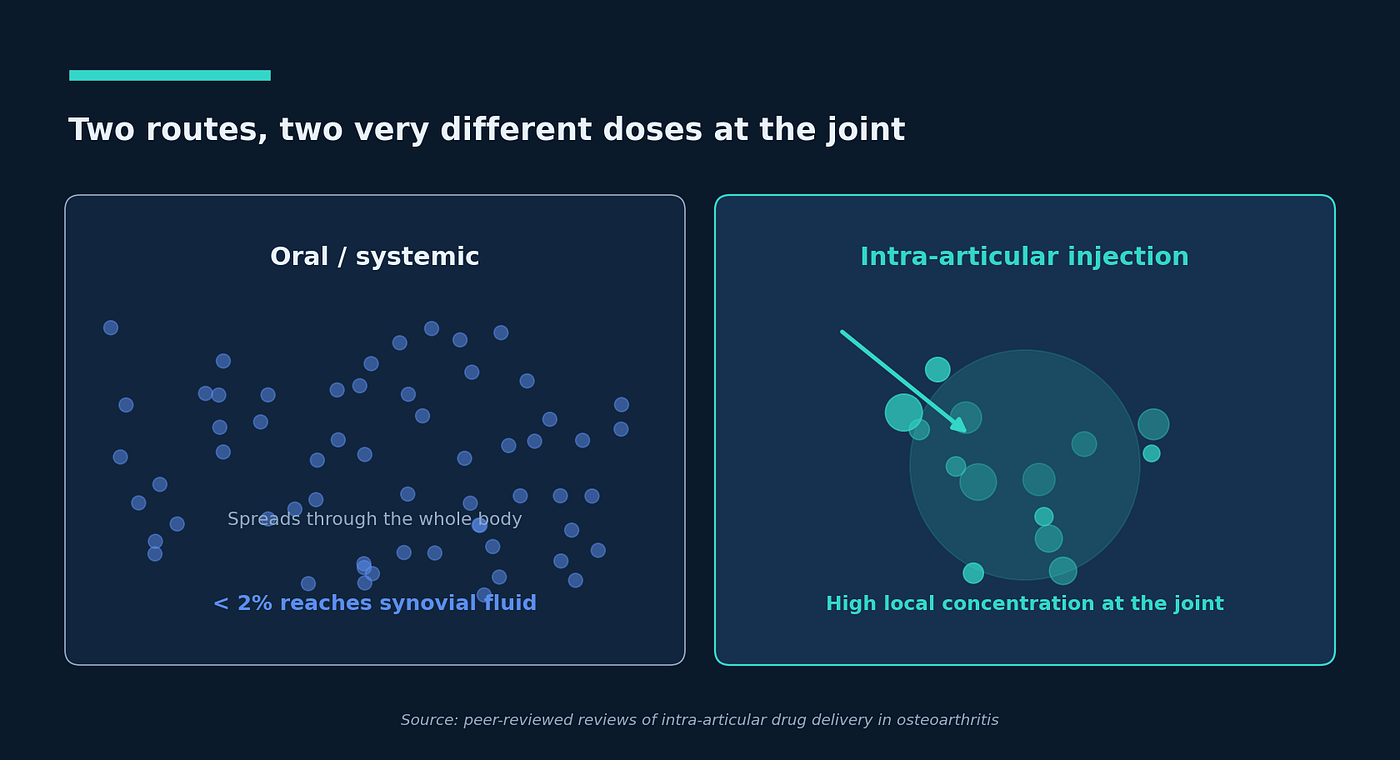
Source: Peer-reviewed of intra-articular drug delivery in osteoarthritis
If a disease lives inside one joint, the treatment has a strong reason to live there too.
The target lives in the joint, as well
There is a second reason to go local. The cells that Allocetra™ is designed to influence are already inside the joint.
For decades, osteoarthritis was described as simple wear and tear. The newer view is different. Research now points to the immune system, and specifically to macrophages in the joint lining, as central drivers of the inflammation behind the disease.
These synovial macrophages can switch states. In their inflammatory state, often labeled M1, they release signals such as IL-1β and TNF-α that fuel swelling and break down cartilage. In a balanced, pro-resolution state, often labeled M2, they help calm the tissue and support repair. In osteoarthritis, that balance tips toward inflammation, which is why rebalancing macrophages is now seen as a promising strategy.
Put simply, the joint has a first line of defense, and in osteoarthritis it can turn on the very tissue it is meant to protect. The question stops being how to suppress that response from a distance, and becomes how to reset it on site.
That imbalance is the exact target Allocetra™ is built around.
Putting the medicine where the biology is
Allocetra™ is an off-the-shelf cell therapy. It is made from healthy-donor blood cells that are processed into a stable apoptotic, or natural cell-death, state. The full mechanism is laid out on the Allocetra™ science page.
Apoptotic cells carry a natural “eat me” signal, a molecule called phosphatidylserine. Macrophages recognize it. As they engulf these cells, they are nudged back toward their calm, homeostatic state. Allocetra™ is designed to borrow that everyday biological process and put it to work on purpose.
Now connect the two ideas. The target macrophages sit inside the joint. The therapy is a signal those macrophages need to receive. So Enlivex delivers it straight into the joint, by intra-articular injection, rather than asking it to find its way there through the bloodstream.
That is what “intra-articular by design” means in plain terms:
- The disease is local, so the treatment is placed locally.
- The target cells already live in the joint, so the signal is delivered to them directly.
- Local delivery aims for a high concentration at the joint while limiting whole-body exposure.
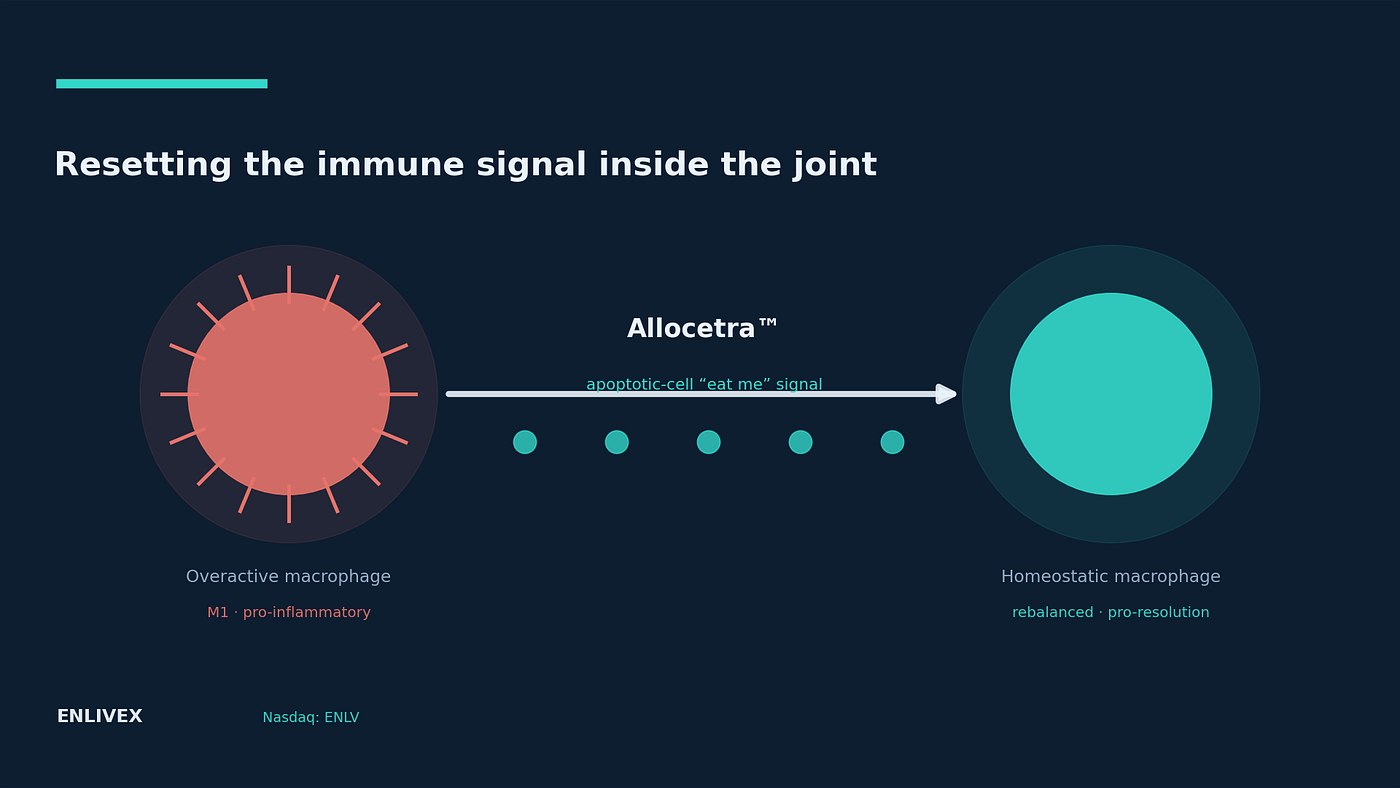
How Allocetra™ is designed to act on macrophages inside the joint.
What the early clinic is showing
Design logic is only worth as much as the evidence behind it. Here the picture is still early, but encouraging.
According to Enlivex, its Phase II data in age-related knee osteoarthritis showed a 72 percent reduction in pain and a 109 percent improvement in function, alongside a favorable safety profile across the patients treated to date. These results are investigational and are not a guarantee of future outcomes.
The benefit also appears to last. Data presented at the EULAR 2026 European Congress of Rheumatology in London described clinically meaningful and statistically significant improvements in pain and function that held up to six months. The findings were delivered as an oral presentation by Prof. Philip Conaghan, an internationally recognized osteoarthritis researcher with more than 700 publications.
Regulators are engaging too. According to Enlivex, the U.S. Food and Drug Administration cleared the Investigational New Drug application for the Phase 2b trial in March 2026, based on Phase 1/2a data in 134 patients. The Danish Medicines Agency followed in April 2026, and the company has since dosed its first United States patient in the Phase 2b study. You can follow the program through the Enlivex clinical trials page and the study record on ClinicalTrials.gov.
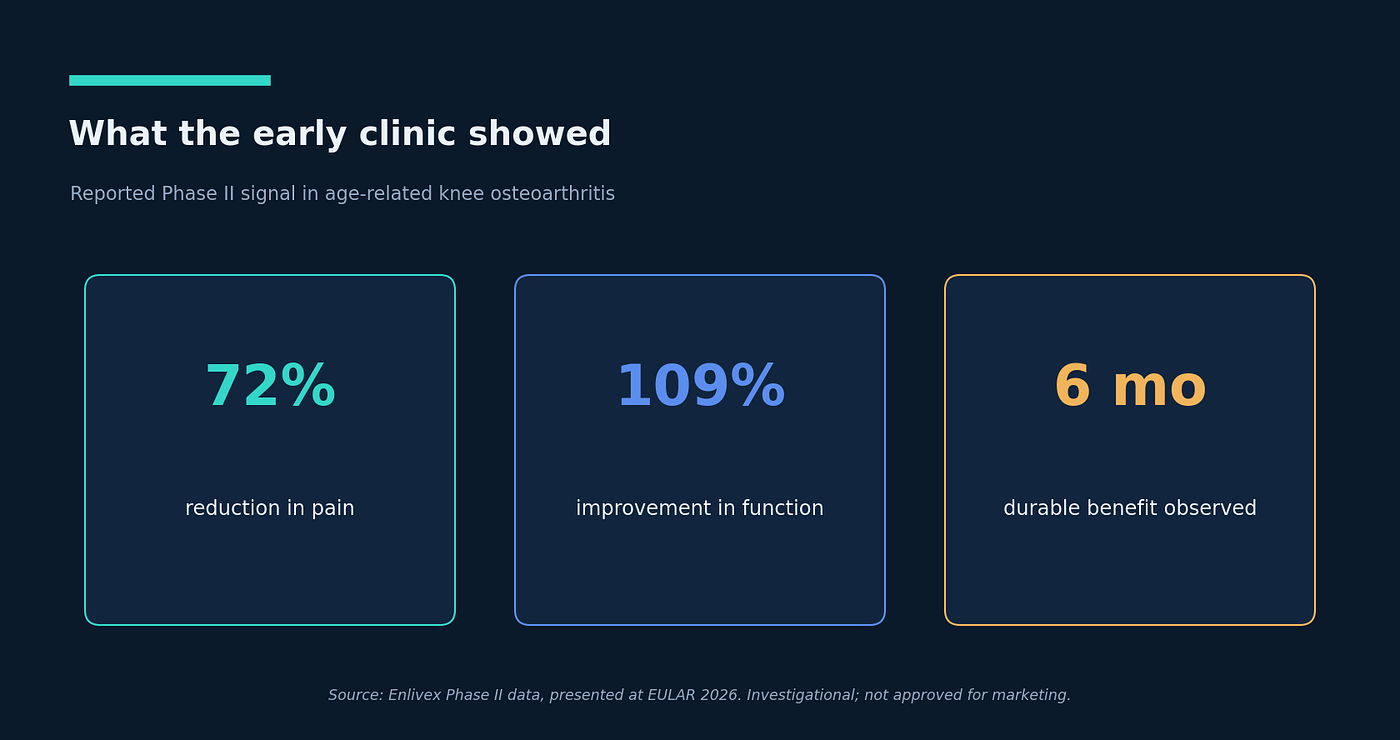
Source: Enlivex Phase ll data, presented at Eular 2026 | Investigational; not approved for marketing
The Phase 2b study is built to test that early signal under stricter conditions. According to Enlivex, it is a global, randomized, double-blind, placebo-controlled trial, with endpoints focused on pain reduction and improved physical function at three and six months, alongside quality-of-life and mobility measures. Those endpoints are a fair summary of what patients actually want back.
Longevity you can feel
Enlivex describes itself as a quality longevity company. That phrase is worth unpacking.
The aim is not simply more years. It is better years, measured in the ability to walk, climb stairs, and stay independent. Knee osteoarthritis attacks exactly those abilities.
Treating the disease at its source, inside the joint, is one expression of that idea. Put the signal where the biology is, and aim it at the inflammation that takes mobility away. Patients and physicians can also learn about expanded access, and ongoing milestones are tracked on the Enlivex investor relations site.
A pill spreads through the whole body to reach one joint. Allocetra™ takes the other path. It goes where the disease already is.
• • •
A note on sourcing and status. Allocetra™ is an investigational therapy under clinical evaluation and is not approved by any regulatory authority. Statements about future development are forward-looking and remain subject to risk, regulatory review, and change. All figures are attributed to the named sources in the text and reflect current data.
메타데이터
- post_id
- e33799cb54fc
- slug
- intra-articular-by-design-why-allocetra-is-delivered-into-the-joint-e33799cb54fc
- url
- https://medium.com/@thecryptoguyy/intra-articular-by-design-why-allocetra-is-delivered-into-the-joint-e33799cb54fc
- canonical_url
- https://medium.com/@thecryptoguyy/intra-articular-by-design-why-allocetra-is-delivered-into-the-joint-e33799cb54fc
- author_url
- https://medium.com/@thecryptoguyy
- status
- ok
- fetched_at
- 2026-07-07 15:45:26