Nvidia’s RTX Spark wildly changes everything
On June 1, 2026, Nvidia CEO Jensen Huang stepped up on stage at the Taipei Music Center during Computex 2026 and changed things big-time…
Nvidia’s RTX Spark wildly changes everything
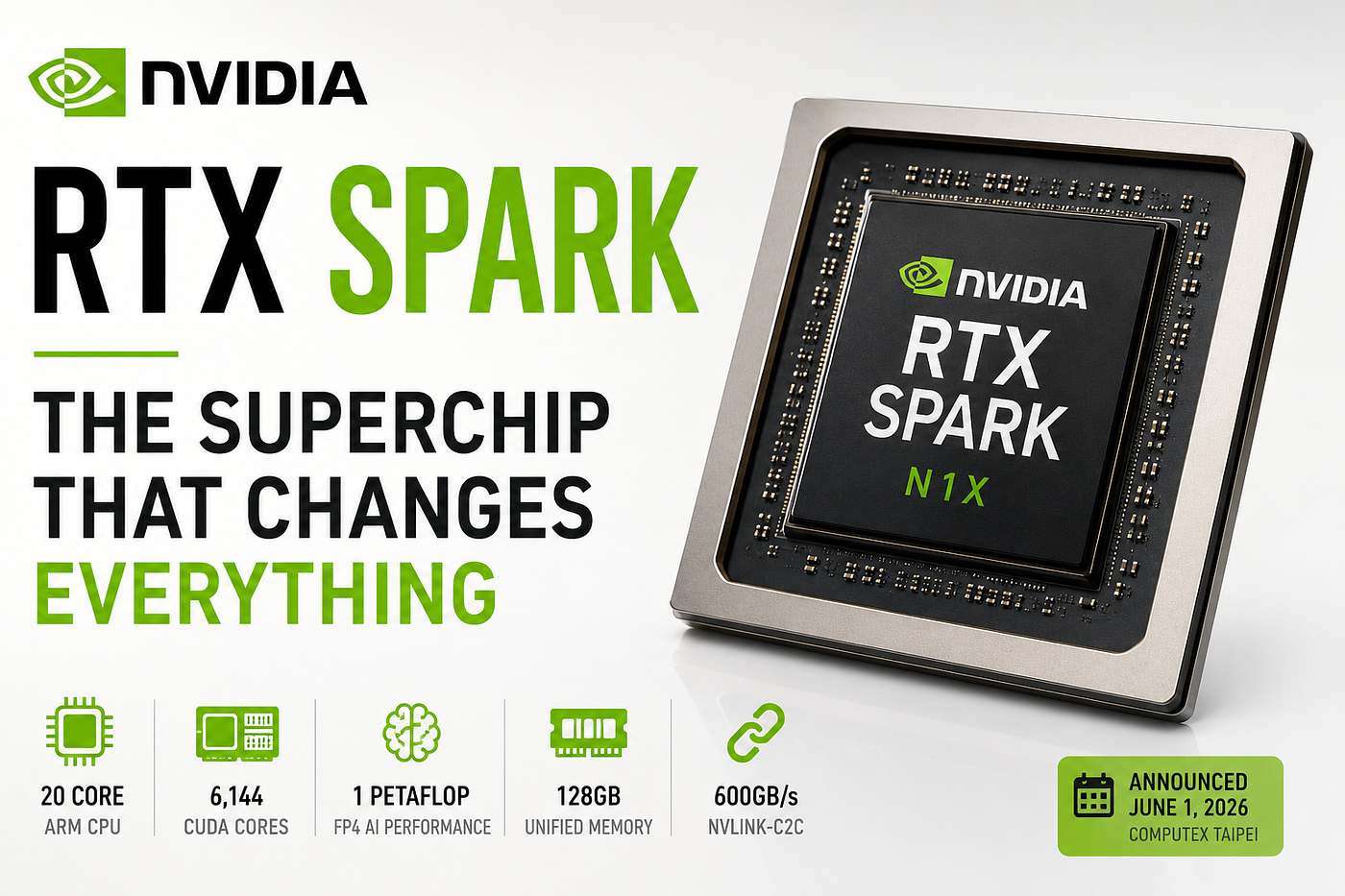
On June 1, 2026, Nvidia CEO Jensen Huang stepped up on stage at the Taipei Music Center during Computex 2026 and changed things big-time. This was huge for the company because Nvidia had never before released a chip like this. Rather than being just another graphics card, the RTX Spark acts as the whole brain of a laptop.
What is the RTX Spark?
RTX Spark is an ARM-based System-on-Chip (SoC), meaning all the main components — the CPU, GPU, memory controller, NPU, and AI accelerators — are crammed onto a single piece of silicon. Nvidia got help on this project too; MediaTek contributed the CPU design, and Microsoft added its expertise in integrating Windows-level AI agents. Plus, it was made using TSMC’s super advanced 3nm process. Can you believe it holds 70 billion transistors and is still thin enough for 14mm laptops? Impressive, right?
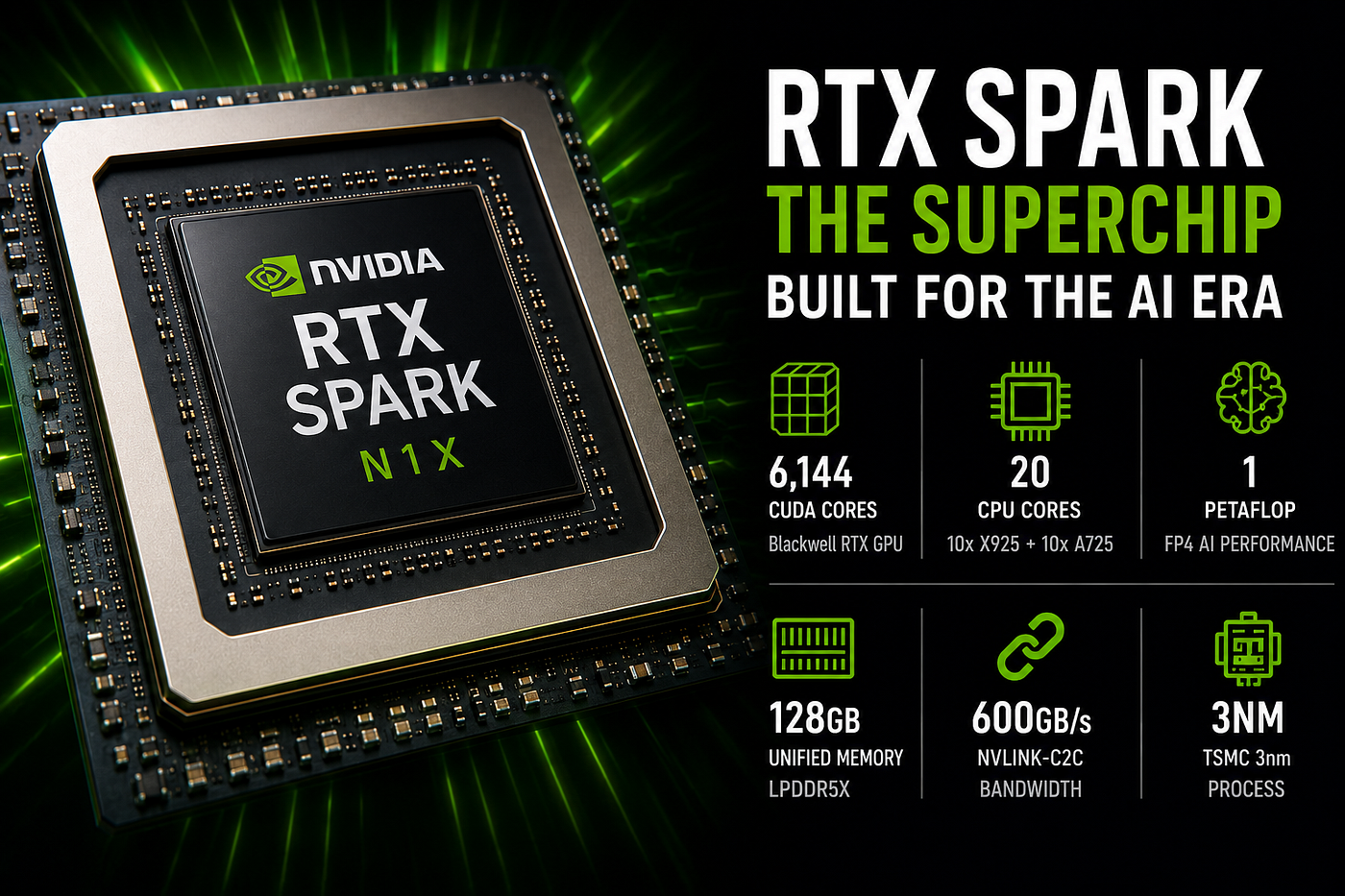
RTX Spark, or N1X for insiders, uses the same GB10 tech as Nvidia’s $3,999 DGX Spark workstation. It starts with that pricey research PC and fits the tech into a laptop size. This move targets everyday users, basically shrinking the big desktop AI machine to a portable chip.
“Microsoft and Nvidia are going to reinvent the PC. The most important reinvention of the PC in 40 years.”
— Jensen Huang, Nvidia CEO, Computex 2026
Exploring Architecture Closely
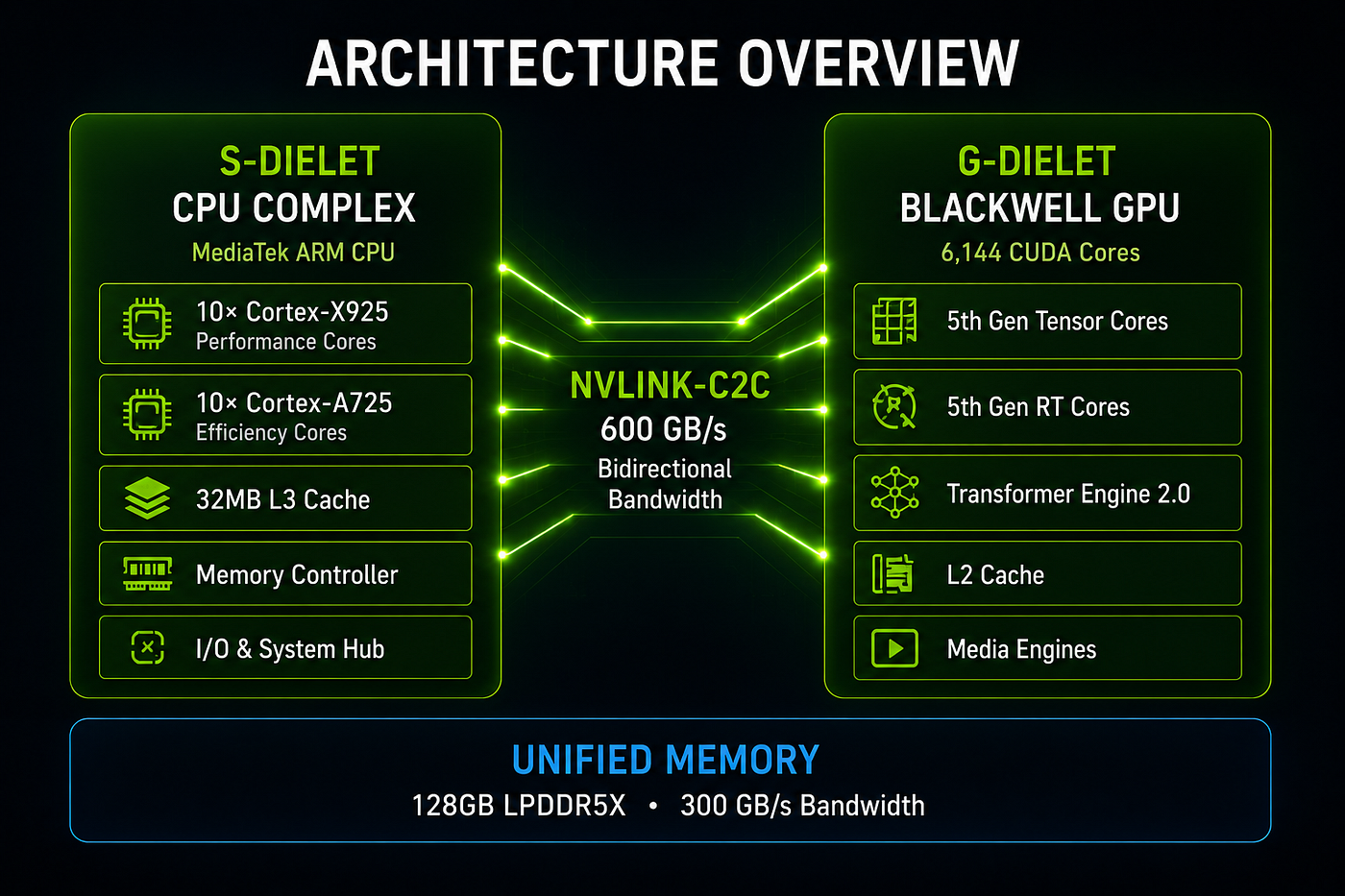
The RTX Spark is a “Superchip” made up of two parts put together with TSMC’s Advanced 2.5D tech on the 3nm node. Getting a grip on how these pieces talk to each other helps you grasp why this chip is super powerful.
First, there’s the S-Dielet, home turf for the CPU. MediaTek cooked up a custom ARM design that holds twenty cores split into two groups. Ten of these are high-tech ARM Cortex-X925 cores, seen for the first time in the 2024 MediaTek Dimensity 9400. The other ten are efficiency-focused ARM Cortex-A725 cores from the Dimensity 8500. So it follows the big.LITTLE pattern just like Apple’s M1.
Every single core gets its own private L2 cache, while the ten-core bunches each share a hefty 16MB L3 cache for a whopping total of 32MB. This setup helps out with speedy data pulls for AI tasks and gaming software.
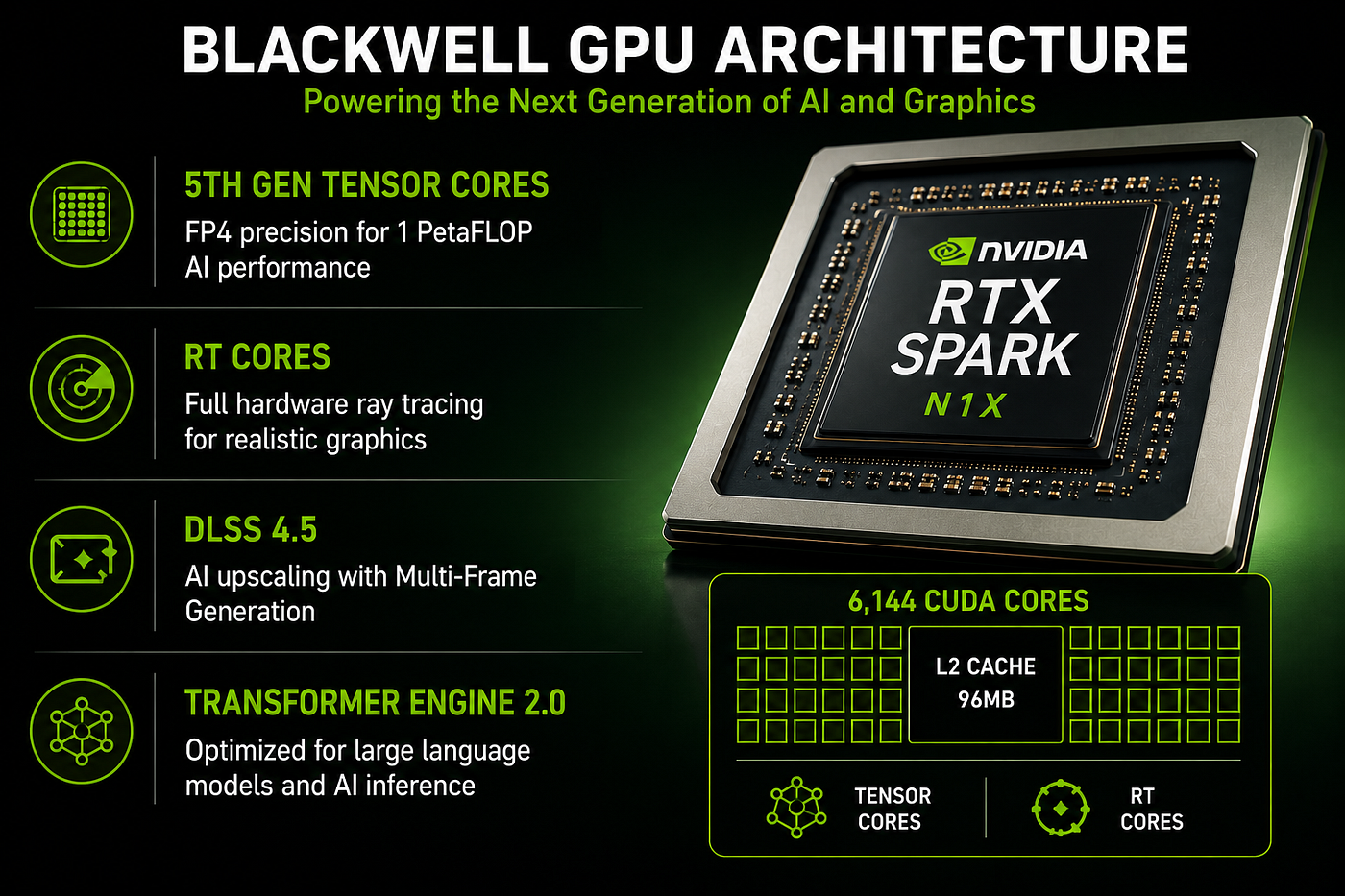
Next, the G-Dielet: it houses the GPU powered by the GB100 Blackwell architecture and boasting a whopping 6,144 CUDA cores. That equals a desktop GeForce RTX 5070 — something usually hogging space and juice with its unique setup and sizable 30cm footprint. However, on the RTX Spark, all that fits cozily onto one teeny chip inside an ultra-slim laptop frame.
Now here’s where it gets interesting. Both these sections talk through Nvidia’s special NVLink-C2C link, moving info at an incredible 600 GB/s. To give you an idea, your run-of-the-mill laptop relies on the slower PCIe Gen 5, maxing out at around 128 GB/s. So, we’re looking at nearly five times the speed for RTX Spark users.
And guess what? In typical setups, laptops keep their CPU and GPU in separate memory silos. Yet, here, thanks to the direct line and shared 128GB pool, RTX Spark blows those barriers away. You get all the perks that make Apple Silicon so desirable — a seamless performance level usually exclusive to beastly, expensive workstations.
Moreover, the CPU here uses ARM v9.2, matching today’s fanciest phones and even some servers, while leaving behind old-school Intel and AMD processors after four decades. This architecture’s new tricks, including SVE2 for fine-tuned AI and processing needs, give an edge not seen before in mainstream gadgets.
Finally, smaller versions will still rock with twelve cores (combining eight premium and four standard) alongside 2,560 or 2,048 shader cores. But remember, these get limited to a more modest 64GB, with an 8-channel (128-bit) hookup. Even then, these should kickstart at an impressive $1,799, making advanced tech more accessible than ever. The flagship model, however, comes in closer to $2,899+, showing where the top-tier performance lands.
MediaTek quietly powers RTX Spark.
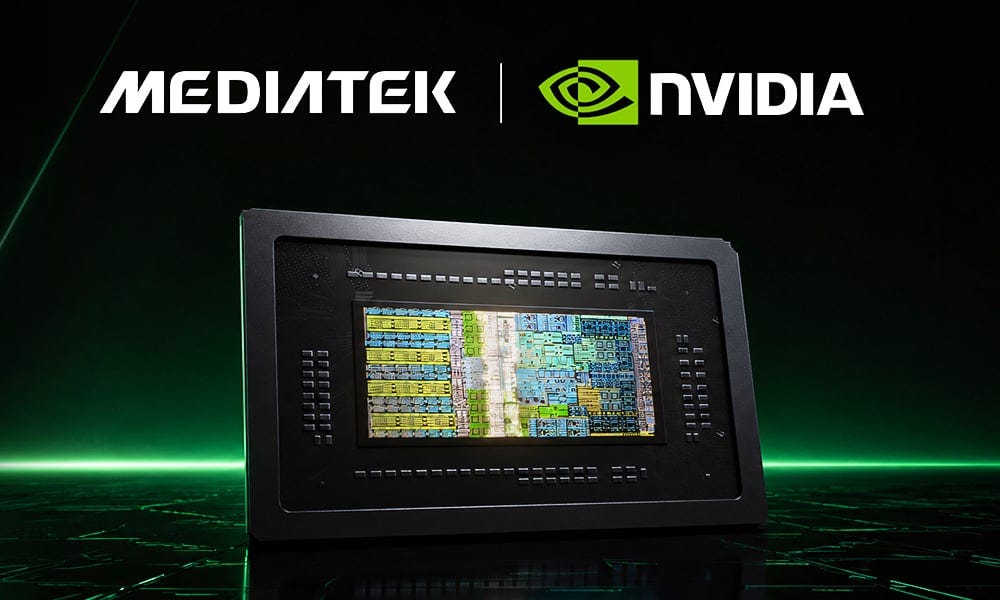
MediaTek is this Taiwanese company that makes semiconductors, around since 1997. You’ll find their chips in about half of the world’s smartphones and laptops, but still, lots of people don’t recognize the name. In the case of RTX Spark, MediaTek isn’t just an extra player; they created the CPU.
The MediaTek team actually designed the RTX Spark’s CPU front-end, including branch predictors, memory control, and power management. It includes 10 Cortex-X925 and 10 Cortex-A725 cores, which are inspired by their Dimensity 9400 and 8500 smartphone chip architectures. They adjusted these for handling AI, graphics, and everyday tasks on a computer. Plus, they made a special memory controller to support up to 128GB of memory, and also integrated advanced power tech for smooth operation.
This isn’t MediaTek’s first time aiming for the high-end PC scene, but past efforts were mainly in cheaper devices like some Chromebooks. With RTX Spark, though, they get a shot at the premium end of things — laptops costing upwards of $2,899, no less. The deal here is that these will be from big-name brands known for top-of-the-line AI tech.
MediaTek and Nvidia are already pals in auto tech, data centers, and more, so RTX Spark builds on that partnership. If all goes well, this could put MediaTek in one of their most spotlighted placements yet, right there in our daily use laptops
“With RTX Spark, MediaTek and NVIDIA bring unprecedented local AI supercomputing directly to consumer PCs.”
— Vince Hu, Corporate SVP, MediaTek
ARM powers Apple M1 and RTX Spark, changing the tech landscape
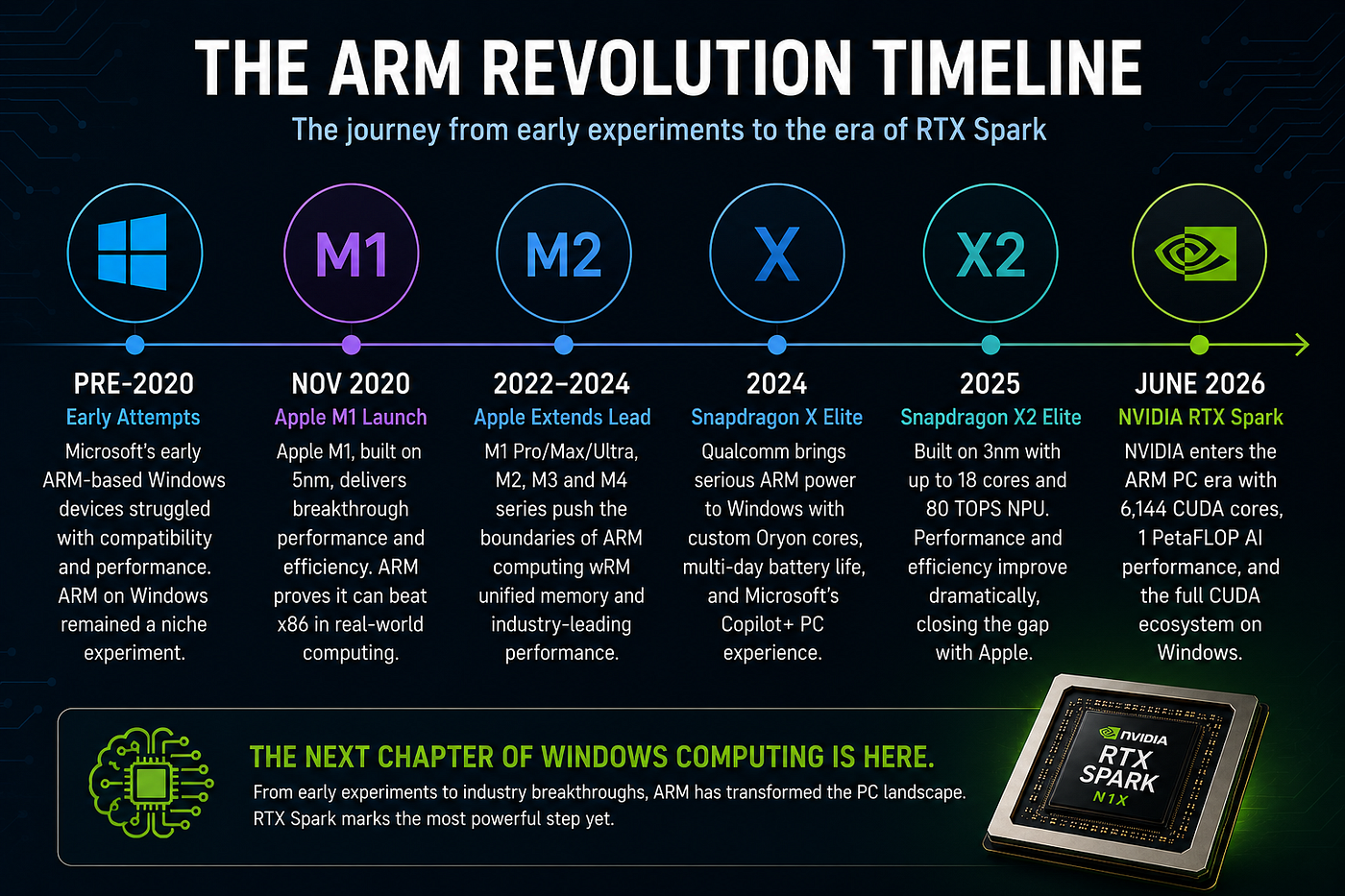
Before 2020, ARM chips weren’t taken seriously for personal computing. Microsoft tried using them with their Surface RT in 2012 and again with the Surface Pro X in 2019. But both times, ARM fell flat because it just couldn’t run regular PC apps well. People saw this kind of ARM usage as a joke rather than a proper platform.
Then, boom! In November 2020, Apple came out with the M1 chip in their MacBook Air and MacBook Pro. Holy wow, did this change everything. Not only did the M1 match Intel’s performance, but it did it while using way less power. Imagine an 8-core CPU, 8-core GPU, and a Neural Engine all on one little piece of silicon with unified memory. That’s insane right? This chip ran super cool and sucked in students with its incredible battery life — we’re talking up to 20 hours here. The whole tech world was blown away by how good ARM could be on a PC.
From there, Apple kept the ball rolling from 2022 to 2024 with newer versions like the M2, M3, and M4. With each one, performance and battery life got even better. And hey, who needed 128GB of memory? Well, apparently some people did, because Apple gave them that too. By 2024, it seemed like everyone else was just catching up.
But guess what? Qualcomm entered the game big time in 2024. Known mainly for phone chips, they released the Snapdragon X Elite. This was for ARM-based Windows laptops and finally made these machines feel like a serious contender. The big selling point? Seriously long battery life and apps running fairly smoothly through Microsoft’s new Prism emulator. Suddenly, Dell, HP, and others started making laptops with Qualcomm’s chips.
Qualcomm continued pushing things forward in 2025 with their second-gen Snapdragon X2 Elite chips. These were made even smaller and used less power, plus they included a ton of cores and crazy processing power. Yet, even with their huge advancements, they still couldn’t fully compete in areas where serious graphics mattered. But they came close, and the vast majority of apps worked okay.
Finally, in June 2026, Nvidia joined the party with their RTX Spark. Man, this was a deal-closer because Nvidia isn’t messing around; they added incredible 6,144 CUDA cores and 1 petaflop AI power to their ARM system. All the sudden, Windows ARM could do serious number-crunching for both pros and games — something that had been lacking. Nvidia didn’t just slide into the market; they tried to dominate it.
It’s wild to think about how far we’ve come in such a short time. From flops to taking over the market in a few years, the shift to ARM looks pretty unstoppable now.
Final Verdict!
The RTX Spark isn’t just any ordinary chip announcement; it’s a declaration that the structure of personal computing is shifting fundamentally. This shift began with Apple’s M1 in 2020, then Qualcomm hopped in with their Snapdragon X in 2024, and now Nvidia joins in with a significant move.
For the first time in four decades, the primary chip powering the Windows system won’t come from Intel or AMD. Instead, it’ll be ARM-based and have unified memory architecture, originally developed for mobile devices. So while the x86 era for Windows might not crash and burn overnight, the RTX Spark sure does speed up its gradual phase-out.
What RTX Spark Gets Right!
RTX Spark nails software ecosystem gravity; with CUDA, it attracts millions of developers right from the start. It also boasts incredible AI compute supremacy, hitting a whopping 1 PetaFlop FP4 — topping all competitors. Plus, its GPU performance? Groundbreaking. The RTX 5070-class GPU in a slim laptop is simply unprecedented. Long-term planning with a three-gen roadmap up to 2030 builds trust with OEMs. Another huge win? Microsoft’s partnership integrates Windows agents directly into the OS, which is super exclusive. Not to mention brand trust: both gamers and AI devs already look to Nvidia.
Who Should Be Paying Attention
Content creators and video editors, listen up! The Blackwell GPU plus Adobe’s built-in upgrades could rocket your performance way past what any current laptop can handle. For AI devs and researchers, running CUDA directly on a 128GB unified memory portable device totally transforms how you work — skip the cloud instances and go full mobile. Gamers, take note: RTX 5070 performance packed into a 14mm frame with DLSS 4.5 sets a new benchmark. Lastly, tech journalists and analysts, get ready because the whole PC market’s power dynamics just shifted dramatically.
메타데이터
- post_id
- e33a5cccd976
- slug
- nvidia-rtx-spark-the-superchip-that-changes-everything-e33a5cccd976
- url
- https://medium.com/@vivekkaneti2/nvidia-rtx-spark-the-superchip-that-changes-everything-e33a5cccd976
- canonical_url
- https://medium.com/@vivekkaneti2/nvidia-rtx-spark-the-superchip-that-changes-everything-e33a5cccd976
- author_url
- https://medium.com/@vivekkaneti2
- status
- ok
- fetched_at
- 2026-06-22 08:33:11