The Slave Trade Britain Did Not Abolish
What colonial records reveal about 143 years of documented slave dealing in southeastern Nigeria
The Slave Trade Britain Did Not Abolish
What colonial records reveal about 143 years of documented slave dealing in southeastern Nigeria
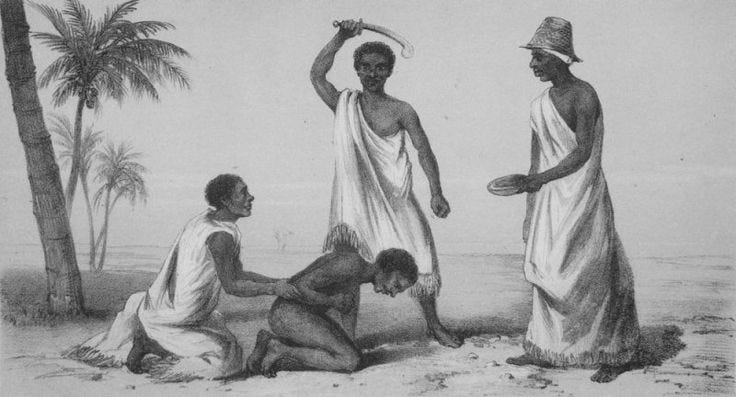
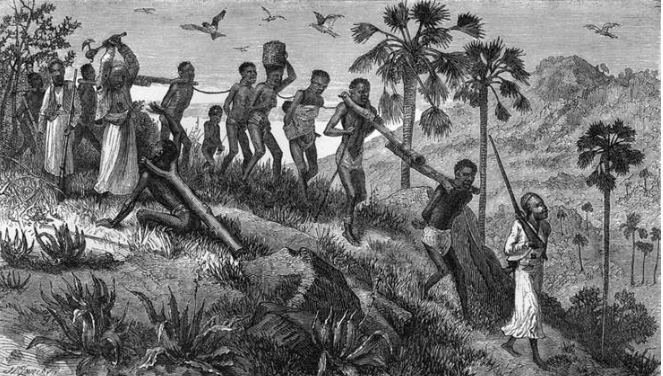
The abolition of the Atlantic slave trade in 1807 is among the most cited events in British imperial history. What is less widely known is that the abolition of the internal slave trade in the Bight of Biafra, the hinterland of what is now southeastern Nigeria was a separate campaign, conducted across a different timeline, with substantially different results.
A.E. Afigbo’s The Abolition of the Slave Trade in Southeastern Nigeria, 1885–1950, published by the University of Rochester Press in 2006, provides the most systematic reconstruction of that campaign available in the scholarly literature. Drawing on the Nigerian National Archives, the British National Archives at Kew, and Rhodes House Oxford, Afigbo traces British policy toward the internal slave trade from the declaration of the Oil Rivers Protectorate in 1885 through to the end of colonial rule in 1950.
His findings are significant for anyone seeking to understand the architecture of British colonial governance in Nigeria.
The Legislative Record
Between 1885 and 1901, sixteen years of formal colonial administration, the Protectorate of the Oil Rivers produced no legislation specifically targeting the internal slave trade. When the Foreign Office asked Commissioner Sir Claude MacDonald in 1895 to account for anti-slavery measures, his response focused primarily on a practice called ‘chopping’ the seizure of persons as debt security, which the government had moved against not on humanitarian grounds but because it disrupted legitimate commerce. The condition of slaves in the delta, MacDonald reported, was not severe enough to warrant immediate intervention.
The first formal legal instrument was Slave Dealing Proclamation №5 of 1901, issued as a prelude to the Aro Expedition of 1901–2. Even then, its application to the full protectorate depended on a separate gubernatorial order, which was not issued until after the military conquest of Aro Chukwu on Christmas Day 1901.
The Military Campaign and Its Limits
The Aro Expedition , the Aro Field Force marching on Aro Chukwu in four converging columns from 28 November 1901 was the most decisive single action the colonial government took against the slave trade infrastructure of the hinterland. Afigbo documents the government’s own assessment: the protectorate was ‘freed forever from the evils of slave raiding and slave dealing on an organised scale.’
The evidence in subsequent chapters of Afigbo’s study complicates that assessment. Within fourteen days of Acting Divisional Commissioner Morrisey warning Uzuakoli traders to cease slave dealing, District Commissioner Granville reported that business had resumed with modified techniques. Buyers dressed slaves as traveling companions. Transactions moved to private houses before and after market days. The Agbagwu regional fair at Uzuakoli continued to function as a slave market, Afigbo documents, through the 1910s, 1920s, 1930s, and into the 1940s.
The 1933 Police Investigation
The most comprehensive attempt to quantify the trade’s persistence was the special plainclothes police squad established in 1933 under Major J.W. Garden, covering Owerri, Calabar, Ogoja, and Onitsha Provinces. The squad’s findings, documented in reports cited by Afigbo from the Southern Provinces archives, confirmed active supply networks running from Idoma and Abakaliki in the north to the Niger Delta in the south, with staging posts at Amachara, Umuokpara, and Uzuakoli, and distribution routes to the Cross River and the delta states.
By the time Major Garden completed his investigation, he had identified the Aro as still controlling the commanding heights of the trade as they had in the precolonial period. ‘In almost all cases which were investigated,’ the secretary for the Southern Provinces summarized, ‘Aro-Chuku men were involved.’
The squad operated for twenty-seven months. In December 1935, the Secretary of State for the Colonies confirmed in the British Parliament that child stealing and slave dealing in Southern Nigeria were ongoing. In May 1936, the special campaign was discontinued. The closing memorandum noted that a ‘section of opinion in England’ would be unlikely to accept the justification for ending the campaign.
Structural Explanations
Afigbo identifies several structural factors that sustained both the supply and demand for slaves under colonial rule. On the supply side: demographic pressure in densely populated Igboland, family debt, and the cosmological practice of selling children who had violated taboos as a substitute for the precolonial practice of ritual killing. On the demand side: the social prestige value of slave ownership in the Cross River region, the matrilineal inheritance structures that made men prefer children acquired from outside their marriage rather than through it, and the labor requirements of delta fishing and trading economies.
These structural conditions were not addressed by the colonial administration’s approach, which remained what Afigbo describes as reactive: prosecuting those unlucky enough to be caught, rather than dismantling the economic and social conditions that made the trade viable.
Implications for Historical Understanding
Afigbo’s research establishes two conclusions with archival precision. First, the abolition of the Atlantic slave trade in 1807 did not produce a corresponding end to the internal slave trade in the Bight of Biafra. Second, the colonial administration of southeastern Nigeria, despite possessing detailed knowledge of the trade’s persistence, consistently prioritized legitimate commerce and administrative stability over the elimination of slave dealing. These conclusions are not polemical. They are the output of systematic archival reconstruction. They require revision of the standard account of 1807 and its consequences.
메타데이터
- post_id
- e33eed97008b
- slug
- the-slave-trade-britain-did-not-abolish-e33eed97008b
- url
- https://medium.com/@OS_Okonkwo/the-slave-trade-britain-did-not-abolish-e33eed97008b
- canonical_url
- https://medium.com/@OS_Okonkwo/the-slave-trade-britain-did-not-abolish-e33eed97008b
- author_url
- https://medium.com/@OS_Okonkwo
- status
- ok
- fetched_at
- 2026-06-09 14:34:10