Côte d’Ivoire 1–0 Ecuador: How Wide Individual Quality and Squad Depth Beat a Disconnected Block
Post Match Tactical Notes #06: Diomandé’s first half dominance, Ecuador’s broken vertical chain and a bench that decided the game
Côte d’Ivoire 1–0 Ecuador: How Wide Individual Quality and Squad Depth Beat a Disconnected Block
Post Match Tactical Notes #06: Diomandé’s first half dominance, Ecuador’s broken vertical chain and a bench that decided the game
Côte d’Ivoire 1–0 Ecuador was not a game settled by a clear gap in possession or chance volume. Both teams set up in a 4–4–2, both carried recognizable strengths, and for long stretches the match was an even, physical contest between two sides who looked capable of leaving a mark on the tournament. The first half in particular was tight and combative, with neither team able to take real control.
What separated them in the end sat underneath the scoreline rather than in it. Côte d’Ivoire had superior individual quality in wide areas, and a depth of squad that Ecuador could not come close to matching. Ecuador actually saw more of the ball, 49.9% to 41.9%, and played more total passes, 513 to 471, yet they consistently failed to convert that possession into meaningful access to the final third. Côte d’Ivoire did less with the ball but did it in far more dangerous areas, and then, when the game flattened out, changed it from the bench.
The winning goal captured the logic of the match. After Côte d’Ivoire reshaped their structure, Wilfried Singo moved into the left back zone and carried the ball forward with power. He then found Amad Diallo, who had come on in the second half and finished brilliantly with his left foot in the 89th minute.
It was a goal built from the same advantages that had shaped the match: squad depth, wide ball carrying quality and the ability to change the game from the bench.
Data snapshot
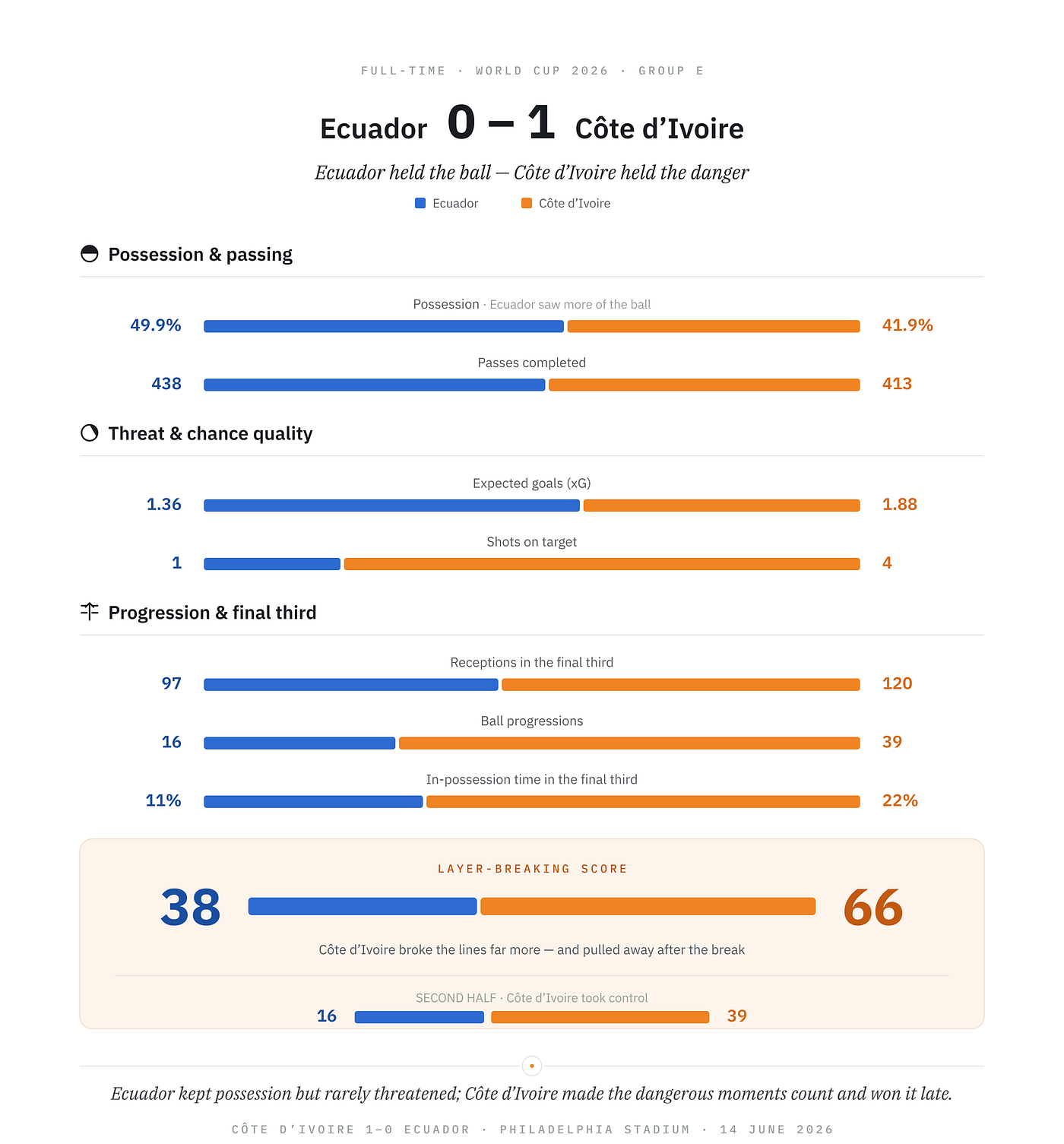
The data shows a clear contrast between possession and threat. Ecuador had more of the ball, but Côte d’Ivoire reached dangerous areas more often.
Côte d’Ivoire led in xG, 1.88 to 1.36, shots on target, 4 to 1, final third receptions, 120 to 97, and ball progressions, 39 to 16. They also spent 22 percent of their in possession time in the final third, compared with Ecuador’s 11 percent.
The Layer Break Score followed the same pattern. Côte d’Ivoire led 27 to 22 at half time, then pulled away after the break, winning the second half 39 to 16 and the match 66 to 38 overall. The numbers support the eye test: the game was balanced early, but Côte d’Ivoire’s ball carrying and attacking depth became decisive after half time.
1. Diomandé and the right flank ran the first half
The defining feature of the opening 45 minutes was Yan Diomandé.
Côte d’Ivoire began with notable changes to both personnel and shape compared with what we had seen earlier in the AFCON cycle. They lined up in a 4–4–2 with Wahi leading the line and Pepe alongside him in a freer role. The decisive call, though, was Diomandé. Rather than the left wing where we are used to seeing him, they started him on the right, and it shaped the entire half.
He was comfortably the best and most influential player on the pitch, the man creating the clearest difference. Côte d’Ivoire’s attacks came overwhelmingly down their right, and that was almost entirely his doing. He repeatedly beat Arsenal’s Piero Hincapié one versus one, going both inside and outside, and it was that dual threat that made him so difficult to contain. When he cut inside, the passes he played created clear chances. When he carried to the line, he rarely crossed at random, instead picking out the free teammate inside the box. The Diomandé and Pepe connection down that side was Côte d’Ivoire’s single most effective attacking mechanism of the half.
His individual line captures how varied the threat was. Diomandé attempted 6 crosses on his own and spread them across five different types: inswing, outswing, driven, lofted and cutback. As a whole side, Ecuador attempted only one more cross than he did by himself, seven in total. That a single player nearly matched an entire opposing team’s crossing volume, and did so across the full range of delivery types, is the statistical fingerprint of a genuinely broad creative toolkit rather than a one trick wide player. When the subject is creation, his hand was unusually rich. He also led the match in take ons.
2. Côte d’Ivoire’s two man midfield was a genuine weakness
For all the threat out wide, the first half also laid bare a clear problem: Côte d’Ivoire’s central midfield.
With only two in the middle, the Kessié and Fofana pairing struggled defensively to lock down the centre. They conceded space repeatedly, especially in the channel between the back four and the midfield line. This was the obvious route into the game for Ecuador, and the chances Ecuador did fashion in the first half came largely from that gap between the defensive block and midfield.
There was a structural knock on effect. Because Côte d’Ivoire had only two central midfielders, they declined to push a man out onto Vité when he dropped to the left of Ecuador’s defence to start build ups, leaving that task to Diomandé. The consequence was that Ecuador’s left back Hincapié was often free in the first half. In principle Kessié should have stepped onto him, but, unwilling to vacate the centre any further, he was reluctant to do so. Côte d’Ivoire were essentially choosing which problem to live with.

Vite drops left to build play, forcing Diomande to step out. Fofana cannot vacate the centre, leaving Hincapié unmarked
This feeds into the broader truth of the match. Côte d’Ivoire looked sharp and combative, but they were also fragile. They committed a number of individual defensive errors, the kind that turn into serious openings for a more incisive opponent, and which a sharper side would have punished. The reason it never cost them is the subject of the next section.
3. Ecuador had the spaces but no chain to use them
Ecuador’s central problem was never a lack of space. It was the inability to connect that space to their attack.
They built at times with three at the back, Vité dropping to the left to take the first pass, and they were comfortable in possession. But their double pivot of Caicedo and Vité was both very defensive by instinct and, more damagingly, too alike in profile. Both want to collect deep and start play. Neither reliably bridged the second and third phases or offered central creativity in the final third. The result was a team that could move the ball into midfield but rarely from midfield into real danger.

The offers to receive data exposes this precisely. The two teams created almost identical totals of passing options, 333 offers for Côte d’Ivoire and 339 for Ecuador, yet in the final third the picture inverts: 139 for Côte d’Ivoire to Ecuador’s 108. Ecuador’s players were moving and showing for the ball in safe zones, but the supply of options dried up in exactly the area where it mattered most, which is another clear sign of the gap between their defensive line and their attacking unit.
The movement to receive numbers make the disconnect even more concrete. In the middle third, Côte d’Ivoire made half of their movements between the opponent’s lines and only 21% in front of them. Ecuador did the opposite, with 42% in front and just 25% in between. When the game reached its most important phase, Ecuador’s players were showing in front of Côte d’Ivoire’s block, in close, safe, unthreatening positions, while Côte d’Ivoire were getting bodies into the gaps between the lines. That single contrast explains why a team with more possession could neither progress cleanly into the final third nor sustain attacks once there. The absence of a penetrative central midfielder, combined with two defensively minded pivots, cost them exactly as you would expect.
To their credit, Ecuador did try to address it. Plata attempted to drop into those linking pockets and create with his movement, and there were moments where his mobility caused a flicker of trouble. But their effectiveness in the third phase remained well short of what was required, and those attempts often ended in turnovers in that zone. Combined with Côte d’Ivoire’s ball carrying midfielders and quick, dangerous wide players, those losses repeatedly fed Côte d’Ivoire attacks toward the Ecuador goal.
4. Build up shape: spontaneous rather than systematic
A note on how Côte d’Ivoire actually constructed play, because it explains a lot about the rhythm of the game.
The man trusted to circulate in the middle of their build up was the centre back Agbadou. Although he is right footed, the role of carrying from the left of the back line was his, and he handled it. But it would be wrong to describe Côte d’Ivoire’s attacks as a smooth, systematic progression from the back. More often than not, their threat grew out of winning 50–50 balls and then releasing them forward, and once again it was Diomandé who was the principal beneficiary and outlet for those moments. Their attacking game was built on transition and individual carrying far more than on patient construction.
Ecuador, for their part, did have a mobile attacking four, and when they got the ball to their forwards’ feet they could give the Côte d’Ivoire defence uncomfortable moments. The problem, as the earlier sections show, was getting it there in the first place.
5. The second half tilted decisively toward Côte d’Ivoire
If the first half was even, the period from the 45th minute through to the water break was where Côte d’Ivoire took genuine control.
They became increasingly threatening in transition, repeatedly hurting Ecuador on the break in a way Ecuador never reciprocated. Most of Ecuador’s dangerous moments came when their wide players ran in behind or beat a man individually. Yeboah at times, and Preciado after his introduction, took that responsibility on, but it was never enough to consistently prise open a well organised Côte d’Ivoire defence.
The introduction of Diallo around the hour mark was pivotal here. With Diallo on the right and Diomandé still on the left, Côte d’Ivoire’s attack stopped funnelling through a single channel and became genuinely two sided, and from that point their attacking output rose sharply. Diallo’s cameo numbers were striking for a match this physical and this tight: in limited minutes he completed all 5 of his attempted line breaks, all 7 of his take ons, and registered 2 attempts and the goal. Set alongside Diomandé’s full game line of 9 ball progressions, 9 take ons and 13 line breaks attempted, the two wide players were the clear engine that opened a stubborn Ecuador. The strength of both their carrying volume and their take on numbers, in a contest this competitive and this combative, is genuinely impressive.
6. Squad depth, not just the eleven, won the match
The most decisive difference between the teams lived on the bench, and in how the two managers were able to change the game.
After the second half water break the tempo dropped noticeably and both sides slipped into a posture that looked content with a draw. Côte d’Ivoire’s substitutions shaped the finish, and to my mind it was here that one of the most important gaps between the teams showed itself. They first brought on Sangaré and Oulai to turn their two man midfield into a three, dropping from two strikers to one, directly answering the central vulnerability that had troubled them in the first half. Later, removing the attacking right back Doué for Singo, a centre back by trade, and adding another defender, was an unambiguous signal that they did not intend to lose the game.
The deeper point is what those changes revealed. Côte d’Ivoire have a level of squad quality and squad depth that Ecuador simply could not match. They held several different attacking weapons in reserve, and players suited to different game states and different styles of play. That flexibility is ultimately what produced the winner: Singo, the defender shifted to left back, carried the ball and found Diallo, the second half substitute, who finished it. The reshuffle, and the depth that made it possible, was the difference.
7. The supporting roles repeat the story: Pepe against Plata
A clean like for like comparison is the two sides’ connecting forwards, the players asked to provide mobility, creativity and a bridge between midfield and attack: Pepe for Côte d’Ivoire, Plata for Ecuador.
The gap is stark. Pepe made 57 offers to receive, the most of any Côte d’Ivoire player, and his movement was heavily penetrative, with 24 between the lines and 17 in behind. Plata managed 38 offers, with far less threatening distribution. Pepe was both more active and more dangerous, constantly making himself an option in advanced areas, and was one of the central reasons Côte d’Ivoire’s attack carried the threat it did. Plata did what he could, but never came close to the same level of influence.
Widening that out to the attacking units as a whole, Côte d’Ivoire’s starting front four offered to receive 149 times to Ecuador’s front four’s 111, and the gap only grows once substitutes are added. Because both teams used a similar attacking structure, comparing the mobility and availability of the two front fours is the right read, and Côte d’Ivoire’s was clearly the more active. That movement was a primary reason they could carry the ball into the final third and keep attacks alive where Ecuador could not.
Analyst takeaway
Côte d’Ivoire 1–0 Ecuador was won at the margins, but the margins were not luck. They were the product of two specific, repeatable advantages.
The first was individual quality in wide areas. Diomandé was the best player on the pitch across the 90 minutes, and the second half arrival of Diallo on the opposite flank turned a one sided attack into a balanced one. Their carrying and take on numbers were exceptional for a game this physical, and the way the LBS pulled clear in the second half, 39 to 16 after an even 27 to 22 first half, was, at its core, a measure of that individual carrying superiority.
The second was structural depth. Côte d’Ivoire were far from flawless. Their two man midfield left the centre exposed, and they made individual defensive errors that a more clinical opponent would have made them pay for. But Ecuador never had the vertical connection to do so. Their possession was real yet hollow, full of the ball and full of offers in safe zones, undone by a double pivot too defensive and too duplicated to link play into the final third. The movement data, with Ecuador showing in front of the block and Côte d’Ivoire showing between the lines, is the neatest summary of why more possession produced less danger. Plata’s attempts to bridge the gap were honest but insufficient, and the turnovers in the third phase they produced kept handing Côte d’Ivoire the ball in transition.
When the match drifted toward a draw, it was Côte d’Ivoire’s bench and their willingness to reshape the side that produced the winner. A converted left back carried, a second half substitute finished, and a team with more weapons and more options found the single moment a more limited squad could not.
Ecuador had the platform to compete, but not enough vertical quality to turn possession into pressure. Côte d’Ivoire had that quality, and in the end, it decided the match.
Originally published at https://footballtacticalnotes.substack.com.
메타데이터
- post_id
- e34c4a21091f
- slug
- côte-divoire-1-0-ecuador-how-wide-individual-quality-and-squad-depth-beat-a-disconnected-block-e34c4a21091f
- url
- https://medium.com/@mkubjk/c%C3%B4te-divoire-1-0-ecuador-how-wide-individual-quality-and-squad-depth-beat-a-disconnected-block-e34c4a21091f
- canonical_url
- https://medium.com/@mkubjk/c%C3%B4te-divoire-1-0-ecuador-how-wide-individual-quality-and-squad-depth-beat-a-disconnected-block-e34c4a21091f
- author_url
- https://medium.com/@mkubjk
- status
- ok
- fetched_at
- 2026-07-09 23:07:12