Live Sports Streaming: The Next Revenue Lift Won’t Come From More Games
There’s a default belief in sports media: if we own more games, we own more value. But what if that’s backwards?
Live Sports Streaming: The Next Revenue Lift Won’t Come From More Games
The economics of live sports are shifting.
Over the last decade, rights fees have escalated into the billions. Platforms compete aggressively for exclusivity. Sports remain one of the few forms of content that can still drive immediate, mass-scale subscriber acquisition.
But the math is tightening.
Live rights are expensive. Subscriber growth is spike-driven. And churn after tentpole moments remains persistent.
The industry’s reflex has been to pursue more:
More leagues. More packages. More exclusive windows.
Yet the next revenue lift may not come from expanding inventory at all.
It may come from elevating the way it’s presented.
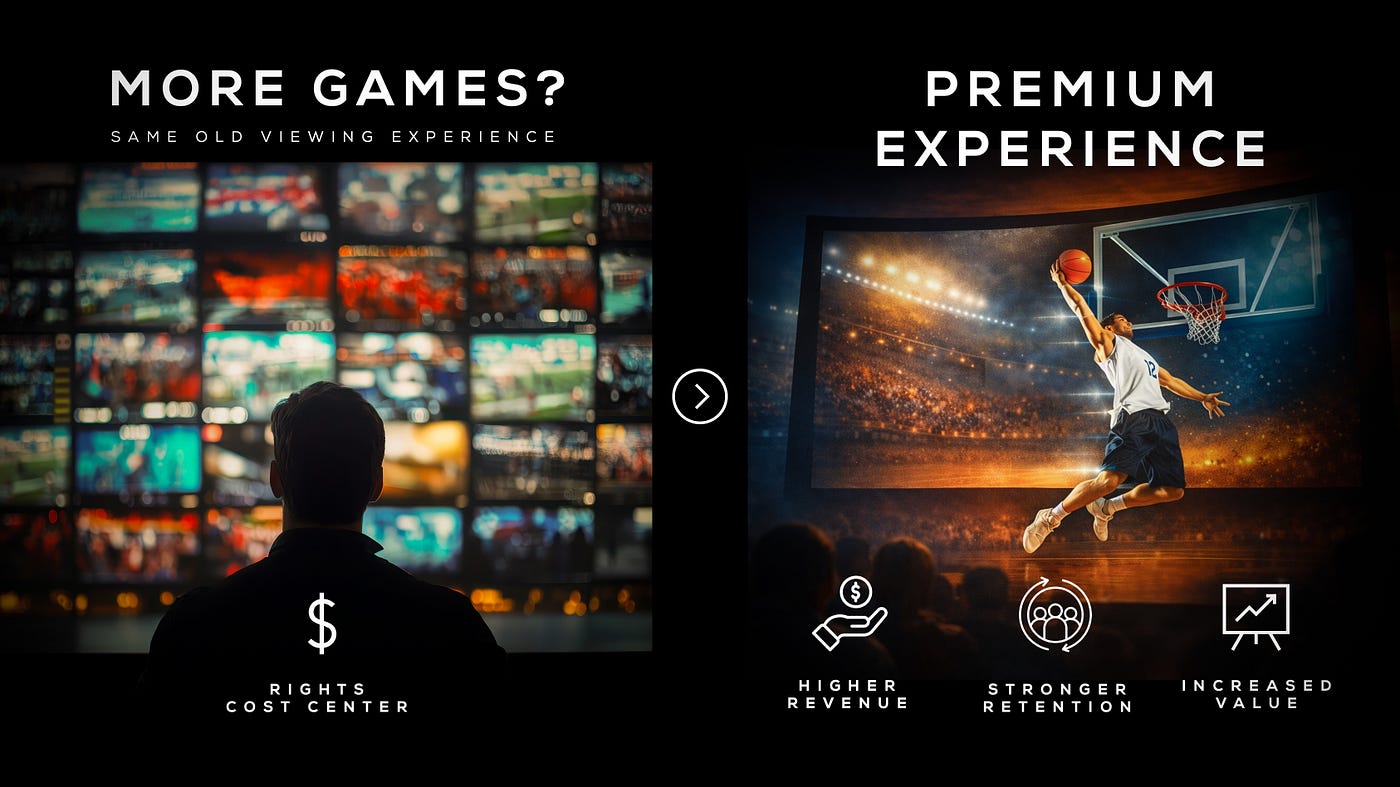
The Core Tension: High Cost, Commoditized Delivery
In our current streaming ecosystem, most major platforms offer live sports in some capacity.
Ownership differentiates — temporarily.
But once multiple players carry live events, presentation begins to converge. The game is available everywhere. The stream works. The broadcast looks “good enough.”
That’s where commoditization creeps in.
For revenue leaders — CROs, Heads of DTC, strategy executives — the key KPI question isn’t just acquisition. It’s lifetime value.
- How do we increase ARPU without triggering churn?
- How do we reduce post-season subscriber drop-off?
- How do we protect ROI on escalating rights costs?
The answer increasingly lies in perceived value, not just access.

Consumers Recognize Premium — And Respond to It
Research consistently shows that consumers perceive premium presentation as distinct and meaningful.
In recent consumer studies, viewers most often describe enhanced formats as “cinematic” and “immersive,” associating them with a true “theatre-at-home” experience (1)
More importantly, that perception translates into business behavior:
- 55% say they would be more interested in starting a new subscription if the service includes a premium experience layer (2)
- 76% say they would be more likely to stay subscribed (2)
- Up to 80% indicate willingness to pay as part of a subscription, with 35% willing to pay $6–$10 more per month (2)
These are not marginal numbers.
They signal something critical: Premium presentation shifts economic behavior.
The Myth of Infinite Expansion
There is a prevailing assumption that rights expansion equals growth.
But rights are finite and increasingly expensive. The marginal cost of acquiring additional inventory often outpaces the marginal revenue lift.
PwC and Deloitte’s annual sports outlooks have both emphasized that media rights inflation is outstripping traditional revenue growth models.
When cost curves steepen, monetization strategy must evolve.
Premiumization offers a more capital-efficient path:
Instead of buying more games, extract more value from the ones you already own.
Why Experience Drives Revenue
1. It Justifies Tier Differentiation
Consumers are price-sensitive — but not indifferent to value.
The data shows that bundling premium presentation within subscription tiers is more effective than per-title upsells2.
This has strategic implications.
Premium presentation becomes:
- A mid-tier anchor
- A reason to upgrade
- A retention stabilizer
In subscription economics, tier architecture is one of the few levers that can move ARPU without pure price hikes.
Premium live presentation strengthens that lever.
2. It Reduces Tentpole Churn
Live sports subscriptions often behave like event tickets.
Fans subscribe for the season opener. The playoffs. The championship.
Then they cancel.
Research indicates that premium differentiation increases likelihood to stay subscribed2
Why?
Because the platform becomes associated with quality — not just access.
When viewers feel they’re receiving the best possible version of the event, the service earns brand equity, not just transactional usage.
Retention improves when the experience feels definitive.
3. It Protects Franchise Value
Sports leagues and rights holders care deeply about brand integrity.
If the most valuable games are delivered in ways that feel flat or undifferentiated, the brand itself erodes over time.
Premium presentation reinforces the stature of the event.
It aligns the at-home experience with the scale and drama that justify billion-dollar rights deals in the first place.
When audiences describe a stream as mirroring a theatrical experience, social buzz and positive sentiment follow1
That halo matters.
4. It Aligns with Consumer Behavior Trends
Consumers are upgrading their home entertainment systems at record rates.
Large-format TVs. Premium soundbars. Immersive setups.
They expect more than “functional.”
They expect spectacle.
Industry analysts consistently note that live sports remain one of the few appointment-viewing formats capable of gathering households together.
If the viewing experience does not match the emotional intensity of the event, the disconnect becomes obvious.
And in competitive markets, obvious gaps become vulnerabilities.
The Packaging Imperative
Premium presentation must be positioned correctly.
Research highlights two important nuances
- Consumers prefer bundled premium benefits over per-title fees2
- Messaging must simplify what the experience is and how to access it3.
This reinforces a strategic principle:
Premiumization is strongest when embedded into plan design, not treated as a technical add-on.
When subscribers upgrade tiers, they aren’t buying a codec.
They’re buying status. Quality. The sense that they have the best seat in the house.
The Broader Industry Pattern
Across media industries, premiumization has driven revenue resilience.
· In music, higher-tier streaming plans incorporate spatial audio and exclusive features.
· In gaming, next-gen graphics and performance justify hardware upgrades.
· In film, theatrical premium formats command higher ticket prices.
Live sports streaming is the next frontier.
Owning rights is foundational. Owning the premium expression of those rights is transformational.
The Strategic Reframe
The traditional question has been:
“How many more games can we acquire?”
The emerging question is:
“How can we make our most valuable games feel irreplaceable?”
If a platform invests billions in live sports rights, the experience must reflect that investment.
Because in the streaming era, value perception drives:
- Subscription starts
- Tier upgrades
- Retention
- ARPU
- Long-term brand equity
Premiumization is not aesthetic polish.
It is commercial strategy.
The Closing Thought
The next phase of streaming competition will not be won by volume alone.
It will be won by platforms that turn marquee moments into premium experiences that feel bigger, more immersive, and unmistakably differentiated.
Rights acquisition was chapter one. Revenue optimization is chapter two.
And premium presentation of the moments that matter most may be the most powerful lever left.
___
1 MarketCast Study 2021
2 NRG Study 2025
3 TRIPTK Study 2022
메타데이터
- post_id
- e34ee2905c5f
- slug
- live-sports-streaming-the-next-revenue-lift-wont-come-from-more-games-e34ee2905c5f
- url
- https://medium.com/imaxtechnology/live-sports-streaming-the-next-revenue-lift-wont-come-from-more-games-e34ee2905c5f
- canonical_url
- https://medium.com/imaxtechnology/live-sports-streaming-the-next-revenue-lift-wont-come-from-more-games-e34ee2905c5f
- author_url
- https://medium.com/@imaxtechblog
- status
- ok
- fetched_at
- 2026-07-14 09:44:18