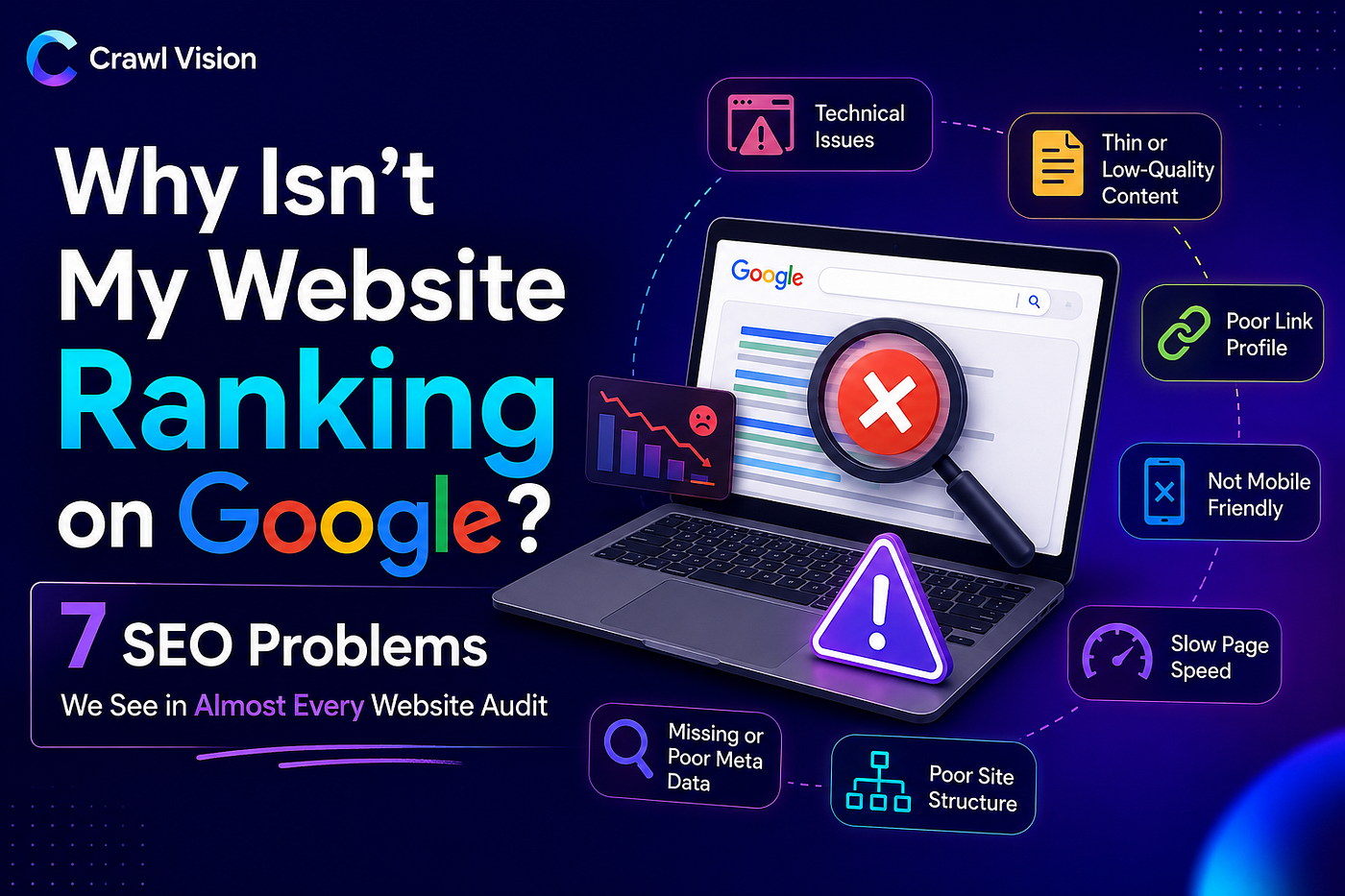
Why Isn’t My Website Ranking on Google? 7 SEO Problems We See in Almost Every Website Audit
Imagine this: You launch a beautiful website, publish a few blogs, optimize some keywords, and wait for Google to send visitors your way.
Why Isn’t My Website Ranking on Google? 7 SEO Problems We See in Almost Every Website Audit
Imagine this: You launch a beautiful website, publish a few blogs, optimize some keywords, and wait for Google to send visitors your way.
Days turn into weeks. Weeks turn into months.
Yet when you search for your business on Google, your competitors dominate the first page while your website is nowhere to be found.
Sound familiar? If yes, you’re not alone.
At **Crawl Vision**, we’ve audited websites across different industries — from local businesses and startups to eCommerce stores and service-based companies. Surprisingly, the same SEO mistakes appear again and again.
The good news? Most of these problems are completely fixable.
Let’s explore the seven biggest reasons your website isn’t ranking on Google — and what you can do about them.
1. Google Doesn’t Fully Understand Your Website
Many website owners assume that publishing a page automatically means Google will rank it.
Unfortunately, that’s not how search engines work.
Before Google can rank your content, it needs to crawl and index it. If your website has technical issues like broken links, blocked pages, missing sitemaps, or incorrect indexing settings, Google may never discover your most important pages.
Think of it this way: if Google can’t read your website properly, it certainly can’t recommend it to searchers.
What to do:
- Submit an XML sitemap.
- Fix crawl errors in Google Search Console.
- Remove accidental “noindex” tags.
- Improve your internal linking structure.
2. You’re Chasing the Wrong Keywords
One of the biggest SEO mistakes is targeting keywords that are either too competitive or too broad.
For example, trying to rank for a keyword like “SEO” is incredibly difficult because you’re competing with thousands of established websites.
Instead, focus on keywords that match exactly what your audience is searching for.
Examples include:
- Affordable SEO services
- Local SEO agency near me
- Website SEO audit
- SEO for small businesses
Long-tail keywords may have lower search volume, but they usually attract visitors who are ready to take action.
Quality traffic always beats random traffic.
3. Your Content Looks Like Everyone Else’s
Google has become much smarter over the last few years.
Simply rewriting information that already exists on hundreds of websites isn’t enough anymore.
If your blog posts don’t offer fresh insights, practical advice, or original experience, Google has little reason to rank them above competing content.
Instead of writing another generic article like “What is SEO?”, create content people actually want to read.
For example:
- Why Your Website Lost Rankings Overnight
- The Complete SEO Audit Checklist for 2026
- Common Technical SEO Mistakes Small Businesses Make
- Local SEO Strategies That Actually Work
When your content solves real problems, people stay longer, share it, and trust your brand.
Google notices that.
4. Your Website Is Too Slow
Nobody likes waiting for a slow website.
Not your visitors.
And definitely not Google.
A slow-loading website increases bounce rates, reduces engagement, and often hurts your search rankings.
Common reasons include oversized images, unnecessary plugins, poor hosting, and unoptimized code.
A faster website creates a better experience for users, which is exactly what Google wants to reward.
Simple improvements like image compression, browser caching, and better hosting can make a noticeable difference.
5. Your On-Page SEO Needs Work
Sometimes the problem isn’t your content — it’s how you’ve optimized it.
Many websites have missing title tags, duplicate meta descriptions, weak heading structures, or poorly organized URLs.
These small details help search engines understand what each page is about.
A well-optimized page should clearly answer three questions:
- What is this page about?
- Who is it for?
- Why is it valuable?
When every page has a clear purpose, Google finds it much easier to rank your content.
6. Your Website Has Little or No Authority
Imagine two websites publishing the exact same article.
One website has hundreds of quality backlinks and years of credibility.
The other is brand new with no online mentions.
Which one do you think Google is more likely to trust?
Authority still plays a huge role in SEO.
Building authority doesn’t mean buying thousands of cheap backlinks.
Instead, focus on earning mentions naturally by creating valuable content, publishing original research, collaborating with other businesses, and contributing guest articles on reputable websites.
Trust takes time — but it’s one of the strongest ranking signals.
7. Your SEO Strategy Is Stuck in the Past
SEO isn’t the same as it was five years ago.
Today, Google shows much more than traditional blue links.
Search results now include AI-generated summaries, featured snippets, videos, local listings, images, and “People Also Ask” sections.
If your SEO strategy hasn’t evolved, you’re already behind.
Modern SEO is about understanding search intent, creating genuinely helpful content, improving user experience, and building topical authority — not simply stuffing pages with keywords.
The businesses winning today are adapting faster than everyone else.
So… Why Isn’t Your Website Ranking?
The truth is, there usually isn’t just one reason.
Most websites struggle because several small SEO issues add up over time.
A few technical problems.
Weak content.
Poor keyword targeting.
Slow performance.
Limited authority.
Individually, they might seem minor.
Together, they can prevent your website from reaching the first page of Google.
The encouraging part is that every one of these problems can be identified — and fixed — with a proper SEO audit.
Final Thoughts
Ranking on Google isn’t about finding a secret trick or shortcut.
It’s about building a website that deserves to rank.
That means creating helpful content, delivering a fast and user-friendly experience, solving technical issues, and consistently earning Google’s trust.
If your website has been stuck for months despite your efforts, it’s time to stop guessing and start auditing.
At Crawl Vision, we help businesses uncover the hidden SEO issues that hold their websites back. Our detailed SEO audits provide clear insights, practical recommendations, and a roadmap to improve rankings and grow organic traffic.
Because better rankings don’t happen by chance — they happen by strategy.
메타데이터
- post_id
- e3535ad5cb28
- slug
- why-isnt-my-website-ranking-on-google-7-seo-problems-we-see-in-almost-every-website-audit-e3535ad5cb28
- url
- https://medium.com/@crawl-vision/why-isnt-my-website-ranking-on-google-7-seo-problems-we-see-in-almost-every-website-audit-e3535ad5cb28
- canonical_url
- https://medium.com/@crawl-vision/why-isnt-my-website-ranking-on-google-7-seo-problems-we-see-in-almost-every-website-audit-e3535ad5cb28
- author_url
- https://medium.com/@crawl-vision
- status
- ok
- fetched_at
- 2026-07-17 02:11:19