Quantum Computing: Are We Ready for the Future? — Transitioning from NISQ to FTQC
From Noisy to Fault-Tolerant Quantum Computing
Quantum Computing: Are We Ready for the Exciting Future? — Transitioning from NISQ to FTQC
From Noisy to Fault-Tolerant Quantum Computing
**Andi Sama *— CIO, Sinergi Wahana Gemilang*
UNESCO declared 2025 the International Year of Quantum Science & Technology (IYQ). This aims to promote global collaboration and address critical challenges in science and technology, facilitated by quantum technologies (UNESCO, 2025).
2025 was selected as the IYQ, following the publication 100 years ago of the first scientific paper on quantum mechanics, authored by Werner Heisenberg. 1925 was the year when Albert Einstein was deeply involved in the discussions and debates surrounding the development of quantum mechanics.
Classical and Quantum Computers
The computers, as we have known for decades, operate with binary digits: 0 and 1. The state of a bit is either 0 OR 1 (Zero or One) at any time. Eight bits become 1 Byte. 1024 Bytes become 1 Kilo Bytes. 1024 Kilobytes become 1 Megabyte, and so on. The bit-based computer is the classical computer.
The computers we have known so far are the classical computers, ranging from supercomputers and servers at the largest data centers to laptops, smartphones, smart devices like IoT-devices (Internet of Things), drones, smartwatches, and self-driving cars. In the era of Generative AI and Agentic AI, even the latest, most demanding GPUs (Graphic Processing Units) for AI training and AI inference are classical computers.
Quantum computers operate with qubits, the quantum bits. Unlike a bit that has the value of 0 OR 1, a qubit can have value 0 AND 1 (Zero and One) at the same time — the state of a qubit in superposition. However, when measured, the value will collapse to a definite value of either 0 OR 1, probabilistically. The computation in a quantum computer is carried out while the qubit is in a superposition.
In physics, the word “quantum” itself means the smallest discrete unit of physical property, such as energy or angular momentum, that can exist (Wikipedia, 2025). Photon, for example, is the single quantum of light of a specific frequency. The energy of an electron bound within an atom is quantized and can exist only in certain discrete values, which is another example.
To perform a computation, a quantum computer is typically paired with a classical computer, known as a High-Performance Computer (HPC). This is referred to as a Hybrid classical-quantum approach. The part that would take a significant amount of time for a classical computer to compute (many months or years, despite having thousands or millions of CPU cores), and for which a quantum algorithm exists, is performed in a quantum computer. The rest of the computation is done normally in the HPC. The HPC then combines the results for further processing.
NISQ and FTQC-eras
Quantum Information Science encompasses quantum computing, quantum communication, quantum sensing, and other related fields.
Quantum Computing
Over the last decade, despite numerous challenges in building qubits (quantum bits) during the NISQ era (Noisy Intermediate-Scale Quantum), advancements in quantum computing have been promising, particularly with the release of the IBM quantum computer, based on superconducting technology.
Starting in May 2016, the public can access the quantum computer through the IBM Cloud. Since then, access to the most advanced research in quantum computing has become accessible to the general public, not just a select few scientists in high-tech, state-of-the-art laboratories with billions of dollars in R&D funding. IBM's quantum computer began offering five qubits, free to the public for exploration.
Several approaches exist in building the quantum computer (CNBC, 2025). IBM, Google, and Amazon are using superconducting technology that requires an environment with a temperature as low as 0K (-273 °C) — colder than outer space. Xanadu and PsiQuantum are utilizing photonic technologies that operate at room temperature. Like IBM, some are also opening their quantum computers to the public.
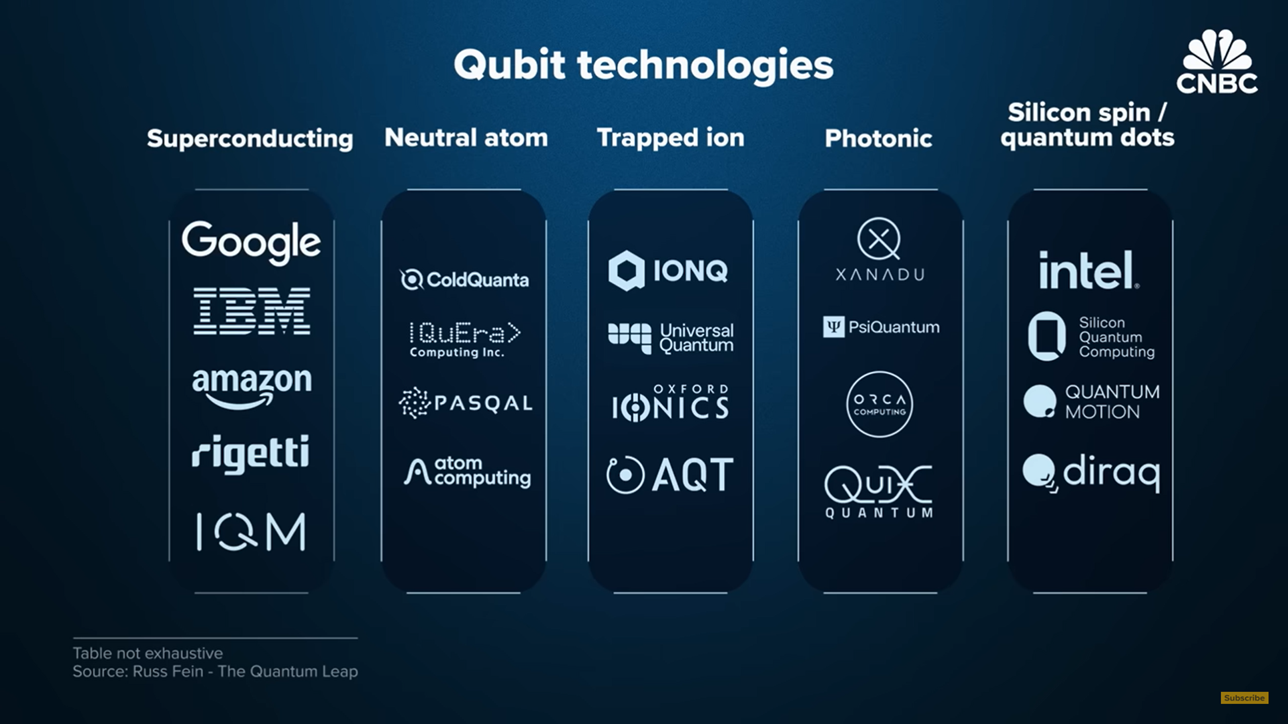
Qubits, The Technologies (CNBC, 2025).
Research on building the software infrastructure, including compilers and software stacks, is also progressing. The programming languages, which were initially available only as assembly languages, have now been extended to support modern ones such as C and Python.
The primary technical challenge remains to maintain a stable qubit within a reasonable timeframe (known as the coherence time) for the system to manipulate the atoms and perform practical computations. In superconducting technology, the coherence time ranges from just 50 microseconds to a few milliseconds.
In 2025, IBM set a target to achieve a Fault-Tolerant Quantum Computer (FTQC) by 2029, starting with 200 logical qubits that can process 100 million gates. IBM has an aggressive plan to build 2,000 (two thousand) logical qubits of a quantum computer that can process 1 billion (1B) gates by 2033 or later.
FTQC Potential Use-Cases
FTQC is a quantum computer designed to operate correctly even in the presence of errors (IBM, 2025). In contrast to NISQ, a quantum computer must operate within its limited time (coherence time).
The long-term goal is to develop a scalable FTQC to solve the most complex challenging problems that are not feasible to solve with a classical computer, often in combination with a classical supercomputer (HPC) with thousands to millions of CPU cores, leveraging a hybrid classical—quantum approach.
In Jan 2025, the author had an opportunity to attend CES 2025, where IYQ was also shared in one of the sessions (CES, 2025). The global industry challenge framework was presented, consisting of various aspects, including industry challenges and potential impacts, as well as quantum computer platforms such as IBM, AWS, IonQ, Rigetti, Q-Ctrl, Qu-Era, and Nvidia. It comes as no surprise that leading universities such as MIT, Yale, Oxford, and Harvard are strong proponents of the quantum-related research.

Global Industry Challenge Framework (CES, 2025).
Reliable quantum computation provided by FTQC opens the possibilities to explore advanced applications that are currently unfeasible or significantly complex to be solved even by a supercomputer (OpenAI, 2025):
- Cryptography: Breaking current encryption (e.g., the asymmetric encryption based on the RSA algorithm) and enabling quantum-safe encryption methods.
- Drug discovery & material science: Simulating complex molecules and quantum systems that are intractable for classical computers (e.g., developing the mRNA technology instructions that will accurately instruct the body on how to make the proteins that can treat diseases (IBM, 2025b)).
- Optimization: Solving large-scale optimization problems in logistics, finance, and supply chains.
- Machine learning: Enhancing specific algorithms for faster or more efficient training and inference.
- Fundamental physics: Simulating quantum phenomena to advance theoretical research.
References
- Andi Sama, 2025, “HPC dan Quantum Computing,” https://andisama.medium.com/hpc-dan-quantum-computing-f8fc78082556.
- Andi Sama, 2022, “Quantum.Tech 2022: Next Generation Insights of Technology Innovations," https://andisama.medium.com/quantum-tech-2022-next-generation-insights-of-technology-innovations-4a88d83a2a26.
- Cambrian AI Research, 2023, "IBM Launches Quantum System Two And A Roadmap To Quantum Advantage," https://cambrian-ai.com/ibm-launches-quantum-system-two-and-a-roadmap-to-quantum-advantage/.
- CNBC, 2025, "A Practical Quantum Computer Is Coming! But When?," https://www.youtube.com/watch?v=IkOicF8qBFU.
- CES, 2025, “Global Industry Challenge: Celebrating International Year of Quantum,” https://www.ces.tech/videos/global-industry-challenge-celebrating-international-year-of-quantum/.
- IBM, 2025, "What is fault-tolerant quantum computing?," https://www.ibm.com/quantum/blog/what-is-ftqc.
- IBM, 2025b "Scaling the limitations of classical computing in mRNA development," https://www.ibm.com/case-studies/moderna
- OpenAI, 2025, "What is the potential application of FTQC, the scalable fault tolerant quantum computer. provide the brief answer.", chatgpt.com.
- Top500.org, 20245 "Top 500 Supercomputers in the World," https://top500.org/lists/top500/.
- UNESCO, 2025, "International Year of Quantum Science and Technology," https://www.unesco.org/en/years/quantum-science-technology.
- Wikipedia, 2025, “Quantum,” https://en.wikipedia.org/wiki/Quantum.
메타데이터
- post_id
- e3808ab2daae
- slug
- quantum-computing-are-we-ready-for-the-future-transitioning-from-nisq-to-ftqc-e3808ab2daae
- url
- https://medium.com/@andisama/quantum-computing-are-we-ready-for-the-future-transitioning-from-nisq-to-ftqc-e3808ab2daae
- canonical_url
- https://medium.com/@andisama/quantum-computing-are-we-ready-for-the-future-transitioning-from-nisq-to-ftqc-e3808ab2daae
- author_url
- https://medium.com/@andisama
- status
- ok
- fetched_at
- 2026-06-09 15:37:30