Why You Never Learned Tetration in School
The Operation They Didn’t Want Us to Know
Why You Never Learned Tetration in School
The Operation They Didn’t Want Us to Know
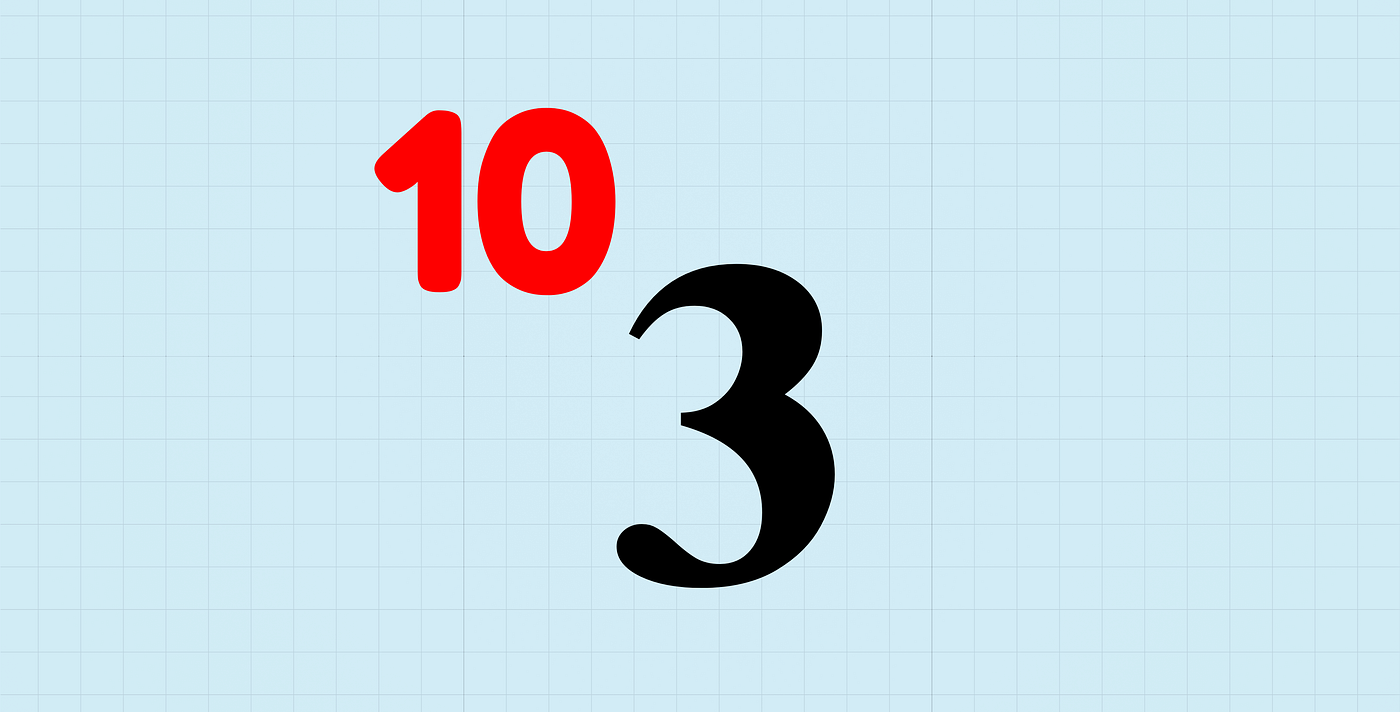
Image by the author
I was never taught tetration in high school. Not even in university.
For a long time, this made me believe that exponents were the highest level of arithmetic. And I’m sure I’m not alone in this. Many people have the same story.
In school, we learn addition, multiplication, and exponentiation, and most of us walk away thinking that’s where it ends.
But the truth is, mathematics does not stop at exponents. There is actually another operation beyond exponentiation, and this one grows so fast that even small numbers become very large almost immediately.
This operation is called tetration.
Most people have never come across this in high school or university, but if you understand the idea behind it, it feels like a natural continuation of the arithmetic we already know.
The easiest way to understand tetration is to notice a pattern connecting the operations we use every day.
Addition is really repeated counting. Multiplication is repeated addition. For example, instead of writing:

We can compress it into:

Exponentiation takes things a little further. So, instead of repeated addition, it is repeated multiplication. So when we write:

This simply means that the number 2 is being multiplied by itself four times, giving us 16.
Cool!!
At first, exponents don’t seem all that scary, especially when the numbers are small. But with time, they can escalate fast.
Powers of 10 make this really obvious. We know that:

Each time the exponent goes up by one, the whole number gets multiplied by 10 again.
Think about it this way — if your salary jumped from $100 to $1,000 overnight, you wouldn’t exactly call that a small raise. That’s the kind of growth we’re talking about.
So naturally, you start wondering what comes next. If multiplication is just repeated addition, and exponentiation is just repeated multiplication, then there has to be something beyond exponentiation too, right?
That question leads directly to tetration.
Tetration is basically repeated exponentiation. Instead of multiplying over and over, you stack exponents on top of each other, and this is why people call it a “power tower.”
Here’s a simple example:

This expression is called the fourth tetration of 2.
I know, it looks intimidating. Maybe even a little unreadable. But the thing is, if you know the rule, it’s actually not that hard to work out.
The trick is knowing where to start. You don’t read a power tower left to right. You work from the top down.
So we start at the very top:

Now, on the right-hand side of the expression, we have:

Again, we work from the top:

And this leaves us with:

Finally, we get:

And that’s already a massive number, just from using 2 four times.
But here’s what makes power towers really interesting.
They are very sensitive to the order you calculate them in. If someone ignored the rule and just started from the left instead, they would end up computing something completely different:

256 and 65,536 are nowhere close to each other. One small mistake in the order of evaluation and you get a completely different answer.
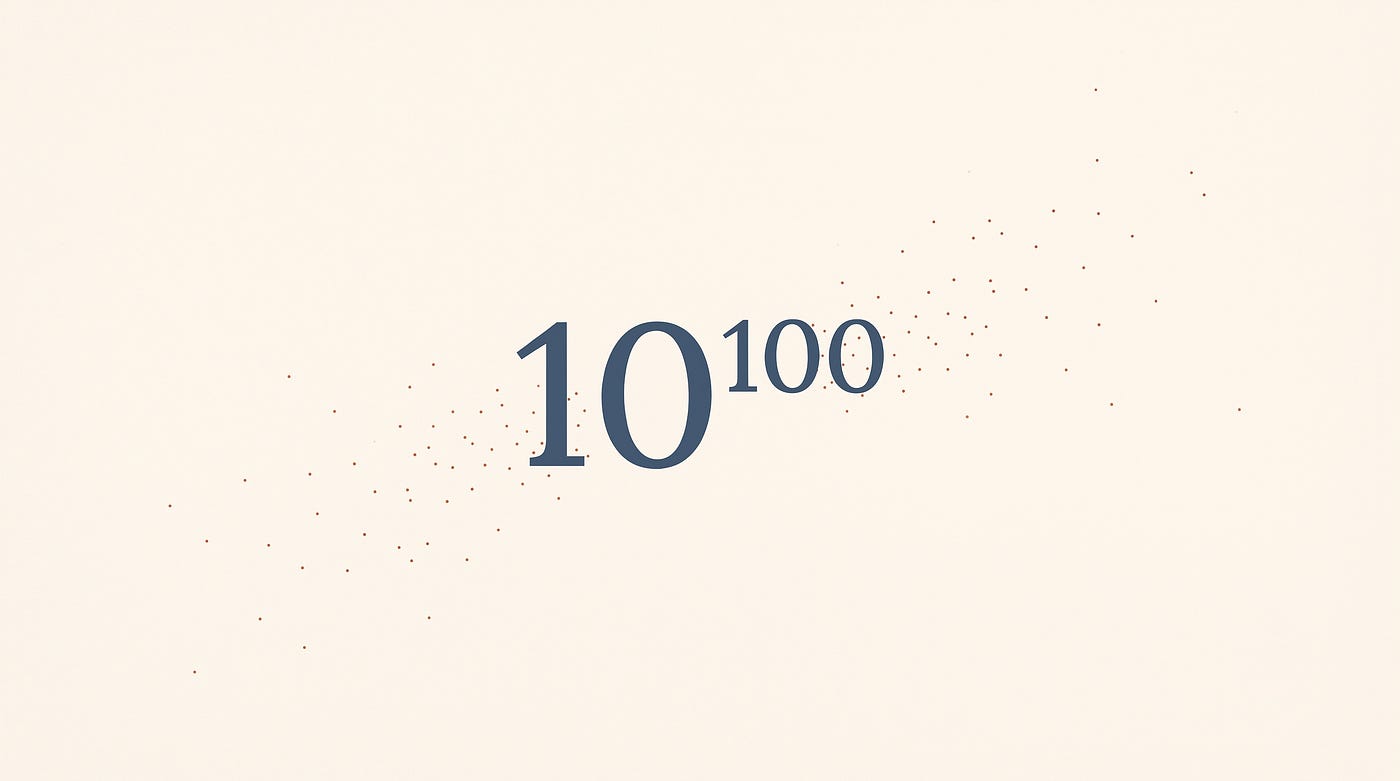
Now let’s look at an example that takes things way beyond anything our intuition can handle:

To evaluate it, we again start at the top to get:
10¹⁰ = 10000000000
This number alone is already enormous. But it now becomes the exponent of another 10, meaning the entire expression turns into:
10¹⁰⁰⁰⁰⁰⁰⁰⁰⁰⁰
That means the number is just a 1 followed by 10 billion zeros. And honestly, it’s hard to even pause long enough to let that sink in.
Writing out 10 zeros is nothing. Even a million zeros, as ridiculous as that sounds, still feels like something you could at least imagine. But 10 billion zeros is on a completely different level.
There’s no real way to write that number out in full. Even if someone spent every single second of their life doing nothing but writing zeros, they still wouldn’t finish. And what makes it even harder to believe is that this whole monstrous number comes from stacking just three 10s together.
This is probably one of the biggest reasons tetration was never really taught in the classroom.
The numbers get absurdly large so fast. Addition grows steadily, multiplication grows much faster, and exponentiation already feels like it’s moving at a crazy pace. But tetration takes things somewhere our brains genuinely weren’t built to follow.
And honestly, that’s what makes it so fascinating.
It’s a window into just how far mathematics goes beyond the numbers we actually deal with in daily life. Sitting quietly just past exponents is a completely different world — giant numbers, strange operations, all growing out of the surprisingly simple idea of stacking powers on top of powers.
Thank you for reading! If you like this article, please give a few claps, follow me, and don’t forget to subscribe to stay updated with my latest articles.
Originally published at https://nnamdisammie01.substack.com.
메타데이터
- post_id
- e39cf6ebadb2
- slug
- why-you-never-learned-tetration-in-school-e39cf6ebadb2
- url
- https://medium.com/think-art/why-you-never-learned-tetration-in-school-e39cf6ebadb2
- canonical_url
- https://medium.com/think-art/why-you-never-learned-tetration-in-school-e39cf6ebadb2
- author_url
- https://medium.com/@mathsammie
- status
- ok
- fetched_at
- 2026-06-09 15:37:30