Not Learning Italian Was My Most Beautiful Disaster
There’s magic in living where you don’t belong
Not Learning Italian Was My Most Beautiful Disaster
There’s magic in living where you don’t belong
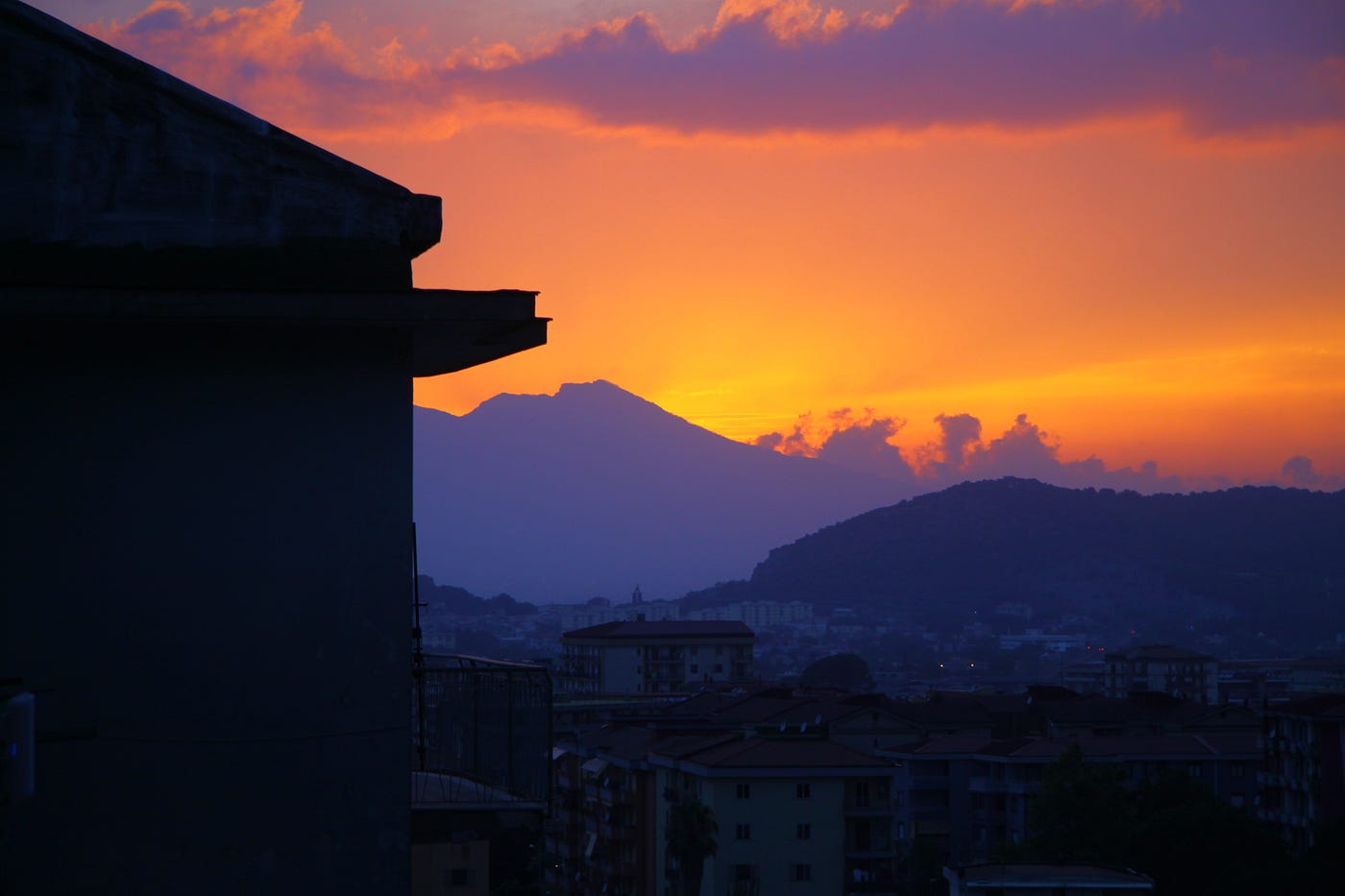
Mount Vesuvius as seen from my balcony in Nocera Superiore, Italy. Photo by author.
“To be, or not to be.”
My Italian landlord quoted England’s national poet with a wide grin on his broad, honest face. If I could have quoted Dante back at him, even a single line in the Italian Dante helped codify and make a national language in a peninsula of dialects, I would have.
We had just moved in. We had been in his apartment for maybe a day or two, the first optimistic stirrings of a six-month sojourn. He had come to have us sign some paperwork, because Italy, he remarked, is a Byzantine country, and there is always paperwork.
He saw my verb tables on the desk, written on paper torn from wire-bound exercise books bought from dollar stores in Canadian strip malls. Each page practically a membrane, so thin you could see the light through when you held it up. Essere, I had written. To be.
This is how you start learning a romance language, something I’ve since learned with my ongoing attempts to speak French. To be. To have. These verbs and their often irregular structure are fundamental to the language, the first building blocks of everything you might later want to say.
Does it work that way in English? I don’t know. I don’t remember learning it. I didn’t.
You’re an entirely different creature before you learn to speak. They say we don’t remember infancy because we had no language, that to learn how to speak, in any language, is to learn how to remember. To become a discrete ego rattling around inside a disconnected world, as opposed to an infant or an animal that only experiences and reacts.
Definitely, our landlord’s English was better than my Italian. But in the town we had moved to, Nocera Superiore, English was a rare skill possessed only by a few.
We soon learned not to expect to be understood. In the café down the street, they would send the allegedly English-speaking waitress over to us every time we sat down. Truthfully, she barely spoke a word. Hello, thank you, a few other minor pleasantries. That was almost all.
All we heard was Italian, except from each other. We lived in a little English bubble in the highest apartment in town, watching Italian storms berate the purple slopes of Vesuvius while the boys played football in the parking lot seven floors below, heedless of the warm Italian rain.
“Diciotto. Diciannove. Venti.”
I counted out the push-ups, my head dipping and rising toward the cool tile floor in the morning before the summer heat got too much. Counting in Italian to drill the numbers into my head. One of the first things you need to learn if you don’t want to look like a complete moron at the grocery checkout.
Do a little bit every day, they say. Make it part of your daily routine. You didn’t sit down to practice English for an hour every day when you were a baby. You were surrounded by it. And that’s still the best way to learn, to make it part of daily routine so that you never forget, so that you can’t forget, so that the numbers and the way the sentences shift and move through different tenses and timestamps become as indelible as your own name.
I never managed it.
I can fumble my way through a restaurant menu in Italian or German. I can tell you a potted history of my life in French. But I’ve never slipped the surly bonds of my native language and learned to really communicate in anything other than this Anglo-Saxon dialect that even fairly recent ancestors of mine didn’t speak at all. My own father spoke Irish in school.
But I will maintain that this, the language I’m talking to you in now, is the most beautiful in the world. It doesn’t have the staccato swagger of Italian, the silken elegance of French. But nothing has the precision, the muscle, the rhythm of English. All those other languages might have a thousand words for heartbreak. But this one, my gorgeous grandiloquent English, will mend it.
“Sin carne.”
I pointed at the menu, uncertain as I have always been outside the anglosphere.
Away from Nocera in nearby Naples, waiters often speak a little English. Still, I wanted to make the effort. But when the waiter’s eyes rolled in that universal expression of non-comprehension, I knew I had made a mistake.
I consider myself Canadian, but I grew up in the UK, which means I don’t pronounce my Rs. Certainly, I don’t roll them the way Italians do.
“No cane?”
The waiter blinked in confusion.
“No. Sono vegeteriano.”
He nodded. And then switched to the English he had in his pocket all along.
“Ah. No caRne. I thought you said, no cane, no dog. There is a Chinese restaurant down the street.”
They hung TVs in the bar
Half the time, they hung only by their power cords, swaying precariously in the breeze above the heads of seated patrons. Nobody cared.
When you live under the shadow of an active volcano, its purple bulk filling the sky at every sunset, you get a lot less precious about the line between existence and not. Essere. Non essere. Shrug.
The World Cup was on. Italy didn’t make it into the tournament that year, a strange aberration for the four-time champions that has since become a bizarre pattern. Instead, the locals cheered for Croatia while we cheered for England.
At least one of the local young men, the one who sold the weed, said ‘sorry’ to us in English when Croatia scored.
Harry Maguire, England’s lumbering *moai *of a central defender, caused problems for the Italian announcers. Maguire’s not a name Italians can say. The best they can do is something like “Magirra.”
The language you learn as a child doesn’t just alter your brain. It changes the layout of your mouth, your throat, your tongue, makes you able to say some sounds and never get close to others. Swinging wildly at a ball you’re never going to hit.
Nocera Superiore is not a holiday destination. Although it’s an ancient town, nearly all the buildings are 20th-century apartment blocks. No one comes here, so that the one and only time we heard English spoken in town, by some lost American tourists, felt unexpectedly jarring.
You get used to not knowing what anyone’s saying. You get used to isolation. Some of us already have a taste for it.
From the old man in the barber shop, who desperately wanted to talk to me about the War, to the senile neighbour who yelled something animated at me from the next-door balcony while her daughter tried to tell me to just ignore her, we constantly ran up against the sharp edge of our own ignorance. There’s a world of difference, it turns out, between learning how to buy groceries or order a meal, and actually understanding the world around you.
But the world doesn’t speak Italian, English, or any other human language.
It spoke to me there, in Nocera, in the bronze bowl the mountains made, in the shadow of the volcano. It spoke in tomato plants that grew on patches of waste ground, in the shattered walls of houses destined never to be fixed. In the pathways of flowers that followed every funeral procession.
It said that to be or not to be is not the question, because there never was a line between the two.
It said that to be, essere, is enough all by itself. You don’t need avere, to have. You can live on cheap wine and well water, and slowly, one sunset after another, you’ll forget every wrong thing you’ve learned. You don’t need to be a tiny little ego, bristling and prickly and cut off from the world. Why be a raindrop when you could be the ocean?
Two more World Cups lie between then and now, a near-decade of fighting the long defeat. I never again quite reached what I had in Nocera.
A strange sense of oneness with a world that could hardly have been less mine. A feeling of serenity that made every lightning storm and shattered stone and forest fire beautiful, surrounded by a world that breaks over and over again from the sheer exuberant force of the life within it.
I never went back.
I never learned Italian either.
Shortly before we left, the parking lot where the boys played soccer was painted with a paragraph of graffiti.
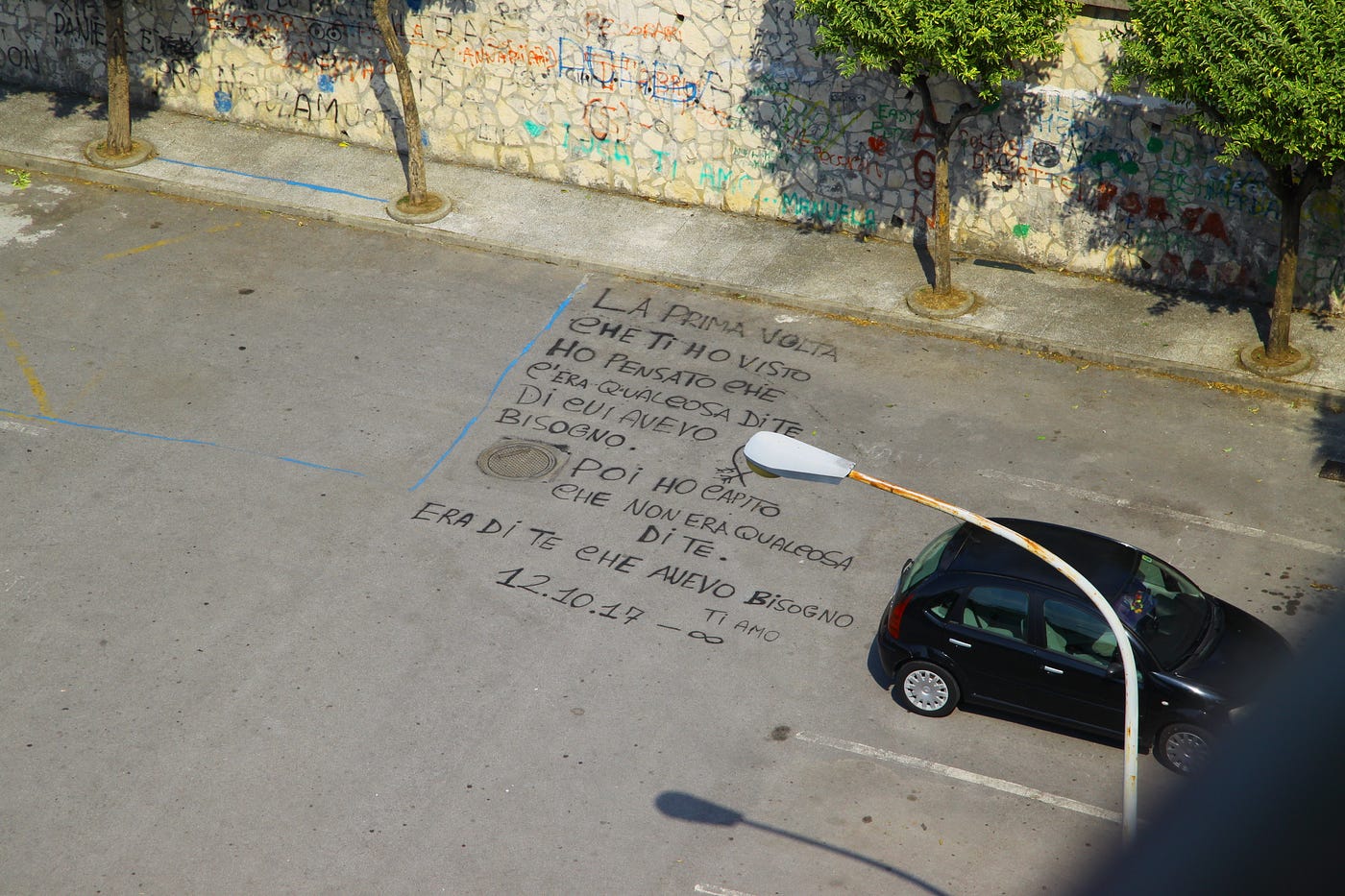
Graffiti in Nocera Superiore. Photo by author.
“The first time I saw you, I thought there was something about you that I needed. Then I realized it wasn’t something about you. It was you that I needed.”
Taken, my research suggests, from the book *Beautiful Disaster *by Jamie McGuire. Magirra, I suppose, in Italian.
What I needed from Nocera, without knowing it, was nothing that the town itself had to offer. Maybe all we really want, when we travel, is to encounter the most lovable version of ourselves. The places where we find that version become sacred to us, bright bronze temples of air and sky, but the temple sanctuary is always empty. The divinity is always somewhere else.
Anywhere you are.
And there’s no language on earth, not even this one, that can tell you what every sun-drunk cat and lizard and tomato plant knows.
To be, or not to be? the English poet asks.
Essere, the Italian sun replies.
Anne Bonfert takes a shopping trip that turns into something far more enriching in this piece:
[embed]I Walked With My Baby Through an African Township And felt safer than if I were alonemedium.com
Michelle Lawson discovers a lost language in a rapidly changing place:
메타데이터
- post_id
- e3aa26ec61b3
- slug
- not-learning-italian-was-my-most-beautiful-disaster-e3aa26ec61b3
- url
- https://medium.com/globetrotters/not-learning-italian-was-my-most-beautiful-disaster-e3aa26ec61b3
- canonical_url
- https://medium.com/globetrotters/not-learning-italian-was-my-most-beautiful-disaster-e3aa26ec61b3
- author_url
- https://medium.com/@ryan-frawley
- status
- ok
- fetched_at
- 2026-06-23 03:48:11