Reading Material for UGC – NET (Home Science) UNIT-I, 3
(i) ‘award of Junior Research Fellowship and appointment as Assistant Professor’,
Reading Material for UGC – NET (Home Science) UNIT-I, 3
(i) ‘award of Junior Research Fellowship and appointment as Assistant Professor’,
(ii) ‘appointment as Assistant Professor and admission to Ph.D.’ and
(iii) ‘admission to Ph.D. only’
UNIT-I : FOOD SCIENCE AND FOOD SERVICE MANAGEMENT
3. Quality evaluation of foods- objective and subjective.
Objective Quality Evaluation of food
Abstract
Methods of evaluating food quality that depend on some measure other than the human senses are often called objective method of evaluation. Objective method include all types of instrumental analysis including laboratory test to determine chemical decomposition, nutrient composition, and bacterial composition. It is repeatable and is not subject to human variation. If the equipment is properly maintained and is used correctly, it should give reliable results. It measures one particular attribute of a food rather than overall quality of the food product. In the case of new food product development it is necessary to change the existing product, for that it is necessary to see acceptance of consumer/ family members, only objective testing is not sufficient, even it may be reliable. It must be correlated with sensory evaluation.
Objective Quality Evaluation of food
Methods of evaluating food quality that depend on some measure other than the human senses are often called objective method of evaluation (1). It measures one particular attribute of a food rather than overall quality of the food product. In the case of new food product development it is necessary to change the existing product, for that it is necessary to see acceptance of consumer/ family members, only objective testing is not sufficient, even it may be reliable. It must be correlated with sensory evaluation (2).
Certain principle must be emphasized when considering objective method to evaluate the quality of food product:
- The objective method must be appropriate for the food product being tested.
- The objective method result should be correlated with sensory method of food evaluation of similar food product to make sure that the method is a reliable index of quality of the food.
- Most objective method used to assess food quality empirical that is they do not measure an absolute property of the food. However the results are still meaningful, as long as instruments are calibrated with materials that have similar properties to the foods under test.

Source: envirocarelabs.com
Objective method include all types of instrumental analysis including laboratory test to determine chemical decomposition, nutrient composition, and bacterial composition. It is repeatable and is not subject to human variation. If the equipment is properly maintained and is used correctly, it should give reliable results. It is necessary to identify contaminants in food and to reveal faulty processing methods as well as testing of deterioration and rancidity. It is must for routine quality control of foods and food products. However they must be correlated with sensory testing, because no single objective test can measure overall acceptability of a specific food or food product. It food involves instrumentation and use of physical and chemical techniques instead of variable human sensory organs to evaluate food quality (2).
Methods Used for Objective Quality Evaluation of food
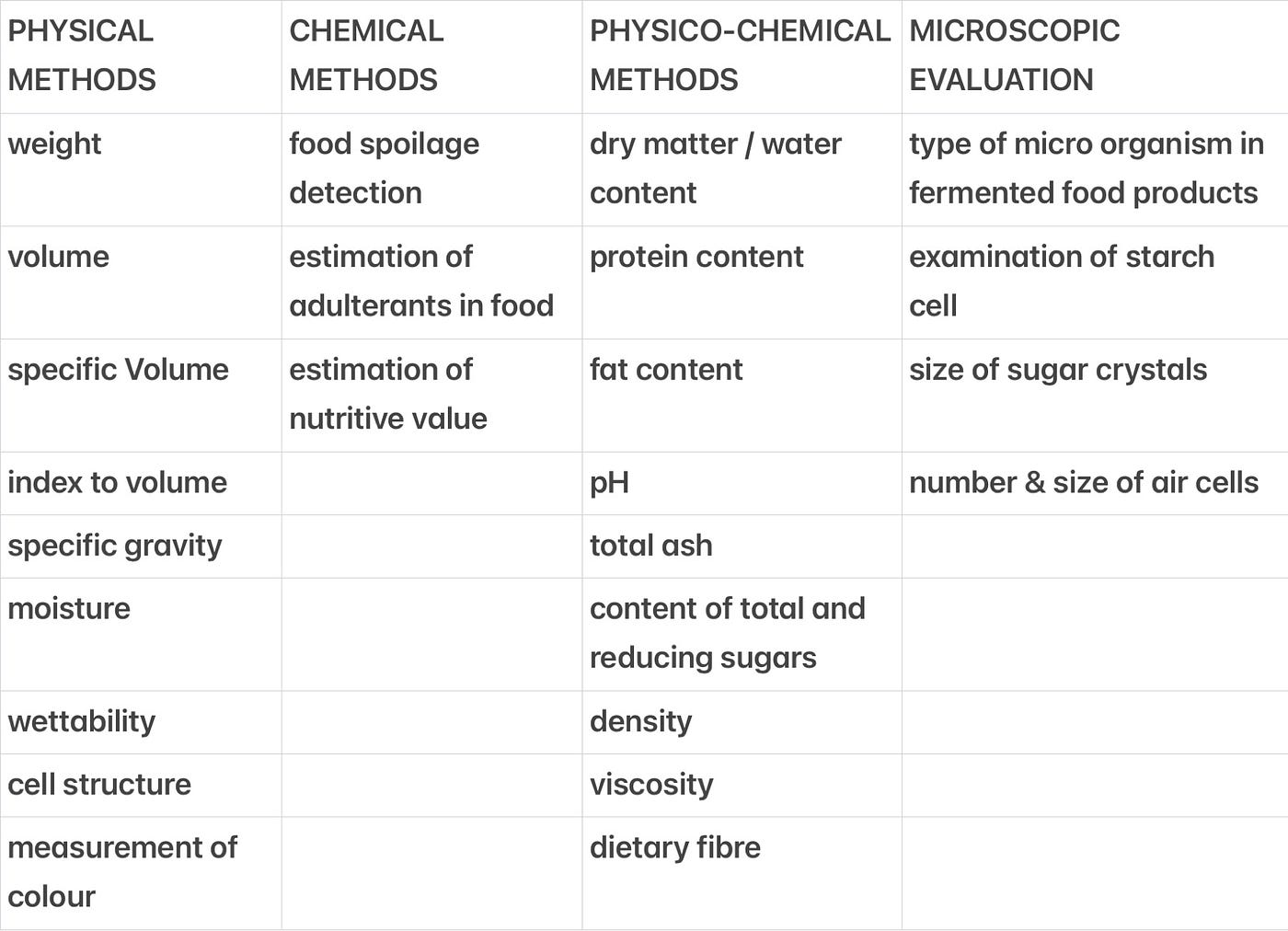

Source: (1), (4), (5)
Instrumental Measurement of Food Texture (3)
Objective evaluation methods using instruments for texture measurement have been categorized into three types: fundamental, empirical, and imitative (Scott-Blair 1958; Rosenthal 1999; Bourne 2002, pp. 107 – 112).
Fundamental method- It is based on materials science, such as rheology, and provide well-defined physical properties.
Examples : Young’s modulus, dynamic shear modulus and viscosity coefficients, but they often fail to explain the textural characteristics perceived by humans. When human touch a material, their perceptions are not in accordance with the idealised hypothesis of a fundamental measurement.
Empirical Method- Values measured by empirical tests are more poorly defined than those measured by fundamental tests, but they can be related to texture from practical experiences. Many instruments are developed to provide numerical values, but these measured values cannot be compared if they are obtained from different instruments. Better correlations to sensory scores have often been obtained using empirical methods rather than fundamental methods.
Examples: Magness-Taylor puncture tester for fruit hardness, the Bloom Gelometer for gelatin jelly strength, the Kramer Shear Press for hardness of processed fruits, vegetables and legumes, and the Warner-Bratzler Shear machine for meat tenderness (Bourne 2002, pp. 189 – 233). Many of these tests can be performed using universal testing instruments, as these attachable probes are commercially available, but users must be reminded that the measured values depend on the test conditions.
Imitative method- It attempts to simulate the conditions to which the food is subjected to human action. As the instrument mimics human movements, obtained empirical parameters help explain the texture perceived by humans.
Instruments Used for Texture Evaluation


Source : (1)
Advantages
●Confidence can be gained as they are reproducible.
●The results would be accurate. Human sensitivity is not involved. Minute differences can be noticed by doing objective method.
●They are less subjected to errors when compared to sensory methods. These methods provide permanent record. So that comparison can be made over a period of time.
●They are not affected by factors other than the one being measured. Emotional burdens and individual ability can be overcome.
Disadvantages
●It is time consuming.
●It is expensive.
●Technical knowledge is required.
●Instruments may not be available sometimes.
●Some aspects of food cannot be evaluated by objective methods e.g., flavour.
Usually both sensory and objective methods are done. Objective evaluation supplement or reinforce the data obtained subjectively through sensory evaluation (1).
References
(1) Srilakshmi B, Food Science, New Age International (P) Ltd, 2004, Pg.no. 299–310
(2) Singham P, Birwal P, Yadav BK (2015) Importance of Objective and Subjective Measurement of Food Quality and their Inter-relationship. J Food Process Technol 6: 488. doi:10.4172/2157–7110.1000488
(3) Kaoru Kohyama, Food Texture – Sensory Evaluation and Instrumental Measurement, Food Research Institute, National Agriculture and Food Research Organization, Tsukuba, Ibaraki, Japan, Chapter · January 2020
DOI: 10.1002/9781119430902.ch1
(4) https://www.gba-polska.pl/en/food/physicochemical-tests/
https://envirocarelabs.com/unlocking-the-importance-of-food-testing-a-comprehensive-insight/
메타데이터
- post_id
- e3cd4e36aa11
- slug
- reading-material-for-ugc-net-home-science-unit-i-3-e3cd4e36aa11
- url
- https://medium.com/@mayuri.kapur88/reading-material-for-ugc-net-home-science-unit-i-3-e3cd4e36aa11
- canonical_url
- https://medium.com/@mayuri.kapur88/reading-material-for-ugc-net-home-science-unit-i-3-e3cd4e36aa11
- author_url
- https://medium.com/@mayuri.kapur88
- status
- ok
- fetched_at
- 2026-08-10 08:02:46