Do It Poorly Until You Learn to Do It Well
The strange partnership between imperfect action, mental rehearsal, and corrected practice
Do It Poorly Until You Learn to Do It Well
The strange partnership between imperfect action, mental rehearsal, and corrected practice
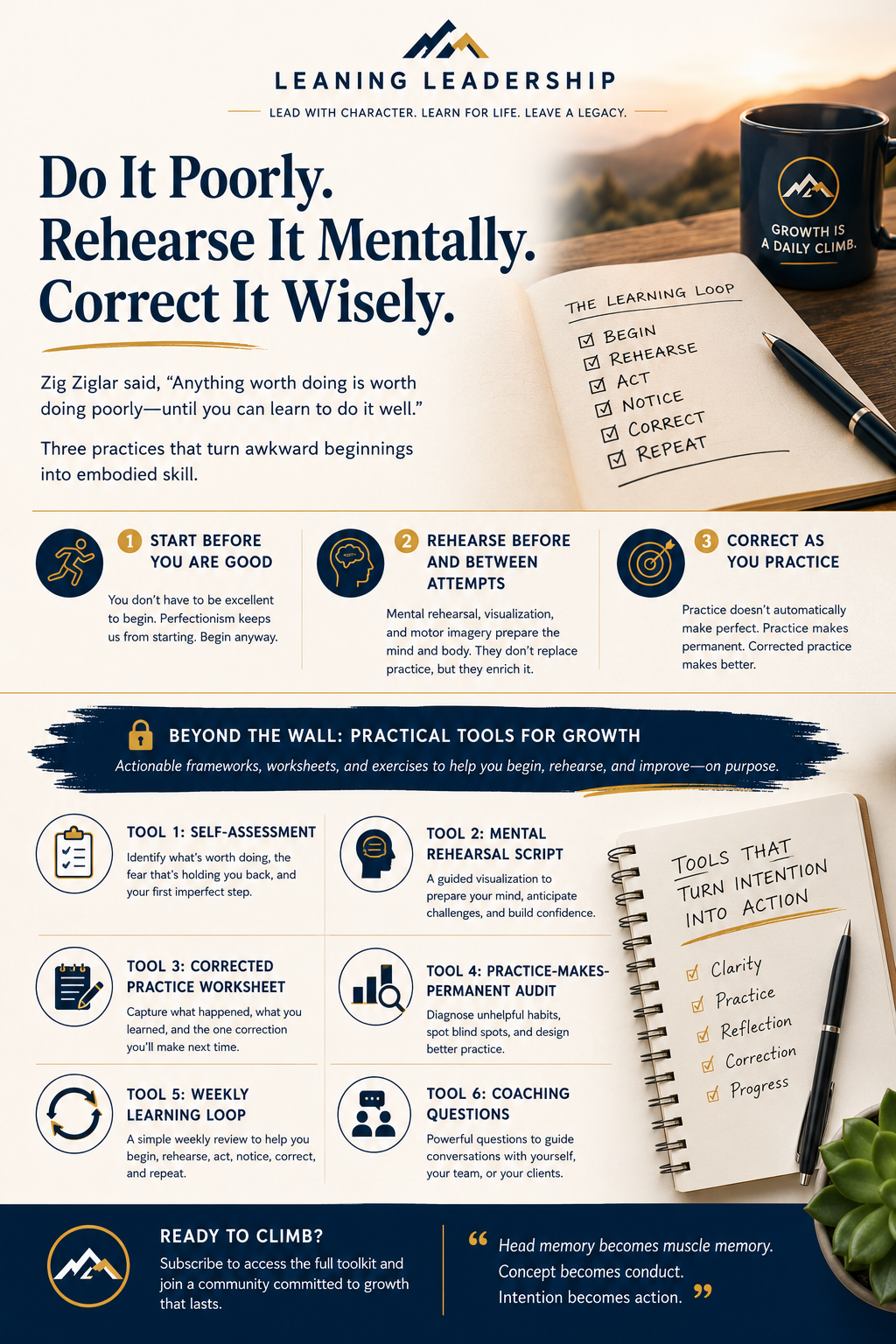
Zig Ziglar is often credited with saying, “Anything worth doing is worth doing poorly — until you can learn to do it well.”
That is not an excuse for sloppy work.
It is an invitation to begin.
[embed]
There is an old perfectionist voice that says, “Anything worth doing is worth doing right.” There is truth in that. We should care. We should bring attention, integrity, and effort to the things that matter.
But sometimes that saying becomes a locked door.
It keeps us from beginning because we are afraid we will not begin well.
And the truth is, we probably will not.
Most of us do not get things right the first time. We may understand the concept. We may have read the book, watched the tutorial, attended the seminar, listened to the coach, and taken notes. We may even be able to explain the idea to someone else.
But understanding is not mastery.
There is head memory.
Then there is muscle memory.
And they are not the same thing.
You can understand swimming from the edge of the pool. You can understand public speaking from the back of the room. You can understand leadership from a case study. You can understand writing from reading good writers. You can understand prayer, selling, teaching, counseling, parenting, coaching, or conflict resolution in theory.
But at some point, you have to get in the water.
At some point, you have to stand up.
At some point, you have to try.
That is the first prong: start before you are good.
Not because goodness does not matter, but because beginning is how goodness begins.
The Power of Mental Practice
There is another truth that works alongside this one.
Mental rehearsal matters.
Athletes have used it for years. Musicians use it. Speakers use it. Leaders use it. Performers use it. People facing difficult conversations use it, even if they do not call it by that name.
They imagine the action before they take it.
They walk through the movement in their minds.
They picture the room, the field, the conversation, the decision, the rhythm, the timing, the response.
There is a word for this: mental rehearsal. In the field of performance and motor learning, it is also discussed as motor imagery — the mental simulation of an action without physically performing it.
There is a famous story, often told about Major James Nesmeth or Nesmith, a Vietnam prisoner of war and golfer. The story says that while he was in captivity, he mentally played rounds of golf every day. After his release, he returned to the course and played remarkably well despite years away from the game.
Whether every detail of that story can be nailed down historically or not, the point it illustrates is consistent with lived experience: the mind can rehearse action.
Mental practice can prepare us.
It can reduce anxiety.
It can clarify sequence.
It can help us see what we might otherwise miss.
It can let us practice courage before we need courage.
That is the second prong: rehearse before and between attempts.
But mental rehearsal has limits.
You cannot imagine your way into full competence without action. You cannot visualize your way into every surprise, every resistance, every awkward moment, every emotional trigger, every real-world complication.
Mental rehearsal is powerful.
But it is not a replacement for doing.
It is a companion to doing.
Practice Makes Permanent
Here is where the third prong matters.
We often say, “Practice makes perfect.”
But that is not quite true.
Practice makes permanent.
If we practice poorly without reflection, we simply become more consistent at doing the wrong thing. We reinforce habits. We groove patterns. We automate mistakes. We get better at being mediocre.
That is why practice must be corrected.
Try.
Observe.
Reflect.
Adjust.
Try again.
That is the learning loop.
We begin poorly because we must begin somewhere. We rehearse mentally because the mind is part of the training ground. Then we correct what we are doing because repetition without correction only deepens the rut.
Corrected practice makes better.
Reflective practice makes wiser.
Humble practice makes growth possible.
The Learning Loop
So the process looks like this:
Begin before you feel ready.
Rehearse mentally before and between attempts.
Act in the real world.
Notice what happened.
Make the correction.
Try again.
That process applies almost everywhere.
The first draft is not the final essay.
The first sermon is not the mature voice.
The first sales call is not the polished pitch.
The first coaching session is not the seasoned method.
The first video is not the finished presence.
The first prayer may stumble.
The first hard conversation may feel clumsy.
The first attempt to lead may expose more questions than answers.
Good.
Now you have feedback.
And feedback is what fear could never give you.
The Doorway to Better Work
Perfectionism often disguises itself as excellence.
But excellence moves.
Perfectionism freezes.
Excellence says, “Let me begin, learn, correct, and grow.”
Perfectionism says, “Let me wait until I can guarantee success.”
But most confidence comes after action, not before it.
That is why Ziglar’s line matters.
Anything worth doing is worth doing poorly until you learn to do it well.
Not because poor work is the destination.
Because poor work may be the doorway.
You begin.
You rehearse.
You correct.
You repeat.
And slowly, head memory becomes muscle memory.
Concept becomes conduct.
Intention becomes action.
And what once felt awkward becomes part of you.
That is how we learn to do it well.
Go Deeper on Substack
This Medium piece is the discovery version of the idea.
On Substack, I take it further with a practical toolkit for turning awkward beginnings into intentional growth. The deeper-dive version includes reflection prompts, a mental rehearsal script, a corrected-practice worksheet, and coaching questions you can use for yourself, your team, your clients, or your creative work.
The idea is simple:
Begin. Rehearse. Act. Notice. Correct. Repeat.
That is how head memory becomes muscle memory. That is how concept becomes conduct. That is how intention becomes action.
Read the deeper dive here:
메타데이터
- post_id
- e3d84eac003f
- slug
- do-it-poorly-until-you-learn-to-do-it-well-e3d84eac003f
- url
- https://medium.com/@tomsims/do-it-poorly-until-you-learn-to-do-it-well-e3d84eac003f
- canonical_url
- https://medium.com/@tomsims/do-it-poorly-until-you-learn-to-do-it-well-e3d84eac003f
- author_url
- https://medium.com/@tomsims
- status
- ok
- fetched_at
- 2026-06-16 19:09:56