The TSFM Showdown: Who’s Winning the Forecasting Battle at Decathlon?
In Decathlon, automatic forecasting plays a crucial role in our daily operations: demand forecasting, dispatch, turnover prediction…
The TSFM Showdown: Who’s Winning the Forecasting Battle at Decathlon?
In Decathlon, automatic forecasting plays a crucial role in our daily operations: demand forecasting, dispatch, turnover prediction, e-commerce orders, and more. The number of use cases is also increasing with the improvement of the data quality and with the goal of improving our efficiency. That is why the rise of time series foundation models (or TSFMs) could be an accelerator for Decathlon in its quest for efficiency.
The promise of TSFM is to provide pre-trained models that outperform without training classical statistical (GAM), ML (LightGBM), or deep learning (DeepAR, TFT) models trained from scratch on in-domain data. While global benchmarks like the GIFT-Eval Time series leaderboard or fev-bench offer a promising starting point for selecting high-performing models, a key question arises: Are these models suitable for our internal, domain specific distribution retail datasets?
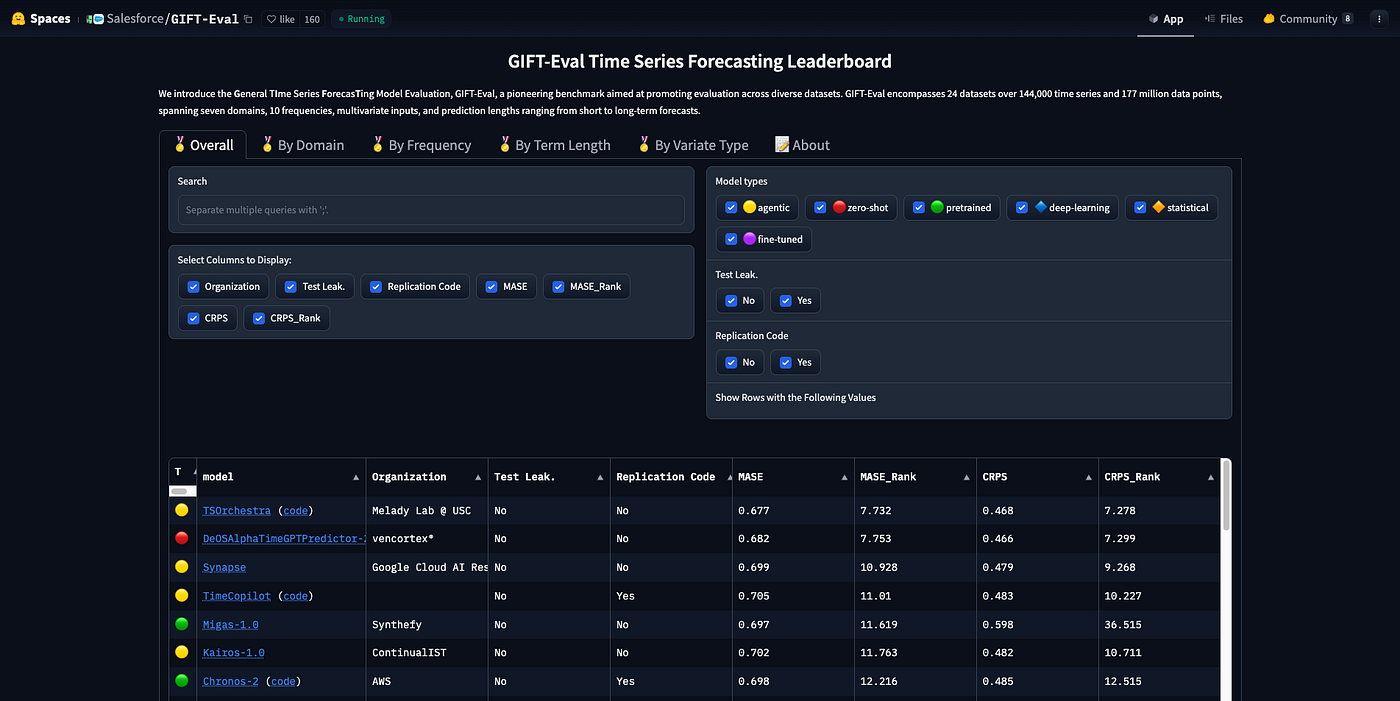
GIFT-Eval leaderboard (December 2025).
Decathlon benchmark
At Decathlon, we developed a forecasting solution that predicts the sales quantity of all Decathlon products on a 52-week horizon. This solution runs weekly so that purchase planners can order goods from Decathlon’s industrial partners. It is deployed in different supply zones (Europe, China, or India). The European Supply zone is the area where we first deployed the solution (since 2021) and have the best data quality. That’s why our benchmark is based on the European perimeter.
Data and scope:
- Time Series: weekly sales frequency, often exhibiting strong seasonal patterns.
- History: an average of 4 years of historical data for each product (shorter time series have to be extended synthetically).
- Cutoffs: we benchmarked the models over 101 cutoffs spanning almost 2 entire years, from week 48 of 2022 (202248) to week 44 of 2024 (202444). For each cutoff, we predict and evaluate the performance of the models.
- Scale: Approximately 25,000 unique products to forecast per cutoff with perimeter variation (end of life, new products, overall there are 39 000 models).

Example of a summer product sales
Key metrics (ordered by business impact):
- **WAPE **(Weighted Absolute Percentage Error) at 12 weeks: our most critical metric, corresponding to the replenishment horizon. This metric is reviewed weekly with purchase planners.
- WAPE at 52 weeks: the long-term horizon, important for strategic stock projection.
- Secondary Metrics: bias and RMSE (Root Mean Squared Error) were used for comparative analysis but are not monitored in production.

WAPE Formula
Baseline and candidate TSFMs
Our production baseline has evolved over the years:
- 202248 to 202444: a hybrid approach using DeepAR for the first 16 weeks and Holt-Winters for the remaining 17 to 52 weeks.
- 202420 onwards: Introduction of TFT (Temporal Fusion Transformer) with minor upgrades.
We focused on a selection of TSFMs known for their strong GIFT-Eval ranking and, crucially, their computational efficiency (inference time under 2 minutes per cutoff). As a comparison, a full TFT with covariates takes between 15–20 minutes to train and predict:

TSFMs tested
For this initial study, we limited the input to only past sales data, excluding any external covariates (like weather or price changes). We deliberately ignored high-ranked/high performing TSFMs with prohibitively long inference running time (e.g., TabTFN-TS with almost 40 minutes of computation per cutoff). Similarly, we did not attempt to fine-tune some TSFMs when the provided fine-tuning code did not scale easily.
Fine-tuned versions of Chronos 2, Chronos Bolt base and TimeGPT-1.5 were considered in our benchmark. Those models were fine-tuned on 202247, 202325, 202352, and 202426. Each fine-tuned version is used until the next fine-tuning operation.
Computation time

Computation time per model
Tirex and TimeGPT are the fastest models on our dataset. Chronos 2 illustrates its capacity to run on both CPUs and GPUs.
LeaderBoard

Main metrics at 12-week horizon on the benchmark
According to the chosen metrics (WAPE 12 and WAPE 52), it appears that TimesFM 2–500M is the best zero-shot TSFM, followed by TimesFM 2.5 and Chronos 2. Surprisingly, the latest version of TimesFM does not show better performance.
Those zero-shot algorithms are the only ones to exceed or approach the performance of our reference model, DeepAR, retrained every week and well-known for its ability to quickly adapt to recent trend shifts.
With fine-tuning, TimeGPT-1.5 beats DeepAR, and Chronos Bolt base, the worst-performing zero-shot TSFM in our benchmark, is now as good as TimesFM 2–500M. Chronos 2 fine-tuned takes a clear lead and beats all the other algorithms by far.
At 52 weeks, with the exception of Chronos Bolt zero-shot, all TSFMs are better than the production algorithm, which is mainly based on Holt-Winters. Chronos 2 fine-tuned is still the best algorithm.

Main metrics at 52-week horizon on the benchmark
And the winner is?
All things considered, Chronos 2 fine-tuned is the undisputed champion. However, a deeper look at the pairwise winning rate (with WAPE 12), which is based on over 2.5 million time series on 39,000 Decathlon products, reveals a more nuanced picture. Here, we used the average winning rate and pairwise winning rate defined in fev-bench, considering the prediction of a unique Decathlon product over all the cutoffs as a forecasting task (so we end up with 39,000 tasks). The average winning rate is then the probability that a model achieves lower error than another randomly chosen model of the benchmark on a randomly chosen task (forecasting a Decathlon product).
As seen before, Chronos 2 fine-tuned is the best model, but TimesFM 2–500M is beating Chronos for 43.2% of the Decathlon products. You may notice the good performance of Moirai 2 on a 52-week horizon as well.

Average win rate

Average win rate with WAPE 12
Conclusion
Global benchmarks such as GIFT-Eval or fev-bench are quite useful for selecting the “best performers” among the large quantity of existing time series foundation models, but a fine-grained benchmark appears to be quite informative when it comes to our specific dataset, with some unexpected results such as TimesFM 2.5 showing lower performances than TimesFM 2. Data quality at inference or at fine-tuning will be the main challenge for forecast practitioners considering that the field of TSFMs is progressing fast and the best current TSFMs exceed or approach the performance of the best classical models trained from scratch.
Key Takeaways:
- Zero-Shot is viable: for quick deployment and as a powerful baseline, TimesFM 2–500M proved to be the best zero-shot algorithm, beating our legacy DeepAR-based solution.
- Fine-Tuning is a game changer: even with a low-frequency fine-tuning schedule (once every 6 months), fine-tuning process significantly improves metric performances, with Chronos 2 fine-tuned emerging as the current leader.
- Not a single winner: even though Chronos 2 fine-tuned exhibits a high winning rate, other models still perform better on large subset of products. This suggests that mixing TSFM with a Mixture-of-Experts (MoE) approach may yield significant gain.
Next Steps
Our current benchmark compares algorithms relying solely on past sales data. The next phase of our exploration will focus on integrating covariates (such as weather, price changes, and store count) to explain the high volatility in our sales. Mixing several TSFMs and classical forecasting models is also a main area of exploration.
Stay tuned for more details on our ongoing tests into TSFMs and the future of forecasting at Decathlon !
[Update] Second part : https://medium.com/decathlondigital/enhancing-time-series-foundation-models-at-decathlon-from-covariates-to-robust-ensembling-6c65d11ecfdd
메타데이터
- post_id
- e3ef17f3f247
- slug
- the-tsfm-showdown-whos-winning-the-forecasting-battle-at-decathlon-e3ef17f3f247
- url
- https://medium.com/decathlondigital/the-tsfm-showdown-whos-winning-the-forecasting-battle-at-decathlon-e3ef17f3f247
- canonical_url
- https://medium.com/decathlondigital/the-tsfm-showdown-whos-winning-the-forecasting-battle-at-decathlon-e3ef17f3f247
- author_url
- https://medium.com/@vianney.bruned_14747
- status
- ok
- fetched_at
- 2026-06-13 07:35:29





