The Next Generation of Mobile Apps: Beyond Basic Customer Portals
Mobile apps have become an important digital channel for businesses of all sizes. But the role of a business app is changing.
The Next Generation of Mobile Apps: Beyond Basic Customer Portals
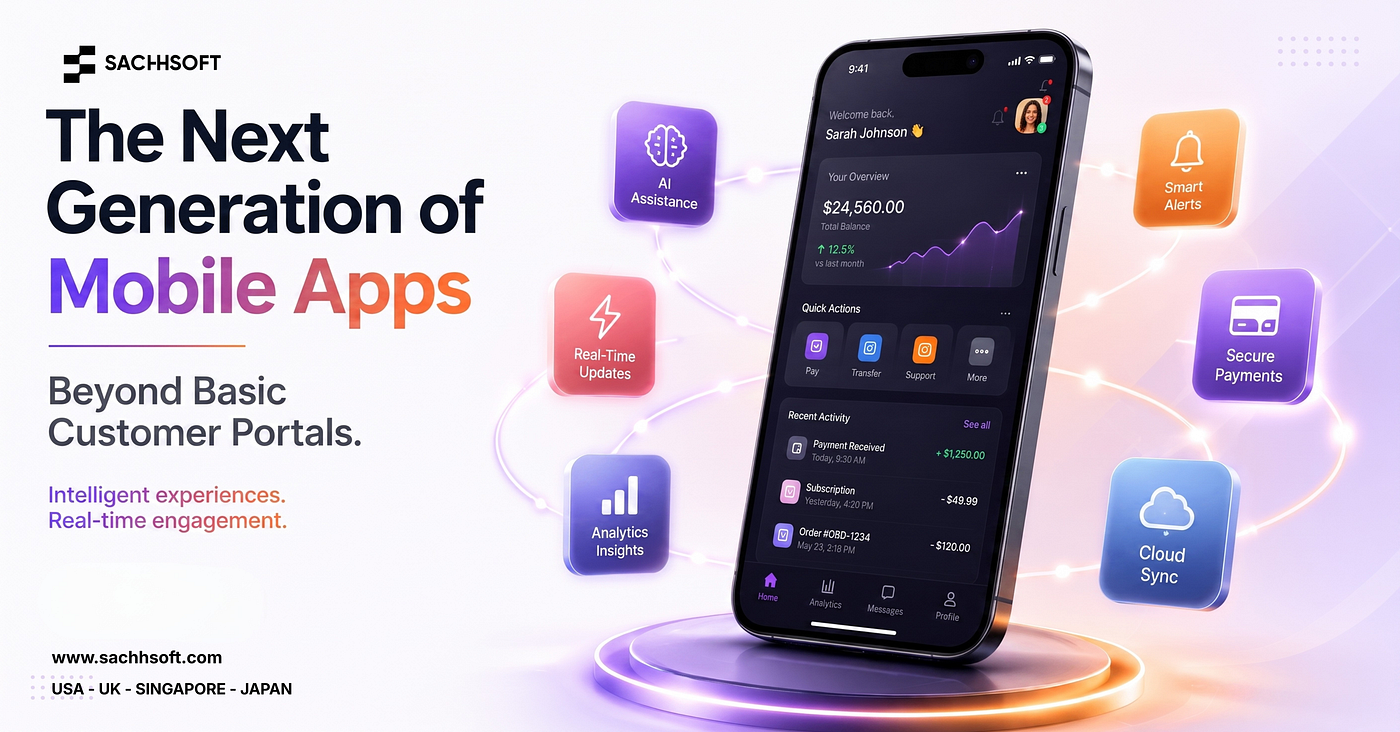
Mobile apps have become an important digital channel for businesses of all sizes. But the role of a business app is changing.
Early business apps were often designed as simple customer portals. Users could log in, view their account, check an order, or access basic information.
Today, expectations are much higher.
Customers want apps that are fast, personalized, connected, and useful throughout their entire journey. Businesses are responding by building mobile applications with real-time functionality, digital payments, intelligent notifications, deeper integrations, and experiences designed around specific user needs.
For startups and established businesses, this shift creates an opportunity to use mobile applications not simply as another communication channel, but as an important part of the product and business ecosystem.
At Sachhsoft, we design and develop custom mobile applications that connect with business systems, provide seamless user experiences, and support long-term scalability.
From Customer Portals to Complete Digital Experiences
The first generation of business apps often focused on basic account management.
Users could:
- Log in
- View their profile
- Check account information
- View orders
- Contact support
These functions remain useful, but modern applications can do much more.
A next-generation business app can combine:
- Personalized experiences
- Real-time updates
- Digital payments
- Location-based functionality
- Push notifications
- Business system integrations
- Secure authentication
- Analytics
- Intelligent features
The app becomes a central part of the customer relationship.
Why Mobile Apps Are Becoming More Important
Smartphones are often the primary digital device for consumers.
This makes mobile applications particularly valuable for businesses that have frequent customer interactions.
An app can provide a direct digital connection between a business and its customers.
Instead of relying entirely on websites, emails, or third-party platforms, businesses can create their own controlled digital experience.
Personalization Is Changing the App Experience
Users increasingly expect applications to understand their preferences.
Personalization can include:
- Recommended products
- Relevant content
- Personalized offers
- Preferred settings
- Customized dashboards
- Location-aware information
For example, an e-commerce app can highlight products based on previous activity, while a financial application can present information based on the user’s accounts and preferences.
Personalization makes an application more useful without making the user search through unnecessary information.
Real-Time Features Are Becoming Standard
Modern users expect information to update quickly.
Mobile applications can provide real-time:
- Order tracking
- Delivery updates
- Account notifications
- Appointment changes
- Inventory information
- Team communication
- Service status
For businesses, real-time functionality can improve transparency while reducing the need for customers to contact support for routine updates.
Digital Payments Are Transforming Mobile Commerce
Payments have become an important part of modern mobile applications.
Businesses can integrate secure payment functionality for:
- Product purchases
- Subscriptions
- Booking fees
- In-app services
- Memberships
- Recurring payments
A seamless payment experience can reduce friction and make it easier for customers to complete transactions.
Payment functionality should be designed with security, compliance, and user experience in mind.
Push Notifications Create Direct Engagement
Unlike email, mobile applications can communicate with users directly through push notifications.
Businesses can use notifications for:
- Order updates
- Appointment reminders
- New products
- Important account information
- Promotions
- Service alerts
However, effective notification strategies should focus on relevance.
Too many notifications can cause users to disable them or stop engaging with the application.
Mobile Apps Are Becoming Connected to Business Systems
A modern mobile application rarely operates independently.
It may connect with:
- CRM systems
- ERP platforms
- Payment gateways
- Inventory systems
- Customer support platforms
- Marketing platforms
- Analytics tools
- Cloud services
APIs make these connections possible.
This allows information to move between the mobile app and the organization’s broader technology ecosystem.
The Architecture Behind Modern Mobile Apps
A scalable mobile application typically involves multiple layers.
Mobile Application
                      │
             ┌────────┴────────┐
             │                 │
        User Interface     Notifications
             │                 │
             └────────┬────────┘
                      │
                    APIs
                      │
             Application Backend
                      │
       ┌──────────────┼──────────────┐
       │              │              │
    Database       Payments       Business Systems
       │              │              │
       └──────────────┼──────────────┘
                      │
                Cloud Infrastructure
This architecture allows businesses to create applications that can evolve as their requirements change.
Mobile Apps Can Become Business Platforms
The most advanced business applications are no longer simply customer-facing tools.
They can become complete digital platforms.
For example, a logistics application might connect:
- Customers
- Drivers
- Dispatch teams
- Warehouse staff
- Administrators
Each user receives a different experience while working from the same underlying platform.
This can improve coordination and provide real-time visibility across the business.
Mobile Apps and Operational Efficiency
Mobile applications can also improve internal operations.
Employees working outside the office can use mobile applications to:
- Update records
- Submit forms
- Capture information
- Track jobs
- Communicate with teams
- Access customer information
This reduces dependence on paper processes and disconnected communication.
Cross-Platform Development Is Expanding Options
Businesses don’t always need completely separate applications for every platform.
Modern cross-platform development approaches can allow companies to build applications for multiple operating systems while sharing significant portions of the underlying codebase.
This can help businesses:
- Reduce development duplication
- Speed up releases
- Maintain consistent functionality
- Simplify ongoing development
The right approach depends on the application’s performance requirements, complexity, device features, and long-term roadmap.
Security Is Essential for Modern Mobile Applications
Mobile applications can handle sensitive customer and business information.
Security therefore needs to be considered throughout development.
Important areas include:
- Secure authentication
- Data encryption
- API security
- Access controls
- Secure payment processing
- Session management
- Regular security updates
Security should be part of the architecture rather than something added after development.
The Business Impact of Next-Generation Mobile Apps
The strongest applications combine several of these capabilities instead of relying on a single feature.
When Should a Business Build a Mobile App?
A mobile application can make sense when customers or employees need frequent digital interaction.
Consider an app if your business needs:
- Regular customer engagement
- Mobile transactions
- Personalized experiences
- Real-time communication
- Loyalty programs
- Appointment management
- Delivery tracking
- Field workforce management
- Secure account access
An app should solve a real business or customer problem rather than simply exist because competitors have one.
What Businesses Should Consider Before Development
Before starting development, businesses should define:
1. The Primary User
Who will use the application?
2. The Core Problem
What should the application make easier?
3. The Essential Features
Which features are required for the first release?
4. The Integrations
Which existing systems need to connect with the app?
5. The Technology Roadmap
What features might be required as the business grows?
6. Security Requirements
What customer and business data will the application handle?
These decisions help create a stronger foundation for development.
Build for the Future, Not Just the First Release
A mobile app should be designed with future expansion in mind.
Businesses may eventually want to add:
- New payment methods
- Additional services
- Advanced analytics
- New integrations
- Additional user types
- New markets
- More automation
A scalable architecture makes these improvements easier to implement.
How Sachhsoft Builds Modern Mobile Applications
At Sachhsoft, we develop custom mobile applications designed around specific business requirements.
Our capabilities include:
- iOS App Development
- Android App Development
- Cross-Platform App Development
- Custom Backend Development
- API Development
- Payment Integration
- Real-Time Applications
- Cloud Integration
- Business System Integration
- UI/UX Development
- App Maintenance and Scaling
We focus on building applications that are secure, scalable, easy to use, and connected to the broader business ecosystem.
Final Thoughts
The next generation of mobile applications is moving far beyond basic customer portals.
Modern apps can combine personalization, real-time functionality, payments, notifications, integrations, and powerful backend systems to create complete digital experiences.
For businesses, the opportunity is not simply to put their services on a smartphone.
It is to rethink how customers and employees interact with the organization.
A well-designed mobile application can become a valuable part of the business itself — connecting users, data, operations, and services through a single digital experience.
The businesses that approach mobile development strategically can create applications that don’t just support their current operations but evolve with their future growth.
Short Summary
Modern mobile apps are evolving from basic customer portals into connected digital platforms. Personalization, real-time features, payments, notifications, APIs, and business-system integrations are creating richer experiences for customers and employees. For startups and established businesses, the right mobile application can improve engagement, efficiency, and long-term digital growth.
Planning your next mobile application? Partner with Sachhsoft to design and develop a secure, scalable mobile solution connected to your business systems and built for long-term growth. Visit : https://www.sachhsoft.com/
메타데이터
- post_id
- e414877136a5
- slug
- the-next-generation-of-mobile-apps-beyond-basic-customer-portals-e414877136a5
- url
- https://medium.com/@sachhsoft/the-next-generation-of-mobile-apps-beyond-basic-customer-portals-e414877136a5
- canonical_url
- https://medium.com/@sachhsoft/the-next-generation-of-mobile-apps-beyond-basic-customer-portals-e414877136a5
- author_url
- https://medium.com/@sachhsoft
- status
- ok
- fetched_at
- 2026-08-10 21:00:01