Green on the Outside
How the European Union used the architecture of climate finance to funnel billions into fossil gas infrastructure, and what that money…
**Green on the Outside**
How the European Union used the architecture of climate finance to funnel billions into fossil gas infrastructure, and what that money could have bought instead.
Part One: The Name Is the First Lie
Before we talk about money, we need to talk about a word.
“Natural gas.” Say it slowly. Natural. It sounds clean. It sounds safe. It sounds like something that belongs in the world, that occurs without harm, that contrasts reassuringly with the dirty, industrial, man-made alternatives. It is one of the most effective pieces of corporate branding in the history of industrial capitalism.
It is also, scientifically speaking, meaningless.
What we are actually talking about is methane, a fossil fuel formed over hundreds of millions of years from the compression and decomposition of organic matter deep in the earth’s crust. It is extracted by drilling into rock formations. It is transported under high pressure through thousands of kilometres of steel pipeline. It is burned to release carbon dioxide, water vapour, and heat. It shares its geological origin story with coal and crude oil. The word “natural” was adopted by the American gas industry in the mid-twentieth century, primarily to distinguish pipeline methane from manufactured town gas and to give the fuel a friendlier identity in the marketplace. It has no meaning in chemistry, climate science, or any classification that matters for the planet’s future.
Arsenic is natural. Crude is natural. Uranium is natural. Anthrax spores are natural. Nature is entirely indifferent to human survival.
But the branding worked. For decades, “natural” gas was positioned as the clean fossil fuel, the bridge fuel, the transition fuel, the pragmatic middle path between dirty coal and an unready renewables sector. And so when the European Union, in January 2023, formally certified natural gas as a sustainable investment under its green finance taxonomy, it was not inventing a lie. It was completing one that had been running for seventy years.
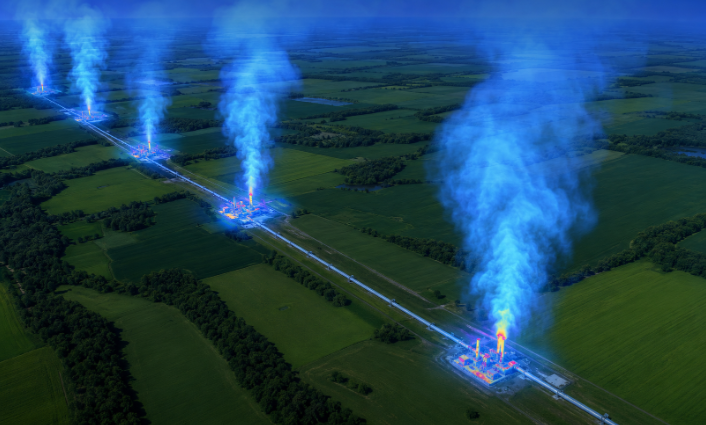
There is also the methane problem that the word “natural” conveniently obscures. Methane does not only become a climate problem when it is burned. Somewhere between two and eight per cent of extracted methane leaks into the atmosphere before it is ever combusted, from wellheads, compressor stations, pipelines, and storage facilities. Methane is eighty times more potent than carbon dioxide as a greenhouse gas over a twenty-year horizon. That is the relevant horizon for limiting warming to 1.5 degrees. When you account for leakage at the higher end of that range, switching from coal to gas produces negligible climate benefit in the near term, and may produce none at all. The “cleaner fossil fuel” claim depends on the leakage problem not being taken seriously. The taxonomy decision depends on the same thing.
The name was the first lie. The certificate was the institution of that lie into European law.
Part Two: How a Label Becomes a Money Pipe
To understand what happened in January 2023, you need to understand what the EU Taxonomy actually is, because it sounds technical and administrative, and its consequences are anything but.
The EU Taxonomy is a list. An official, legally grounded list of economic activities that the European Union has certified as environmentally sustainable. It does not force anyone to do anything. It does not distribute funds directly. It is a classification system. A stamp. The stamp reads: This activity is green.
That stamp, however, controls access to what is arguably the largest directed pool of private capital in human history.
Every ESG fund, and there are thousands of them, managing trillions of euros in assets, operates under mandates that define what they can hold. Those mandates reference the taxonomy, directly or through the frameworks that feed from it. Every green bond issued in the EU market signals to investors that its proceeds are directed at activities consistent with the taxonomy. The ECB’s climate-tilting programme, designed to decarbonise its corporate bond holdings, treats taxonomy-aligned bonds preferentially. Every chapter of a national recovery plan claiming green credentials is evaluated against the taxonomy. The institutional investors group managing fifty trillion euros in assets looks at that list when defining what “sustainable” means.
The European Commission spent years building this architecture correctly. It was designed to create a common language for sustainable investment, to channel private capital toward genuine climate solutions, and to prevent greenwashing, companies and funds claiming green credentials they had not earned. The taxonomy was the cornerstone. The definitions it contained were meant to be the firewall between genuine transition investment and fossil-fuel business-as-usual dressed in green language.
Then the politics arrived.
France wanted nuclear power on the list. Germany, Italy, Poland and several other member states wanted gas. The justification was that the war in Ukraine had created an energy emergency, that gas was needed as a bridge while renewables scaled up, and that gas pipelines could eventually carry hydrogen, making them future green infrastructure. The Commission accepted these arguments, drafted the conditions, and, on July 6, 2022, the European Parliament voted 328 to 278 against rejecting the inclusion of gas and nuclear. By January 2023, gas was on the list.
The conditions attached look robust on paper. Gas power plants must keep direct emissions below 270 grams of CO2-equivalent per kilowatt-hour. New gas infrastructure must commit to switching to green gases by December 31, 2035. Facilities must be “hydrogen ready.” These conditions were presented as the safeguards that made gas inclusion responsible rather than reckless.
In practice, they are close to meaningless.
The emissions cap applies only to direct emissions. The gas that gets burned by end users, in homes, in industry, in power plants, is excluded from the calculation. The 2035 deadline to switch to green gases sits comfortably beyond the investment horizon of most of the infrastructure being financed today. Investors deploying capital in 2023 expect returns well before 2035. The “hydrogen-ready” certification requires no proof of hydrogen supply. It requires no verified retrofit engineering. It requires no contractual commitment to a hydrogen provider. It is a self-declared intention, attached to a physical asset that will spend the next decade doing exactly what it was always going to do: moving fossil gas.
The conditions were designed to survive legal scrutiny, not to change investment behaviour. The label was the product. Once the label was in place, every green capital channel opened simultaneously, and the money moved.
Part Three: The Hydrogen Alibi
Before we see what the money did, we need to dismantle the central pillar of the argument for gas inclusion, because it is the load-bearing wall of the entire construction: that gas pipelines and LNG terminals represent investment in future hydrogen infrastructure, and therefore qualify as transition assets.
This argument is built on a technology that does not yet exist at anything like the required scale, transported through infrastructure not designed for it, and justified by a timeline the underlying science cannot support.
Green hydrogen is not here. The European Commission’s target was ten million tonnes of domestic green hydrogen production by 2030. Today, green hydrogen is less than 4% of the hydrogen produced. As of 2024 and into 2025, Shell and Equinor had ditched plans for large-scale low-hydrogen production and transportation in northern Europe due to a lack of demand. Australia, the United States and Europe all saw the acceleration of cancelled or shelved projects. The IEA and multiple independent analysts noted that green hydrogen remains too expensive to justify multi-billion-dollar infrastructure investments in the absence of actual market demand. The demand being cited is demand created by policymakers, subsidies chasing a market into existence, not demand driven by an industry that has found hydrogen economically rational.
Performance problems compounded the picture. In 2024, completed electrolyser projects across Europe experienced significant underperformance. The optimism about rapid reductions in learning rates for production costs proved premature. What took three to four decades for solar and wind to achieve genuine cost competitiveness, hydrogen is being asked to replicate in a fraction of that time, without the manufacturing scale, without the established supply chains, and without the fundamental physics advantage that makes solar and wind so compelling.
The pipeline problem is structural, not solvable. Existing natural gas infrastructure is made of steel designed for methane. Hydrogen causes hydrogen embrittlement; it permeates steel at a molecular level, making it brittle and prone to failure. Existing pipelines can typically handle hydrogen blends of up to twenty per cent without significant retrofitting. Pure hydrogen requires essentially new pipelines, compressors, sealing materials, and safety systems. The “hydrogen-ready” claim attached to the taxonomy certification requires none of this engineering work to be demonstrated. It requires only that the operator intend to do it. An intention attached to a fossil gas asset does not make it a green investment. It is a fossil gas investment with a green label on the paperwork.
The efficiency argument demolishes the rest. Even if green hydrogen existed at scale and the pipelines could carry it, using hydrogen as an energy carrier would be extraordinarily wasteful. To produce green hydrogen, you use renewable electricity to split water into hydrogen and oxygen through electrolysis. You then compress or liquefy the hydrogen for transport. You then transport it. You then reconvert it to energy at the point of use, either by burning it or through a fuel cell. Each step loses energy. The round-trip efficiency of this process is approximately twenty-five to thirty-five per cent.
Using that same renewable electricity directly, through the grid, into heat pumps, into electric vehicles, into industrial processes, achieves efficiencies of ninety per cent or more. The argument for hydrogen in a gas pipeline is not an energy argument. It is an asset preservation argument. It protects the book value of infrastructure whose owners lobbied for its certification as green. Routing renewable energy through hydrogen because the gas infrastructure industry needs a future is not a climate strategy. It is a stranded asset rescue operation paid for by the planet.
The hydrogen alibi exists because, without it, there is no credible case for gas in the taxonomy at all. With it, there is still no credible case. There is only a credible-sounding story, dressed in engineering language, that the financial markets were willing to accept because they needed a justification, and the Commission provided one.
Part Four: The Snam Case: The Anatomy of a Legal Swindle
Snam has been moving fossil gas through Italian pipelines for eighty years. It owns approximately 38,000 kilometres of pipeline. It manages one-sixth of all EU gas storage capacity. Its own energy consumption is 96.4% reliant on fossil gas. Its entire business is the transport, storage, and importation of methane. That is what it is. That is what it has always been.
After January 2023, it became one of Europe’s most celebrated sustainable finance issuers.
The transformation was methodical. By 2023, Snam had raised €4.7 billion from nine sustainable bonds, of which €2.7 billion came through transition bonds. In 2023 alone, it issued a €500 million EU Taxonomy-aligned transition bond and a €650 million EU Taxonomy-aligned transition bond, winning “Transition Bond of the Year” from Environmental Finance for the second consecutive year, an award it had already won in 2022. In 2024, it issued a €500 million inaugural green bond and then a $2 billion sustainability-linked bond in the US market, which was five times oversubscribed on an order book of approximately $10 billion. By 2023, sustainable finance constituted 80% of Snam’s total committed funding, with a target of 85% by 2027.
Read that again. A gas company. 80% sustainably financed.
The industry celebrated it. Environmental Finance awarded it. The ECB bought its paper under its climate-tilting programme, designed to decarbonise the central bank’s corporate bond holdings. Snam was named “Sustainable Finance Issuer of the Year” at the IFR Awards in 2024.
Now look at what the money actually bought.
The Institute for Energy Economics and Financial Analysis ran the numbers. Of Snam’s €2.2 billion in capital expenditure in 2023, €626 million (29%) was aligned with the EU taxonomy. More than half of its gas network capital spending and two-thirds of its biofuel capital spending were not taxonomy-aligned. The company had issued over €1 billion in taxonomy-aligned bonds in a single year while spending 71% of its actual capital on gas infrastructure that failed its own green criteria.
It gets more specific. Snam had not detailed the specific projects associated with the €918 million of allocated bond proceeds as of 2023. It had not confirmed how those projects comply with the taxonomy’s technical screening criteria. The bonds exist. The labels exist. The audited disclosure of where the labelled money went does not.
While issuing green bonds, Snam was simultaneously expanding its LNG capacity with the urgency of a company newly granted permission to grow. In May 2022, it purchased the Golar Tundra floating storage and regasification unit, which entered commercial operation in July 2023. In December 2023, it acquired FSRU BW Singapore. It increased its stake in Adriatic LNG from 7.3% to 30%, becoming Europe’s third-largest regasification operator with an annual managed capacity of 28 billion cubic metres. By the end of 2025, its LNG terminals were handling 18.7 billion cubic metres of LNG, covering approximately one-third of Italy’s national gas consumption, with 205 vessels arriving from more than 10 countries.
The company’s own risk assessment found that only 1% of its pipelines might face stranded asset risk by 2040. Snam assessed its own exposure to the energy transition and concluded it had almost none. This assessment was produced as part of a transition plan that won praise from sustainable finance commentators.
The structure of what happened here is important to understand, because it is not a story of a company gaming a loophole. It is a story of a system functioning exactly as designed once gas received its taxonomy label. The taxonomy did not require that the majority of a company’s activities be green. It only required that the specific identified projects meet the technical screening criteria. A gas company could raise billions under a green label, spend 71% of its actual capital on non-taxonomy-aligned gas infrastructure, decline to disclose which projects the bond proceeds funded, and do all of this in full legal compliance. The ECB could buy those bonds under its climate programme and record it as a decarbonisation action.
No fraud was committed. That is the point.
Part Five: The Other Leaks
Snam is the most thoroughly documented case, but the taxonomy decision was not written for Snam alone. It was written for an industry.
Bloomberg Intelligence identified the immediate beneficiaries, the moment the taxonomy change was proposed: Uniper, RWE, Naturgy, and Snam would see improving investment fundamentals for natural gas-fired generation and storage in Europe. These were not marginal players. They were Europe’s dominant gas infrastructure operators.
Uniper, Germany’s largest gas importer, which was bailed out by the German government for approximately €30 billion after the Russian gas crisis of 2022, launched an inaugural Green Finance Framework in 2025, aligned with the EU taxonomy, to support its €8 billion investment plan. The plan includes gas infrastructure assets acquired and expanded during the crisis period.
RWE and Naturgy are both positioned to access green capital channels that the taxonomy change has opened. The mechanics are the same in each case: the label creates eligibility; eligibility creates investor access; investor access reduces the cost of capital for assets that, without the label, would carry a fossil fuel risk premium.
Germany’s FSRU programme makes the public money explicit. The European Commission approved €4.06 billion in German state aid to support the operation of four floating LNG terminals operated by state-owned Deutsche Energy Terminal, explicitly justified under the REPowerEU plan. The aid covers the losses the terminals were expected to incur from the outset because they were chartered at peak-crisis prices, and their operating window does not allow for full cost recovery. Up to €4.96 billion in total exposure if losses exceed projections. Public money, Commission-approved, routed to fossil gas import infrastructure, using energy security as the justification and the taxonomy’s transitional framing as the cover.
The Connecting Europe Facility co-financed LNG terminals in Croatia (the Krk FSRU), gas transmission reinforcements across several member states, pipeline interconnectors, and the new onshore LNG terminal section in Gdansk, Poland. Four calls for proposals ran between 2022 and 2025. These are EU public funds, infrastructure grants, flowing into the physical buildout of gas import capacity.
The scale of what was built: EU LNG import capacity grew by 70 billion cubic metres in 2023 and 2024 alone. A further 60 bcm of additional capacity is expected to become available by 2030. The capital investment behind that buildout runs into the tens of billions of euros across public and private channels. No consolidated audit of green-labelled funding within that total exists. The EU has produced no comprehensive figure for how much ESG capital, taxonomy-aligned bond proceeds, ECB purchases, or public finance vehicle money flowed into gas infrastructure as a direct consequence of the January 2023 label change. That absence is not an oversight. A system that cannot be audited cannot be held accountable.
Part Six: The Arithmetic They Don’t Want You to Do
Here is where the argument moves from accusation to reckoning. Not with rhetoric, with numbers.
The standard objection to renewable energy goes like this: Solar panels only last 25 years. Wind turbines need to be replaced. Gas plants run for 40 years. Therefore, gas infrastructure is a more durable, more economical long-term investment. It sounds plausible. It is, when you run the actual arithmetic, one of the most expensive lies in modern energy policy.
Let’s use a round number: €1 billion of capital. Applied in two ways.
Option A: A combined-cycle gas power plant.
€1 billion buys approximately 800 to 1,000 megawatts of gas generation capacity at current European installed costs. At an average capacity factor of 50% over 25 years, that plant generates around 87 terawatt-hours of electricity. To produce that electricity, it burns gas. A combined-cycle plant converts roughly 55–60% of fuel energy into power, meaning you need approximately 1.75 units of gas for every unit of electricity delivered. At the European TTF benchmark price ,€41 per MWh in 2023, €35 in 2024, and €50 today in the middle of the 2026 Hormuz crisis, the fuel cost per MWh of electricity generated sits at roughly €70. That is at today’s depressed average. It hit the equivalent of €230 per MWh during the 2022 crisis.
At €70 per MWh over 87 terawatt-hours, the fuel bill over 25 years is €6.1 billion. Add €1 billion in O&M, carbon costs, and plant servicing. The total 25-year cost of that €1 billion gas investment: approximately €8 billion. The original capital is less than 13% of the asset’s actual cost. The other 87% is the ongoing extraction.
Now run the same calculation for 40 years, the lifespan that the gas industry cites to make its durability argument. The fuel bill does not stop. It compounds. Forty years of gas purchases at volatile global prices, from suppliers whose geopolitical reliability is already demonstrably zero, through infrastructure that has to be maintained, insured, and eventually decommissioned. The 40-year lifespan argument is not an economic advantage. It is a 40-year sentence to the extraction economy, dressed up as engineering prudence.
Option B: Utility-scale solar with battery storage.
€1 billion at current European installed costs of approximately €900 per kilowatt delivers around 1.1 gigawatts of solar capacity. Allocate roughly €165 million of that to battery storage, enough to shift 50% of daytime generation into the evening hours, making the output genuinely dispatchable. You have approximately 930 megawatts of solar and meaningful storage.
Fuel cost over 25 years: €0.
The sun does not invoice. The wind does not bill by the megawatt-hour. O&M for solar runs €5-€8 per kilowatt per year, covering cleaning, inverter checks, and occasional component replacements. Over 25 years, that is approximately €150 million across the entire installation.
Total 25-year cost of the €1 billion solar investment: approximately €1.15 billion.
The comparison, on the same capital base over the same horizon:
Gas: €8 billion. Solar plus storage: €1.15 billion. The gas option costs seven times more. Not marginally more. Not somewhat more. Seven times more, and that is at conservative, below-crisis gas prices.
Now address the lifespan objection directly, because it is the argument that will be deployed against these numbers.
Solar panels degrade at approximately 0.5% per year. After 25 years, a well-maintained system still operates at roughly 88% of its original output. Many tier-one installations continue producing well into their 30s. The world’s oldest operating solar installation has been running for over 40 years. Yes, at some point, 25 to 30 years, the panels benefit from replacement. At current cost trajectories, the replacement in 2050 will cost a fraction of what installation costs today. The refresh is a one-time capital event at declining prices.
The gas plant at year 25 still needs gas tomorrow. And the day after. Every single day until decommissioning. The 40-year lifespan is not a financial advantage. It is 40 years of open fuel liability denominated in a commodity controlled by someone else.
As for wind: O&M is higher than solar due to moving parts, running at €15 to €20 per MWh all-in over the asset’s life. Turbines are typically repowered at 20 to 25 years, often on the same site with the same grid connection and foundations, at costs well below the original build. The repowering cost is bounded and predictable. The gas fuel cost is neither.
One more number to anchor the scale of what was decided. Snam’s €4.7 billion sustainable bond programme alone, redirected at rooftop solar at €1,260 per kilowatt-peak, would have installed 3.7 gigawatts of generation capacity, enough to permanently power approximately 1.4 million European households with zero ongoing fuel cost. Germany’s €4 billion FSRU commitment, directed at onshore wind, would have built 2.7 to 3.4 gigawatts of permanent capacity covering 2 to 2.5 million homes. Those households would have made their last fuel payment on the day construction was completed.
Instead, they are still paying the invoice. That is not a side effect of the taxonomy decision. It is the point of it.
Part Seven: The Meter Is the Business
There is a question that the taxonomy debate, the bond programmes, the hydrogen alibi, and the 25-year lifespan argument are all designed to prevent you from asking. It is the only question that matters.
Why, when renewable energy has been cost-competitive with gas for years, when it produces no emissions, no geopolitical exposure, and no ongoing fuel cost, when the arithmetic is as lopsided as the numbers above, why is there any serious institutional resistance to its rapid and total deployment?
The answer is not engineering. It is not grid stability, though grid stability is the argument. It is not intermittency, though intermittency is the talking point. It is not the lifecycle emissions of solar panel manufacturing, though that is the number reached for when everything else fails.
The answer is that renewable energy, once installed, cannot be metered.
You cannot charge a household for sunlight. You cannot invoice for wind. A gas pipeline is not primarily an energy delivery system. It is a billing system. Every molecule that passes through it generates a transaction. The LNG terminal, the compressor station, the storage facility, the distribution network, every component of that chain exists to ensure that energy arriving at your home or your factory carries an invoice. The invoice is the product. The gas is the mechanism.
A household with rooftop solar, battery storage, and a heat pump has, after a capital payback period of seven to ten years, effectively exited the extraction economy. They are no longer a revenue stream. They cannot be metered. They cannot be held hostage to a pipeline, a shipping route, a cartel decision, or a crisis in the Strait of Hormuz. Multiply that household by fifty million across Europe, and you have not just an energy transition. You have the end of one of the most durable and lucrative extraction systems in economic history.
This is why the opposition to renewables is never really about energy. The intermittency argument would have been solved with the battery storage investment that was redirected into LNG terminals. The grid stability argument would have been answered by the distributed generation capacity that was not built. Every technical objection has a technical answer, and the answers have been available and affordable for years. The objections are not sincere. They are delay tactics deployed in the service of a business model that depends on the meter staying attached.
The taxonomy decision was not made to keep the lights on. Europe had alternatives. It was made to keep the meters running. The gas infrastructure being certified as green, financed through ESG channels, underwritten by the ECB, and subsidised with public money, is not being built to solve an energy problem. It is being built to preserve a billing relationship between the extraction economy and the hundreds of millions of European households who have been paying that bill their entire lives and who, given a genuine alternative, would stop.
The methane is toxic because the meter is profitable. The label was the instrument that kept both in place.
The word “natural” did that job for seventy years at the level of language. The taxonomy did it at the level of capital markets. The machinery is more sophisticated. The function is identical. And the households still paying the invoice are proof that it worked.
Postscript: The Conditions That Will Never Be Enforced
The 2035 deadline to switch gas infrastructure to green gases will arrive. When it does, the assets will be twelve years old. The hydrogen supply will not exist at scale. The pipeline retrofit will not have been engineered. The operators will present their sunk-cost arguments to whichever Commission is sitting at the time, noting that the infrastructure is essential to European energy security, that decommissioning it would be economically devastating, and that the transition needs more time.
That argument is not a prediction. It is a plan. It was the plan in 2022, when the lobbying was done; in 2023, when the label was issued; and in 2025, when the bonds were oversubscribed. The conditions were not safeguards. They were the price of silence from the people who should have objected, paid in a currency, future enforcement, that the payers knew would never be collected.
The European Union built the most sophisticated green finance architecture in history, and then used it to extend the operating life of the system it was designed to dismantle. That is not irony. That is capture.
Aldo Grech is an author, political analyst, and strategic advisor. He is the author of HOW: Elections Are Won in the Digital Age, Kleptocracy, The Great Populism Hustle, and seven other books on political manipulation, elite capture, and the failure of democratic institutions to adapt.
”The future is embedded in the choice”. **Books and [private advisory](http://www.aldogrech.com/)**.
메타데이터
- post_id
- e4351824593b
- slug
- green-on-the-outside-e4351824593b
- url
- https://medium.com/@aldogrech55/green-on-the-outside-e4351824593b
- canonical_url
- https://medium.com/@aldogrech55/green-on-the-outside-e4351824593b
- author_url
- https://medium.com/@aldogrech55
- status
- ok
- fetched_at
- 2026-06-09 15:37:30