A Texas Death Match, on Long Island
It was the match of the year. No holds barred. No disqualifications. No count-outs. And no way for our four wrestling-obsessed 12-year-olds…
A Texas Death Match, on Long Island
It was the match of the year. No holds barred. No disqualifications. No count-outs. And no way for our four wrestling-obsessed 12-year-olds to get there.
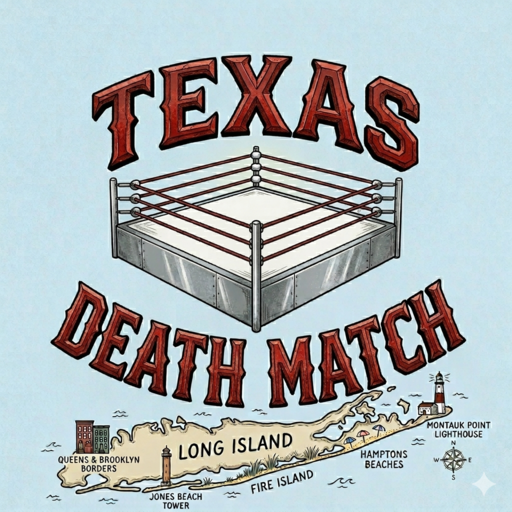
SUMMERS OF THE SUPERFLY is a memoir about the obsession three childhood friends and I had with the World Wrestling Federation of the years 1981–83, while growing up in small-town Long Island. This was prior to the national expansion of promoter Vincent K. McMahon and the rise of Hulkamania, when the WWF was still a northeast regional wrestling territory. Of course, I am well aware of the horrific events that were going on in the life of wrestler Jimmy Snuka at the same time and will address them from the perspective of an adult in the penultimate chapter. However, much of this memoir is written from the POV and memories of children who were inside the pre-Internet bubble of wrestling fandom and unaware of anything else. This is Chapter 4. Chapter 1 can be read here, Chapter 2 here, and Chapter 3 here. I will publish a new chapter every few weeks, for a total of 9. Thanks for reading!
“A Texas what match?” my Grandmother asked, not even believing what she just heard. “Terry, it’s not sensible. What are you watching?”
“It’s a Texas Death Match, Grandma.”
“Do you have to go to Texas to see it?” she asked.
“It’s right here on Long Island! Can you drive us?” I replied.
“No.”
It wouldn’t have mattered if my grandmother eagerly wanted to drive us to Nassau Coliseum for the big card, though. The “Last Blast of Summer,” as Vince McMahon had dubbed it. Labor Day Weekend was not only the last, best chance for Jimmy Snuka to win the title, it was also my family’s last, best chance to make any significant summer money at the motel before the oft-spotty fall season, and then the totally deadly winter settled in for 6–8 months. No other adults in the family could go either, for the same reasons. I probably shouldn’t have even been going myself, as I helped out all I could at the motel at 12 without being a legal employee yet. I actually had been working there since I could walk and speak at the same time, as it was considered my responsibility as the kid of the family to help keep the other kids staying at the motel entertained, usually via swimming with them or sharing my comic books. I looked at this just as making new friends, but my adult family did reap some financial benefits when the guest kids weren’t bored out there in the country and wanted to return next summer. Some even wanted to return mainly to see me, their Greenport motel friend, but I was nonetheless not going to be available for any non-wrestling socialization on the Saturday evening of Labor Day Weekend, 1982. Larger violins were playing at the Nassau Coliseum. If we could just get it together somehow.
Inspiration to solve our dilemma came from any and all available sources. We had recently watched a network airing of The Bad News Bears in Breaking Training, where the Bears basically stole a van from an elderly man to go on the road to the Houston Astrodome. A version of this scheme was under serious consideration because Todd’s next-door neighbor, Mr. Utzschultz, was known to leave his keys in the ignition after a night of heavy drinking and would probably not notice the car missing until after we had already returned it. A bigger problem than obtaining a vehicle was that none of us had a driver’s license.
“I can drive, though,” added Skimmer, who went on to say that his dad let him helm the clam truck back from Riverhead once. This may have been true, but there was no way we were trusting Skimmer’s driving two hours up the island, and two hours home. At night. In a hypothetically stolen car from a local alcoholic. Mr. Utzschultz also resembled a real-life version of Popeye, and reportedly once beat a man unconscious at Meyer’s Bar and Grill with a rowboat oar. I would rather have Killer Khan catch me stealing his car.
A solution soon manifested itself from an unexpected source.
Three blocks away from Todd resided Dutch, a kid our age who was always in trouble of some sort. Dutch had been recently arrested at the local IGA supermarket for stealing a steak he had stuffed in his pants, which he had gotten out the door with successfully. Where Dutch got nabbed was when he returned a few minutes later to also steal a bottle of A-1 Steak Sauce, which he had decided he needed for maximum dining pleasure. This had inspired an inside joke amongst our group, as we’d quip, “Never-ever try to steal the steak and the sauce too” when watching a baseball player on television try to rob one base too many.
The first time I heard the term “juvenile delinquent” was when some of our parents were discussing Dutch, when they assumed we were out of earshot. Dutch didn’t go to our local school, and he didn’t go to private school either. My mom said Dutch was in some sort of special educational program, but it may have just been a reform school. One that apparently let him out on weekends.
Dutch would occasionally come over to watch wrestling with us, although he wasn’t really a consistent part of the group. Which was fine with us because while we didn’t exactly dislike him, nobody really loved him either. He was a friend due to geographical convenience, basically, as Bart Simpson once explained regarding his relationship with eternal sidekick Milhouse.
While I still taped “Championship Wrestling” at midnight every week, a second WWF program, “All Star Wrestling,” had begun airing on Saturday mornings at 11 am on WOR-TV. Taped at a venue called the Field House in Hamburg, Pennsylvania, a town which was a short drive from Allentown, the matches often featured the same stars as “Championship Wrestling,” just at another arena. With two hours of wrestling now every weekend, we watched both shows religiously, and Todd’s house had become our gathering spot every Saturday morning for “All Star.” No one knew who had invited Dutch, but he’d always show up, too.
Somewhat oddly, or maybe not based on his semi-criminal history, Dutch always rooted for the rulebreakers. While we all had recently become obsessed with Jimmy Snuka, one of the WWF’s first antiheroes, Dutch loved the flat-out villains. He even clapped as Killer Khan rubbed sweat in the eyes of the scrub-moes. There was nothing “cool” about Killer Khan, unless cool for you involved being a sadistic lunatic. For Dutch, it apparently did. He was a Snuka fan, too, of course, and wanted to see the Texas Death Match as badly as we did.
“My dad said he’ll take us to wrestling at Nassau,” blurted out Dutch one day, during the commercials. We didn’t even know this adult was a chaperone possibility, as none of us had ever even seen Dutch’s father, and we weren’t sure that he existed. Dutch’s family situation was a little unusual, even by the norms of our general neighborhood, which had a few extended family- type set-ups in the 70s and 80s, with kids who were being brought up by their aunts, uncles, and grandparents. Often, the mothers or fathers were there, but were single and just needed help. Other times, the mothers, or fathers, weren’t there either. In the case of Dutch, it was even more complicated. The woman whom we had thought was Dutch’s young mother for a few years was later revealed to be his much older half-sister, who was around 22. She was apparently raising Dutch, with financing from their mutual father, who had another family, with whom he lived, on the other side of town. The whereabouts of Dutch’s actual mother never came up.
Was Dutch’s dad safe to drive two hours each way with? Apparently so. According to my parents, Dutch’s dad was a respected businessman in the area, and they were fine with him as our chaperone. While the fact that he didn’t let Dutch live with him didn’t sound so cool, I had also decided he was probably the greatest dad in the world for driving us to wrestling. It didn’t occur to me that only an adult with something wrong with him would likely agree to take five little wrestling lunatics way up Long Island on Labor Day Weekend.
Regardless, the die was cast. In three weeks, we were going to see our heroes live for the first time. I could barely sleep.
Simultaneously, some of the most exciting developments we had ever seen on the wrestling television shows were also happening that August of 1982, and they all revolved around Jimmy Snuka. A twist of sorts was afoot in the WWF that month. A wrinkle in the fabric of the Wrestling World reality. For the first time in our viewing history, the most interesting thing in the WWF rings involved scrub-moe-for-life Charlie Brown not getting his ass kicked.
Things initially took a turn for the weird on a mid-August episode of “All Star Wrestling,” two weeks or so before we were going to the Coliseum. In what promised to be just a regular star vs. preliminary wrestler bout, Jimmy Snuka pushed opponent Charlie Brown up against the ring ropes, and then gave him a “clean break.” This flew in the face of every pattern of Snuka’s ring work that we had gotten accustomed to for the last several months. Usually, when Snuka pushed an opponent to the ring ropes, he was supposed to give him a “clean break,” allowing the opponent to step freely away from the ropes. However, Snuka would always instead drive his knee hard into his opponent’s stomach or smash him across the chest with a forearm.
This time, though, Snuka held his hands up when Charlie was on the ropes, motioning that he was free to step back. This was similar to what the scientific wrestlers did with their opponents. A rulebreaker never broke clean. Snuka just had, though.
The television crowd immediately noticed the deviation from the norm. A “What the hell?!” murmur, with assorted claps and cheers mixed in.
Whoa. We were all now watching very closely.
Snuka then returned to wrestling as aggressively as he normally did, hitting poor Charlie Brown with multiple karate chops to the head. The Superfly pushed Charlie against the ropes again and…
…once more, gave him a clean break!
The Crowd showered this with applause now.
At ringside, Captain Lou Albano was not happy. He shouted “Fijian” at Snuka, who glared back at him, with what looked like annoyance. After a knee drop to the chest, Snuka quickly rolled Charlie Brown up for a pin, forgoing the usual devastation of the Superfly Splash, which was not necessary to win the match at this point.
As Snuka exited the ring, Albano continued to berate him. Snuka didn’t acknowledge Albano’s rants, but just walked ahead of his manager en route to the dressing room.
“What just happened there?!” Todd exclaimed.
“If Snuka turns good guy, I am done with him,” Dutch grunted, the only one of us who was disturbed, rather than excited, by what had just gone down.
Snuka “turning good guy?” We had heard about things like this from the Apter mags, which Dutch had borrowed several copies of from me. That’s where I assumed he even learned that such a total character transformation of a wrestler was possible. It appeared to be more common that a good guy turned “bad,” by betraying a close ally. A year or two ago, in the Georgia federation, Dusty Rhodes had had a tag team partner, a mean, stocky cracker named Ole Anderson, sneak attack him during a steel cage match. Although the reverse, of rulebreaker turning good guy, had a precedent also, with one of the WWF’s more illustrious former stars, no less. Hulk Hogan had started as a rulebreaker a few years earlier in the WWF, under the management of Freddie Blassie. He had later migrated to the AWA, where he entered the midwestern league as a rulebreaker, but must have had a change of heart of some sort, and now was the top good guy of the AWA, in dogged pursuit of arrogant rulebreaker Nick Bockwinkel’s heavyweight championship. Was Snuka morphing the same way before our eyes? Definitely not quite morphing yet. Maybe shimmering a bit.
It was also maybe just a one-time aberration, but the next week proved otherwise as Snuka gave a clean break to yet another scrub-moe who he had previously sent out on a stretcher, Barry Hart. The Crowd applauded even louder this time. At ringside, Albano gave up and headed for the dressing room, throwing his hands up in frustration.
“Maybe Snuka is really a good human being,” Todd half-stated, half-queried.
“I think it’s Albano that’s the problem!” continued Skimmer. “Snuka is from Fiji, and he’s just confused. He’s only following his manager’s directions!”
“Right,” I chimed in. “Because if Albano told Snuka that you have to send the scrubs out on stretchers to win a match, Snuka thinks those are the rules. He doesn’t even know he’s breaking them!”
“He can’t speak our language, what can he do?” added Todd.
“Snuka’s a sucker if he turns good, whether he speaks English or not,” blurted Dutch.
This opposite take from the rest of the group stopped us all short. Dutch grabbed a copy of Pro Wrestling Illustrated from amongst the half-dozen Apter mags scattered about the room, and turned to the “Off the Top Rope” letters column written by Dan Shocket, the snide journalist who favored the rulebreakers.
“Dan Shocket says that scientific wrestlers are morons for being goody-goody and wanting to make the fans happy. Why follow the rules when you don’t have to?” Dutch shrugged.
On television, the next match started, and this discussion about the logic of wrestling rulebreaking was tabled for the moment. Yet, I couldn’t stop thinking about how Snuka might have a heart of gold underneath the savage exterior, which made our hero even more mysterious. Sort of like Wolverine of the X-Men, once being a violent killer, but who now was trying to atone for his past life, to fight for the forces of good. Wolverine knew how to be both bad and good, and was struggling with which way to go. Snuka, maybe also.
Our new and possibly evolving Superfly was once again on a collision course with Bob Backlund, the match that we were going to attend in a week. Was Nassau Coliseum going to be the place where Snuka finally turned on Albano once and for all? And what would it mean for Snuka to be a “good guy?” He wasn’t going to become a scientific wrestler like Backlund all of a sudden. His best moves were still brutal chops, kicks, and the Superfly Splash. Would he start fighting rulebreakers and still keep his wrestling style, just with clean breaks at the ropes and no more stretchering out of his scrub-moe opponents? Would he and Backlund become friends and even tag team partners? So many questions. I couldn’t concentrate on anything else.
[embed]
(Above, a promo interview with Snuka, Albano, and Vince McMahon on “Championship Wrestling” to hype up the September 4, 1982 card at the Nassau Coliseum. Courtesy of World Wrestling Entertainment.)
At 12 years old, summer existed in its own pocket universe of time. A place between places. Between school years, to be sure. We were about to enter the 8th Grade, the prospect of which generated both excitement and trepidation. Before that, though, we had the Summer of 1982 to finish, and it had been a summer with a great deal of fun, but also a tragedy for me. Earlier that August, my beloved great-grandmother, who was nicknamed “Mah-Mah,” had died suddenly at the motel, on a very hot day. 86 years old, she had gone into Room 14 to watch her favorite soap opera, “General Hospital,” and had passed away sometime around 3:30 in the afternoon. My entire family and I were devastated. Because my mother and grandmother had no choice but to keep the motel running during our busiest season, they had little time to grieve in August, or to help me with that process. I had subsequently retreated into Wrestling World, mind, body, and soul. Maybe we could end the Summer of 1982 on a better note, the little gang and I, at Nassau Coliseum, when we’d cheer on Snuka to finally take the championship. Maybe he’s even become a good guy. Nothing could bring back Mah-Mah, of course, but a glorious night at Nassau would be a positive way to close the Summer book for all of us. I might get a little happier, at least.
Finally, that fateful Saturday had arrived.
There was one final “All Star Wrestling” that morning before we left for the Coliseum that afternoon, and the promo interviews by Vince were entirely devoted to the card we were actually attending. This time, we wouldn’t have to call the belligerent Frankie Mudd for the results, or hope Warner Wolf deigned to go to the videotape. We would be there live. For once in our 12-year-old lives.
Other than the main event of Snuka vs. Backlund, the second biggest match of the night was going to be Ivan “Polish Power” Putski versus rulebreaker Cowboy Bob Orton. Although I was only about 1/8th Polish, our end of Long Island was filled with second and third generation Polish immigrants, or the descendants thereof. In nearby Riverhead, there was even an 8-block “Polish Town” section, which had been settled by Polish immigrants in the early 1900s. Putski was huge with Long Island wrestling fans, and our group all loved him, despite whatever minor percentage of our ancestors migrated here via Warsaw or Krakow.
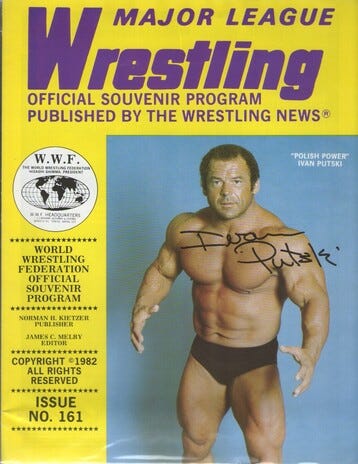
“Polish Power” Ivan Putski on the cover of the Major League Wrestling souvenir program, often distributed at WWF Matches. This is an autographed copy from 1982, sold on eBay. Courtesy of the Wrestling News.
During the interview segment, Vince brought out Putski, clad only in his black ring trunks, to discuss his upcoming match that evening, introducing him with the compliment, “This man is really put together!!” Vince then added something slightly odder with “He’s a Polish brickhouse!” which today invokes thoughts of some sort of polka-disco dance floor hit.
As Vince praised Putski’s physique, the camera did a languorous pan up his bulging muscular body. When the camera got back to Putski’s face, he waved his finger at us with a smile.
“The Polish Army is gonna be there tonight!” shouted Putski. Hell yeah, we were!
Next up, Snuka and Albano entered to discuss the Texas Death Match main event. In his typical ranting fashion, the Captain explained how they were finally going to get the title tonight in the Nassau Coliseum. Sounded good to us, except for Paul, who watched stone-faced. After his spiel, Albano exited the screen, but Snuka remained behind with Vince, breaking the previous pattern of always walking off when Albano did.
“Mr. Snuka, what about a comment from you?” queried Vince.
For the first time, Snuka leaned forward as if he were about to reply into the microphone.
Albano ran back into frame before anything could emerge from Snuka’s mouth, shouting furiously, “I told you already, dummy!” at Vince, then berated Snuka in “Fijian,” before they exited.
Turning to each other, we all simultaneously shouted some variation of “Snuka was about to talk!” And indeed, he was. Maybe tonight was when he would finally. All this time, we had never heard our hero’s voice, even in Fijian. Could he perhaps speak English? Maybe he’d even speak to us when we were at ringside?
Around 5 pm, Dutch’s Dad arrived to pick us up in a nice station wagon, which we all piled into. The de facto artist of our group, I had two giant “fan signs” I had drawn on poster boards in tow, one of a huge musclebound arm holding a hammer and the phrase “Polish Power!”, and another that just read “Superfly!!!” in large letters. I also lugged along a cardboard box of well-worn Apter mags, with the intention of maybe getting some autographed, if that was possible, as we had seen wrestlers signing magazines on the television shows for fans at ringside. With our puffy-letter t-shirts, fan signs, and assorted paraphernalia, we had quickly turned the station wagon of Dutch’s Dad into a wrestling dork mobile.
Based on our perception of Dutch himself, it was unexpected to meet this friendly, preppily-dressed father who seemed to be relatively happy to be taking us to wrestling, even though he was sure to face two hours of beach-related traffic on a hot Saturday afternoon. As the station wagon departed the bucolic farmlands of the North Fork and headed through the beginning of the strip mall/suburban sprawl in Riverhead, the unmistakable opening rock thumps of “Eye of the Tiger” by Survivor came on the radio.
“Dad, can you turn this up?” asked Dutch. His father obliged, cranking the volume on one of the biggest radio hits of the summer of 1982.
“Rising up/Back on the streets/Did my time, took my chances…” In one of those moments where life gave you a perfect needle drop straight out of the movies, “Eye of the Tiger” felt like the ideal “Going to Wrestling” song, partially because a month or so earlier, in July, we had all watched Rocky III at the single-screen Greenport Movie Theater. The mega-hit film featured a key scene in which Rocky Balboa takes on a gargantuan wrestler named “Thunderlips” in a charity match. Thunderlips was played by none other than Hulk Hogan. As the tanned and blonde Hogan pounded on Rocky, we, and the rest of America, caught a glimpse of wrestling’s future. As much as we loved Snuka, Hogan was on another level of “larger than life” altogether. Huge, muscle-bound, charismatic. Every one of his devastating moves looked like it was executed by a human freight train. Hogan was in another federation for now, though, and he might as well have been on Mars in terms of when we would get to see him again.
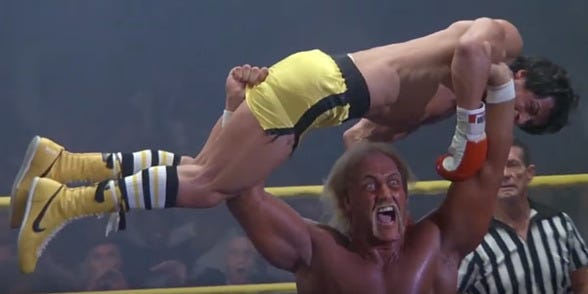
Hulk Hogan as “Thunderlips” vs. Rocky Balboa (Sylvester Stallone) in 1982’s ROCKY III. Courtesy of MGM/UA.
What also felt exciting, although it was difficult to put into words at our age, was that Wrestling World had crept into mainstream entertainment with Rocky III, a film that seemingly every young person in the country saw that summer, sometimes two or three times. Something was validating about that for our obsessive fandom. And it wasn’t just Rocky III. In April, just four months earlier, Jerry “the King” Lawler had piledrived comedian and actor Andy Kaufman during a match in Memphis, sending him into the hospital, as their long-simmering feud raged on. Then, in July, the Lawler-Kaufman pair had appeared on some weird show called “David Letterman” or something, where Lawler knocked Kaufman off his chair with a slap to the face. Both wrestling-related incidents made the national news and were treated relatively seriously as real events, not faked ones. The slap on “Letterman” was even written about in the New York Times. That night, we felt like we were heading right into the middle of the coolest thing in America, in a Long Island station wagon.
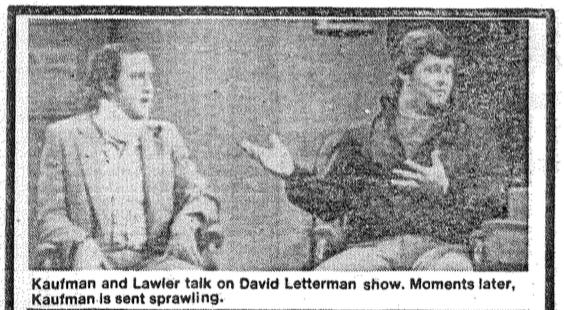
A newspaper clipping about the Kaufman-Lawler altercation on “Late Night with David Letterman” in July 1982.
It’s the Eye of the Tiger/It’s the thrill of the fight -
We didn’t all know every word, and none of us could actually sing, but sing we did at the top of our lungs, as the station wagon pulled onto the entrance of the Long Island Expressway, the main traffic artery which coursed from Riverhead to all points west.
Rising up to the challenge of our rival/And the last known survivor stalks his prey in the night -
I always admired how Survivor managed to name-drop themselves into the lyrics of their biggest song.
And he’s watching us all with the EYEEEEEEEE of the Tiger!!!
As that last line crescendoed with us all belting it out, Dutch’s Dad had to have been thinking, “It’s only for a few hours…”
About 90 minutes later, we finally approached the Promised Land. Although it wasn’t the tallest building in development-heavy Uniondale, the Nassau Veterans Memorial Coliseum was surrounded by huge, flat parking lots with no structures on them, making it loom like a giant beige hockey puck on the horizon as we approached via the Hempstead Turnpike.
Heading into the parking lot, we passed two kids about our age riding bikes into the rapidly filling parking lot, and they were also carrying Apter mags in their hands. It must have been so cool to live close enough to wrestling that you could bike to it! I held up an Apter mag in the window, and one of the Bike Kids gave a thumbs-up and a smile. Maybe we’d meet those Bike Kids inside and become friends. They were probably obsessive fans just like us.
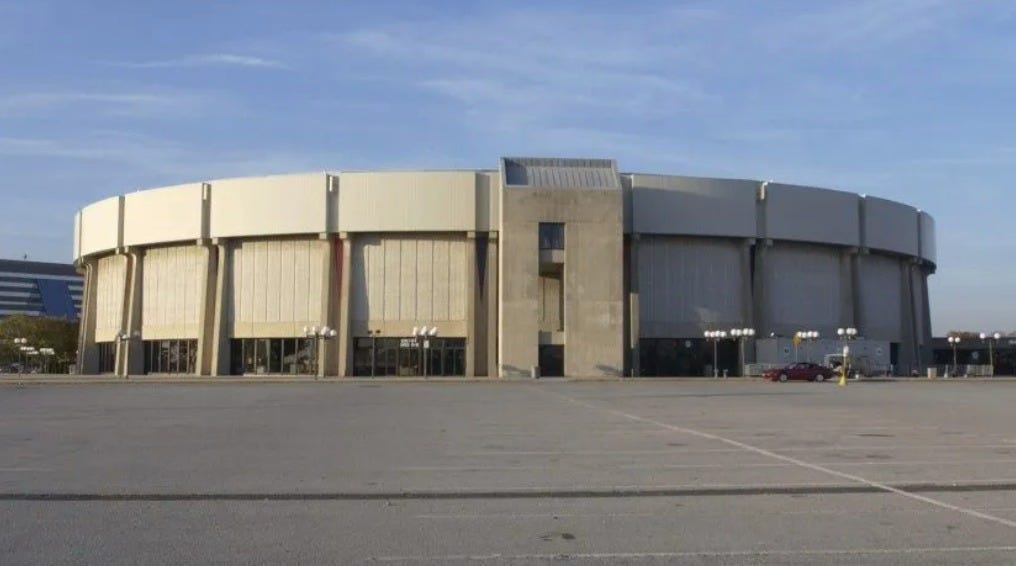
Nassau Coliseum, as it looked in the early 80s. Courtesy of Newsday.
However, we were soon to learn what obsessive wrestling fans really were. As we entered the Coliseum, we followed Dutch’s Dad around the outer atrium, looking for our seat tier, and we soon encountered a group of adult individuals, the likes of which we never knew existed.
“Why did you bring your magazines?!” an older male voice asked as we passed, very loudly, and with a contemptuous tone.
I stopped to see a Nerdy Guy with Glasses, about 18 or so, staring at me, with two of his friends, who looked similar in both their age and in their general lack of coolness. Obnoxiousness, though, that they had in spades.
“Um, I wanted to get them signed?” I replied with a half-question. Our whole group had stopped behind me. Dutch’s Dad waited several feet ahead and watched us now with a bit of impatience, wanting to just get this band of misfits to our seats, and finally beginning to wonder what he had volunteered for here.
The bullies I was used to dealing with in Greenport Schools didn’t look like these definite dorks, but I had the feeling I was about to be bullied anyway.
“You’re not gonna get anyone to sign ALL of those,” the Nerd Leader laughed. His friends joined in, but one of them seemed nicer and attempted to bring me into their conversation.
“So, who’s your favorite wrestler, man?” queried the Lesser Nerd.
“Snuka!” I proudly answered.
The Nerds all nodded.
“Good choice,” said the Nerd Leader.
“Also, Pedro Morales,” I added, still holding a torch for my original fave.
“Pedro’s not going to be Intercontinental Champ too much longer,” the Nerd Leader said with a smug confidence. The other two Nerds nodded, then shook their heads with a bit of sadness.
“He was cool, too, though. Legend,” the Lesser Nerd said.
“Legend,” they all agreed.
“How do you know Pedro’s not gonna stay Intercontinental champ?” Todd quickly jumped in. Our current Snuka obsession aside, Pedro was his first love, also.
“I know people who work in wrestling, trust me,” said the Wrestling Nerd Leader. “Here’s what’s gonna happen… Pedro is going to lose the Intercontinental belt to Buddy Rose at MSG next month.”
“No way!” we all exclaimed in near-unison.
“Not Playboy!” said Paul, who could have been speaking for me as well. None of us thought much of the championship caliber of “Playboy” Buddy Rose, whose gimmick was that he was an overweight, wealthy guy, often accompanied to the ring by two girls in bathing suits, who always managed to sneak his way to a win. He was entertaining, but not who we saw dethroning Pedro, or anyone else. Even Dutch thought he was, as he said last week at Todd’s, a “big fat twinkie.”
“Playboy, the Fed likes him. I mean, He’s going to only hold the title for a month, though, you know, transitional champion, and Snuka is going to turn good and win the Intercontinental Belt. Also in MSG, by December for sure, maybe November. And if that doesn’t happen, I’ll eat my hat!” the Wrestling Nerd Leader proudly finished, folding his arms.
“Guys!” shouted Dutch’s Dad, motioning for us to follow. We acknowledged we’d be right there, but we were also enraptured by these strange, wrestling-crazed child-men, the likes of which we had never met growing up in our small town. Their predictions felt like some sort of forbidden knowledge, and they weren’t even finished dissolving our craniums yet.
“Hey, you guys know about George ‘the Animal’ Steele, right?” the Wrestling Nerd Leader said in low, conspiratorial tones.
“No?” I replied. “I mean, I know who he is.”
“Did you know he’s a high school math teacher in Detroit?”
“No way?!” we collectively replied again.
The whole group of Wrestling Nerds nodded their heads affirmatively, with a little sympathy, as if they were breaking the news that Santa didn’t exist.
“He comes to the WWF during the summer breaks, then goes back home to teach in the school year,” said Lesser Nerd #2.
It was true that the Animal only ever seemed to be in our federation during the summer months. When I had discovered the wrestling drug via the Animal’s televised tag team match with Killer Khan, it had been right at the end of the summer last year, on Labor Day Weekend, and then he hadn’t been back for the entire year.
Something that didn’t occur to me at the time was that we were exactly one year from my watching that first lopsided wrestling match in my Grandmother’s bedroom at the motel. Saturday of Labor Day Weekend 1981 to Saturday of Labor Day Weekend 1982, and I was actually at the matches now, talking with the weirdest people I had ever met. Had I been more self-aware of such things, I would have felt a swelling sense of symmetrical achievement of some sort.
“You guys shouldn’t read those magazines, anyway. I’m gonna start a newsletter, it’ll tell the truth about wrestling. What’s really going on in the Fed,” the Wrestling Nerd Leader said.
He then leaned in to me, as if he had decided that the kid with the box of magazines was likely the one who really needed to hear this.
“It’ll smarten you up to the business,” Wrestling Nerd Leader said, winking conspiratorially. “Watch for it!”
“I will,” I replied, not having any idea how I was going to do that.
“Have a great card!” said Lesser Wrestling Nerd, wrapping up the conversation, mercifully.
We all moved on to join Dutch’s Dad, but our minds had also sort of been blown to learn that there were grown-ups, or sort of, that obsessed over wrestling, even more than we did. This was also the first time I encountered what would become known years later, largely when the internet really took off, as “Smart Fans.” They seemed to assume, without question, that wrestling was fake and that there was a whole world of machinations going on behind the scenes to determine what would happen each week. To me, that was almost more interesting than if the matches were real athletic contests, although I still was very much of the opinion that they were.
“How did he know so much?” I asked our gang.
“He said he knew people, who knew people, who knew people,” replied Todd.
“But what people?” I queried.
“Playboy’s gonna beat Pedro, though?!” Skimmer chimed in.
“But Snuka’s gonna beat Playboy!” Paul added.
“And that means Snuka’s turning good for real!” I exclaimed. “Because Playboy is definitely staying rulebreaker.”
“I knew Snuka was a good human being!” added Skimmer with excitement.
“What about the Animal being a school teacher?” I chimed in.
“That’s got to be bullshit,” Todd replied. The others nodded.
“They were screwing with us on that,” added Skimmer.
“Those guys were just losers,” said Dutch. “They didn’t know squat.”
“Yeah, probably don’t talk to any more fellows like that, guys,” recommended Dutch’s Dad.
But what had arisen was a fundamental question of wrestling faith, really. There was no way wrestling could be “real,” if the green-tongued, turnbuckle-munching Animal was also a Detroit math teacher. Granted, it may have been a really bad school that would have hired Animal for math, but regardless. It was one thing that the fix might be in for Playboy to win the title from our beloved Pedro. We had always assumed the finishes of some of the matches could be “arranged,” just like they often were in boxing movies that had a mob corruption storyline. That didn’t mean the boxers in those stories weren’t real boxers, or wrestlers in our case. But it was quite another thing for the Animal to be a high school faculty member.
Our wrestling fandom had taken a strange turn in that hallway of the Nassau Coliseum. Caught somewhere between still thinking it was a real sport, but simultaneously intrigued by the “secret knowledge” of those dorky Smart Fans. What difference did it make if Snuka was a good human being, if it was all a show? And who was deciding who won? The wrestlers themselves? Or someone else? A cigar-smoking mob kingpin? Was there a magical Wrestling God who decided the outcomes?
These were nearly existential questions that were too much for our 12-year- old, somewhat evolved chimp brains to navigate. There wasn’t much time to ponder these weighty matters, though, because Dutch’s Dad swung open the door to the entrance to the arena.
“Level 204, this is us!” he announced, hoping to finally get this increasingly bizarre group of kids, which included his own son, wrangled into seats.
The first thing we saw in the middle of the Coliseum was the wrestling ring, which was lit up already, empty of participants though it was. A thin haze of cigarette smoke hung in the air about the lights. The sight of the ring almost surprised me for a moment. I didn’t know what I was expecting to see. This was a wrestling card, of course, but seeing that ring solidified that it was a wrestling card. We were really here.
All of the house lights were also still on in the Nassau Coliseum, which looked to be about 1/2 full. The lower levels were largely filled with people sitting, standing, or milling about. The upper decks were more sparsely occupied, with some rows completely empty. Although the fans were definitely excited, this large arena, which could hold about 18,000, was not a sell-out, as the far smaller Ag Hall and Fieldhouse always seemed to be. There were many kids in our age range, with some even younger. Plenty of families. A whole lot more color and ethnic diversity than the largely white Allentown audience, as well. Far more Italians, Puerto Ricans, and African-Americans. Long Island itself was a cross-section of every race and economic class imaginable, and this was a representative Long Island crowd to be sure. Fewer seniors than Allentown, also, with many more twentysomethings. Some of whom were getting ready for the matches with a pre-party of drinks and cigarettes.
“Be-er HE-RE!” shouted a mobile vendor, with a tray of beers in plastic mugs around his neck. Settling in for a long evening, Dutch’s Dad bought two and took his seat at the end of our tier, which was only about 15 rows back from the floor. He was unfortunately going to have to get used to us running past him all night, which started with us all scampering down to the ring with a sense of almost religious awe. Vince would often refer to Madison Square Garden as the “Mecca of Professional Wrestling” when hyping up that month’s MSG card. Well, the Coliseum was our Mecca of Professional Wrestling for tonight, Vince.
Other kids had had the same idea, and a dozen or so were gathered around the ring touching it. We all did the same, along with the ring ropes.
“Guys, the ring is hard!” remarked Paul.
Indeed, the “mat” was much more solid than expected, which we had often discussed was probably like a school gymnasium floor, covered with foam rubber. Instead, the ring floor was a very stiff canvas that felt like hitting it would most definitely hurt. The ring ropes were also very firm, made of what seemed to be iron cables covered by colorful silver vinyl. There was nothing “fake” about that ring.
Without warning, the house lights went down, the ring bell loudly sounded three times, and cheers erupted from the fans.
We were still standing by the side of the ring when the first wrestler we ever saw in person climbed through the ropes, “The Unpredictable” Johnny Rodz, who wore striped yellow and green wrestling shorts and was of Puerto Rican descent. Rodz was in a category of wrestlers that we referred to as the “Better Scrub-Moes.” These were a handful of wrestlers who usually got some offense in against their star opponents, maybe even came close to getting a pin, but inevitably lost. Also, unlike the real scrub-moes, they of the unmemorable monickers and sad dad physiques, Rodz looked genuinely tough, and he was even allowed a gimmick nickname, of sorts. In truth, though, the only thing unpredictable about “Unpredictable” was that he was going to have his shoulders on the canvas for the 1–2–3 by the end of the match. Nonetheless, we screamed “Johnny!” and “Unpredictable!!” for Rodz at the top of our lungs, as if he were Snuka himself.
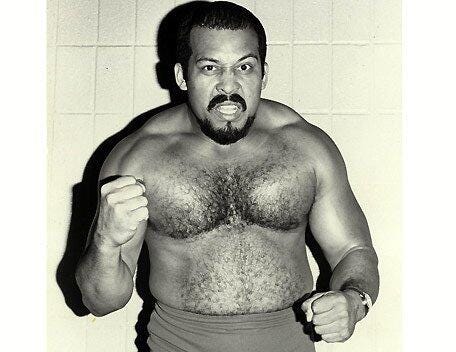
The “Unpredictable” Johnny Rodz, above. Courtesy of FOX Sports.
The harried ushers dutifully herded all of us back to our seats, which we rejoined to watch our first live match, pitting Rodz against none other than S.D. “Special Delivery” Jones, whose beating at the hands and feet of Killer Khan and the Animal had hooked me on the sport exactly a year earlier. Although this preliminary match wouldn’t have raised much noise from the Allentown fans, the Nassau Coliseum audience treated this first face-off of the night as if it were a top-tier bout. Maybe a lot of the crowd were like us, seeing their stars for the first time in-person. Every move from Unpredictable and Special Delivery received robust cheers and jeers, even simple headlocks and tosses into the ropes. The ring was miked, so each slam to the mat echoed throughout the Coliseum. It was an intoxicating atmosphere, one that drew us into the matches far more than simply sitting on a couch at home and watching them on a small television.
Goddamn, was this real! It was really real. Really, really real. I’m sorry I had every doubted.
“We want blood!” chanted some fans a few tiers away from us. The chant was picked up by more fans on the other side of the arena, then settled down.
After a powerslam, S.D. managed to get the pin on Rodz, maybe the only victory we had seen S.D. ever achieve. Special Delivery was in a rare tier of wrestlers for whom we didn’t quite have a label. “Even Better Scrub-Moes” maybe? Very popular with the fans, S.D. felt a slight notch above Rodz in the skill and pecking order departments. He often put on a decent showing against the rulebreaker stars, but true victories almost always eluded him. Not tonight, though. S.D. headed triumphantly back down the aisle to what we had determined was the good guy/scientific wrestler dressing room. On the opposite side of the arena, the rulebreakers seemed to make their way back and forth to the ring from a different dressing room. It certainly made sense that they had to keep the good and bad guys separated.
For the next match, light cheering indicated that wrestlers were heading to the ring, but we couldn’t see the grapplers for this particular match above the fans who crowded the guard rails. We would learn why, as two tag teams of little people, Sonny Boy Hayes & Sky Low Low, and the opposing team of Little Beaver & Tiger Jackson, finally climbed through the ropes, where they were no longer blocked by the mostly taller fans. Although this term would be considered derogatory today, the announcer in 1982 stated this was a “Mighty Midget Tag Team Match.” The first reaction was scattered laughter from the audience, particularly as he announced the weight and height of each combatant. Seeing this as a novelty bout, lots of people headed for the bathrooms and concession stands.
They missed out.
These two tag teams were far faster, and often more athletic overall, than their heavyweight counterparts. They took to the air almost as much as Snuka, if not at the same heights, for dropkicks and leaps from the bottom ropes. The crowd responded in kind by the end, showering the four with applause.
“Those guys were awesome!” exclaimed Paul, who now pointed to the ring, his eyes wide. Someone new had just arrived. “Dude!”
But it was definitely not a dude we were looking at. Standing in the ring for the next match was a tall Young Woman of about 24. She had short curly hair, long bare legs, and was waving to audience members with a big smile. The Young Woman took off a ring jacket to reveal her wrestling attire, essentially a red one-piece bathing suit and yellow boots. Some of the older male members of the crowd, as in older than us at least, whistled and cheered.
“Hey, wanna wrestle me?” shouted a 20-something lout in a tank top who could have later grown up to be Joey Buttafuocco. Seemingly used to handling fans like this with aplomb, the Young Woman shrugged and smiled.
The Ring Announcer introduced the Young Woman as “Sherri Martel” and informed us that the next match would be for the World Women’s Championship. I never knew such a title even existed, as it was rarely, if ever, mentioned on television.
“Do you think that’s Rick Martel’s sister?” asked Skimmer. I was wondering the same thing, as she shared the last name of the popular former tag team co-champion. Maybe it was his wife? I was hoping Sherri wasn’t married. Also, what dressing room did she use? We didn’t have long to ponder any of this, though, as a true legend of the sport was about to appear, albeit one that we had never heard of until now.
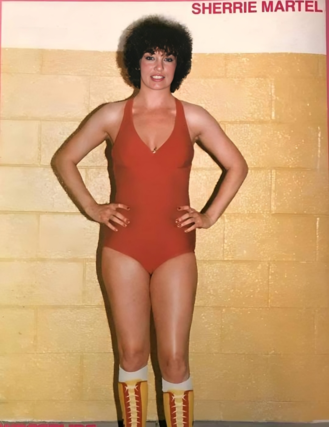
Sherri (Sherrie) Martel in 1982, also the year of her professional debut. Courtesy of World Wrestling Entertainment.
Stepping through the ring ropes was a squat, tough-looking lady with a 1950s mildly bouffanted hairdo and a satin cape tied about her neck. She sported a pug-like face that radiated meanness and reminded me a bit of Mrs. Bosley, our school truant officer.
“And now, here she is, the Women’s World Champion: THE FABULOUS MOOLAH!!”
While we didn’t know her age at the time, the Fabulous Moolah was definitely older than Sherri by decades. (Moolah was 59 in 1982, still a few years older than I am today.) Moolah’s Women’s World Championship belt featured her own picture on the front, in case you didn’t already know she was the champ by the fact that she was the one wearing the strap. The picture appeared to be of a much younger Moolah, as in 20 years younger, giving the impression that she had held the title for a very long time. Moolah strutted arrogantly around the ring ropes, sneering at the chorus of boos that were hurled at her from ringside. The fans seemed to be very familiar with Moolah, likely from previous cards, and they sure didn’t appreciate her.
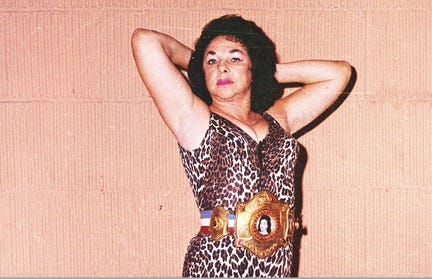
The Fabulous Moolah and her Championship Belt, emblazoned with her face, in the early 80s. Courtesy of World Wrestling Entertainment.
Although we had never seen women wrestlers on the WWF television shows, there was no question who the fan favorite was for us. Sherri the Friendly Babe vs. Snarling Old Moolah? Even Dutch was rooting against Moolah. This was also the first match that I noticed Dutch’s Dad lean forward in interest to watch.
Unfortunately, the cheers wouldn’t be enough for Sherri. She put on a game fight with Moolah at first, hitting her with athletic dropkicks and bodyslams. Nonetheless, Moolah had been champ for this long not because of her spryness, although she was remarkably fast and strong for her age, but thanks to her devious nature. Ten minutes into the match, Moolah pulled Sherri’s tights for leverage, to roll the young challenger up for a sneak pin. Totally illegal, but the ref didn’t catch her. Visibly disappointed, Sherri didn’t win the title that night, but she won some new fans for sure.
With the undercard out of the way, the biggest star of the night so far now appeared, as vicious rulebreaker Cowboy Bob Orton stepped into the ring, sporting his signature ten-gallon hat, green trunks, and leather vest, which he wore over a bare chest. The tall and lanky Cowboy had made a good run at Backlund’s World Heavyweight belt, as well as Pedro’s Intercontinental Title, a few months earlier, but came up short in both at Madison Square Garden. His devastating finishing maneuver, the “Superplex,” was a massive suplex from the top rope. For those not familiar with the intricacies of the garden-variety suplex, the move involves pulling one’s opponent upwards by the trunks, balancing him almost perpendicular in the air, then smashing him down to the mat. By doing the move off the top rope, as the “Superplex,” it was a guaranteed lights-out maneuver that no one walked away from. After the Superfly Splash, Cowboy’s Superplex was currently the most feared finishing move in the Federation. Even though Cowboy was no longer in title contention, we feared for Ivan Putski if he were to get caught in the mighty Superplex.
Todd and I had run down separately from the group, and we stared up at Orton from the guard rails. The Cowboy had a strangely defeated-before-he-started look about him, as he casually leaned back in the turnbuckle, waiting for his opponent’s arrival.
“Something’s wrong with Orton,” observed Todd.
“Hey, Cowboy, you suck!!” I daringly/stupidly shouted at Orton, but he didn’t even acknowledge us, despite our only being a few feet away. This was a marked difference from the arrogant taunts I had seen him return to jeering ringside fans on television.
“Maybe he’s sick,” I explained to Todd, who shook his head negatively.
“Nah, he’s got to be leaving the federation soon,” Todd continued. “If you’re leaving, you’re losing. I’ve noticed that.”
I couldn’t say he was wrong. Todd and I had analyzed extensively the patterns of how rulebreakers would enter the federation strong and first lose against Backlund for the Heavyweight belt. Then, they’d fall against Pedro in contests for the Intercontinental championship. Finally, the rulebreaker would face a popular non-champ like Andre, Tony Atlas, or…Ivan Putski and lose once more before they were never seen on television, or even mentioned, again.
“Those guys freaked me out a little,” Todd added, apropos of nothing. “The ones outside. I don’t think we want to grow up like them.”
“We won’t,” I reassured.
“Suppose they know what they’re talking about, though? You know what I’m saying,” Todd answered.
The latest debate between Todd and me about the possible illegitimacy of our favorite sport was interrupted by cheers — the loudest of the night so far, practically a roar. Ivan Putski sprinted to the ring, then paused on the ring apron to wave to the Crowd, who showered him with more verbal and clapping love. At around 5'7'’, Putski wasn’t much height-wise, but made up for it in muscular width that felt nearly 5'7'’ across his shoulders as well. He pointed towards the crowd and flexed both biceps, the muscles of which popped up like hard baseballs under the skin.
At ringside, the other guys had joined us, and we all held up my “Polish Power!” Arm and Hammer fan sign. It took a minute or so, but Putski actually noticed us and gave us a smile, a point, and a wink. That acknowledgement from one of our heroes gave us all a moment of pure ecstasy. As Putski had promised in the television promo, “the Polish Army” was in attendance, and we were a part of it! Despite not really being very Polish.
Putski then grabbed the announcer’s microphone and shouted, “POLISH POWER!!!!!” His ever-popular catchphrase received a crescendo of fan applause that rang my eardrums.
“That poster’s awesome! Let me take a picture of you dudes,” said a twenty-something Guy with a light-colored beard and glasses, along with a camera, who was inside the ringside barriers. He had a laminated pass around his neck and appeared to be a professional photographer. We all gathered around the poster and gave a big smile.
“Where will this be published?” I asked the Photographer Guy.
“Either Pro Wrestling Illustrated or Inside Wrestling,” he replied nicely, before walking off. (From pictures I’ve seen since the advent of the internet, the Photographer Guy was likely Craig Peters, a popular staff writer for the Apter mags. Craig, if you are actually reading this memoir 44 years later, do you still have that picture I could add to the piece?!)
Full Wrestling World delirium had taken over us now. We might be in one of our favorite magazines. Actually, the only magazines we read at all.
As the match got underway, Cowboy took command of Putski with a grinding headlock. A brutal series of bodyslams and knee drops to the chest, from Cowboy, followed. Putski was in real trouble as Cowboy lifted him up by his legs and seated him unwillingly on the top turnbuckle, a preliminary move en route to the Superplex that we had seen Cowboy perform before on so many scrub-moes.
“NOOOOO!!!” we all screamed.
This was it for Putski, but… no, no it wasn’t! Putski suddenly pummeled Cowboy with a flurry of punches to the back of his head, with almost superhuman speed and fury, knocking Cowboy onto the mat. Putski dismounted from the turnbuckle, out of Superplex danger and ready to go on the offense.
Putski hurled Cowboy into the ropes, and we knew what was coming: As Cowboy bounced back, Putski struck Cowboy hard with his “Polish Hammer” finishing move, which involved both hands clasped together to deliver a mega-punch to the chest that sent Cowboy down again, totally out of breath. Before Putski could cover him for a pin, though, Cowboy rolled outside of the ring, where the Referee counted him out, giving the victory to Putski.
The whole arena erupted in cheers, and we all bounced up and down, except for Dutch, of course, who had Cowboy picked to win in under five.
Pat Patterson, one of our two surrogate wrestling uncles, now entered the ring wearing a referee’s shirt, and we knew what match had at last arrived.
“Ladies and Gentlemen… this next contest is your Main Event for the World Heavyweight Championship,” the Ring Announcer dramatically intoned. “It is a Texas Death Match. No count-outs. No disqualifications. Victory is by pinfall or submission only.”
The entire Nassau Coliseum erupted into cheers and foot stomping. Our gang all immediately ran down towards the guard rails, along with every other fan, seemingly. It was a mad stampede, with fans doing everything but hitting each other with folding chairs to get there first.
“First, the Challenger, he hails from the Fiji Islands -”
No, we were going to miss Snuka walking past! I needed to slap his hand, as I had envisioned it. This was not going the way it was supposed to!
“- weighing in at 250 pounds -”
We just reached the guard rails as Snuka had already passed, and my chance for slapping his hand had also passed. I got a semi-close look at the back of his head, with that cool shell bandana, at least. Snuka had slapped the hands of other fans heading into the ring, though, just not my late-arriving palm. Acknowledging the fans in any positive way was not the typical behavior of a Rulebreaker, and that was noteworthy. Also of note, Captain Lou Albano was nowhere to be seen. Had Snuka traveled to Nassau by himself? Could he even drive? Did he hitchhike on the L.I.E.? Did Moolah give him a lift? We would have picked him up if we knew he needed a ride.
“- he is known as the Superfly — Jimmy Snuka!!”
As he stepped up into the ring, the Crowd finally got a good look at Snuka, and the cheers and applause were momentarily deafening. This positive response was quickly countered with a wave of boos, as well, from other fans. Snuka was still a bad guy in the eyes of many of the die-hard purists, and boos are what a bad guy traditionally receives. Tradition, though, was definitely being challenged tonight.
Snuka signs popped up in selected spots in the crowd. We held up my “Superfly!!!” poster board, too, but, unlike with Putski, Snuka didn’t even notice our little tribute, maybe because there was a huge banner in the audience, held up by several fans at once, across a number of seats, which said “Superfly!” as well. Snuka didn’t flat-out wave to these fans, but he nodded to them, acknowledging their gesture. A small grin even appeared on his face for a second, then vanished.
Snuka’s ring attire had changed significantly since he had arrived in the Federation, and the contrast was really noticeable tonight. Whereas when he debuted in February on “Championship,” the Superfly dressed more of the role of a savage, with a leopard-print tunic emblazoned with the face of a big cat on the back. Now, he was dressed in a red/hot pink floral-patterned robe, with a brighter Polynesian feel to it. Like a super-long Hawaiian shirt. Softer and friendlier. But, not too friendly, of course. There was still a Texas Death Match to fight.
Another wave of cheers heralded the imminent arrival of champion Bob Backlund, and Snuka turned his attention to his opponent, who was sprinting to the ring from the other side of the arena.
It was only then that I noticed Paul had disappeared. Across the ring, I saw him amongst a gaggle of other kids, slapping hands with Bob Backlund, who always took time to greet his fans. Paul looked thrilled. Just like Snuka was my hero, the All-American Boy was his.
Backlund wore his usual light blue wrestling jacket and white towel around his neck, with his WWF Heavyweight Championship belt strapped around his waist. As the champion entered the ring, now in full view of the crowd, he threw up his arm in the air to the fans, in a punching-type motion, which had a “We’re gonna win this!” feeling. It was a signature move of his, which usually received a huge burst of cheers.
The triumphant arm throw-to-the-sky received love from Backlund’s own fans, but also boos from the Snuka maniacs in the house. Ourselves included. The Champion had never done anything to us to merit the jeers— well, maybe having to watch him do that stupid Harvard Step Test for an hour — but we didn’t care. Backlund appeared momentarily confused to hear any negative reaction, which he wasn’t used to.
Back in our seats, we watched on pins and needles, literally barely sitting, as Special Referee Pat Patterson gave them the opening instructions, then clapped his hands together, and the ring bell sounded.
Snuka and Backlund circled each other. They locked up, and it was game on.
Backlund started strong, with a series of clean arm-drags on Snuka, who hit the mat each time, but bounced up easily, not even losing his balance for long. Still, Backlund maintained control, locking Snuka into a grinding arm bar, which the Superfly couldn’t break. Snuka screamed in pain.
The All-American Boy yanked Snuka hard to his feet, via the airtight arm bar, with force that could dislocate a shoulder. Backlund then got behind Snuka and pushed him into the ropes, ready to wrap him up for an early pin with his vaunted O’Connor Roll, the move with which Backlund had ended so many challengers before.
Not this time.
Planting his feet firmly, Snuka grabbed onto the ropes, so Backlund wasn’t able to roll him backwards. Backlund tumbled hard onto the mat, and Snuka was free.
We, and all the Snuka fans there, went nuts. Snuka had just put the brakes on the Backlund move so mighty that it opened the title sequence of “Championship Wrestling.” Anything felt possible now.
Superfly composed himself, shaking off the residual pain from the wrenching armbar, and then turned to face Backlund. They circled each other once more. Snuka raced at Backlund, chopping him in the head karate-style, sending Backlund back to the canvas. He then yanked Backlund up by his neck and hurled him into the ring ropes. Backlund bounced back in Snuka’s direction, looking to tackle him, but Snuka jumped several feet in the air from a standing position to Leap-Frog over Backlund.
The Champion then bounced off the opposing ring ropes, hurling himself at Snuka again.
A standing Leap Frog from Snuka once more! Amazing agility. Losing control, Backlund bounced off the ropes again…
…where Snuka tagged him with a vicious chop across the throat. Backlund seemed to linger mid-air for a few seconds before he hit the mat hard, groggy and ready to be pinned.
We erupted with cheers and screams.
Snuka jumped down onto Backlund for the pin. Special Ref Pat Patterson hit the 1–2, but Backlund kicked out on the 3. So very close. Snuka scooped Backlund up for a hard bodyslam, then ran towards the turnbuckles. We all got to our feet, as did most of the crowd. Was he going to do the Superfly Splash?! He had to!
A previously unfamiliar sound came out of my mouth, sort of a scream, but not as loud. More like the very anticipation of a scream.
Snuka climbed up to only the second turnbuckle, but he still propelled himself into the air, driving his fist down on the head of the prone Backlund.
There was no way Backlund was getting up now.
The Superfly covered him for the pin.
1!
2!
Backlund kicked out once more somewhere between 2 and 2.9. Damn!
Snuka turned to Referee Pat Patterson with frustration, indicating that he thought the count was slow by smacking his hands together 3 times. Patterson shrugged him off, earning some boos from Snuka fans, who agreed with the Superfly about the slow count.
Back on the attack, Snuka lifted the still-groggy Backlund up into the air and then slammed his stomach down across his knee. He did the slam a second time, and then scooped Backlund up for a third, and surely, a final smash across the knee, when…
… Backlund kicked his feet against the nearby top turnbuckle, causing Snuka to lose his balance. Backlund fell on top of him, in pinning position!
Pat Patterson swept in for the count. 1–2–3! Pinned!!
Backlund got him!!
BUT…
…Snuka’s foot was clearly draped across the bottom rope. One of the long-standing rules in professional wrestling was that a pinfall does not count if a wrestler was grabbing the ring ropes, or had his feet on them in any way.
Backlund jumped to the second turnbuckle and held his championship belt up to the crowd triumphantly. The reaction was half cheers…and half boos. Both sides were rabid.
Snuka argued with Pat Patterson, indicating his foot was on the ropes. Patterson shrugged innocently and exited the ring, showered with boos from Snuka fans. Our surrogate cool uncle was no longer so cool. He instead felt like the face of the system keeping Superfly down. However, his leaving the ring indicated the decision was final. Backlund would retain the title, and the match was over.
We howled at the injustice of the decision.
“Bullsht! That’s fcking bullsh*t!!” shouted Dutch. His Dad glanced around, embarrassed. He got even more embarrassed when we all chimed in. All except for Paul, who was smiling ear to ear. So happy that his hands were shaking.
“Bullsht!! Fcking bullsh*t!!!!!!” we roared, waving our fists defiantly.
Hundreds of others joined us from the crowd.
“NOT bullshit!” shouted Paul.
Snuka paced around the ring in a circle, angry and confused.
Backlund hopped down from the turnbuckle and turned to face Snuka. The two opponents stared each other down. There was a precedent for them continuing to fight after matches were over, as they did in their first two meetings at MSG. All the fans in the audience cheered for them to continue.
The “We Want Blood” chant erupted from the handful of fans in the upper decks. We joined in the chant, shouting it at the top of our lungs.
Then, the unexpected. Backlund held out his hand to Snuka.
Snuka looked at it. He even moved his right hand a bit forward, but not all the way.
We screamed for Snuka to shake Backlund’s hand. If he shook it, that meant, well, we didn’t know what exactly, but that something big was afoot.
“Shake it!!!” we roared.
Snuka then pulled his right hand all the way back, definitely not going to shake tonight. He nodded to Backlund, though, who nodded back. A moment of respect between the two ring gladiators. Snuka then turned and exited the ring.
This was so close! Snuka really was turning good. Or turning somewhere between “good” and wild. We knew it! Just a matter of time, it had to be. So what if it didn’t happen tonight?
Both Backlund and Snuka received huge cheers as they disappeared from the sight of the fans into the dressing rooms.
“Let’s get to the parking lot, guys, before it gets too crowded,” said Dutch’s Dad, who couldn’t wait to be on the eastward-bound portion of the Long Island Expressway, headed home.
Dutch patted his father on the back.
“Thanks for taking us to wrestling, Dad,” Dutch said. His father smiled and patted him on the back as well. We also thanked him. This had been the greatest night of our lives.
“I’m glad I was able to do it,” Dutch’s Dad said, then turning to the rest of us, “That Sherri Martel sure was nice, right guys?”
We agreed. Couldn’t argue with that.
“Maybe you guys will start going out with girls and stuff this school year,” he added, as if to really say “Now that you’ve got this wrestling stuff out of your system.”
We also agreed that would be cool, but what we were actually thinking was that next week’s “All Star” and “Championship Wrestling” shows couldn’t arrive fast enough.
Goodbye to the Summer of 1982. 8th Grade was about to start for us, and Wrestling World was about to change for the better, too.
It was gonna be so awesome.
But not if Captain Lou Albano had anything to say about it. The ever-scheming manager had been suspiciously noticeable by his complete absence tonight. While we couldn’t have known this at the time, dark forces were already in motion against our favorite Superfly.
Wrestling World was about to be rocked to its very core.
Chapter 5, “Two Piledrivers on a Concrete Floor in Allentown, PA,” will be posted in about two weeks. Thanks for reading!
메타데이터
- post_id
- e4389b4c130b
- slug
- a-texas-death-match-on-long-island-e4389b4c130b
- url
- https://medium.com/@terrykeefe/a-texas-death-match-on-long-island-e4389b4c130b
- canonical_url
- https://medium.com/@terrykeefe/a-texas-death-match-on-long-island-e4389b4c130b
- author_url
- https://medium.com/@terrykeefe
- status
- ok
- fetched_at
- 2026-06-09 15:37:30