SOC Metrics Explained: SLA, MTTD, and MTTR
In a Security Operations Center (SOC), detecting threats is not enough. What truly matters is how quickly threats are detected, how…
SOC Metrics Explained: SLA, MTTD, and MTTR
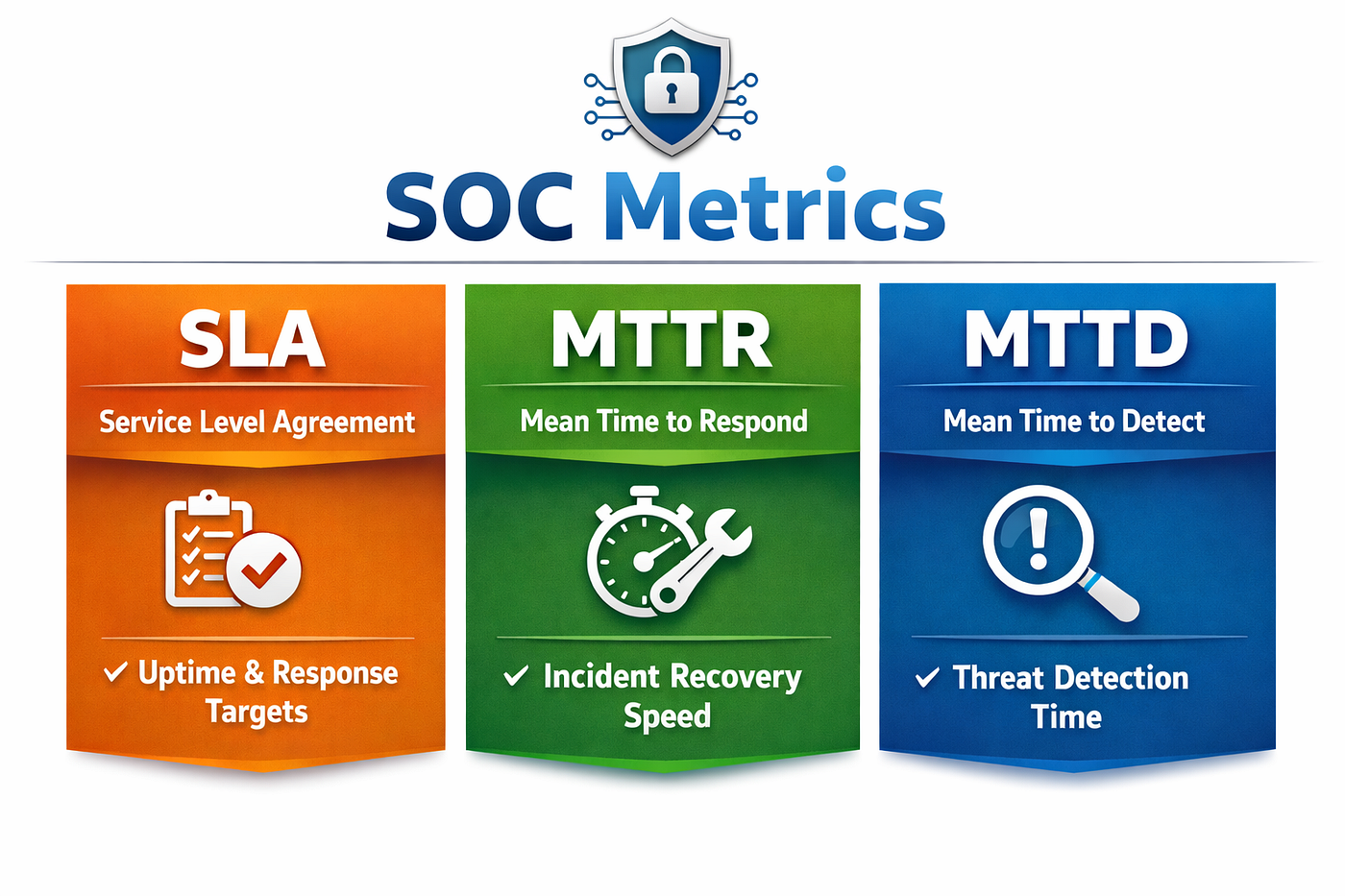
In a Security Operations Center (SOC), detecting threats is not enough. What truly matters is how quickly threats are detected, how efficiently they are handled, and whether commitments to the business are met. This is where SOC metrics such as SLA, MTTD, and MTTR play a critical role.
These metrics help organizations measure SOC performance, improve incident response, and reduce business impact.
Why SOC Metrics Matter
- Measure SOC efficiency and maturity
- Identify process and tooling gaps
- Reduce incident impact and downtime
- Improve customer trust and compliance
- Prevent alert fatigue and SLA breaches
A mature SOC continuously monitors and improves these metrics.
1. SLA (Service Level Agreement)

What is an SLA?
An SLA (Service Level Agreement) is a formal commitment between the SOC and the business or customer that defines how quickly security alerts and incidents must be acknowledged, investigated, and escalated.
SLA is not a metric of performance — it is a target or promise.
SOC Example of SLA
Critical (P1) — 15 minutes High (P2) — 30–60 minutes Medium (P3) — 4 hours Low (P4) — 24 hours
If a critical incident is not acknowledged within 15 minutes, it results in an SLA breach.
What SLA Means for a SOC Analyst
- Alerts must be acknowledged quickly
- Tickets must be updated regularly
- Escalation must happen before SLA expiry
- Poor ticket hygiene can cause SLA violations
Why SLA Is Important
- SLA breaches may cause financial penalties
- Impacts customer satisfaction
- Reflects SOC reliability
- Used in SOC performance reporting
2. MTTD (Mean Time to Detect)

What is MTTD?
MTTD (Mean Time to Detect) measures the average time taken to identify a security incident after it has begun.
It reflects how effective monitoring, logging, and detection mechanisms are.
MTTD Formula (Conceptual)
MTTD = Time incident is detected − Time incident started
Real SOC Example
- Attack begins at: 10:00 AM
- SIEM alert generated at: 10:12 AM
➡ MTTD = 12 minutes
Why MTTD Matters
- Lower MTTD = earlier detection
- Reduces attacker dwell time
- Limits lateral movement and data loss
- Indicates strong SIEM rules and visibility
What Improves MTTD?
- Well-tuned SIEM correlation rules
- Endpoint Detection & Response (EDR)
- Threat intelligence integration
- Continuous log ingestion
- Proactive threat hunting
3. MTTR (Mean Time to Respond / Resolve)

What is MTTR?
MTTR (Mean Time to Respond or Resolve) measures the average time taken to contain, eradicate, and recover from an incident after detection.
It reflects SOC response efficiency.
MTTR Formula (Conceptual)
MTTR = Time incident resolved − Time incident detected
Real SOC Example
- Incident detected at: 10:12 AM
- Endpoint isolated and threat removed at: 11:02 AM
➡ MTTR = 50 minutes
Why MTTR Matters
- Lower MTTR = less business disruption
- Reduces system downtime
- Prevents further exploitation
- Shows effectiveness of incident response playbooks
What Improves MTTR?
- Clear SOC playbooks
- Automation (SOAR)
- Proper escalation paths
- Skilled analysts
- Accurate incident scoping
SLA vs MTTD vs MTTR (Comparison)
- SLA: Expected response time → Compliance
- MTTD: Detection speed → Visibility
- MTTR: Response & recovery speed → Effectiveness
How These Metrics Work Together
- MTTD determines how fast you see the attack
- MTTR determines how fast you stop the attack
- SLA ensures you meet business expectations
A strong SOC focuses on reducing MTTD and MTTR while consistently meeting SLA.
Common Mistakes in SOC Metrics
- Meeting SLA but missing real threats
- High false positives increasing MTTR
- Poor documentation causing delays
- Over-reliance on tools without tuning
SOC Analyst Practical Tips
- Acknowledge alerts immediately
- Follow playbooks strictly
- Document every action clearly
- Escalate early if unsure
- Keep SLA always in mind
Final Thoughts
SOC metrics are not just numbers — they represent how well an organization can defend itself against cyber threats. A mature SOC continuously works to reduce detection and response time while meeting SLA commitments.
Understanding these metrics is essential for every SOC analyst, especially at the entry level
메타데이터
- post_id
- e43d9ac8f49f
- slug
- soc-metrics-explained-sla-mttd-and-mttr-e43d9ac8f49f
- url
- https://systemweakness.com/soc-metrics-explained-sla-mttd-and-mttr-e43d9ac8f49f
- canonical_url
- https://systemweakness.com/soc-metrics-explained-sla-mttd-and-mttr-e43d9ac8f49f
- author_url
- https://medium.com/@Archana-p01
- status
- ok
- fetched_at
- 2026-06-20 20:29:01