Decentralized cloud storage with blockchain: A technical comparison of Filecoin, Storj, and IPFS…
As the CTO of a leading EdTech platform overseeing multi-cloud operations, I’ve spent years architecting and scaling systems across AWS…
Decentralized cloud storage with blockchain: A technical comparison of Filecoin, Storj, and IPFS for enterprise use
As the CTO of a leading EdTech platform overseeing multi-cloud operations, I’ve spent years architecting and scaling systems across AWS, GCP, and Azure. Centralized cloud storage provides impressive flexibility and scalability. At the same time, it exposes users to risks such as vendor lock-in, regional failures, and centralized control. When a critical dependency fails, teams usually fix the immediate issue but rarely question the underlying architectural fragility that caused it.
Over time, I’ve come to view storage as one of our stack’s most strategic yet brittle layers. A single region misconfiguration, billing anomaly, or vendor policy shift can cascade into outages or compliance challenges. This realization led me to explore decentralized storage technologies as a methodical effort to de-risk our infrastructure.
I aim to evaluate whether decentralized storage can deliver on its promises of resilience, cost efficiency, and data sovereignty without introducing unacceptable operational complexity. This blog represents the first step in that analysis: a technical comparison of Filecoin, Storj, and IPFS, and their suitability for enterprise environments. This analysis will inform our next phase of testing these platforms in production environments.
Why enterprises evaluate decentralized storage
Decentralization replaces a single trusted entity with a network of mutually untrusting participants governed by protocol rules. This model fundamentally reduces exposure to any company’s failures or policy changes. It offers a path to storage without ceding control to a third-party jurisdiction for data with high sovereignty requirements. Furthermore, blockchain-based ledgers provide an immutable, auditable data storage and retrieval trail. This enables programmable incentives and transparent verification, turning storage into a verifiable commodity market rather than a closed service, providing a strategic advantage.
This diagram illustrates the fundamental shift from a hub-and-spoke model to a peer-to-peer (P2P) network.
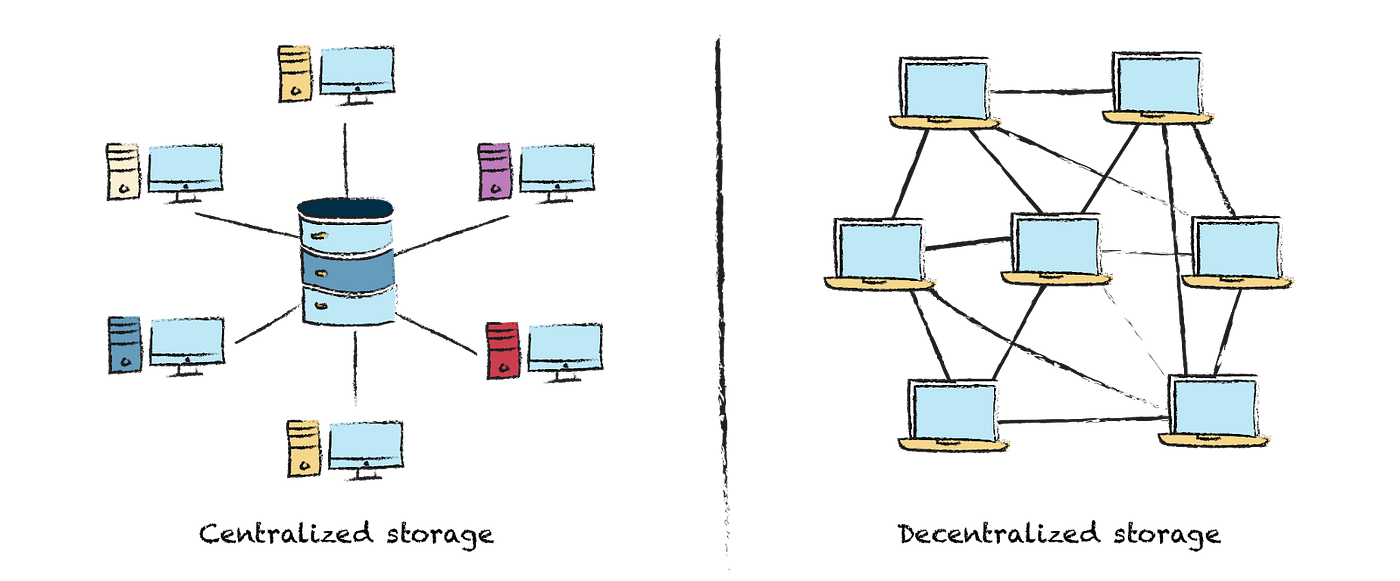
Architectural differences between centralized and decentralized cloud storage models
Understanding this architectural divergence is key. This is a different operational paradigm with new failure modes and new opportunities for resilience. It should not be seen as just a different provider.
Content addressing and distributed hash tables
To evaluate these systems, we must first understand their foundation. Unlike traditional storage that retrieves data by its location (e.g., s3://bucket/folder/file.jpg), decentralized systems primarily use content addressing. Each piece of data is identified by a cryptographic hash of its contents, known as a Content Identifier (CID). This means the identifier QmXoypizjW3WknFiJnKLwHCnL72vedxjQkDDP1mXWo6uco will always point to the same data, regardless of storage location. This design provides the immediate benefits of data integrity and automatic deduplication. If a single bit flips, the hash changes, and the data is recognized as different. If the same file is uploaded twice, it’s stored once.
The next challenge is locating the data. How do you find a piece of content on a network of thousands of nodes without a central index? This is solved using a distributed hash table (DHT). A DHT is a distributed key-value store where each node in the network is responsible for a small portion of the overall hash table. When a client wants to retrieve data, it calculates the CID, queries the DHT to find which peers store that content, and connects to them directly. This makes the network scalable and resilient. There is no central server to fail. The InterPlanetary File System (IPFS) is the foundational protocol that masterfully demonstrates these principles. Both Filecoin and, to a lesser extent, Storj build upon these core primitives.
This workflow visualizes how a file is processed and located on a decentralized network.

This mechanism is effective because it decouples the data you want from its current state. The next step is understanding how different platforms build incentives and guarantee layers on top of this foundation.
Architectural overview of Filecoin, Storj, and IPFS
Decentralized storage, from protocol-level foundations to full-fledged, incentive-driven services, rests on a spectrum. IPFS provides the how of decentralized data exchange, but not the why. It defines how content can be addressed and shared without central servers, but doesn’t ensure persistence, reliability, or economic motivation. For enterprises, those guarantees require incentives, governance, and verifiable accountability. Filecoin and Storj use distinct approaches to build sustainable, verifiable storage ecosystems on top of decentralized primitives.
Filecoin’s market approach to storage
Filecoin, developed by Protocol Labs, is a decentralized marketplace for storage built around cryptographic proofs and economic incentives. While Filecoin complements IPFS and shares its underlying technologies, it operates as a separate blockchain designed specifically for verifiable, long-term data persistence.
Core mechanisms:
- Proof-of-replication (PoRep): A storage provider (miner) proves they have created a unique, physical copy of the client’s data at the time of the deal.
- Proof-of-spacetime (PoSt): The provider continuously proves they are storing that data over an agreed period.
If providers fail these proofs, their collateral staked in **FIL tokens** is slashed. This structure creates strong economic incentives for uptime and reliability. Enterprises can make custom “storage deals” with providers through the open market, balancing cost, duration, and geographic diversity. The design makes Filecoin ideal for auditable, archival-grade storage where verifiable proofs matter as much as redundancy.
Simplifying cloud storage with Storj
Storj approaches decentralized storage from a usability-first perspective. Rather than relying on on-chain proofs, it enforces reliability through cryptographic redundancy, client-side encryption, and ongoing audits.
When data is uploaded to Storj:
- It’s encrypted end-to-end on the client side.
- The encrypted data is divided into 80 or more pieces using erasure coding.
- Those pieces are distributed across thousands of independent storage nodes worldwide.
Only 29 pieces are required to reconstruct the original file, enabling robust fault tolerance even if many nodes go offline. Storj’s infrastructure is managed through satellites, storage nodes, and Uplink clients, and it coordinates reputation, auditing, and repair. While payments and node rewards use an Ethereum Layer 2 network, enterprise users interact through familiar interfaces, including an S3-compatible API, making Storj nearly a drop-in replacement for conventional cloud storage.
The key **differentiator between Filecoin and Storj **is that Filecoin relies on on-chain economic proofs for verifiability, while Storj depends on mathematical redundancy and a reputation system for operational trust. Filecoin prioritizes auditability and persistence, while Storj prioritizes performance, security, and ease of adoption.
The foundation of decentralized data
IPFS (InterPlanetary File System) remains the base protocol for decentralized content addressing. It’s optimized for content distribution, Web3 integration, and peer-to-peer data sharing, but lacks built-in incentives or persistence guarantees. Without pinning or integration with an incentive layer (like Filecoin), IPFS data may eventually disappear. This makes IPFS excellent for content delivery and inter-protocol interoperability, but insufficient for enterprise-grade durability.
Comparison of Filecoin, Storj, and IPFS Across Key Decentralized Storage Features

Evaluating storage economics and cost structure
Cost predictability and transparency are as critical as performance or availability for any production-grade system. Decentralized storage networks challenge traditional billing conventions by introducing market dynamics, tokenized incentives, and sometimes volatile pricing. Understanding these models is important for enterprise financial planning and procurement alignment.
- Filecoin operates as a decentralized marketplace where storage providers set prices based on supply, demand, capacity, and reputation. Typical rates average around $0.19 per TB per month, though costs can fluctuate with the FIL token and network gas fees. This market model offers the possibility of extremely low storage costs, but budgeting can become complex due to token volatility and deal variability.
- For organizations with predictable workloads, Filecoin’s elasticity is both an opportunity and a risk. A practical challenge lies in maintaining deal continuity and availability guarantees. Data must be regularly renewed and retrieved across a globally distributed network, adding administrative and monitoring complexity.
It’s best suited for archival or infrequently accessed datasets, where optimizing for long-term cost precedes short-term billing stability.
Beginner’s tip: When evaluating Filecoin, model your costs based on a pessimistic forecast for the FIL token and network transaction fees (gas) to avoid surprises.
- Storj’s pricing is intentionally designed for financial predictability. It offers fixed global storage rates, currently $4/TB monthly, with no hidden transfer fees. This structure mirrors the simplicity of AWS S3 Standard-IA but without unpredictable bandwidth charges. Payments to storage node operators are handled in STORJ tokens via Ethereum Layer 2, but enterprise customers can transact in fiat or credit card through managed billing partners. This abstraction ensures that enterprises benefit from decentralized infrastructure without navigating token economics. The result is a cost-stable, S3-compatible model that aligns with standard cloud budgeting and procurement workflows. This model is ideal for production workloads requiring predictable monthly operating expenses. That said, retrieval latency and compliance verification can pose practical challenges, especially for enterprises with performance-sensitive or regulated workloads.
- IPFS has no native cost structure. Storage is free to run your nodes or rely on the public network. However, this comes with no guarantees. Data persists only as long as at least one node on the network chooses to “pin” it. For guaranteed persistence, you must use a third-party pinning service, which effectively re-centralizes the service and introduces its costs.
Here is a breakdown of how these models impact financial planning:

The choice here is a classic trade-off between market-driven potential savings and fixed-price operational stability.
Security, privacy, and operational risk
Security in a decentralized system is about protocol-level guarantees and cryptographic verification. My team evaluates these platforms based on their ability to ensure confidentiality, integrity, and availability without a central authority.
- Storj is designed with privacy as a first principle. All files are encrypted client-side with user-controlled keys before being uploaded. They are then erasure-coded and spread across a vast network of nodes, such that no single node operator holds more than a fraction of any file. An attacker would need to compromise dozens of nodes across different jurisdictions and operators to reconstruct a single file, all without the encryption key. This is a very strong confidentiality posture.
Attention: While Filecoin’s proof systems attest to storage integrity, encryption is not handled at the protocol level. Client-side encryption is the user’s critical responsibility.
- Filecoin’s security model focuses on integrity. The economic stakes are high. Storage providers must lock up significant FIL collateral to participate. Any failure to provide Proof-of-Spacetime results in financial penalties. This makes data loss an expensive event for the provider, creating a powerful incentive for reliability. However, confidentiality is not built-in. Filecoin does not encrypt user data by default; encryption must be applied client-side before upload. This deliberate architectural choice is common across decentralized storage systems to keep verification transparent and independent of user data. For enterprises, incorporating end-to-end encryption into their workflow is not optional but essential.
- IPFS, as a public file-sharing network, offers no native privacy. All data addressed by its CID is publicly accessible to anyone who has that CID. The hash itself does not reveal the content. However, it is not a confidentiality mechanism. Like Filecoin, secure enterprise use of IPFS requires a robust client-side encryption strategy. Its primary security feature is integrity. Content addressing guarantees that the file you retrieve is the exact file you requested.
How redundancy and availability are ensured
In my experience, system availability is a function of well-designed redundancy. Centralized systems achieve this with multi-region or multi-AZ architectures, while decentralized systems achieve it through fundamentally different means.
- Storj uses Reed-Solomon erasure coding to provide exceptional durability. As mentioned, a file is encrypted and split into 80 pieces; only 29 are needed for recovery. This means over 60% of the nodes storing a file’s fragments can go offline simultaneously without impacting data availability. Because nodes are geographically and jurisdictionally diverse, this provides resilience against large-scale network outages, natural disasters, and political censorship. It is a mathematically robust approach to high availability.
- Filecoin’s model is market-driven. Redundancy is not automatic. It is configured by the user when they create a storage deal. An enterprise can choose to deal with multiple storage providers in different regions to achieve its desired level of redundancy. This offers flexibility but also places the operational burden of managing replication on the user. Tools like FileInsurer are emerging to help manage and underwrite this risk, but it is a newer, more dynamic model than Storj’s built-in approach.
Note: The operational overhead of managing replication deals on Filecoin is a key consideration. It requires active management, whereas Storj’s redundancy is a passive protocol feature.
- IPFS does not provide service-level agreements (SLAs). Data availability is based on “best-effort” persistence. A file remains available if someone on the network finds it valuable enough to pin. Relying on the public network for critical data is not viable for an enterprise. You must run your IPFS nodes or use a pinning service to ensure your data persists, which adds operational complexity and cost.
The choice depends on your risk appetite and operational capacity. You can choose between built-in cryptographic redundancy and user-managed, market-based replication.
Latency and throughput under enterprise load
Performance is a non-negotiable requirement for many enterprise workloads. We measure retrieval latency and sustained throughput to determine a system’s viability for anything other than cold archival.
- Storj is architected for performance comparable to hot cloud storage. It can often saturate a client’s downstream bandwidth by retrieving erasure-coded pieces from the fastest-responding nodes in parallel. Its decentralized architecture can also reduce latency for globally distributed users by serving data from nearby nodes. This makes it suitable for active workloads like content delivery, large file sharing, and even database backups that require timely recovery.
- By contrast, Filecoin is generally optimized for storage cost and verifiability. It is not ideal for low-latency retrieval. Retrieval times can vary depending on the storage provider, network conditions, and deal terms. Some providers may keep data in cold storage, introducing significant delays (hours) for retrieval. While faster retrieval markets are developing, Filecoin is best-suited for “write-once, read-rarely” archival use cases where latency can be compromised.
Note: IPFS performance is highly dependent on content popularity and network topology. Popular content cached on many nodes can be retrieved very quickly. Obscure data stored on a single node in a poorly connected region may be slow or impossible to retrieve.
- Throughput on IPFS is unpredictable. It relies on the peer-to-peer connections you can establish to nodes storing the data. For enterprise use, performance can be made more consistent by running a dedicated IPFS node or cluster and carefully managing which peers you connect to, but this again adds significant operational overhead. Without such measures, performance is compromised.
Enterprise integration and ecosystem maturity
A technologically superior platform with a poor developer experience will fail to gain adoption. Integration friction is a major risk.
- Storj leads in this category due to its S3-compatible API. The transition is minimal for any engineering team already using S3. Existing tools, SDKs, and infrastructure-as-code scripts can be pointed to the Storj gateway with minor configuration changes. This significantly lowers the barrier to entry and makes it feasible to integrate Storj into existing cloud-native applications without a major rewrite. Several production deployments already leverage this advantage.
- Filecoin’s ecosystem is growing rapidly, but is less mature from an enterprise integration standpoint. Tooling is often specific to the Filecoin network, requiring developers to learn new APIs and concepts. While progress is being made on multi-cloud orchestration and compliance tooling, it requires more specialized engineering effort to integrate than Storj.
- IPFS has a vibrant developer ecosystem, particularly in the web3 space. Its strength is protocol composability. However, it lacks the operational and management tools enterprises expect for production workloads. Monitoring, access control, and SLO management are left as exercises for the user.
Best-fit scenarios, edge cases, and what to avoid
The correct choice depends entirely on the workload’s technical and business requirements. There is no single best platform.
- If you need S3 compatibility, strong privacy by default, and predictable costs, choose Storj. It is the best fit for active archives, large media file distribution, and backups where fast, reliable retrieval is essential. Its design minimizes operational overhead.
- If your priority is auditable, long-term archival at the lowest possible cost, and you can manage market volatility, choose Filecoin. It is ideal for massive datasets with low retrieval frequency, such as scientific data, video archives, or compliance records.
- If you are building open protocols, public data commons, or content-addressable applications, use IPFS. It is a powerful primitive for Web3, but it shouldn’t be used alone for critical enterprise storage without a dedicated persistence strategy (e.g., a pinning service or your own nodes).
Be mindful that Storj is S3-compatible. A full feature parity check is necessary because it does not replicate every niche S3 feature. Avoid using public IPFS for sensitive or mission-critical data without a robust encryption and pinning layer. Avoid Filecoin for latency-sensitive applications.
Summary and technical decision checklist
Decentralized storage is no longer a theoretical experiment. Filecoin, Storj, and IPFS represent three distinct points in the design space, each with clear trade-offs. Storj offers an operationally simple, secure, and performant on-ramp for enterprises. Filecoin provides a powerful, verifiable, and potentially very low-cost market for archival. IPFS remains the foundational protocol for the decentralized web.
When my team evaluates these systems, we use a simple checklist.
- Cost model: Is predictable OpEx or the lowest possible cost the priority?
- Performance: What are the latency and throughput requirements for this workload?
- Security: Is privacy built-in, or is client-side encryption sufficient?
- Integration: How much engineering effort can we commit to integration and ongoing operations?
From here, the path is experimentation. We’ll run small, measurable pilots to evaluate cost behavior, retrieval latency, and integration effort across Filecoin and Storj. Those results will inform where decentralized storage fits within our production stack and whether it can meet our standards for reliability and governance.
메타데이터
- post_id
- e455f7a7d42b
- slug
- decentralized-cloud-storage-with-blockchain-a-technical-comparison-of-filecoin-storj-and-ipfs-e455f7a7d42b
- url
- https://medium.com/@naeemulhaq/decentralized-cloud-storage-with-blockchain-a-technical-comparison-of-filecoin-storj-and-ipfs-e455f7a7d42b
- canonical_url
- https://medium.com/@naeemulhaq/decentralized-cloud-storage-with-blockchain-a-technical-comparison-of-filecoin-storj-and-ipfs-e455f7a7d42b
- author_url
- https://medium.com/@naeemulhaq
- status
- ok
- fetched_at
- 2026-07-15 07:04:54