Solar Facades for IT Parks & Corporate Campuses: A Guide
As sustainability becomes a core priority in modern infrastructure, IT parks and corporate campuses are increasingly shifting toward…
Solar Facades for IT Parks & Corporate Campuses: A Guide
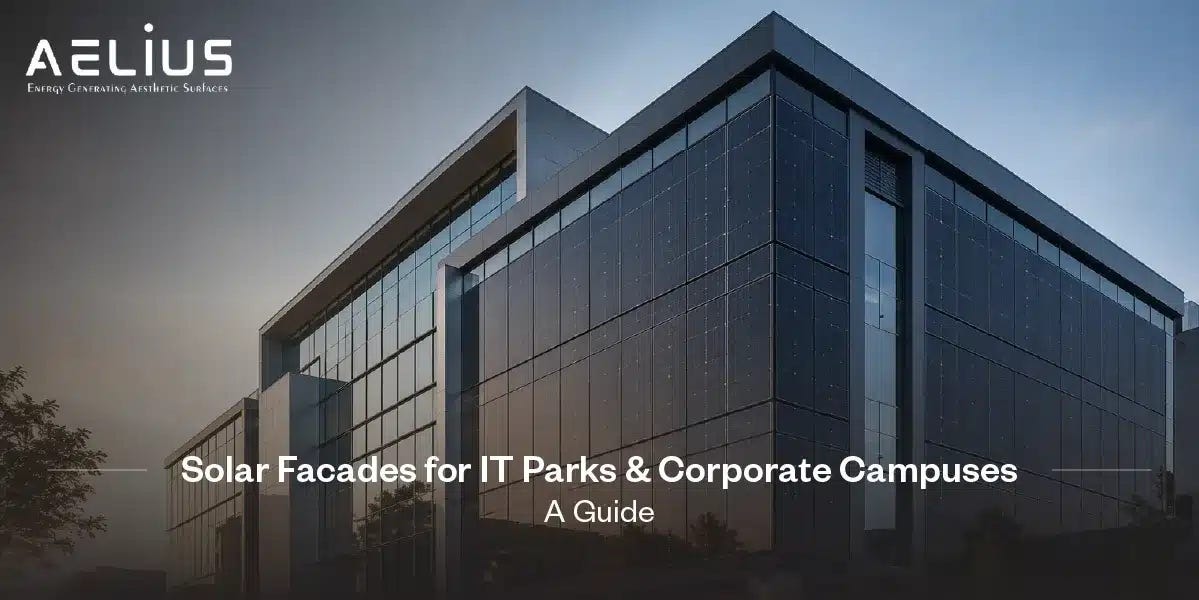
As sustainability becomes a core priority in modern infrastructure, IT parks and corporate campuses are increasingly shifting toward energy-efficient architectural solutions. One of the most impactful innovations in this space is the integration of solar facades, particularly through Building-Integrated Photovoltaics (BIPV). These systems not only generate renewable energy but also redefine how large commercial buildings are designed and operated.
What Are Solar Facades?
Solar facades are building exteriors embedded with photovoltaic technology that converts sunlight into electricity. Unlike traditional rooftop solar panels, these systems are integrated directly into the building envelope — walls, glass panels, and shading structures — making energy generation a seamless part of architectural design.
For IT parks and corporate campuses, which typically feature large glass surfaces and expansive buildings, solar facades offer a highly efficient way to utilize vertical spaces for power generation without compromising aesthetics.
Why IT Parks and Corporate Campuses Need Solar Facades
Corporate campuses are among the highest energy consumers due to continuous operations, data centers, HVAC systems, and lighting requirements. Solar facades address several key challenges:
- High energy demand offset through on-site generation
- Better use of vertical surfaces for energy production
- Support for ESG and net-zero commitments
- Enhanced architectural identity with modern, futuristic design
At the planning stage itself, architects are now focusing on **designing with BIPV**, ensuring that energy generation is not treated as an add-on but as a core part of the building’s visual and structural identity. This shift allows better optimization of sunlight exposure, façade orientation, and material performance.
Role of BIPV in Modern Facade Design
Building-Integrated Photovoltaics (BIPV) are at the heart of solar facade systems. Unlike conventional solar panels mounted on rooftops, BIPV elements replace traditional building materials such as glass, cladding, or shading devices.
In corporate campuses, BIPV can be used in:
- Curtain walls and glass facades
- Atrium skylights
- External shading louvers
- Spandrel panels and building skins
This integration ensures that energy generation becomes an inherent part of the building’s structure rather than an added system.
Design Considerations for Solar Facades
When implementing solar facades in IT parks and corporate campuses, several design factors must be considered:
- Orientation & sun path analysis
- Balance between transparency and energy generation
- Thermal performance and cooling load impact
- Structural integration with building envelope
- Visual harmony with overall architecture
Benefits for Corporate Infrastructure
Solar facades offer multiple long-term advantages for corporate environments:
- Reduced operational costs
- Energy independence through on-site generation
- Improved green building certifications
- Stronger sustainability branding
- Future-ready infrastructure aligned with global trends
Challenges and Limitations
While solar facades offer many benefits, they also come with challenges:
- Higher initial investment
- Complex design and engineering coordination
- Dependency on sunlight availability
- Maintenance and cleaning requirements
Despite these challenges, continuous advancements in BIPV technology are making adoption more practical and scalable.
The Future of Solar Facades in India
With rapid urbanization and rising energy demands, India is witnessing growing adoption of sustainable building technologies. IT hubs in cities like Mumbai, Bengaluru, and Hyderabad are especially well-positioned for solar facade integration due to their large-scale infrastructure and sustainability-driven corporate ecosystems.
Conclusion
Solar facades represent a powerful fusion of architecture and renewable energy, transforming IT parks and corporate campuses into self-sustaining ecosystems. By integrating BIPV systems early in the design process, organizations can achieve both aesthetic excellence and long-term energy efficiency.
The future of corporate architecture lies in smart, sustainable, and energy-generating structures driven by innovation and responsible design thinking. If you are exploring how such advanced solutions can be applied to your project, **connect with Aelius** to move toward a more intelligent and sustainable built environment.
메타데이터
- post_id
- e45f7f61f2ed
- slug
- solar-facades-for-it-parks-corporate-campuses-a-guide-e45f7f61f2ed
- url
- https://medium.com/@aeliusturbina2026/solar-facades-for-it-parks-corporate-campuses-a-guide-e45f7f61f2ed
- canonical_url
- https://medium.com/@aeliusturbina2026/solar-facades-for-it-parks-corporate-campuses-a-guide-e45f7f61f2ed
- author_url
- https://medium.com/@aeliusturbina2026
- status
- ok
- fetched_at
- 2026-06-26 21:52:29