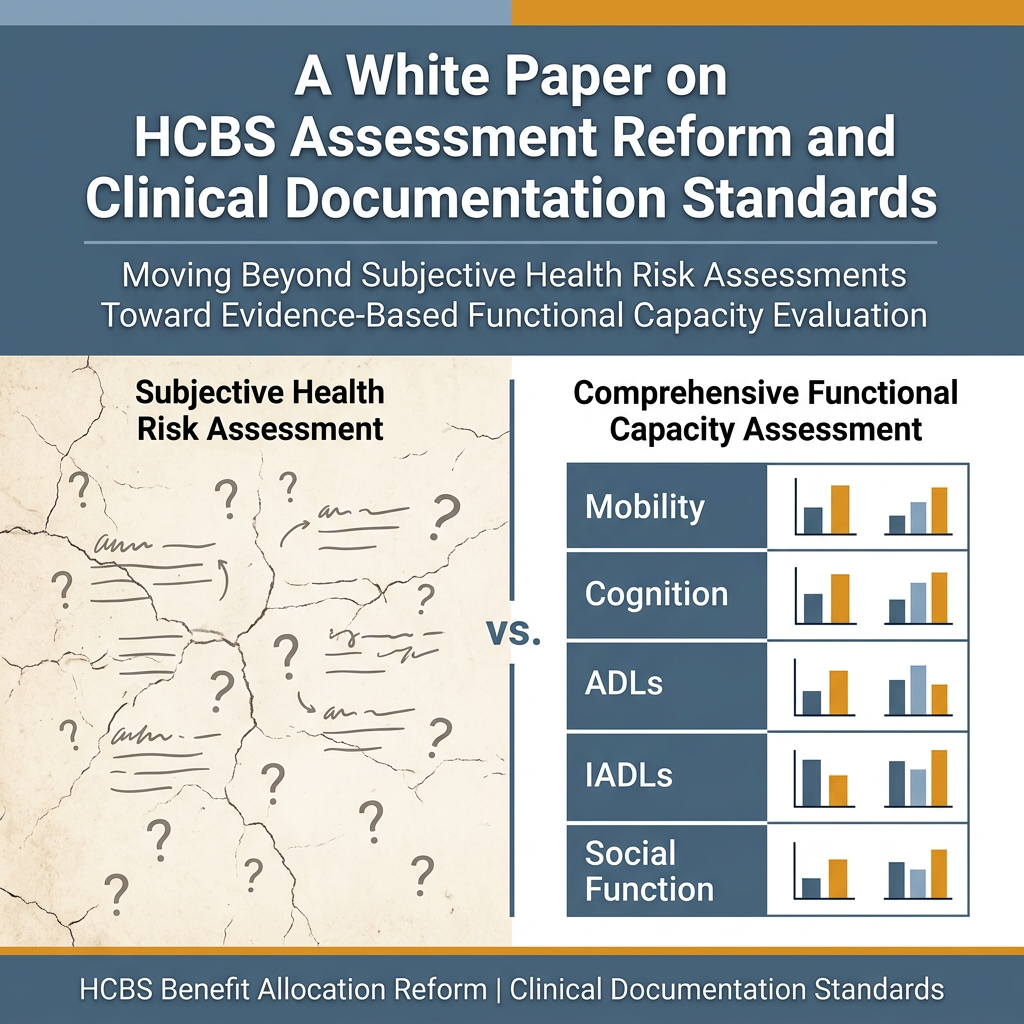
How Medicaid 1915(c) HCBS Waiver Case Management Practices Inherently Shape Patterns of Fraud…
May 2026
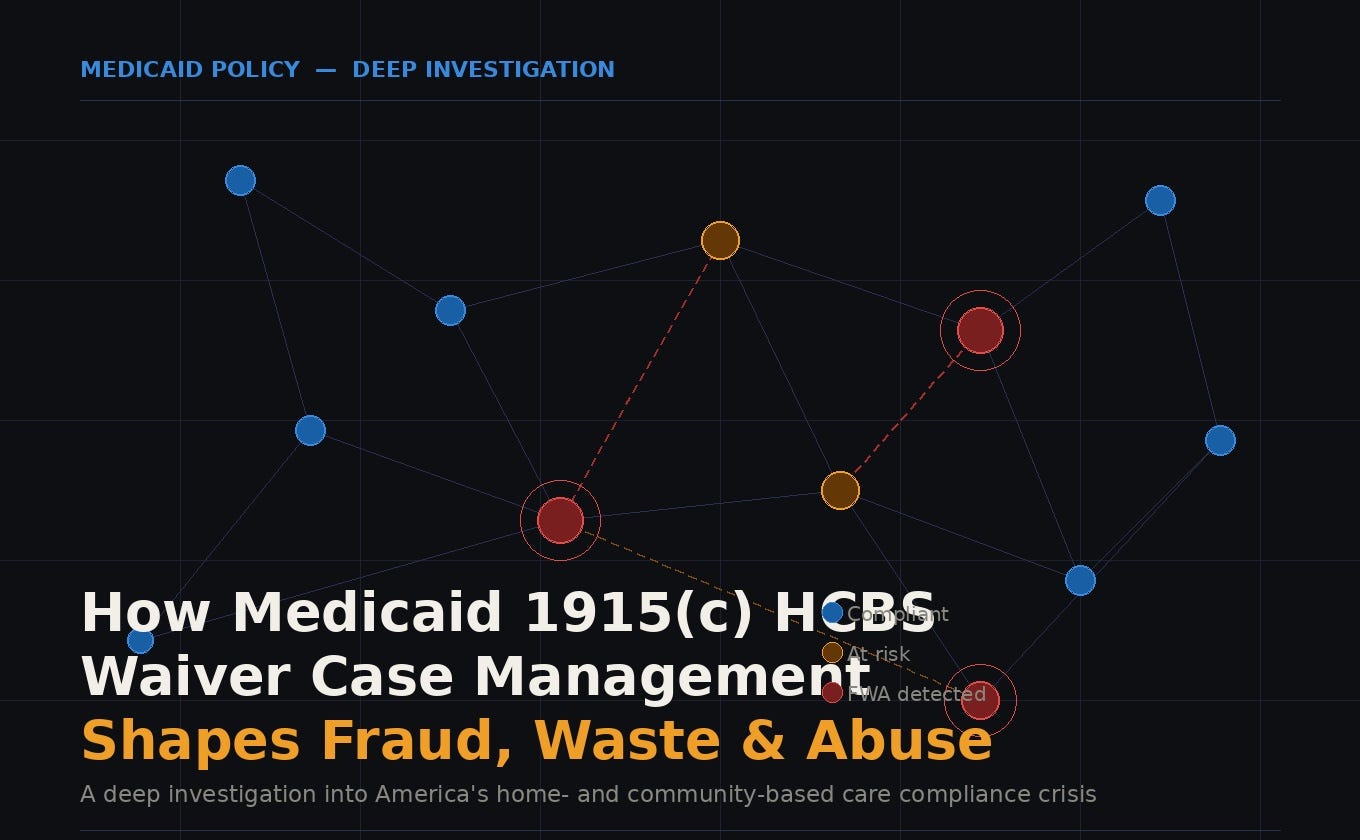
How Medicaid 1915(c) HCBS Waiver Case Management Practices Inherently Shape Patterns of Fraud, Waste, and Abuse
May 2026
A deep investigation into the hidden compliance crisis inside America’s home- and community-based care system, and what health plans, states, and case managers must do before it’s too late.
The System Was Built to Help. Then the Money Arrived.
Somewhere between Congress’s promise to keep disabled and elderly Americans living at home and the explosion of Medicaid Home and Community-Based Services (HCBS) spending, something went fundamentally wrong.
It didn’t happen because bad actors suddenly discovered an easy target — though they certainly did. It happened because the architecture of the 1915(c) waiver system, the very framework designed to expand access and respect individual preference, created a near-perfect environment for systemic fraud, waste, and abuse (FWA) to take root inside the case management function, and then flourish quietly, invisibly, and expensively, for years.
Today, the price tag is undeniable. Medicaid HCBS spending reached $95 billion in 2019 and has grown substantially since. In fiscal year 2024, states’ Medicaid Fraud Control Units (MFCUs) reported 1,151 convictions and $1.4 billion in total recoveries. Personal care service attendants alone accounted for 298 fraud convictions in FY 2024–36% of all MFCU convictions, more than any other provider type. And those numbers represent what was caught.
In Minnesota, federal prosecutors have estimated that fraud in state-run Medicaid HCBS programs may exceed $9 billion. In February 2026, CMS deferred $259.5 million in federal Medicaid funding, citing “unusually high spending and rapid growth” in personal care and HCBS.
But Minnesota is not the story. Minnesota is the symptom. The story is what happens inside the case management process — in every state, in every contracted health plan, at every authorization decision point — when clinical accountability yields to preference, convenience, or structural conflict of interest.
This article argues that Medicaid 1915(c) HCBS waiver case management, as commonly practiced, does not merely tolerate fraud, waste, and abuse. It inherently shapes it.
PART ONE
The Architecture of Risk
How 1915(c) Waivers Were Designed — and What That Design Missed
The 1915(c) Home and Community-Based Services waiver authority, created under the Omnibus Budget Reconciliation Act of 1981, allows states to waive certain federal Medicaid requirements in order to provide long-term services and supports (LTSS) to individuals who would otherwise require institutional care. The core promise is simple: give people the services they need to live in the community rather than in a nursing facility.
The case manager sits at the center of this promise. They assess the individual, translate that assessment into a person-centered service plan, authorize specific services and hours, monitor utilization, and, theoretically, adjust the plan when the individual’s condition changes. In a well-functioning system, the case manager is both the gateway to needed services and the firewall against unnecessary ones.
The problem is that the system has never been fully designed to enforce that firewall. Federal regulations at 42 CFR 441.301(c)(2)(xii) require that services under 1915(c) waivers be “commensurate with the level of need of the individual.” That is the standard. But operationalizing that standard has largely been left to states, and from states, to health plans, and from health plans, to individual case managers.
The result is a patchwork of accountability that, in practice, often means none at all.
The “Wants vs. Needs” Fault Line
Every HCBS case manager knows the tension. A participant wants 40 hours of personal care assistance per week. The standardized functional assessment supports 25. The participant’s family advocates forcefully. The case manager, facing caseloads of 50, 80, or 100 or more individuals, wants to maintain a cooperative relationship, move on to the next file, and avoid a formal appeal or grievance.
So the care plan reflects 40 hours. That decision, multiplied across thousands of case managers and hundreds of thousands of participants, is not a rounding error. It is the engine of HCBS waste.
CMS’s own training materials define waste as costs incurred when an individual receives more hours of service than their current functional status requires. The written plan of care must be commensurate with assessed need, not with expressed preference.
Yet the federal policy literature contains no widely cited empirical study that directly quantifies the share of HCBS FWA attributable to care-plan-level over-authorization. What we can measure is the environment that makes these losses inevitable.
PART TWO
The Hidden FWA Risks No One Is Tracking
The Cost of Invisible Over-Authorization
For states operating HCBS in fee-for-service mode, over-authorization results in direct Medicaid expenditures for services that exceed assessed need. For contracted health plans operating MLTSS or managed HCBS programs under capitation, over-authorized services inflate costs within a fixed capitation payment, eroding plan margins without triggering state “improper payment” flags. The plan absorbs the cost. The problem stays invisible.
A multi-state OIG review of HCBS waiver programs found that state agencies claimed at least $176.5 million in federal share of unallowable and unsupported Medicaid reimbursement for waiver services. Inadequate linkage between service plans and assessed needs was a consistent contributing factor.
Structural vulnerabilities identified by federal oversight include:
• “Set-and-Forget” Care Plans. Once established, a care plan may not be reassessed when a participant’s condition improves. Authorized hours continue to flow for months or years.
• Chronic Under-utilization Without Plan Adjustment. When a 40-hour weekly plan results in only 22 hours of actual delivery over a rolling quarter, that gap signals either over-authorization or service failure — both FWA risks. Few health plans have analytics that surface this at the case manager level.
• Conflict of Interest in Care Planning. Entities providing both case management and direct HCBS benefit allocation face inherent incentive conflicts, creating subtle pressure toward over-authorization even when separate staff nominally perform each function. This is the leading cause of problems among Medicaid contracted health plans.
The Minnesota Warning: When the Problem Becomes National News
Minnesota represents the most publicly visible manifestation of what happens when HCBS program integrity controls fail systemically. Between 2024 and 2026, the state’s Medicaid fraud crisis in personal care and HCBS became a national case study.
Since January 1, 2025, the Minnesota Department of Human Services has stopped payments to 636 providers based on credible allegations of fraud and has made more than 300 referrals to law enforcement. CMS deferred $259.5 million in federal Medicaid funding after rejecting the state’s initial corrective action plan. A federal prosecutor described one HCBS-adjacent benefit as so “easy to scam” that it attracted criminal entrepreneurs who traveled from other states specifically to exploit it.
The mechanisms that enabled Minnesota’s crisis — loose provider enrollment controls, inadequate service verification, insufficient care-plan auditing, and weak linkage between authorized services and assessed functional need are not unique to Minnesota. They are endemic to HCBS systems that have grown faster than their oversight infrastructure.
The National Enforcement Picture
States’ Medicaid Fraud Control Units recovered $2 billion in fiscal year 2025, from 1,185 criminal convictions and 674 civil settlements. Personal care services consistently represent the largest single category of MFCU convictions by provider type.
Electronic Visit Verification (EVV), mandated under the 21st Century Cures Act, has meaningfully reduced one category of fraud — billing for services not rendered. The average number of personal care fraud convictions exceeded 400 per year between 2015 and 2022, before EVV was fully in place. By FY 2024, that figure had fallen to 298.
But EVV addresses delivery-level fraud. It cannot confirm that authorized hours were clinically justified in the first place. That gap — between verified service delivery and needs-based service authorization — is where the most systemic and least visible FWA in HCBS resides.
PART THREE
The Clinical Competency Gap
Non-Clinical vs. Clinical Case Managers: Patterns That Inherently Produce FWA
One of the most consequential and least examined sources of HCBS FWA is not intentional fraud but structural incompetence — the systematic pattern of authorization decisions made by case managers who lack the clinical training to accurately interpret functional assessments or distinguish assessed need from participant preference.
The Medicaid case management workforce is not uniformly credentialed. Across states and health plans, 1915(c) waiver case managers may be registered nurses, licensed clinical social workers, bachelor ’s-level social workers, or individuals with no clinical credential at all. The overwhelming majority of health plans hire non-clinical case managers because it is more cost-effective than hiring nurses. Health plans cite waiver programs' benefits are services and supports, authorizations, and not deemed clinical; therefore, clinical expertise is not required. In pursuing this course of action, it has created a predictable divergence in authorization patterns:
Non-Clinical Case Managers and Over-Authorization
Without clinical training to assess the objective validity of a reported functional limitation, non-clinical case managers are more likely to accept participant or family self-report at face value. They lack the frame of reference to connect the intensity of the requested service to the actual functional assessment score. The path of least resistance, particularly for a case manager with a high caseload and limited supervisory support, is to authorize what the participant requests and document the preference as justification.
Non-Clinical Case Managers and Under-Detection
Non-clinical case managers are also less likely to identify functional improvement that should trigger a step-down in services, less likely to recognize clinical red flags indicating a service is not being appropriately delivered, and less likely to make FWA referrals arising from case management observations. The HHS OIG has noted that most FWAs in HCBS/PCS are detected through billing anomalies or enforcement actions, rather than through the case management function.
Clinical Case Managers and the Opposite Risk — Under-Authorization
In managed care environments, clinical case managers may face productivity targets, cost-management pressures, or capitation incentives that push toward systematic under-authorization, denial, reduction, or termination of hours in ways that do not reflect assessed need and may trigger legitimate appeals or access-related quality failures. The FWA risk is not only in giving people more than they need. It is equally in giving people less.
Here lies the rub: health plans are plagued by this every day, yet continue to fail to address it appropriately. CMS guidance is explicit: person-centered plans must reflect enrollee goals and preferences while remaining consistent with functional needs and coverage standards. Over-authorization driven by preference and under-authorization driven by cost pressure are two manifestations of the same underlying failure: care planning disconnected from objective clinical assessment. Therefore, HCBS waiver benefits are service/support benefits, but are clinically rooted and need to be addressed as such.
What Good Authorization Actually Requires
Federal guidance and state training materials consistently describe a single standard for needs-based authorization: each authorized HCBS service and number of units should be explicitly linked to a specific assessed need or goal documented in the functional assessment. Material deviations should require supervisory review and documented clinical justification.
Kentucky’s 1915(c) service authorization training materials identify supervisory review of person-centered service plans as a best practice specifically to protect against FWA and adverse monitoring findings. The reality, in many health plans and waiver programs, is that supervisory review is infrequent, inconsistently applied, and largely limited to documentation completeness rather than clinical appropriateness.
PART FOUR
Why Some States Catch Fraud Faster
A Comparative Analysis of State Capability
The speed and effectiveness with which states detect HCBS fraud reflect deliberate policy choices about data infrastructure, organizational authority, provider enrollment controls, and the integration of case management into the broader program integrity apparatus. States that detect HCBS fraud faster tend to share several structural characteristics:
1. Strong EVV Implementation with Real-Time Exception Reporting
States with mature EVV programs have built automated exception rules, patterns that trigger immediate review rather than retrospective audit, including GPS location anomalies, visit duration outliers, service delivery during known hospitalization periods, and simultaneous service delivery across locations.
2. Integrated Data Matching Across Programs
The Public Assistance Reporting Information System (PARIS), required as a condition of enhanced federal Medicaid systems support since 2009, allows states to identify individuals receiving benefits in multiple states. States that extend integration to unemployment insurance, vital records, incarceration records, and other databases close the most common vectors for fraud in HCBS.
3. Analytics-Driven Case Manager Outlier Detection
Leading-edge state programs use authorization data to identify case managers whose approval patterns are statistical outliers, those who consistently authorize hours significantly above the normative range for their participants’ assessment tier, who rarely adjust care plans following reassessment, or who generate a disproportionate share of authorizations for specific vendors. This remains underutilized in most HCBS programs.
4. Rapid Payment Suspension Authority
Minnesota’s aggressive use of administrative payment suspension, stopping payments to 636 providers based on credible allegations since January 2025, with more than 300 referrals to law enforcement, demonstrates the value of clear statutory authority to act quickly on fraud signals before losses accumulate further.
5. Pre-Enrollment Screening with Meaningful Thresholds
States with the lowest HCBS fraud rates tend to have more rigorous provider enrollment screening, including physical site visits, license verification, background check requirements for all direct care workers, and periodic revalidation. The ease of becoming a Medicaid HCBS provider in many states, particularly for non-licensed personal care services, remains a fundamental vulnerability.
Where the Gaps Are Widest
The Senate Special Committee on Aging has noted that, in the absence of national quality standards for HCBS, it remains impossible to compare states’ programs on a standardized scorecard, as CMS compiles for other Medicaid elements. States with the weakest fraud detection capabilities have no national benchmark against which to assess or be held accountable for their deficiencies.
The April 2024 CMS Final Rule on access to Medicaid services established enhanced reporting and transparency requirements for HCBS programs. These requirements will create more comparative data over time. But the rule does not directly mandate the program integrity analytics infrastructure that distinguishes fast-detecting states from slow ones.
PART FIVE
How Contracted HCBS Health Plans Can Perform FWA Audits
The Managed Care Accountability Framework
Under 42 CFR 438.608, Medicaid managed care organizations operating MLTSS or managed HCBS programs have affirmative obligations to maintain program integrity — including maintaining a compliance program, training staff to detect and report potential FWA, and referring credible fraud allegations to the state Medicaid agency or MFCU within defined timeframes.
The following framework describes what a genuinely effective contracted HCBS health plan FWA audit program looks like , drawing on federal guidance, state health plan audit findings, and emerging industry practice.
1. Care Plan Accuracy Auditing Against Functional Assessments
The core audit question for case management FWA is simple: Does the authorized service plan reflect what the functional assessment actually documents? Effective care plan auditing samples records across case managers, regions, and assessment score tiers, and applies a structured review instrument evaluating:
• Assessment-to-Plan Linkage: Is each authorized service explicitly tied to a specific assessed need or functional limitation documented in the assessment?
• Deviation Documentation: Where authorized services significantly exceed the normative range for the participant’s assessment tier, is there documented clinical justification reviewed by a clinical supervisor?
• Reassessment Timeliness and Outcome: Was the reassessment completed within required timeframes? Did it result in any care plan adjustment?
• Chronic Under-utilization Flags: Does the participant consistently use significantly fewer hours than authorized? If so, was a care plan review triggered?
Kansas has operationalized this approach through its MCO-delegated HCBS provider qualification audit program, under which the three state-contracted MCOs jointly retained an external auditor to conduct annual audits of all HCBS providers. The 2024 expansion to a full audit covering both general and service-related waiver provider qualifications represents a meaningful advance.
2. Case Manager-Level Analytics
Health plans with robust program integrity infrastructure should generate, at a minimum, the following analytics at the case manager level on a quarterly basis:
• Authorization outlier ratios: Authorized weekly hours per participant, stratified by functional assessment tier, compared to plan-level and state-level norms.
• FWA Referral Rates: Number of FWA referrals originating from case management per 1,000 LTSS enrollees. Zero referrals over a full year is not a signal of a fraud-free caseload.
• Chronic Under-utilization Rates: Percent of enrolled participants with greater than 25% of authorized hours consistently unused over a rolling three-month period.
• Assessment-to-Plan Divergence Rates: Percent of care plans audited with material deviations from assessment-supported service levels, without documented supervisory review.
3. Pre-Payment vs. Post-Payment Controls
Prepayment controls for HCBS case management include automated clinical review of authorizations that exceed normative thresholds, supervisory approval requirements for high-tier authorizations, and EVV-based service verification integrated into the authorization workflow.
Post-payment controls include retrospective utilization review comparing authorized to actual service delivery, structured care plan audits of a statistically valid sample, and targeted deep-dive audits of case managers or vendors identified as statistical outliers.
4. Conflict-of-Interest Auditing
Health plans must go beyond organizational attestations of COI compliance and conduct substantive auditing of how COI manifests in actual authorization behavior. This means identifying all case managers or case management entities with organizational or financial ties to direct service providers, oversampling authorizations from COI-flagged entities, comparing authorization patterns between COI-flagged and COI-clean relationships, and requiring enhanced documentation standards for any authorization that results in services delivered by a COI-flagged entity.
5. FWA Training with Measurement
Annual FWA training is necessary but not sufficient. Effective health plan programs measure training completion, test comprehension of red-flag indicators specific to HCBS personal care settings, and track FWA referral rates by case manager following training to assess behavioral impact.
Case managers should be trained not only on fraud recognition but on the affirmative duty to report and the protected status of good-faith FWA referrals — reducing the cultural reluctance to report concerns about participants, families, or vendors.
6. Financial Incentives Aligned With Integrity
A composite case management scorecard with meaningful financial at-risk components should weight assessment timeliness, care-plan completeness, assessment linkage, utilization appropriateness, and FWA detection outcomes, alongside enrollee experience measures. This balanced approach prevents both the over-utilization risk driven by compliance avoidance and the under-utilization risk driven by capitation cost pressure.
PART SIX
A Framework for Action
What Must Change and Who Must Change It
The systemic FWA risk embedded in Medicaid 1915(c) HCBS case management is not the product of malicious intent by the many thousands of dedicated case managers working in this field. It is the product of a system that has never adequately operationalized needs-based authorization, never built the analytics infrastructure to see authorization-level waste, and never aligned incentives to prioritize assessed need over expressed preference.
For CMS and Federal Oversight:
CMS should prioritize developing national benchmarks for authorization-to-assessment alignment that allow states and health plans to compare their performance. The HCBS Quality Measure Set, updated in April 2024, should incorporate authorization appropriateness indicators alongside access and experience measures. CMS should also develop a shared analytics framework for case manager outlier detection.
For State Medicaid Agencies:
States must establish minimum clinical credentialing standards for 1915(c) waiver case managers performing authorization functions. The current patchwork — which in some states requires no clinical credential at all for HCBS service authorization — is inconsistent with the clinical accountability that needs-based authorization demands. States should also mandate and monitor care plan accuracy auditing as a contractual requirement for all health plans operating MLTSS or managed HCBS programs.
For Contracted Health Plans:
Health plans operating MLTSS or managed HCBS programs should treat case management as their highest-risk program integrity domain. Plans should immediately develop or enhance case manager-level authorization analytics, implement structured care plan accuracy auditing tied to functional assessment scores, and build FWA training and referral performance into case management incentive structures.
For Case Managers:
Case managers should understand that person-centered care does not mean preference-driven authorization. The federal standard is clear: services must be commensurate with assessed need. Documenting participant preference as the justification for an authorization that materially exceeds assessed need is not person-centered practice. It is a waste and, in some contexts, enables downstream fraud by creating cover for service delivery that should never have been authorized.
The Reckoning That Is Already Here:
The fraud crisis in Medicaid HCBS is not a future risk. It is a present reality, measured in billions of dollars of federal and state expenditure, hundreds of criminal convictions per year, and the corrosive effect on public trust in a program that millions of the most vulnerable Americans depend on to live in the community rather than in an institution.
The solutions are not mysterious. They require clinical accountability in the authorization function, data infrastructure capable of surfacing case manager-level waste, structural separation of case management from service provision, and financial incentives that reward needs-based decision-making rather than approval volume.
What has been missing is not knowledge of the problem. The HHS OIG has documented it. CMS training materials describe it. State audit findings confirm it.
What has been missing is urgency. Minnesota made it urgent. The $259.5 million federal payment deferral made it urgent. The 2025 National Health Care Fraud Takedown, which charged 324 defendants in schemes totaling over $14.6 billion in alleged Medicare and Medicaid fraud nationwide, made it urgent.
If the 1915(c) HCBS waiver program is going to fulfill its promise, to support community living for people with disabilities and elderly individuals who deserve better than the institutional alternative, then the case management function at its center must be held to the clinical and integrity standards that promise requires.
The architecture of risk is not destiny. But it becomes destiny when we choose not to see it.
References
-
CMS/Medicaid. Monitoring Fraud, Waste & Abuse in HCBS Personal Care Services [Training]. https://www.medicaid.gov/medicaid/home-community-based-services/downloads/hcbs-3a-fwa-in-pcs-training.pdf
-
CMS/Medicaid. Conflict of Interest in HCBS Case Management [Presentation, July 2018]. https://www.medicaid.gov/medicaid/home-community-based-services/downloads/conflict-of-interest-hcbs-case-management-july2018_0.pdf
-
CMS/Medicaid. Increasing Fiscal Protections for Personal Care Services in HCBS. https://www.medicaid.gov/medicaid/home-community-based-services/downloads/hcbs-increasing-fiscal-protections-v6.pdf
-
HHS Office of Inspector General. Medicaid Personal Care Services Media Materials. https://oig.hhs.gov/newsroom/media-materials/medicaid-personal-care-services/
-
KFF. Understanding Medicaid Home Care Amid CMS Focus on Potential Fraud and Abuse (February 24, 2026). https://www.kff.org/medicaid/understanding-medicaid-home-care-amid-cms-focus-on-potential-fraud-and-abuse/
-
Kentucky CHFS. 1915(c) Service Authorization Training Slides. https://www.chfs.ky.gov/agencies/dms/dca/Documents/serviceauthorizationtrainingslides.pdf
-
KFF. 5 Key Facts About Medicaid Program Integrity. https://www.kff.org/medicaid/5-key-facts-about-medicaid-program-integrity-fraud-waste-abuse-and-improper-payments/
-
HHS OIG. State Agencies Claimed Unallowable and Unsupported Medicaid Reimbursements for HCBS Waiver Program Services (2016). https://oig.hhs.gov/reports/all/2016/state-agencies-claimed-unallowable-and-unsupported-medicaid-reimbursements-for-services-under-the-home-and-community-based-services-waiver-program/
-
Paragon Health Institute. Beyond Minnesota: Four Medicaid Services Vulnerable to Fraud (February 17, 2026). https://paragoninstitute.org/medicaid/beyond-minnesota-four-medicaid-services-vulnerable-to-fraud-and-the-case-for-stronger-cms-enforcement/
-
Home Health Care News. CMS Targets Medicaid Personal Care, HCBS In Sweeping Fraud Crackdown (February 26, 2026). https://homehealthcarenews.com/2026/02/cms-targets-medicaid-personal-care-hcbs-in-sweeping-fraud-crackdown/
-
Minnesota Reformer. U.S. Attorney: Fraud likely exceeds $9 billion in Minnesota-run Medicaid services (December 18, 2025). https://minnesotareformer.com/2025/12/18/u-s-attorney-fraud-likely-exceeds-9-billion-in-minnesota-run-medicaid-services/
-
Minnesota DHS. Program Integrity Fact Check (2025–2026). https://mn.gov/dhs/program-integrity/factcheck/
-
National Association of Medicaid Directors. Why and How States Are Addressing FWA (February 27, 2026). https://medicaiddirectors.org/resource/why-and-how-states-and-territories-are-addressing-fwa/
-
Georgetown CCF. Long-Standing State-Based Efforts to Combat Fraud Against Medicaid Continue to Improve (April 10, 2026). https://ccf.georgetown.edu/2026/04/10/long-standing-state-based-efforts-to-combat-fraud-against-medicaid-continue-to-improve/
-
Health Affairs Forefront. Unfounded Fraud Allegations Threaten Vital Medicaid HCBS (March 16, 2026). https://www.healthaffairs.org/content/forefront/unfounded-fraud-allegations-threaten-vital-medicaid-home-and-community-based-services
-
CMS. HCBS Quality Measure Set (QMS) — 2024 Update [CMCS Informational Bulletin, April 11, 2024]. https://www.medicaid.gov/federal-policy-guidance/downloads/cib041124.pdf
-
CMS. Medicaid and CHIP Managed Care Final Rule: FFS Access & HCBS (April 22, 2024). https://www.mercer-government.mercer.com/our-insights/Managed-Care-Final-Rule-FFS-Access-and-HCBS.html
-
CMS. LTSS Quality Measures Technical Specifications, 2024. https://www.medicaid.gov/medicaid/managed-care/downloads/mltss-tech-specs-res-manual.pdf
-
NASDDDS. Medicaid and Case Management for People with IDD (2022). https://www.nasddds.org/wp-content/uploads/2022/09/MedicaidCaseManagement.pdf
-
KMAP / Sunflower Health Plan. 2026 HCBS Provider Qualifications Audit (December 22, 2025). https://www.sunflowerhealthplan.com/newsroom/kmap-25299.html
-
ClarisHealth. 3 Ways MCOs Can Prevent Fraud, Waste and Abuse (2024). https://www.clarishealth.com/blog/3-ways-to-prevent-medicare-fraud-waste-and-abuse/
-
Highmark FIPR. FWA Auditing and Monitoring Plan — 2025 Supplement Reference. https://providers.highmark.com/content/dam/highmark/en/providerresourcecenter/highmark-health-options/hho-wv/documents/pdfs/resources/forms-and-reference-material/HHOWV-2025-AuditPlanSupplementalGuide-FIPR.pdf
-
CHCS. Striking a Balance in Utilization Management (2026). https://www.chcs.org/resource/striking-a-balance-in-utilization-management-state-strategies-for-medicaid-managed-care-accountability/
-
U.S. Senate Special Committee on Aging. CMS HCBS Fraud Oversight Letter. https://www.aging.senate.gov/download/cms-hcbs-fraud-oversight-letter?download=1
-
Factually.co. Which States Lead in Medicare and Medicaid Fraud Recoveries 2024–2025 (December 2, 2025). https://factually.co/fact-checks/justice/which-states-lead-medicare-medicaid-fraud-recoveries-2024-2025-4ccfa1
-
HHS OIG. MFCU Fiscal Year 2024 Annual Report. https://oig.hhs.gov
-
MACPAC. Key Federal Program Accountability Requirements in Medicaid Managed Care. https://www.macpac.gov/subtopic/key-federal-program-accountability-requirements-in-medicaid-managed-care/
-
CMS. Medicaid Definition of Covered Case Management Services — Clarification [Fact Sheet]. https://www.cms.gov/newsroom/fact-sheets/medicaid-definition-covered-case-management-services-clarified
Medium Hashtags for Maximum Readership
#Medicaid #HealthcarePolicy #HCBS #FraudWasteAndAbuse #MedicaidFraud #CaseManagement #LongTermCare #HomeAndCommunityBased #HealthPlans #ManagedCare #MLTSS #MedicaidWaiver #HealthcareCompliance #ProgramIntegrity #PersonalCareServices #HealthEquity #MedicaidReform #PublicHealth #SocialDeterminantsOfHealth #HealthcareAdministration #CMS #MedicaidManagement #ElderCare #DisabilityPolicy #HealthPolicy #MedicaidSpending #FWA #ComplianceAndEthics #HealthcareFraud #CareManagement #ElectronicVisitVerification #MFCU #42CFR438
Disclaimer: This article reflects publicly available federal guidance, academic literature, enforcement data, and policy analysis as of May 2026. It was prepared for professional development and those interested in public welfare and healthcare delivery education. It does not constitute specific state or federal regulatory compliance or legal advice, which is left to the discretion of the reader.
메타데이터
- post_id
- e4606f3a70ae
- slug
- how-medicaid-1915-c-hcbs-waiver-case-management-practices-inherently-shape-patterns-of-fraud-e4606f3a70ae
- url
- https://medium.com/@dliotta_37712/how-medicaid-1915-c-hcbs-waiver-case-management-practices-inherently-shape-patterns-of-fraud-e4606f3a70ae
- canonical_url
- https://medium.com/@dliotta_37712/how-medicaid-1915-c-hcbs-waiver-case-management-practices-inherently-shape-patterns-of-fraud-e4606f3a70ae
- author_url
- https://medium.com/@dliotta_37712
- status
- ok
- fetched_at
- 2026-06-11 06:59:45