Tucker Carlson Doesn’t Know What to Do. Black Women Have Always Known. Let’s Talk About That.
Tucker Carlson spent 35 years defending the Republican Party.
Tucker Carlson Doesn’t Know What to Do. Black Women Have Always Known. Let’s Talk About That.
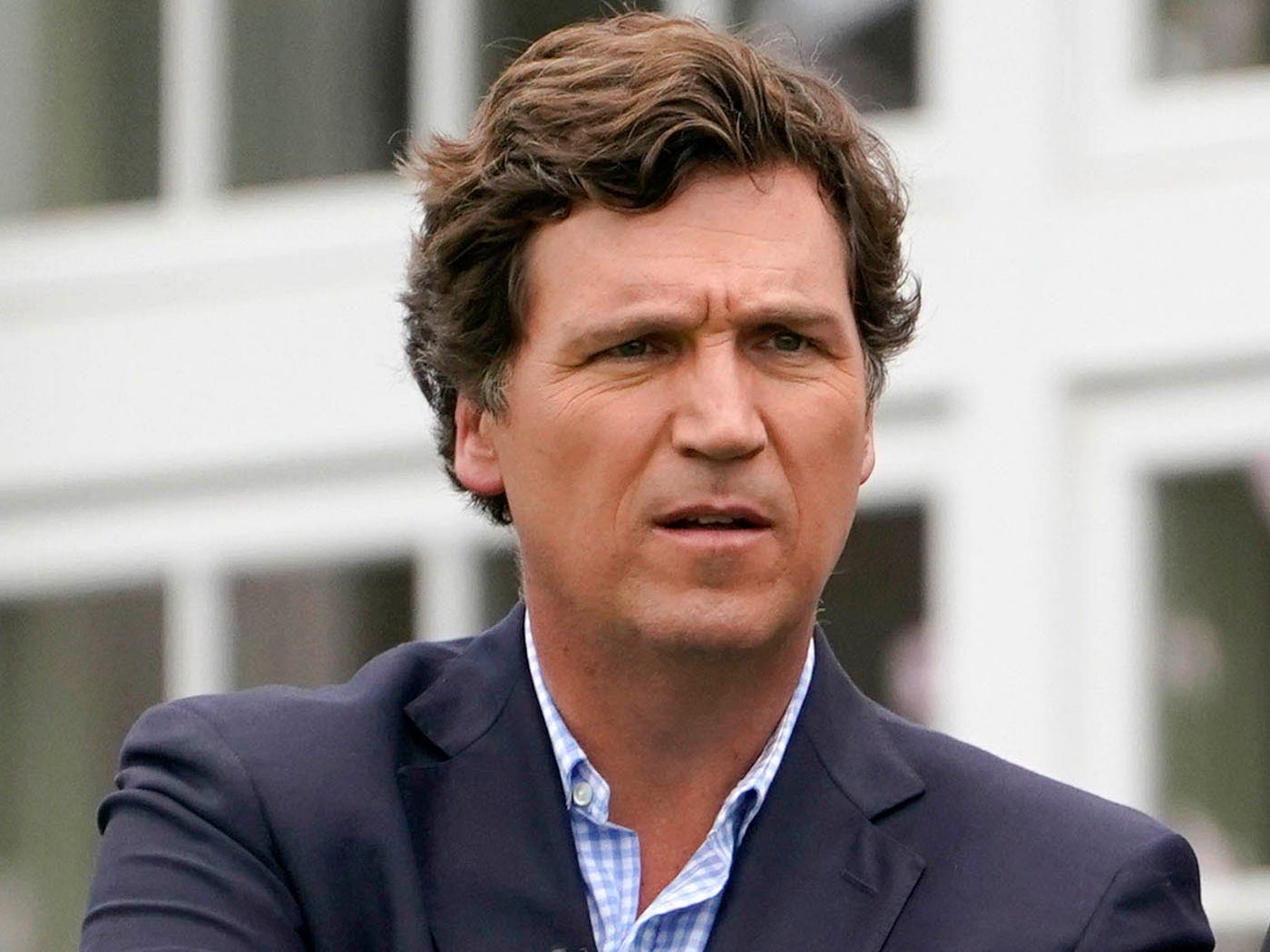
Tucker Carlson spent 35 years defending the Republican Party.
Thirty. Five. Years.
He defended it on CNN. He defended it on MSNBC. He defended it at Fox News for years, five nights a week, to millions of viewers, while the party did things that strained the definition of defensible. He defended Donald Trump specifically. He attended White House meetings with him. He interviewed him. He told his audience, repeatedly, to trust the process.
And then, on June 18th, 2026, he sat down on a podcast and said: “There’s no chance I would support the Republican Party.”
He added, “I don’t know what I’m going to do.” Tucker Carlson doesn’t know what to do.
I need you to think about who has always known exactly what to do and has been doing it — correctly, consistently, without credit — for decades.
What Just Happened and Why It Matters
Let’s get the facts on the table first.
Carlson’s break with the GOP is about Trump’s decision to go to war with Iran earlier this year — a war that, according to Emerson College Polling, 53% of Americans now view as more of a failure than a success. Carlson, who is among the conservatives who believe the U.S. entered that war at Israeli Prime Minister Netanyahu’s urging, has called the GOP’s position “treasonous” and “immoral.” He says he last spoke to Trump on February 27th, 2026 — the night before the war began — and that Trump understood the risks and went ahead anyway.
Marjorie Taylor Greene has echoed him. She posted that there are “A LOT” of conservatives who are “absolutely fed up” with a party that has “betrayed its voters and country.” This is the MAGA coalition eating itself, and the political analysts are treating it like breaking news.
For those of us who have been watching this party’s relationship with truth and accountability for decades, the shocking thing is not that it’s happening. The shocking thing is that it took this long to crack — and that the people cracking are acting like they just discovered something women of color have been saying out loud since before some of them were in media.
The Data Says What the Headlines Won’t
According to the April 2026 Emerson College Polling, Democrats currently lead the generic congressional ballot by 10 points. Among women, Democrats lead by 21 points — 55% to 34%. Morning Consult’s tracking shows a 16-point gender gap: women at D+11, men at R+5. Trump’s approval has cratered to 40%, with 57% disapproval. For the first time since 2010, according to the Brookings Institution, Democrats are more trusted than Republicans to handle the economy.
The political environment heading into November is, by most measures, a Democratic advantage. And who is driving that advantage? Women. And within women, who specifically?
According to the Center for American Women and Politics at Rutgers, the gender gap in voter turnout is largest among Black voters. In the 2025 governor’s races in New Jersey and Virginia — the two most recent tests of political temperature before this November — approximately 95% of Black women voted for the Democratic candidates in both states.
Latinx women broke for Democrats over Trump by 15 points in 2024, even as Latinx men shifted substantially toward the Republican Party. Yale’s Spring 2026 Youth Poll found that Democrats have gained the most ground since fall 2025, specifically among women ages 18 to 45.
This is not an accident. This is not a coincidence. This is a pattern so consistent, so documented, so historically durable that it should be the lede of every political story written about the 2026 midterms.
Can We Talk About White Women for a Second?
Every election cycle, the political class performs a version of the same ritual: they look at the polling, they see the gender gap, and they ask — hopefully, desperately, sometimes in tones that border on pleading — will white women finally break for Democrats this time?
The answer, historically and statistically, has been: probably not. Since 1952, with only two exceptions, the majority of white women have voted for the Republican presidential candidate. In 2016, 52% of white women voted for Trump. In 2020, 53% did. In 2024, 51% did — a slight improvement for Democrats, but still a majority. As Rutgers political scientist Kelly Dittmar has said, “Partisanship matters more than gender solidarity. Democrats vote for Democrats, and Republicans vote for Republicans.”
The Dobbs decision — which eliminated federal abortion rights — did not flip white women to Democrats in the numbers that many hoped. Instead, voters in multiple states simultaneously chose Trump and voted for abortion access on state ballots. They separated the issue from the party. They kept the party.
This is not a condemnation of every white woman voter. But it is a pattern that the political conversation refuses to sit with honestly, because sitting with it honestly requires asking uncomfortable questions about whose interests white women have historically voted to protect — and whose they have not.
Meanwhile, Black women have consistently shown up for Democratic candidates at rates of 90% or higher for decades. They showed up for Hillary Clinton. They showed up for Joe Biden. They showed up for Kamala Harris. They showed up in New Jersey and Virginia in 2025. They are showing up right now, in the polling, in the organizing, in the grassroots work that rarely makes the front page.
And every election cycle, the political conversation centers on white women as the persuadable, the decisive, the uncertain bloc that must be wooed and won — while treating Black women’s votes as a given, a floor, a reliable baseline that campaigns can count on without investing in. That is a political choice, and it has consequences.
What Tucker’s Breakdown Actually Reveals
Tucker Carlson’s “I don’t know what to do” moment is bigger than him personally. He is experiencing, for the first time, what it feels like to be politically homeless in a two-party system that was never designed to accommodate the full range of what people actually believe or need. He is experiencing the disorientation of realizing that the party he defended for 35 years made decisions based on interests that were not his.
He is experiencing what it feels like to be politically abandoned. Women of color — Black women especially — have navigated that feeling throughout this country's history. They have voted in a system that was literally designed to exclude them.
They fought for the right to vote at the intersection of a suffrage movement that did not prioritize them and a civil rights movement that did not always center them. They have voted for candidates who did not always deliver. They have voted in states with active voter suppression.
They have voted in spite of, at rates that exceed nearly every other demographic group, because they understand what is at stake when you stay home. Tucker Carlson has the luxury of not knowing what to do. He can afford political ambivalence in a way that women of color cannot, because the consequences of Republican governance have never landed on him the way they land on the communities that show up most reliably to oppose it.
His confusion is a form of privilege he does not appear to recognize.
What Comes Next
The 2026 midterms are shaping up to be a referendum on everything: the war in Iran, the economy, the dismantling of federal civil rights infrastructure, the future of reproductive rights at the state level, and the question of what American democracy looks like when one of its two parties begins to fracture from within.
Women will decide it. The data is clear on that. Women favor Democrats by 21 points. Women turn out at higher rates than men. Women — and women of color specifically — are the most organized, most motivated, and most consistent voting bloc in this election.
The question is not whether women will show up. They always show up.
The question is whether the political conversation — and the candidates, campaigns, and media — will finally show up for them.
Tucker Carlson doesn’t know what to do.
Black women do.
They always have.
메타데이터
- post_id
- e47dd13f156e
- slug
- tucker-carlson-doesnt-know-what-to-do-black-women-have-always-known-let-s-talk-about-that-e47dd13f156e
- url
- https://zora.medium.com/tucker-carlson-doesnt-know-what-to-do-black-women-have-always-known-let-s-talk-about-that-e47dd13f156e
- canonical_url
- https://zora.medium.com/tucker-carlson-doesnt-know-what-to-do-black-women-have-always-known-let-s-talk-about-that-e47dd13f156e
- author_url
- https://medium.com/@mnhoskin25
- status
- ok
- fetched_at
- 2026-07-09 10:29:04