Climate-Resilient Smart Indoor Agriculture System A Sustainable Concept Integrating Solar Energy…
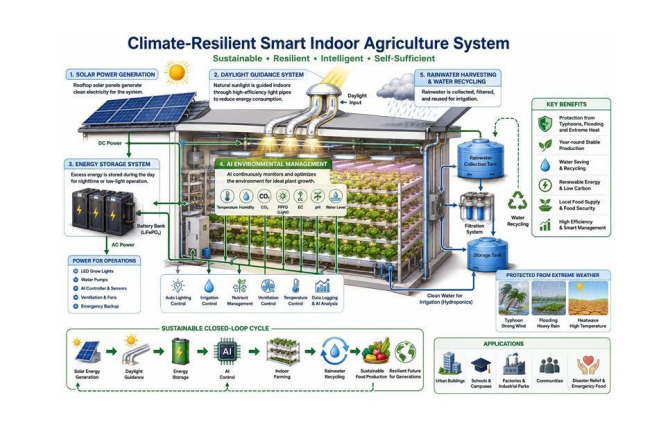
Climate-Resilient Smart Indoor Agriculture System A Sustainable Concept Integrating Solar Energy, Daylight Guidance, Energy Storage, AI Control, and Rainwater Harvesting Abstract Climate change has significantly increased the frequency and severity of extreme weather events, including typhoons, flooding, prolonged droughts, and heatwaves. These environmental challenges have reduced the stability and resilience of conventional outdoor agriculture. This proposal presents a conceptual Climate-Resilient Smart Indoor Agriculture System that integrates solar photovoltaic generation, natural daylight guidance, energy storage, artificial intelligence (AI)-based environmental management, and rainwater harvesting into a unified sustainable agricultural platform. The objective is not to replace conventional farming but to provide a complementary solution capable of maintaining stable crop production under increasingly unpredictable climatic conditions. — -
- Background Agricultural production worldwide is becoming increasingly vulnerable to climate-related disasters. Typical challenges include:
- Typhoon-induced crop lodging and structural damage.
- Flooding that destroys farmland and root systems.
- Heat stress that reduces crop quality and yield.
- Water shortages caused by prolonged drought.
- Increasing pressure on arable land due to urbanization.
- Rising energy consumption associated with controlled-environment agriculture. These issues motivate the development of climate-resilient agricultural infrastructure capable of reducing environmental risks while improving sustainability. — -
- Proposed System Architecture The proposed system consists of five integrated modules. 2.1 Solar Photovoltaic Power Generation Rooftop photovoltaic panels generate renewable electricity for the agricultural system. Generated electricity supplies:
- Environmental sensors
- Water circulation pumps
- AI controllers
- Ventilation equipment
- Supplemental LED grow lighting — - 2.2 Natural Daylight Guidance Instead of relying solely on artificial lighting, natural sunlight may be delivered indoors through technologies such as:
- Optical light guides
- Reflective daylight tubes
- Fiber-optic daylight transmission
- High-efficiency reflective channels This approach may reduce electricity demand while providing a more natural lighting environment for plant growth. — - 2.3 Energy Storage System Excess daytime electricity can be stored using battery energy storage systems for nighttime operation. Stored energy supports:
- LED grow lights
- Hydroponic circulation
- Environmental monitoring
- AI computing
- Emergency backup power — - 2.4 AI Environmental Management An AI controller continuously monitors:
- Temperature
- Relative humidity
- CO₂ concentration
- Photosynthetic light intensity (PPFD)
- Electrical conductivity (EC)
- pH value
- Water level The controller may automatically regulate:
- Lighting schedules
- Irrigation
- Nutrient delivery
- Ventilation
- Cooling
- Humidity control The objective is to optimize plant growth while minimizing energy and water consumption. — - 2.5 Rainwater Harvesting and Water Recycling Rainwater collected from building rooftops may be filtered and reused for irrigation. Potential advantages include:
- Reduced freshwater consumption
- Stormwater management
- Supplemental water during drought periods
- Increased sustainability of indoor agriculture — -
- Expected Benefits Agricultural Resilience
- Reduced crop losses caused by typhoons.
- Protection against flooding.
- Stable production during heatwaves.
- Year-round cultivation independent of seasonal weather. Sustainability
- Increased utilization of renewable energy.
- Lower electricity consumption through daylight guidance.
- Reduced irrigation water demand.
- Lower carbon emissions.
- Shorter food transportation distances. Smart Agriculture
- Continuous environmental optimization.
- Reduced labor requirements.
- Data-driven cultivation strategies.
- Improved production consistency. — -
- Potential Applications The proposed concept may be adapted for:
- Urban vertical farms
- Residential buildings
- Commercial buildings
- Schools and universities
- Industrial campuses
- Community food production centers
- Emergency food security facilities
- Disaster-resilient agricultural infrastructure — -
- Future Development Opportunities Future research may investigate:
- Adaptive daylight distribution systems.
- AI prediction of crop growth and energy demand.
- Building Energy Management System (BEMS) integration.
- Smart microgrid operation.
- Autonomous maintenance robots.
- Modular expansion for scalable indoor farming. Experimental validation and economic analysis would be valuable to evaluate technical feasibility and commercial viability. — - Conclusion This proposal presents a conceptual framework for a Climate-Resilient Smart Indoor Agriculture System that integrates renewable energy, natural daylight utilization, AI-assisted environmental control, energy storage, and rainwater harvesting. Rather than replacing conventional agriculture, the proposed system is intended to complement existing food production methods by improving resilience against increasingly frequent climate-related disasters. The concept may contribute to sustainable urban agriculture, enhanced food security, reduced resource consumption, and future climate adaptation strategies. — - Keywords Climate Resilience; Indoor Agriculture; Sustainable Farming; Solar Photovoltaics; Daylight Guidance; Artificial Intelligence; Energy Storage; Rainwater Harvesting; Smart Agriculture; Vertical Farming; Controlled Environment Agriculture. Proposed Deployment Strategy: Modular Climate-Resilient Agriculture Motivation Constructing dedicated indoor farming buildings requires substantial investment in land, construction, energy infrastructure, and operational management. Therefore, a modular deployment strategy may provide a more practical pathway for technical validation and gradual commercialization. Instead of immediately constructing large-scale agricultural buildings, this proposal recommends developing standardized modular units that can be deployed individually or combined according to local requirements. — - Three-Phase Development Roadmap Phase 1 — Smart Agriculture Module The first stage focuses on a single modular unit (container or prefabricated building). Each unit integrates:
- Solar photovoltaic generation
- Natural daylight guidance
- Battery energy storage
- AI environmental control
- Hydroponic cultivation
- Rainwater harvesting
- Environmental monitoring This phase aims to validate technical feasibility, operational stability, and energy efficiency. — - Phase 2 — Modular Agriculture Network After successful verification, multiple modules can be interconnected. Dedicated modules may include:
- Seedling production
- Vegetable cultivation
- Fruit cultivation
- Mushroom production
- Water treatment
- Energy storage
- Cold storage
- Packaging and logistics The modular architecture enables flexible expansion according to production demand. — - Phase 3 — Climate-Resilient Agriculture Building Once technical performance and economic viability have been demonstrated, modular technology may be integrated into multi-story agricultural buildings. Potential features include:
- Building-integrated photovoltaics (BIPV)
- AI energy management systems
- Automated harvesting systems
- Building Energy Management System (BEMS)
- Smart microgrid integration
- Urban food production Rather than replacing conventional agriculture, these facilities could complement regional food production while increasing resilience against extreme weather. — - Emergency Agriculture Module A modular unit may also serve as an emergency food production facility. Possible deployment scenarios include:
- Typhoon recovery
- Flood-affected regions
- Earthquake disaster zones
- Remote islands
- Mountain communities
- Emergency shelters
- Military logistics bases The system could operate independently using solar energy, battery storage, and harvested rainwater, providing a resilient agricultural platform when conventional infrastructure is disrupted. — - Advantages of Modular Deployment Compared with constructing dedicated agricultural buildings, modular deployment offers several advantages:
- Lower initial investment
- Faster installation
- Easier maintenance
- Flexible scalability
- Standardized manufacturing
- Easier transportation
- Reduced deployment risk
- Faster technology verification — - Vision The long-term vision is to establish a distributed network of climate-resilient agricultural modules capable of supporting sustainable food production under increasingly frequent extreme weather events. This proposal envisions a scalable pathway from individual smart farming modules to interconnected agricultural networks and, eventually, fully integrated climate-resilient agricultural buildings that contribute to future food security and sustainable urban development. “Instead of constructing large agricultural facilities from the beginning, this proposal advocates a modular, scalable, and resilient development pathway, allowing technology verification, gradual expansion, and practical implementation toward sustainable food production.”
메타데이터
- post_id
- e486c50b6d2c
- slug
- climate-resilient-smart-indoor-agriculture-system-a-sustainable-concept-integrating-solar-energy-e486c50b6d2c
- url
- https://medium.com/@jeffofjeff/climate-resilient-smart-indoor-agriculture-system-a-sustainable-concept-integrating-solar-energy-e486c50b6d2c
- canonical_url
- https://medium.com/@jeffofjeff/climate-resilient-smart-indoor-agriculture-system-a-sustainable-concept-integrating-solar-energy-e486c50b6d2c
- author_url
- https://medium.com/@jeffofjeff
- status
- ok
- fetched_at
- 2026-08-21 07:55:18




