The AI Arms Race Is Quietly Centralizing Power
For the better part of the past decade, Silicon Valley sold AI as the great democratizer. Intelligence would become abundant. Expertise…
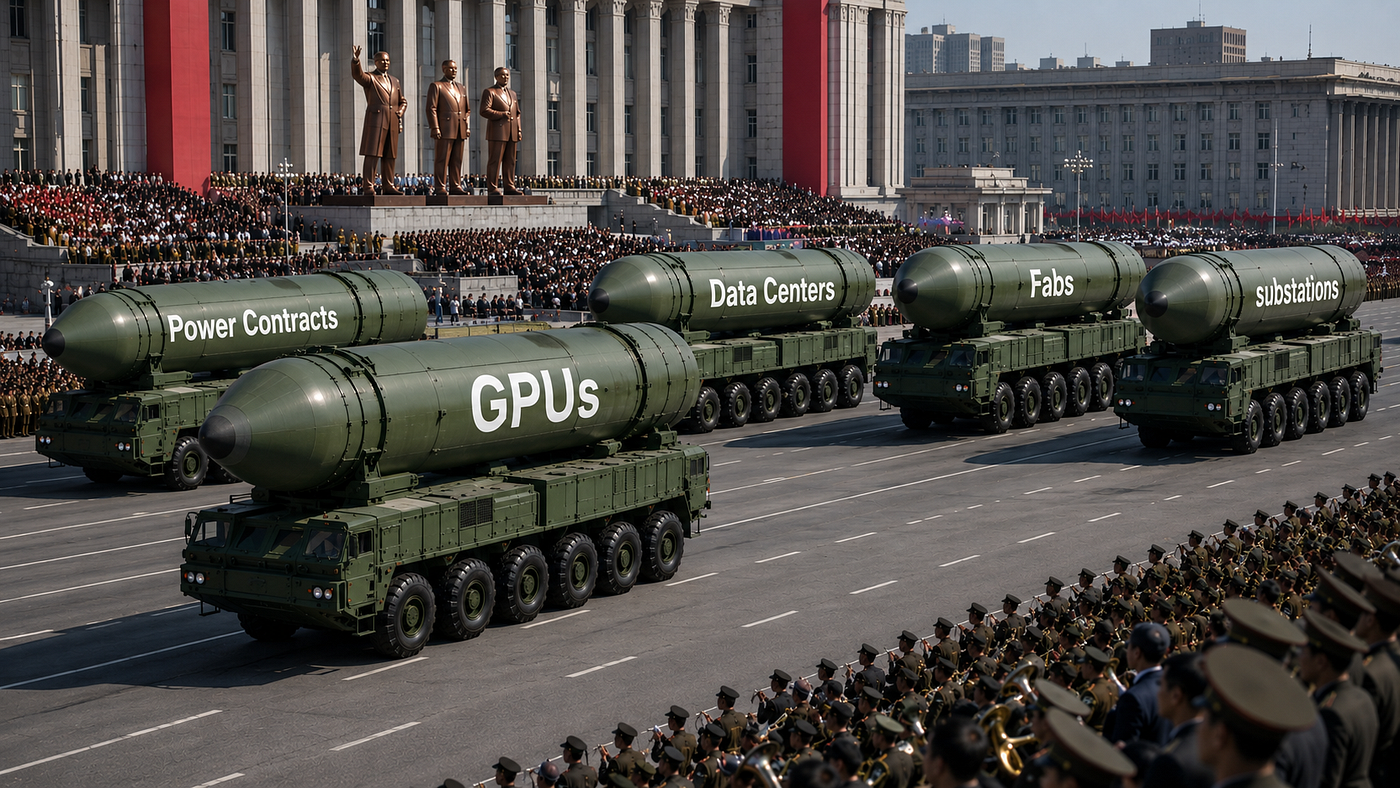
The AI arms race isn’t just about better models. It’s about control of compute, data centers, fabs, substations, and power. The future belongs to those who own the infrastructure, not just the intelligence.
The AI Arms Race Is Quietly Centralizing Power
For the better part of the past decade, Silicon Valley sold AI as the great democratizer. Intelligence would become abundant. Expertise would become inexpensive. A teenager in Lagos would command the computational firepower once only reserved for a Fortune 500 company. Every founder would have an army of engineers, researchers, designers, and lawyers living inside a laptop.
At the application layer, much of that promise is already beginning to materialize. But beneath the surface, a very different story is unfolding. Economic power is concentrating around the small number of companies and countries that control four increasingly scarce assets: compute, distribution, proprietary data, and electricity.
The interface may look democratic. The underlying infrastructure is becoming anything but.
Intelligence Is Cheap. Building the Machine Is Not.
The Internet lowered the cost of distribution. Cloud computing lowered the cost of starting a software company. AI is now lowering the cost of producing many forms of cognitive work. But building frontier AI has become ferociously capital intensive.
Amazon, Microsoft, Alphabet, and Meta are expected to spend roughly $725 billion on capital expenditures in 2026, much of it directed toward AI infrastructure. Amazon recently turned to the bond market for another $25 billion as the industry’s infrastructure ambitions began outrunning even Big Tech’s prodigious cash generation. These are no longer software budgets. They are nation-state budgets masquerading as technology investments.
Training frontier models requires advanced chips, high-bandwidth memory, networking equipment, cooling systems, massive data centers, and teams of researchers earning compensation packages that would make a top hedge fund manager blush. Research on frontier-model economics found that training costs have increased by roughly 2.4 times annually since 2016, making billion-dollar training runs a plausible reality before the end of this decade.
The economics are already reshaping who can compete. According to Stanford’s *2026 AI Index*, industry produced more than 90 percent of the notable frontier models released in 2025. Universities can still study the frontier. Increasingly, only a handful of corporations can afford to push it forward.
That marks a profound reversal from the mythology of the personal computing and Internet revolutions. The image of entrepreneurs building the future from a garage may still hold true, but the infrastructure required to power that future is increasingly controlled by a remarkably small club of incumbents.
The Stack Is Becoming a Series of Choke Points
AI power is concentrating vertically across the technology stack. Nvidia and a narrow supplier base control the most coveted accelerators and memory architecture. The hyperscalers control the cloud capacity required to run them. The frontier model labs depend on that infrastructure and financing. Those models are then distributed through search engines, operating systems, productivity suites, developer platforms, social networks, and mobile ecosystems.
The result is an unusually tight chain of incentive alignment. Microsoft does not merely invest in a model company. It can finance the model, provide the compute, distribute the product through Azure and Microsoft 365, and absorb the resulting demand back into its own infrastructure. Amazon and Google have built similar relationships with Anthropic. The Federal Trade Commission has warned that these cloud-model partnerships could affect access to compute, switching costs, sensitive information, and competitive independence.
This is how markets consolidate almost imperceptibly. Financing becomes dependency. Dependency becomes integration. Integration becomes distribution. Distribution becomes the default.
A startup can switch models through an API gateway. That is valuable optionality, but it does not change who controls the underlying infrastructure. Changing suppliers is not the same as owning the supply chain.
Distribution May Matter More Than Model Quality
Model performance is converging faster than most investors expected. Open-weight systems continue to improve, inference costs keep falling, and enterprises are increasingly routing tasks among multiple models based on price, latency, and capability. As Vercel CEO Guillermo Rauch recently observed, committing to a single model provider is quickly becoming obsolete as companies adopt modular, multi-model architectures.
At first glance, that appears to decentralize the market. In one sense, it does. But history suggests that when one layer of the technology stack commoditizes, value migrates to the next control point. If models become increasingly interchangeable, distribution becomes correspondingly more valuable because customer access becomes the scarce asset.
The incumbents already own much of that distribution. Google has Search, Android, Workspace, and YouTube. Microsoft has Windows, Microsoft 365, GitHub, and an enterprise sales organization capable of selling Copilot before the customer has finished locating the procurement department. Amazon has AWS and the economic exhaust of global commerce. Meta has billions of users and an open-model strategy designed to commoditize someone else’s margin while reinforcing its own advertising fortress.
For founders, the jugular question is no longer whether a model can perform the task. It is who owns the customer relationship when every capable model can. The companies controlling workflow, identity, payments, proprietary data, and recurring distribution may ultimately capture more durable value than those producing raw intelligence. The history of technology is littered with brilliant component suppliers that eventually discovered the platform owner kept the better economics.
Power Is Becoming the Ultimate Constraint
Every technology revolution eventually collides with the physical world. For AI, that collision happens at the electrical grid.
The International Energy Agency projects that global data center electricity consumption will more than double to roughly 945 terawatt-hours by 2030, growing more than four times faster than electricity demand from the rest of the economy. In the United States, data centers could account for nearly half of incremental electricity demand through 2030. The decisive AI asset may therefore prove to be neither the model nor the chip, but a signed interconnection agreement in Virginia, Texas, or the Gulf backed by enough firm power to illuminate a small city.
That reality is already reshaping the competitive landscape. Companies with deep balance sheets, utility relationships, land, permitting expertise, and access to nuclear or natural gas generation possess advantages that three founders with a clever architecture simply cannot code around. In AI, power availability is rapidly becoming a market boundary condition.
The implications extend well beyond corporate strategy. They reach into geopolitics. The Center for a New American Security estimates that the United States and China control approximately 90 percent of the compute required to develop and deploy frontier AI. Every other country is increasingly forced to decide whether to build sovereign AI capacity, align with an American or Chinese technology stack, or become a digital tenant. As AI becomes strategic infrastructure, governments are unlikely to remain passive observers. Export controls, industrial policy, antitrust scrutiny, energy policy, and permitting battles are becoming enduring features of the competitive landscape rather than temporary headlines.
The new arms race is measured in GPUs, fabs, substations, data centers, and long-term power contracts. Aircraft carriers still matter but, increasingly, so do transformers.
What Investors Should Underwrite
None of this means startups are doomed. Quite the opposite. Every period of infrastructure concentration creates new bottlenecks, and every bottleneck creates opportunities for entrepreneurs to relieve it.
Some of the most compelling opportunities may emerge in the layers that loosen the incumbents’ grip: inference optimization, model routing, specialized silicon, cooling, grid software, power generation, data center construction, cybersecurity, synthetic data, open models, and vertical applications built around proprietary workflows. But investors should remain intellectually honest about where durable leverage actually resides.
A thin application that depends on another company’s model, cloud infrastructure, customer access, and pricing has limited control over its own destiny. A business built around proprietary data, embedded distribution, switching costs, and the ability to arbitrage across models begins to develop something far more durable: strategic independence.
That distinction will become even more important as compute prices continue to fall. Cheaper infrastructure expands the market, but it also lowers barriers to entry and subsidizes competition. When intelligence becomes abundant, the scarce assets are customer trust, workflow ownership, proprietary data, and the right to distribute.
Final Word
AI will democratize capability even as it centralizes infrastructure. Those two forces are not contradictory. They are reinforcing.
Millions of people will gain access to tools once reserved for elite institutions, unlocking extraordinary innovation and economic opportunity. That’s transformative. At the same time, the infrastructure producing those capabilities will be financed, powered, and distributed by a remarkably small group of corporations and sovereign states. That is the paradox investors need to understand and underwrite.
The future may contain more builders than at any point in history, operating on fewer foundational platforms than ever before. The biggest winners will be the companies that recognize where intelligence is becoming abundant and where economic power remains stubbornly scarce.
Markets eventually discover the truth. In AI, the companies that appear to own intelligence may simply be renting it. The enduring value may ultimately accrue to those who control the infrastructure beneath it.
***Jonathan Tower has been a global venture investor for over 20 years, having managed more than $5 Billion in AUM, invested in more than 85 companies, and seeded 10+ companies that went on to become unicorns across three core investment themes: consumer (marketplaces, ecommerce enablement, digitally native brands), enterprise (software, services, infrastructure, storage, data orchestration) and frontier technologies* (AI/ML, IoT, robotics, Fintech, etc).
Jonathan’s direct investments have resulted in more than $10 Billion in exits, including early bets in Jet.com (acquired by Walmart for $3.5 Billion), Dollar Shave Club (acquired by Unilever for $1 Billion), Freshly (acquired by Nestle for $1.5 Billion), IfOnly (acquired by Mastercard), InsideView (acquired by Demandbase), and MapR Technologies (acquired by HP). Other notable investments, which Jonathan led or helped champion, include Groq (acquired by Nvidia for $20 Billion), Virtue AI (acquired by Meta), Hammerspace, Cohere, TogetherAI, Snorkel AI, Jeeves, SingleStore, Artera, Cart.com, Madison Reed, Qumulo, and many other companies that have gone on to become market leaders.
Jonathan writes frequently on venture capital and technology topics on his blog, Adventure Capitalist, and he’s been a frequent contributor to The New York Times, Fortune, The Wall Street Journal, FastCompany, Forbes, The Washington Post, The LA Times, and other leading publications.
X: @jonathan_tower; instagram: jonathan_tower
메타데이터
- post_id
- e48fc458ca0d
- slug
- the-ai-arms-race-is-quietly-centralizing-power-e48fc458ca0d
- url
- https://medium.com/@jtower09/the-ai-arms-race-is-quietly-centralizing-power-e48fc458ca0d
- canonical_url
- https://medium.com/@jtower09/the-ai-arms-race-is-quietly-centralizing-power-e48fc458ca0d
- author_url
- https://medium.com/@jtower09
- status
- ok
- fetched_at
- 2026-07-27 12:41:27