A Red-Painted Oak Tree
But why was this dead tree painted bright red?
A Red-Painted Oak Tree
But why was this dead tree painted bright red?

A dead, red oak tree — Photo by Author
Introduction
During a recent visit to Kew Gardens, we came across this red-painted, dead oak tree. It truly stood out against the greens of the other trees, so much so that it was impossible to miss it even from a distance.
But why was it painted red? Of all the things you’d expect to see at a Royal Botanic Gardens, something so artificial seemed out of place.
Of course, we had to go over and investigate! That’s when the alarming truth emerged.
Climate change
Climate change seems to ruffle feathers one way or another. Some people, even powerful people high up in government, refuse to believe it exists. Others accept what the scientists are saying. The Royal Botanic Gardens at Kew does.
Below is a graphic from one of their notice boards near this tree to depict how our temperatures are increasing markedly. In the Climate Stripes Project started by Professor Ed Harkins at the University of Reading (west of London), blues represent the temperatures that were lower than average that year and reds represent those temperatures that were higher than average in a year.

Graphic representing tree rings from this dead tree — Photo by Author
It’s very clear how in the past 10 years, the average temperatures have risen markedly since records started in 1881. Although this refers to the UK, I believe it’s true globally.
The red-painted tree died in 2022 as a direct result of the temperatures being too high for it to continue to live. Kew Gardens describes it as the ‘climate-changed tree’.
It’s a mature red oak (Quercus rubra) that was planted in the 1880s. Rather than cut it down, the tree people at Kew Gardens decided to leave it where it had grown and paint it red as a rallying cry to action.
The graphic above represents a cross-section of this tree killed as a direct result of climate change.
Benefits of trees
The benefits of trees are manifold. However, Kew Gardens have identified five important benefits.
- A natural cooling effect: They act like giant air conditioners. Their shade and leaves lower city temperatures.
- Natural air purifiers: They produce oxygen and filter the air through their leaves by trapping dust and absorbing pollutants.
- Managing water: Their roots act like sponges, soaking up heavy rain, which prevents flooding. At the same time, they naturally filter our water supply.
- Catching carbon: They breathe in atmospheric CO₂ and lock it away in their trunks and the soil around their roots, with the help of fungi.
- Improving our wellbeing: We probably all feel better for a walk amongst trees. Being near them helps to lower our stress levels, clears our minds and benefits our overall mental health.
Tree of hope
One of the strategies that Kew Gardens has to mitigate the effects of climate change is to launch an ambitious plan to future-proof their tree collection. First, they figured out which of the species in their tree collection will be most threatened by a hotter, drier climate.
Then, they reached out to their global network to identify similar species of tree growing in regions with such hotter climate conditions. As a result, they are now growing tree seeds collected from those regions, so that they can be added to our landscape and increase our resilience against our warming climate.
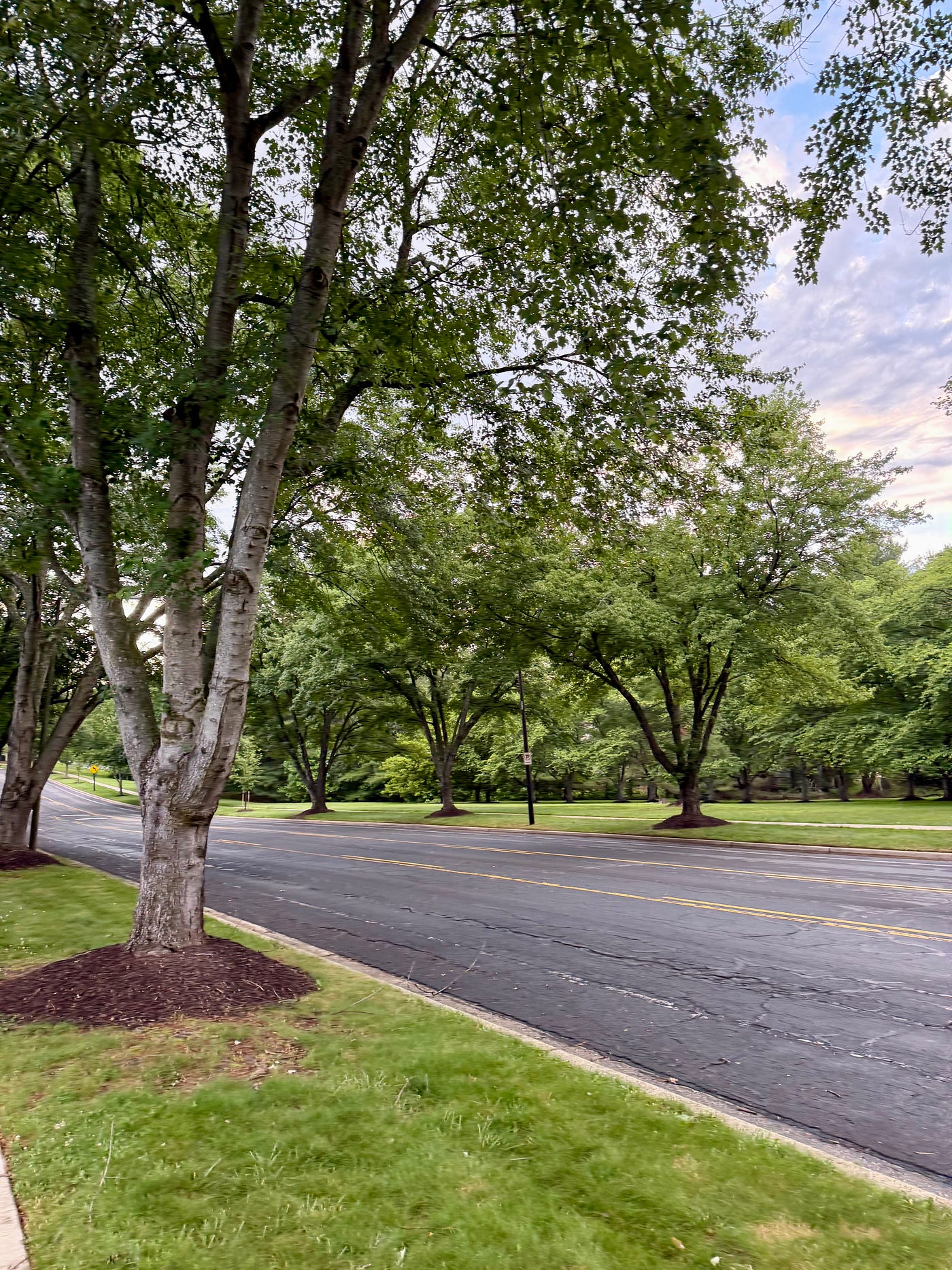
They’ve planted a tree of hope opposite the dead red oak tree.

Living tree of hope opposite dead, red oak tree — Photo by Author
This new tree is a climate-resilient Hungarian oak (Quercus frainetto), planted in 2026 by Kew’s Youth Council to give hope to the next generation.
Finally…
There’s something alarming about the colour red. It’s deliberately used to capture our attention. This red-painted, dead oak tree certainly succeeded in doing just that.
The UK is currently in its fifth heatwave. It’s good that our tree experts are finding ways to mitigate against the effects of our warming climate.
Thank you for reading
People, who’ve asked to be tagged: Aodhán Mac Cárthaigh Lu Skerdoo
메타데이터
- post_id
- e49c5efd134e
- slug
- a-red-painted-oak-tree-e49c5efd134e
- url
- https://medium.com/weeds-wildflowers/a-red-painted-oak-tree-e49c5efd134e
- canonical_url
- https://medium.com/weeds-wildflowers/a-red-painted-oak-tree-e49c5efd134e
- author_url
- https://medium.com/@ella_58865
- status
- ok
- fetched_at
- 2026-08-19 09:25:09