The Bill is Due
How Sir Keir Starmer’s government chose to balance the books on the backs of disabled people, and what it tells us about what Labour is…
The Bill is Due
How Sir Keir Starmer’s government chose to balance the books on the backs of disabled people, and what it tells us about what Labour is now.
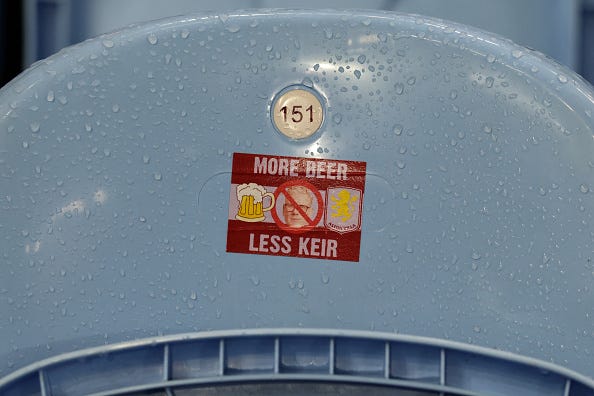
April 1st, a day affiliated with practical jokes and harmless fun, signals the beginning of Spring and new births. Unfortunately, the joyous gauge that today seems to foster has been vastly overshadowed by yet another poor decision from the government. No announcement, no press conference, no ministerial statement timed for this morning’s bulletins. As the sun starts to set slightly later, the Universal Credit health element for new disabled claimants was cut almost in half. People who become seriously ill or disabled from this month forward will receive £50 a week toward the additional costs of living with a limiting condition, down from £97. The change went through in the autumn, buried inside a bill that was itself rewritten under pressure, stripped down, partially walked, and finally passed through a parliament whose own members did not fully understand its consequences. It is law now. It is happening today.
I want to try to make that concrete, because the numbers in welfare debates have a way of becoming abstract, which is convenient for everyone who would rather they stayed that way. £47 a week is not an abstraction. It is, for someone newly diagnosed with MS or Parkinson’s or a deteriorating back condition, the difference between keeping the heating on and not. It is the cost of the Uber to the hospital appointment when you can no longer drive. It is the medication top-up that the NHS doesn’t cover, the specialist chair and the grab rail. Disabled households need, on average, an extra £1,010 a month compared to non-disabled ones, according to Scope. The government just cut support for new claimants by roughly £200.
And the particular cruelty (and I think cruelty is the accurate word) is who this falls on. It isn’t the people who claimed last year, or people who are already in the system, who were protected after the rebellion. Those people are fine (for now!) The cut applies to anyone who becomes disabled from April 2026 onward. The older lady who has the car accident by no fault of her own in May. A young person whose mental health collapses at the hands of the dire state of their future this summer. The forty-year-old that has to stop working due to the diagnosis they were dreading. They will be treated differently for the rest of their claim from someone with an identical condition who had the ‘luck’ to fall apart slightly earlier. A two-tier system, not as a charge from the opposition, but as the literal stated design of the legislation.
Stephen Flynn, the SNP’s Westminster leader, put it plainly enough when the bill was being debated: if you collapse at school today, you will receive less support than someone who collapsed last year.
This is not the first time a British government has drawn this kind of line, and the historical amnesia around it is, I think, deliberate. George Osborne cut the real value of disability benefits by roughly 7.5% over the course of the 2010s. Between 2010 and 2020, disabled people lost around £1,200 a year in benefit payments, while non-disabled people lost about £300. The food bank network that now serves around 3 million people a year in this country did not exist at that scale before austerity. It grew alongside it and filled the space that the state vacated. When the Trussell Trust warns that the welfare cuts will push nearly 440,000 disabled people into severe hardship, they are not projecting into some unknown future. They are describing a mechanism they have watched work before, but on an even greater scale.
Labour knows all of this. The party that introduced these cuts was built, in its original conception, in direct opposition to exactly this kind of thing. The Attlee government that passed the National Assistance Act in 1948, the legislation that underpins the modern welfare state, did so in a country that was far more fiscally constrained than today’s Britain. The post-war debt was enormous. Rationing was still in place. And yet Aneurin Bevan and his colleagues decided that a state which abandoned its most vulnerable members to the logic of the market was not a state worth defending. That the NHS would be free at the point of need, and disability would not be a financial sentence. Those were the choices made under far worse fiscal conditions than anything Rachel Reeves inherited.
1948 is obviously not 2026. The welfare bill has grown, as the NHS’s inability to treat people quickly contributes to long-term sickness claims, and the fiscal inheritance from the Conservatives was worse than advertised. It’s undeniable that the government had real constraints, but what I cannot accept is the pretence that cutting £47 a week from future disabled claimants was the only available response to those constraints. It was a choice. Made against the explicit warnings of the government’s own impact assessment, which projected, before the concessions, 250,000 more vulnerable people would be pushed into poverty. Made while a UN committee on disability rights was writing to the government asking it to justify what it was about to do. Made while 49 of the government’s own MPs voted against it, and while 127 others had signed an amendment asking it to stop.
In March 2025, the Pathways to Work green paper was published. It proposed tightening PIP eligibility by requiring claimants to score at least four points from a single daily living activity rather than accumulating lower scores across several activities. The original version applied to existing claimants. When 127 Labour MPs signed an amendment that would have killed the legislation, the government retreated: existing claimants would be protected. New claimants would not. This was described by the prime minister as striking “the right balance.” It was described by disabled campaigners, more accurately, as kicking the problem forward. The people who are not yet ill have no lobby and cannot sign the amendment. They will find out what was decided for them when they need help, and the system tells them what they are worth now.
This is also the same government that is currently conducting the Timms Review, a consultation into whether the PIP assessment is fit for purpose, launched alongside the very cuts it is supposedly examining the wisdom of. The call for evidence opened in March 2026 and runs until May. The findings are expected in autumn 2026. The changes to Universal Credit health payments began today. So the government is, right now, simultaneously implementing cuts to disability support and asking whether such cuts are appropriate. What sort of backwards reform is that? It is designed so that by the time any review concludes anything, the cuts will have bedded in, the savings will be in the OBR forecasts, and reversing them will cost money the Treasury will say it doesn’t have.
What should frustrate the British public most is that the intellectual case for an alternative was never made. The government never seriously attempted to explain why wealth taxes were off the table. Tax Justice UK had proposed a 2% levy on assets over £10 million at £24 billion. It would affect around 20,000 people. The welfare cuts were projected to affect 3.2 million families. The choice between those two things was never put to the country or fiercely debated in parliament. It was simply made behind closed doors by a government that had decided what the limits of acceptable politics were and did not bother to ask whether those limits were correct.
Neil Duncan-Jordan, Labour MP for Poole, said during the rebellion: cutting benefits does not create jobs, it creates poverty. . The Resolution Foundation found no meaningful evidence that tightening PIP eligibility pushes people into employment. The Joseph Rowntree Foundation found that the growth in sickness claims is driven by deteriorating population health, NHS waiting times, and a labour market that does not accommodate people with limiting conditions. These are structural problems. The government’s response was to make the structural problems worse and then reduce what you receive when you fall through the gap.
The welfare state was not, in its original conception, a concession by capital to labour. Beveridge believed, and the postwar Parliament agreed, that the risks of industrial life should be shared collectively, not borne individually. That the arbitrary cruelty of sickness and disability was not something a person should face alone. That was the deal. For seventy-five years, the deal held, with more or less generosity depending on who was in power.
What has changed under both Conservative and now Labour governments is the willingness to say, clearly, who the welfare state is for. The answer, increasingly, is: not you.
We are a country with 14 million people in poverty. Four and a half million of them are children. One in five people in poverty are in work. None of it is the result of forces beyond political control. It is the accumulated consequence of specific decisions made by specific people, who had other choices available to them.
메타데이터
- post_id
- e49f9701b630
- slug
- the-bill-is-due-e49f9701b630
- url
- https://medium.com/@m0o0/the-bill-is-due-e49f9701b630
- canonical_url
- https://medium.com/@m0o0/the-bill-is-due-e49f9701b630
- author_url
- https://medium.com/@m0o0
- status
- ok
- fetched_at
- 2026-07-12 01:29:19