Heracles and Iolaus
…killing the lion wasn’t enough to take the vices out of Heracles.
Heracles and Iolaus
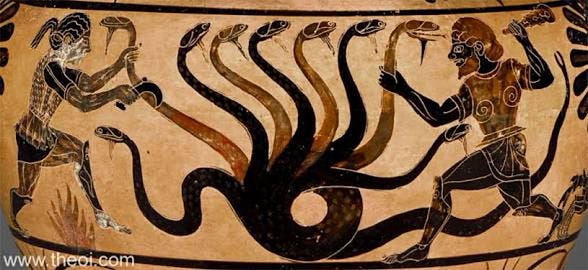
𝘏𝘺𝘥𝘳𝘢 & 𝘏𝘦𝘳𝘢𝘤𝘭𝘦𝘴, attributed to the Eagle Painter ca. 525 B.C.E.
(Click here for more about the artwork.)
I have often considered that the born again experience is akin to Heracles’s first labor.
Heracles had to kill the Nemean Lion. The lion represented Heracles’s animal nature.
After it was slain, one would see Heracles traveling around with the lion skin draped over his body.
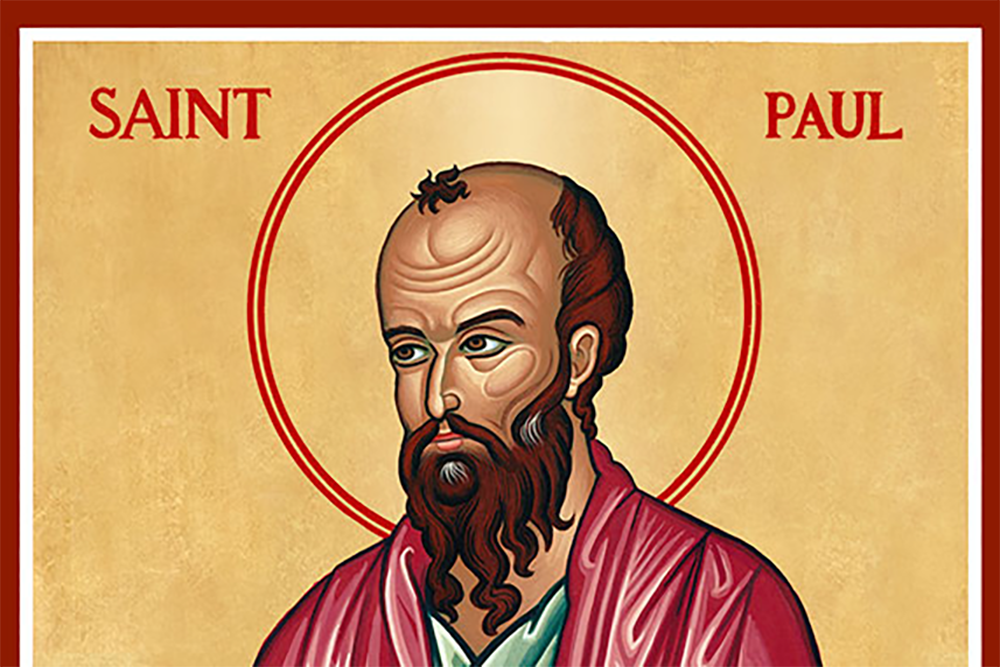
It’s like when Paul said, “I’ve been crucified with Christ — nevertheless I live, but not I — for Christ lives in me.” On the outside, Paul looks the same. But the old Paul is now dead, just as the outermost layer of Heracles — the lion draped around him — is now dead. The lion represents the part of Heracles that needed to die to make way for the better part. Paul and Heracles both became changed men.
But Heracles wasn’t done with his labors after his slaying of the lion (labors which he actually chose for himself in life, knowing that hardship would make him a virtuous person.)
Starting on the path is not the same as finishing. Being “born again” (in Christian terminology; Tibetan Buddhists call it aryahood according to Thupten Phuntsok) — is merely having a glimpse into the Kingdom of Heaven, whereas one must be “born of water and the Spirit” to actually enter. (I speak about this in more detail here.)
Similarly, Heracles, having slain the Nemean Lion, has passed through his “born again” experience — but there remains an even greater fight.
For his second labor, he is asked to kill the nine-headed hydra.
In the same way that one plague wasn’t enough for Pharaoh to let Israel go, killing the lion wasn’t enough to take the vices out of Heracles.
Pharaoh needed ten plagues, and Heracles needed to kill ten heads before he could truly be “crucified with Christ,” which, in the ten plagues analogy isn’t accomplished until “the death of the firstborn.”
But although Heracles could take care of the lion on his own, he needed help with the hydra. Because every time he cut off one head, three more would grow in its place. So, as soon as he cut one off, Iolaus had to step in to cauterize the wounds with fire — the only thing preventing the growth of new heads.
Everyone needs an Iolaus — or a community of Iolauses. Paul once wrote,
“As the body is one and has many members, but all the members of that one body, being many, are one body, so also is Christ. For in fact the body is not one member but many. If the foot should say, “Because I am not a hand, I am not of the body,” is it therefore not of the body? And if the ear should say, “Because I am not an eye, I am not of the body,” is it therefore not of the body? If the whole body were an eye, where would be the hearing? If the whole were hearing, where would be the smelling? But now God has set the members, each one of them, in the body just as He pleased. And if they were all one member, where would the body be? But now indeed there are many members, yet one body. And the eye cannot say to the hand, “I have no need of you”; nor again the head to the feet, “I have no need of you.” And if one member suffers, all the members suffer with it; or if one member is honored, all the members rejoice with it” (I Corinthians 12:12, 14-21, 26).
Growing up Christian, I often heard that Christians need prayer, Bible reading, and fellowship.
And, similarly, marrying my wife who had her greatest moments of spiritual clarity in the context of Tibetan Buddhism, I’ve learned that Buddhists take refuge in “the three jewels” — The Buddha, the sangha, and the dharma. Like my upbringing taught me to pray to Christ, the anointed one, Buddhists are taught to take refuge in the Buddha, the awakened one. (I believe that like Moses and David were foreshadowings of Christ, so was the Buddha. Like Moses and David share similarities with Christ, so does the Buddha. For example, both the Buddha and Jesus were thrice tempted by Satan [in Buddhism, Mara] before they were sent to teach the world.)
Buddhists are also taught to take refuge in the dharma, meaning the teaching — akin to the encouragement I received to read the Bible. I have found many similarities between Buddhist and Christian teachings. This Buddhist teaching, for example, from Geshe Langri Thangpa, reads as if it could have been delivered by Christ.
Finally, Buddhists are taught to take refuge in the sangha — the community of those seeking enlightenment — just as I was taught to seek out the community of those who are actively seeking to be conformed to the image of Christ.
For Heracles, the most important member of his community during the time of his second labor was Iolaus. And for me, since our engagement and subsequent marriage, the most important member of my community has been my wife.
Although I was born again before we met, my wife is helping me in slaying the other nine heads which are always threatening to grow back. I have blind spots. The author of the tale of Heracles and the hydra had insight on the reality of human nature that humans need help on their spiritual journeys. In my case, if I wasn’t married, it would have been very difficult for me to see those blind spots — it is difficult as it is.
I understand that the purpose of Buddhist monastic communities is to help single people towards enlightenment, and the purpose of Christian monastic communities is to help single people towards conformity to Christ’s image. And both seek also to help their broader community towards the same.
But my life path is not one of celibacy, and therefore my wife is not only my wife but has been, for me, more than anyone else — my main Iolaus — helping me to defeat the beast within.
“Two are better than one,
because they have a good return for their labor:
If either of them falls down,
one can help the other up.
But pity anyone who falls
and has no one to help them up.
Also, if two lie down together, they will keep warm.
But how can one keep warm alone?
Though one may be overpowered,
two can defend themselves.
A cord of three strands is not quickly broken” (Ecclesiastes 4:9–12).
메타데이터
- post_id
- e4a25fe4c6a4
- slug
- heracles-and-iolaus-e4a25fe4c6a4
- url
- https://medium.com/@mashiachbenyosef/heracles-and-iolaus-e4a25fe4c6a4
- canonical_url
- https://medium.com/@mashiachbenyosef/heracles-and-iolaus-e4a25fe4c6a4
- author_url
- https://medium.com/@mashiachbenyosef
- status
- ok
- fetched_at
- 2026-08-03 02:39:07