Mastering API Versioning
Building Application Programming Interfaces (APIs) is straightforward. However, keeping them stable, predictable, and reliable as a system…
Mastering API Versioning
Building Application Programming Interfaces (APIs) is straightforward. However, keeping them stable, predictable, and reliable as a system evolves is one of the greatest challenges in software architecture.
API consumers rely heavily on API contracts. A minor, unannounced adjustment — such as renaming a field, changing a response payload format, or altering an endpoint structure — can immediately break production downstream integrations. While shifting business requirements necessitate API updates, backend engineers must communicate and execute these changes without disrupting consumers.
This is where API versioning comes in. It provides a structured mechanism for evolving APIs while ensuring consumers can transition to new contracts at their own pace.
The Concept of API as a Contract
An API is fundamentally a contract between the provider and the client. This contract explicitly defines the shape of the data, the endpoints, and the expected behavior of the system.
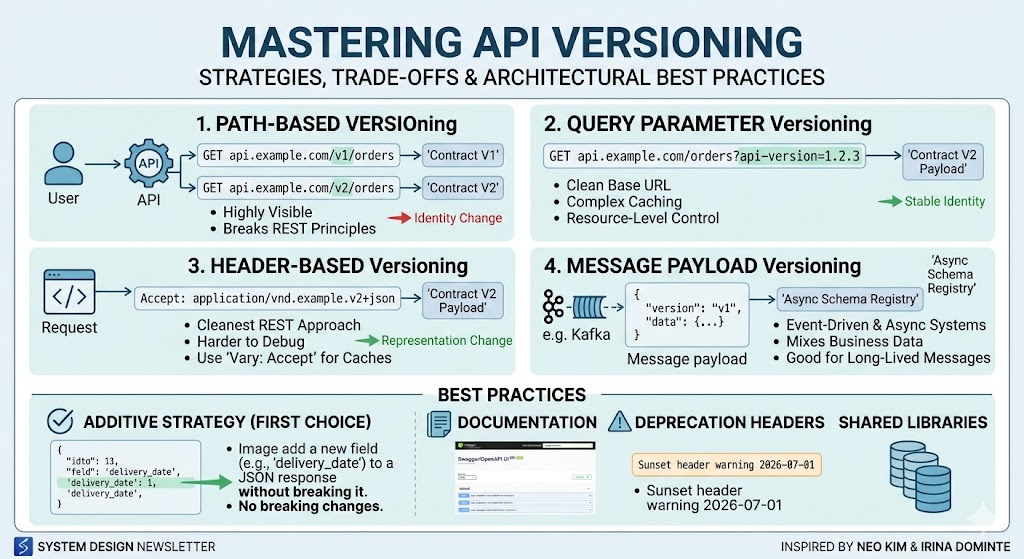
When a bug is fixed or a new business requirement emerges, the contract changes. Versioning allows teams to maintain historical contracts while simultaneously deploying optimized variations. When an API contract must evolve, architects generally choose between three core pathways:
- Deploying a New Version in a New Location: For example, introducing
/api/v2/orderswhile maintaining/api/v1/orders. This protects existing integrations but introduces significant maintenance overhead, as bug fixes and security patches must be backported across multiple active codebases. - Releasing a Backward-Compatible Version: Implementing additive changes (such as optional request parameters or new fields in a JSON response body) that do not break current clients. This allows for fluid growth but can constrain significant structural or architectural redesigns.
- Breaking Compatibility: Forcing an immediate upgrade across all clients. While generally treated as a last resort, it becomes unavoidable when addressing severe security vulnerabilities, migrating to fundamentally different data models, or correcting flawed legacy designs.
In production environments, a robust system architecture typically leverages a hybrid model of these three pathways based on the scope and impact of the architectural changes.
Evolutionary Strategies: Additive vs. Explicit Versioning
Before selecting a technical implementation, it is vital to distinguish between the two primary approaches to API evolution:
Additive Versioning
This strategy involves continuously expanding the API without incrementing the official version number. Engineers add new endpoints, fields, or optional parameters while ensuring existing schemas remain untouched. Because nothing is renamed or deleted, consumer integrations continue to function smoothly without requiring modification.
Explicit Versioning
This approach is used when a breaking change is completely unavoidable. It explicitly states that a modification will break compatibility by splitting the API behavior using distinct identifiers (e.g., via URLs, custom headers, or query parameters). This guarantees that legacy behavior is safely preserved under one version, while updated behavior lives under another.
Technical Implementations of Explicit Versioning
There are four primary technical patterns used to implement explicit API versioning, each presenting unique trade-offs regarding routing, caching, and maintenance.
1. Path-Based Versioning
Path-based versioning embeds the version identifier directly into the URI path:
GET https://api.example.com/v1/ordersPros:
- Highly visible and explicit; consumers easily understand which contract they are executing against.
- Simplifies routing configurations at the API Gateway level.
Cons:
- Violates core REST principles regarding resource identity. As Roy Fielding (the creator of REST) notes, resources should maintain a stable identity even if their internal representation shifts. Adding
/v1/or/v2/treats the exact same entity as two entirely distinct resources. - Violates the foundational web axiom (“Cool URIs don’t change”).
Production Best Practices:
If path-based versioning is utilized, architects should implement the Sunset Header (RFC 8594) and standard HTTP redirection to manage deprecation safely:
HTTP/1.1 200 OK
Deprecation: true
Sunset: Wed, 01 Jul 2026 00:00:00 GMT
Additionally, 301 Moved Permanently redirects can be employed to seamlessly route clients to newer resource paths when structural changes are minimal:
HTTP/1.1 301 Moved Permanently
Location: /api/v2/orders
2. Query Parameter Versioning
This strategy keeps the base URI completely clean and stable, appending the version specification as a query string parameter:
GET https://api.example.com/orders?api-version=1.2.3Pros:
- Keeps the base URL immutable and compliant with REST resource identity principles.
- Allows granular, resource-level versioning without altering the global API routing architecture.
Cons:
- Query strings can quickly become cluttered when combined with pagination, filtering, and sorting parameters.
- Complicates caching layers (CDNs, reverse proxies). If intermediate proxy servers misconfigure or strip query strings, clients risk receiving cached payloads from incorrect versions.
Production Best Practices:
Ensure your Content Delivery Network (CDN) or reverse proxy is explicitly configured to include the query parameter within its cache key evaluation. Normalize query inputs at the gateway layer (e.g., treating ?version=2 and ?version=02 identically) to avoid cache pollution.
3. Message Payload Versioning
Payload versioning incorporates the schema version directly inside the request or response body:
{
  "version": "v2",
  "data": {
    "id": 987,
    "status": "processed"
  }
}
Pros:
- Exceptional for asynchronous, event-driven, or message-queue architectures (e.g., Kafka, RabbitMQ).
- Allows messages stored in logs or broker queues to be self-describing, enabling consumer microservices to safely deserialize historical payloads years after they were originally published.
Cons:
- Introduces a severe separation of concerns issue for synchronous, short-lived REST interactions by mixing transport metadata with core business data.
Production Best Practices:
Restrict message payload versioning entirely to event-driven processing pipelines. Pair this approach with a centralized Schema Registry to track and validate event definitions across decoupled distributed services.
4. Header-Based (Media Type) Versioning
Header-based versioning leverages HTTP request headers to process version metadata, keeping the URI completely pristine. This can be handled via custom headers or utilizing the standard Accept header (often referred to as Media Type or Content Negotiation versioning):
GET /api/orders HTTP/1.1
Host: api.example.com
Accept: application/vnd.example.v2+json
Pros:
- Highly compliant with proper HTTP and REST semantics: the URI remains a permanent identifier for the resource, while headers dictate the specific representation of that resource.
- Offers a clean, highly maintainable, and scalable long-term versioning architecture.
Cons:
- Harder to debug, test, and log via standard web browsers since headers must be manually injected via clients like Postman or
curl. - Requires careful cache orchestration.
Production Best Practices:
To prevent edge caches and downstream CDNs from serving mismatched payloads to different clients, the server must explicitly emit the Vary: Accept (or Vary: Your-Custom-Header) HTTP response header. This instructs downstream caches to isolate and partition cache entries based on the header value supplied.
Architectural Deep Dive: Versioning Formats
Choosing how to format version identifiers determines how effectively you communicate system changes to engineering teams.
FormatStructurePrimary Use CaseFocusSemantic Versioning (SemVer)MAJOR.MINOR.PATCHComponent-based, public developer ecosystems.Impact: Instant visibility into whether a change is breaking (MAJOR), additive (MINOR), or a patch (PATCH).Calendar Versioning (CalVer)YYYY.MM.DD or YY.MMMassive enterprise SaaS APIs and operating platforms.Freshness: Clearly signals when a contract was cut, facilitating deprecation tracking.Hash Versioning (HashVer)Shortened Git commit string (v-237a2b4f)internal microservices and continuous deployment tracks.Traceability: Links an API state directly to a specific code compilation point.
Real-World Case Studies
Stripe: Header-Driven CalVer
Stripe employs a highly resilient, developer-centric versioning architecture.
- Mechanism: Header-based versioning using a custom header (
Stripe-Version: 2023-10-16). - Strategy: New developer accounts are automatically pinned to the latest stable release. When breaking architectural changes occur, legacy accounts remain unaffected.
- Developers can explicitly override their pinned version on a per-request basis via headers to seamlessly test new structures before initiating a global migration.
GitHub: Clean URIs via Content Negotiation
GitHub leverages native HTTP mechanisms to maintain structural cleanliness.
- Mechanism: Media type variation using the
Acceptheader (X-GitHub-Api-Version: 2022-11-28). - Strategy: The base resource endpoint never shifts (
[https://api.github.com/users](https://api.github.com/users)). Additive iterations are transparently rolled out globally, while breaking adjustments spawn a new date identifier. GitHub guarantees version snapshots for at least 24 months, ensuring external developers have predictable windows to update codebases.
Summary: Strategic Decision Matrix
There is no singular “correct” strategy for versioning an API. The choice depends entirely on your architectural boundaries and who consumes your endpoints:
- Choose Path-Based / SemVer when developing internal microservices where your organization controls both the client and server codebases, allowing synchronized, automated deployment pipelines.
- Choose Header-Based / CalVer when maintaining high-scale, public SaaS platforms where you do not own the consumer applications. This prioritizes contract stability, backward compatibility, and client-driven migration.
- Choose Payload Versioning strictly within event-driven architectures, data streams, and message queues to ensure long-lived data blobs remain parseable over time.
Ultimately, an additive strategy should be your first line of defense. When explicit versioning becomes necessary, select the paradigm that minimizes integration surprises for your consumers. In system design, maintaining API stability and developer trust is far more valuable than adhering strictly to any rigid technical dogma.
메타데이터
- post_id
- e4a8748ed63e
- slug
- mastering-api-versioning-e4a8748ed63e
- url
- https://medium.com/@musertac/mastering-api-versioning-e4a8748ed63e
- canonical_url
- https://medium.com/@musertac/mastering-api-versioning-e4a8748ed63e
- author_url
- https://medium.com/@musertac
- status
- ok
- fetched_at
- 2026-06-09 15:37:30




