Beyond the Studio
Reflections from the Charles Correa Foundation
Beyond the Studio
Reflections from the Charles Correa Foundation
I am currently in my second week of a three-week BITS community project at the Charles Correa Foundation (CCF) in Panaji, Goa. The Foundation preserves and advances the legacy of eminent Indian architect Charles Correa by safeguarding his professional archives, hosting public forums on architecture and urbanism, and advancing urban research and advocacy to improve human settlements across India. Working here has added a new layer to my understanding of what design practice looks like each day. An initiative of the Charles Correa Foundation, Nagari is an annual short film competition curated to develop 7-minute short films to understand urban dynamics and crises in the Indian context. The Nagari Films serve as a form of visual documentation of contemporary Indian urbanism.
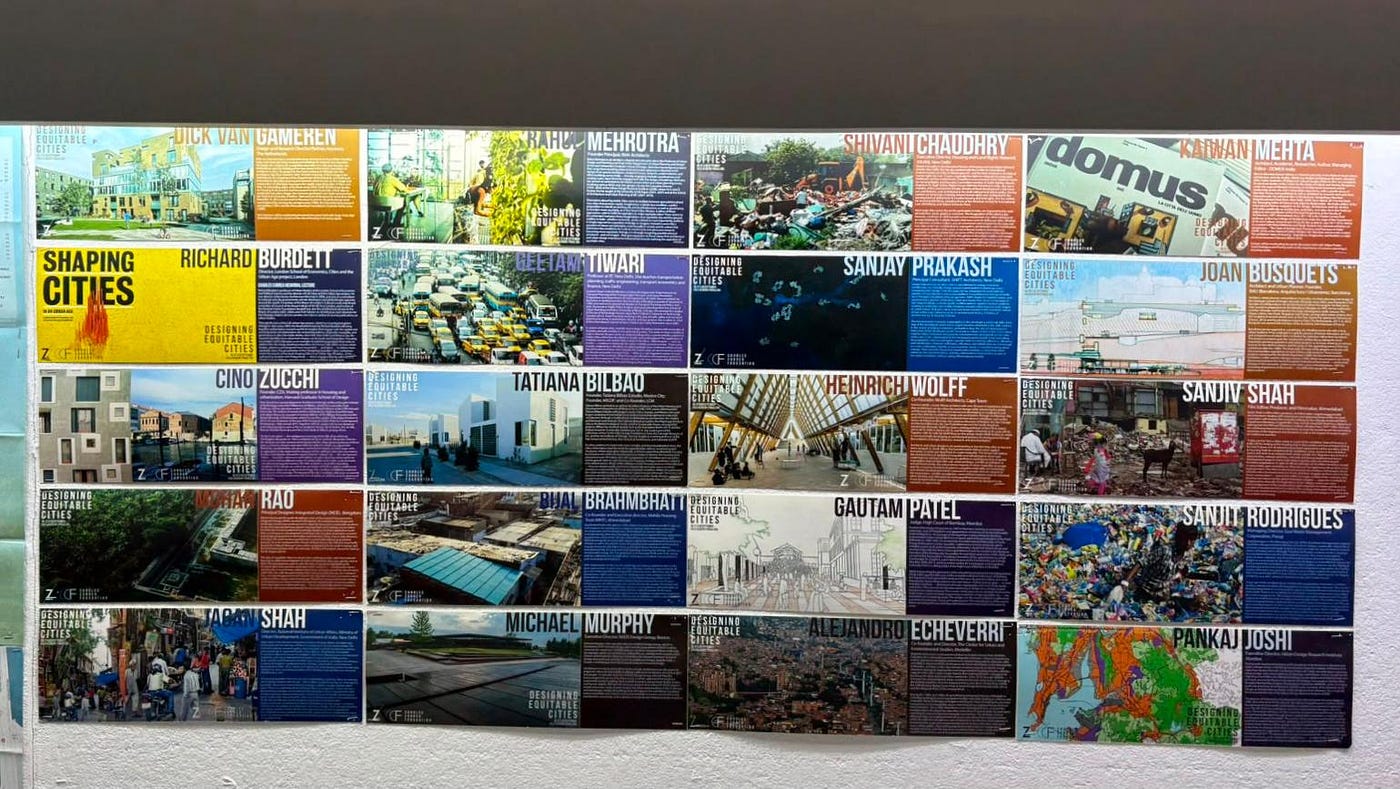
My work here is around the Nagari Education Program. Module A of the Nagari Education Program is the academic module developed by the Charles Correa Foundation. It is an initiative to integrate the archives of 60+ Nagari films made over six editions into a formal curriculum for architecture and design universities, with institutions such as the Kamla Raheja Vidyanidhi Institute for Architecture and Environmental Studies (KRVIA) and the JJ School of Arts and Architecture leading the collaboration. The module aims to build a meaningful bridge between the film archives and academic engagement at the university level, helping architecture and design students use these films as reference points for understanding how to document and interpret the world around them.
On the very first day, we were asked to simply spend time with the Nagari film archives on the website. There were no immediate deliverables. We were allowed to just observe and understand. That initial immersion served as both an introduction to the work ahead and to the Charles Correa Foundation’s broader method of working. It set the tone for the three weeks that followed. Throughout the process, organisation members have been consistently supportive, either by guiding the direction of work or even sharing relevant documents, and ensuring I had the information I needed at each stage. A meeting with KRVIA faculty member Anubhav Borgohain was also organised, who walked me through the elective course briefly, answered my questions in detail, and provided further context about the course’s intent and structure. At every step, work in progress was shared with the organisation, making it a genuinely collaborative process.
The first week was largely about research and compilation. My role was to collate the material for module A and work out how it could be used as a resource tool for universities to understand how Nagari could be incorporated into their academic curriculum. For that, I studied how college syllabi are typically structured, which gave a framework to the process of gathering the required information. I referred to documents shared by the organisation, spoke with members of the organisation, and used the insights from the KRVIA meeting to begin compiling syllabus content for both colleges on a Google Doc. Alongside this, I prepared a Figma board mapping out what content syllabi typically comprise. Once this compiled information was reviewed and approved, the work shifted to the next phase, which was figuring out how to present it on the Nagari website. I began developing website prototypes on Figma, exploring different options for how the syllabus content could be displayed for both colleges in the context of the elective course, integrating the Nagari film archives. The prototype is still in development. The overall flow, structure, and content have been approved, and work is now focused on refining the method of presentation and ensuring it aligns with the existing design language of the Nagari website.
The Nagari films reveal social dynamics, political realities, and cultural tensions through a single visual. It shows layers that text alone rarely captures with the same immediacy. The Education Program’s use of these archives as reference points for documenting situations was what resonated with me. It reinforced something I had begun to understand through my academic modules as well; that our relationship with the environment, for instance, is not purely ecological. It is shaped by the influence of a range of cultural, societal, and political elements. The film archives made this visible in a way that coursework theory alone may not have.
The connection to our Year 1 learning was present throughout. While compiling the course outcomes for the KRVIA elective, a key emphasis emerged on the value of on-site visits and visual media over purely theoretical learning. This resonated directly with my Design Methods module, where over nine weeks we visited a site, observed its dynamics, conducted interviews, conducted hypothesis testing, and developed a problem statement entirely from direct field experience. That process had taught me the importance of being physically present in a situation before drawing conclusions, and of having the right frameworks in place to make sense of what you observe. Both of these instincts proved useful here. Even the Languages of Design module, which was entirely research-based, further reinforced that design extends well beyond materials and drawing. It showed us each week that design is deeply shaped by political, social, ecological, and cultural forces. The Nagari film archives brought these same principles to life visually, and that created a strong parallel for me between my academic learning and the work being done at the Charles Correa Foundation.
The most significant shift over these two weeks, however, was one of my own perspectives. When I first received the brief, my approach was rigid. The syllabus, in my mind, was a plain text document, and so, I focused on content and structure in the most conventional sense. But after studying the Nagari website’s design language, the organisation’s broader approach to presenting content, and their thought process behind the Nagari Education Program, I began to understand what was being asked of me. The intent goes beyond simply hosting the Nagari films on a platform. They want the archives to become a tool for building empathy and social awareness among architecture and design students and to help them see the layers of society that their field of work will intersect with. Once I understood that, my approach to the prototype changed entirely. The Nagari films’ storytelling, I came to see, illuminated the many dimensions of society that design as a practice is embedded in. Such layers are easy to overlook when work stays confined within a studio or a screen, and as a design student, this point deeply resonated with me as well.
These two weeks pushed me to think beyond what design typically means in an academic setting. I came in with assumptions about process and structure that I had to consciously unlearn. More than any specific skill, I developed an ability to read context and understand not just what is being communicated, but why and for whom. I grew more comfortable with ambiguity, learning to make considered decisions without complete clarity. And perhaps most significantly, I began to see design not as problem-solving in isolation, but as deeply embedded in the social and cultural fabric it operates within.
BITSDesignSchool
BITSCommunityProject
DesignForImpact
DesignForChange
StudentVoice
DesignWithCommunities
메타데이터
- post_id
- e4bd2eae9b42
- slug
- beyond-the-studio-e4bd2eae9b42
- url
- https://medium.com/@vruddhidempo/beyond-the-studio-e4bd2eae9b42
- canonical_url
- https://medium.com/@vruddhidempo/beyond-the-studio-e4bd2eae9b42
- author_url
- https://medium.com/@vruddhidempo
- status
- ok
- fetched_at
- 2026-06-15 22:55:51