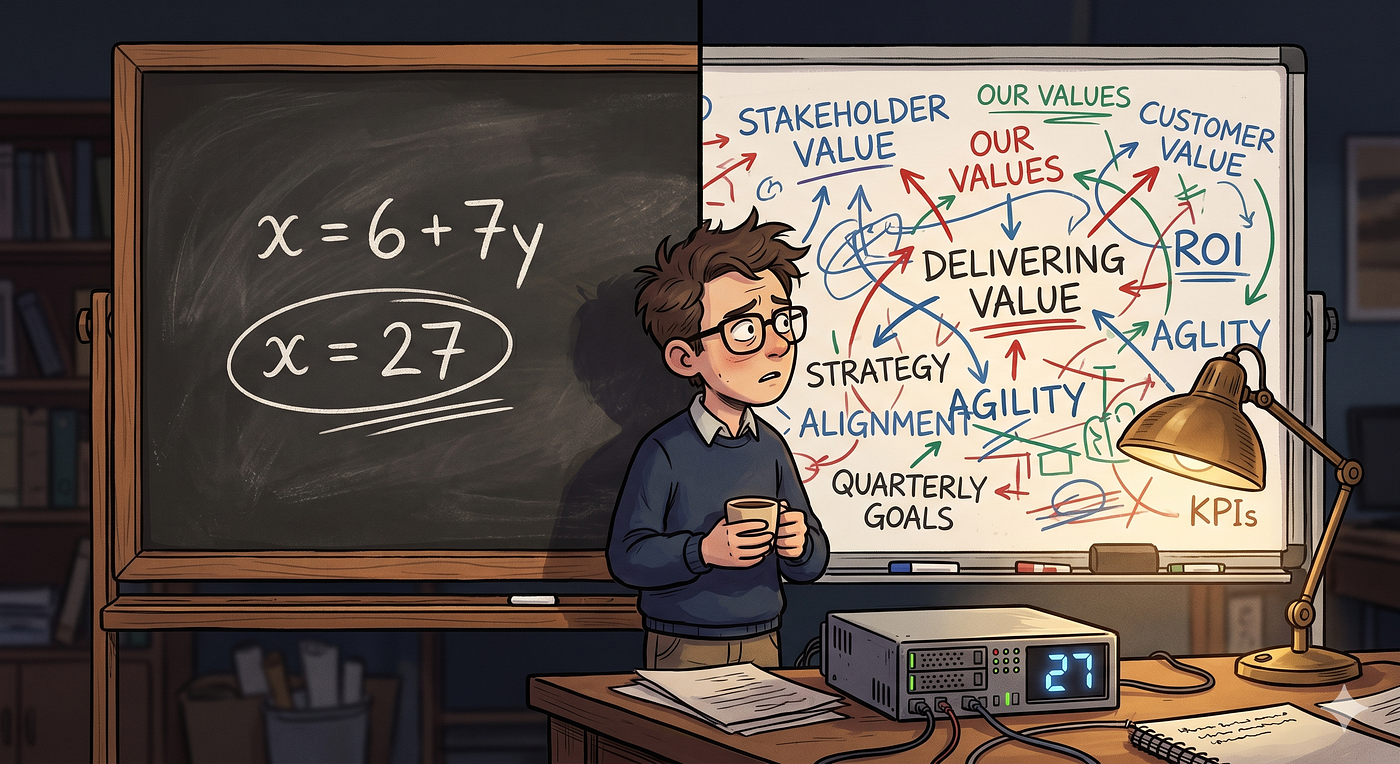
Are We Losing the Ability to Intuit?
Notes on the Quiet Skill We Keep Handing Away
Are We Losing the Ability to Intuit?
Notes on the Quiet Skill We Keep Handing Away
There is an old joke about a man who asks his friend how he became such a good chess player. The friend says, “Good moves.” And how did he learn to make good moves? “Bad moves.” We laugh because we recognize ourselves in it. Every quiet instinct we trust was paid for, move by move, long before we noticed we were paying. The trouble, as we will see, is that we are now outsourcing the bad moves. And no one has yet explained what happens to the good ones when we do.
This piece explores whether we are in danger of losing the ability to intuit, now that two forces (artificial intelligence and social media) are quietly reshaping how we think. I suspect we are. But I want to explore rather than declare, because the honest answer is more interesting than the alarmed one.
Photo by Edz Norton on Unsplash
The Quiet Skill We Rarely Name
Before we can worry about losing intuition, we should be clear about what it is. The word gets thrown around as if it meant magic, or a sixth sense, or the thing our grandmothers had. It is none of those things, and it is also, in a way, all of them.
Cognitive scientists describe intuition as the ability to know something without having to reason it out aloud. It is fast, quiet, and usually right about the things it has seen before. One researcher calls it “a non-sequential information processing mode, which comprises both cognitive and affective elements and results in direct knowing without any use of conscious reasoning.” In plain words: our brain notices something, matches it against thousands of past moments, and hands us a feeling before it hands us a sentence.
Daniel Kahneman calls this “System 1” thinking, the quick, automatic mind that runs while the slow, deliberate mind is still putting on its shoes. Gary Klein, who studied firefighters, nurses, and soldiers, found that experts in high-pressure fields make most of their critical choices this way. They do not list options. They see the situation, and the right move appears. Klein estimates that something like ninety percent of expert decisions work like this.
So intuition is not mystical. It is a compressed experience. It is what happens when we have seen enough rain to know, without checking the sky, that we should close the window.
Where the Good Moves Actually Come From
Here is the part that matters most for our question. Intuition does not arrive from nowhere. It is built slowly from two raw materials: direct contact with the world and the mistakes we make within it.
Researchers who study expert decision-making have found a simple pattern. People develop strong intuition when they get many chances to try, fail, notice the failure, and try again in the same domain. A firefighter becomes good at reading a burning room because she has stood in many. A doctor learns which patient looks “off” because he has seen thousands of patients, some of whom were fine and some of whom were not. The mistakes are not a side effect of learning intuition. They are the learners.
This is why intuition is often described as “embodied.” It is tied to sensation, emotion, memory, and physical presence. We build it by being there. The more we experience a domain directly, the more our brain stores small patterns we cannot name but can feel. Over time, these patterns become the gut feeling we trust.
That means intuition has a supply chain. And like any supply chain, it can be disrupted.
When the Brain Starts Sending the Work Elsewhere
Here is where our two new forces enter the story. Researchers have a tidy term for what happens when we hand a thinking task to a tool: “cognitive offloading.” We have done this forever, of course. Writing is cognitive offloading. So is a shopping list. So is a calculator. These tools freed us to think about bigger things, and the world became richer as a result.
But something different is happening now. A 2025 study by Michael Gerlich at SBS Swiss Business School surveyed 666 people across age groups and found a significant negative association between how often we use AI tools and our performance on critical-thinking tasks. The connection, Gerlich argues, runs through cognitive offloading. The more we let AI think, the less we practice thinking for ourselves. Younger people, who use AI the most, showed the largest drops. The study is correlational, not causal, so we should be careful. It may be that fewer critical thinkers reach for AI first. Still, the pattern is hard to ignore.
The “Google Effect,” documented over the past fifteen years, already showed that we remember information less well when we know we can look it up again. AI pushes this further. Instead of outsourcing memory, we are beginning to outsource reasoning itself. And reasoning is the slow cousin of intuition. Both grow from the same soil.
The Problem With Living Inside a Feed
Now add social media. At first glance, it seems unrelated to intuition. But look again.
Intuition is built on direct contact with real situations. Social media replaces much of that contact with a curated feed. We spend hours watching compressed, edited, algorithm-selected slices of other people’s lives. The faces we see are not the faces in our neighborhood. The emotions we react to are not the emotions we would feel if we walked outside. We are training our pattern recognition on a sample of the world that someone else chose for us, optimized for engagement rather than for truth.
There is a second problem. Intuition benefits from slow, quiet attention. The unconscious mind needs room to sift. Social media offers the opposite: constant small inputs, each one demanding a quick reaction. The feed rewards the fast judgment (like, share, scroll) and punishes the slow judgment (sit with it, think again tomorrow). Over the years, this may reshape which mental muscles we use most.
And there is a third problem, which I find the most troubling. Much of what we now “know” comes to us second-hand, through screens, through confident strangers, through summaries of summaries. Our gut develops opinions about things we have never touched. That is not intuition. That is borrowed certainty wearing intuition’s clothes.
What Actually Might Be Lost
Let us be careful here. Humans are not going to wake up tomorrow unable to feel a bad vibe in a room. Intuition is ancient and deeply wired. We are not losing the machine. We may, however, be losing some of the fuel.
Three things seem genuinely at risk. First, domain expertise is built through struggle. If AI writes our first drafts, solves our puzzles, and suggests our decisions, we skip the productive failure that builds expert gut feeling. We become good at checking AI’s work, not at producing our own. Second, attention to our own bodies and environments. The more we live inside screens, the less raw material our intuition has to draw from. Third, the trust we place in our own quiet signals. When external sources always seem more confident than we feel, we may stop listening to the small internal voice that used to catch us before we made a mistake.
The pattern is not that intuition disappears. The pattern is that intuition gets shallower, narrower, and less ours.
Reasons to Hold the Alarm Loosely
I want to resist the easy story here. Every generation worries that a new technology is rotting the mind. Socrates worried that writing would destroy memory. Parents worried that television would destroy attention. Those worries were partly right and mostly wrong. Something is always lost, but something else is usually gained.
AI may turn out to be a tool that builds new kinds of intuition. People who work closely with AI are developing a skill we did not need before: a feel for when the machine is right and when it is bluffing. That is a new form of pattern recognition. We may trade one intuition for another, and end up roughly even.
It is also possible that careful use matters more than total exposure. The Gerlich study found that people with higher levels of education appeared to be partly protected against the cognitive effects of heavy AI use. Skill, habit, and self-awareness may act as a shield. The tool is not the enemy. The posture we take toward the tool is what matters.
What We Might Practice, On Purpose
If intuition is built from direct contact, slow attention, and productive failure, then protecting it is partly a matter of intentionally keeping those three things in our lives.
That might mean doing some hard thinking before we ask AI for help, so we still meet the problem ourselves first. It might mean spending time in real rooms with real people, watching faces and feeling silences, rather than reading about feelings online. It might mean letting ourselves be bored, so our unconscious mind has space to work. It might sometimes mean noticing when a confident voice on a screen is drowning out a quieter voice inside.
None of this is a rejection of the new tools. It is a recognition that intuition is a garden, not a product. It needs tending.
A Final Thought
We began with a joke about a chess player who learned from his bad moves. The question now is whether we are still willing to make bad moves ourselves, or whether we would rather hand the board to something that never blunders. The good player is not the one who avoids mistakes. The good player is the one whose mistakes have taught her something no instruction manual could.
So yes, I suspect we are in some danger of losing the ability to intuit, at least in the deep, earned sense of that word. But the danger is not sudden or total. It is slow and depends on the choices we make every day, often without realizing it. The machine will not take away our gut feeling. We will quietly loan it out, one task at a time, unless we decide otherwise.
What are we seeing in our own lives? Where does our gut still speak clearly, and where has it gone quiet? That, I think, is the conversation worth having.
메타데이터
- post_id
- e4bdb5e6a7dc
- slug
- are-we-losing-the-ability-to-intuit-e4bdb5e6a7dc
- url
- https://medium.com/@varada/are-we-losing-the-ability-to-intuit-e4bdb5e6a7dc
- canonical_url
- https://medium.com/@varada/are-we-losing-the-ability-to-intuit-e4bdb5e6a7dc
- author_url
- https://medium.com/@varada
- status
- ok
- fetched_at
- 2026-06-12 07:40:50