Your Highlights Are Lying to You: The Dunning-Kruger Effect in Note-Taking — and Why Zettelkasten…
Here is a test. Think of the last non-fiction book you read carefully — one you highlighted, maybe exported into Obsidian, maybe even…
Your Highlights Are Lying to You: The Dunning-Kruger Effect in Note-Taking — and Why Zettelkasten Is the Fix
Here is a test. Think of the last non-fiction book you read carefully — one you highlighted, maybe exported into Obsidian, maybe even summarized. Now explain the central argument in two sentences. Not the author’s sentences. Yours.
Most people hit a wall somewhere in that second sentence. Not because they weren’t paying attention, and not because the book wasn’t worth reading. Because highlighting and saving are not the same cognitive act as understanding — and the systems we use to take notes are specifically designed to hide that difference from us.
This is not a personal failing. It is a structural one, and it has a name. Psychologists call the broader pattern the Dunning-Kruger Effect: the finding that people with limited knowledge in a domain systematically overestimate their own competence, precisely because they lack the metacognitive skill to see what they’re missing [1]. A separate but directly related body of research identifies the specific mechanism at work during study as the fluency illusion — the well-documented tendency to mistake the ease of recognizing a familiar idea for the ability to recall and use it independently [6]. Note-taking systems that make collection frictionless and comprehension optional don’t just fail to prevent these illusions. They actively engineer them.
Zettelkasten is one of the few systems I’ve encountered that runs in the opposite direction. It doesn’t make learning feel good. It makes the gaps visible. That, as it turns out, is what learning actually requires.
The core problem: Your note-taking system is a Confidence Machine, not a Knowledge Machine. Zettelkasten’s value isn’t that it helps you learn more — it’s that it prevents you from believing you’ve learned more than you have.
What Does the Dunning-Kruger Effect Actually Say?
In 1999, psychologists Justin Kruger and David Dunning published “Unskilled and Unaware of It,” testing performance and self-assessment across grammar, logic, and humor tasks. Their core finding: people in the bottom quartile of actual performance consistently rated themselves as above average [1]. They weren’t lying. They genuinely couldn’t see the gap — because accurately assessing your performance in a domain requires the same skills that performing well requires. If you lack the skills, you lack the meter too.
The inversion is equally important and equally uncomfortable. Participants in the top quartile tended to underestimate their relative standing — because genuine expertise comes with a clear view of how much complexity the field contains [1].
Note the distinction carefully: DK-style underestimation in experts comes from not knowing how rare their ability is. Calibrated confidence in Zettelkasten comes from knowing specifically what you do and don’t understand. These are different states. One is uncertainty about your rank. The other is precision about your gaps.
Neither pattern is about intelligence. Both are about exposure. And this is where note-taking enters the picture.
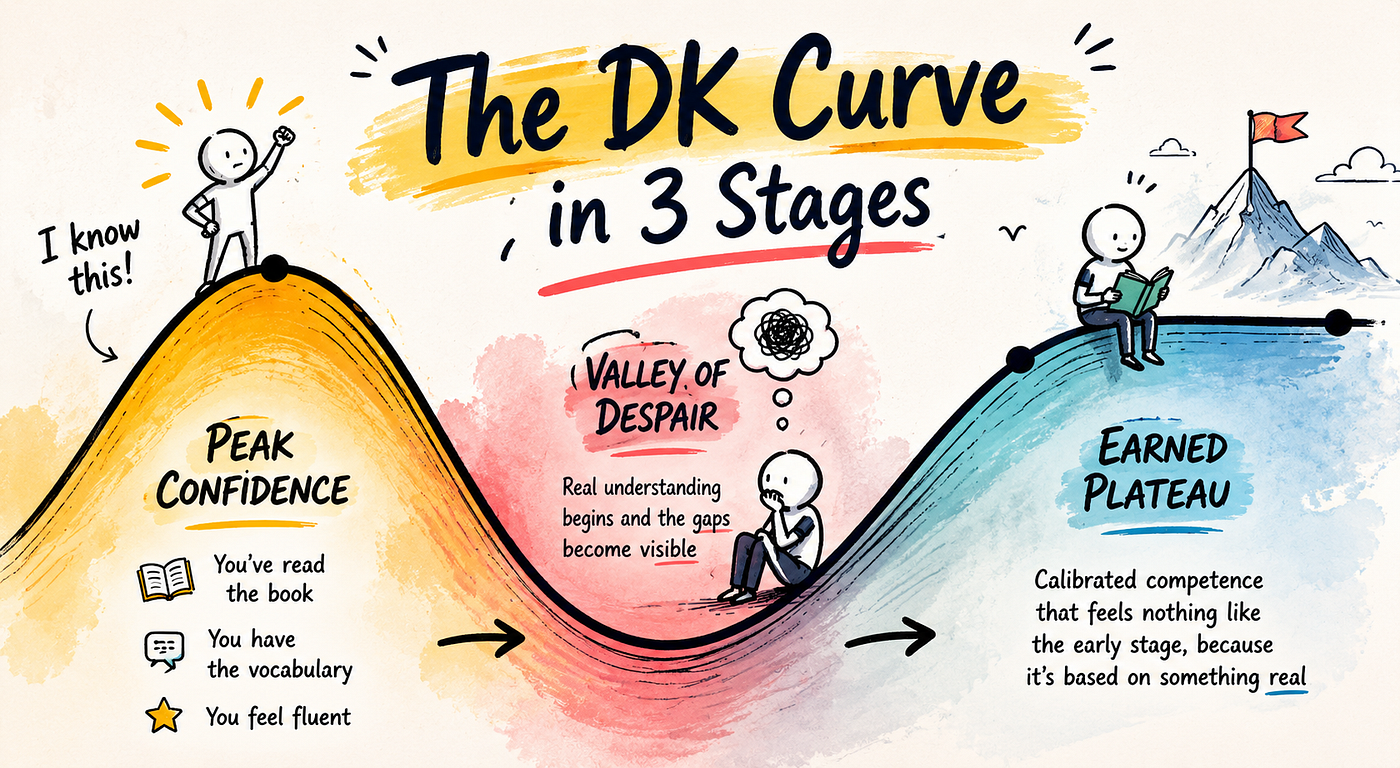
The DK curve in three stages:
- Peak confidence — you’ve read the book, you have the vocabulary, you feel fluent
- Valley of Despair — real understanding begins and the gaps become visible
- Earned plateau — calibrated competence that feels nothing like the early stage, because it’s based on something real
Most note-taking systems keep you at the peak indefinitely.
Why Passive Note-Taking Creates the Fluency Trap
To be precise about the mechanism: the Dunning-Kruger Effect as originally studied concerns performance in skill domains. The direct analog for note-taking behavior is what researchers call the fluency illusion — the finding that learners systematically mistake the subjective ease of processing familiar material for actual mastery of it [6]. When you reread a highlighted passage and it feels clear, that feeling of clarity is real. What it is not is evidence that you could reproduce the idea without the page in front of you.
Koriat and Bjork (2005) demonstrated this directly: when people assess how well they know material, they rely heavily on cues that are present during study but absent during recall [7]. A highlighted passage looks like knowledge. It functions as a cue that retrieves the author’s thinking — not yours. No study has tested Zettelkasten directly against these metacognitive outcomes, but the structural requirements of the method map precisely onto what the research identifies as corrective: generation over recognition, reconstruction over review.
Here is what a typical reading session produces.
You pick up a book. You highlight the passages that feel important. You export those highlights into Obsidian. You tag them. You feel, genuinely, like you’ve engaged with the material — because you have evidence of engagement.
What you’ve actually done is collected the author’s understanding, not built your own.
Highlighting is passive. Research consistently rates it as a low-utility learning strategy [2]. When learners rely on highlighted passages during review, they tend to process isolated statements rather than the relationships between ideas — which limits the inferential thinking that produces usable knowledge. Your highlight doesn’t prove you understood the idea. It proves you recognized that someone else thought the idea was important. There’s a meaningful difference.
The same problem runs through most digital note systems. A vault full of summarized articles, captured tweets, and clipped web pages is a collection, not a knowledge base. The information is waiting to be retrieved, never having passed through the one process that would make it yours:
The process of having to explain it in your own words.
Research on note-taking behavior confirms the cost of skipping this step. In studies of real-time note-taking during lectures, people who transcribed ideas verbatim showed significantly shallower processing than those who paraphrased and reconstructed — because reformulation requires engaging with meaning, not just recording words [3]. The broader principle holds beyond lecture notes: generating an explanation, not recognizing a good one, is where understanding is built or revealed as absent.
This is where the fluency illusion finds its home in your vault. When your notes still carry the shape and language of the source material — when you can point to the folder and say “I have notes on that” — you feel competent. The folder is evidence of engagement. But engagement and understanding are not the same thing, and a well-organized vault is very good at hiding the difference.
Does This Mean Highlighting Is Worthless?
No — and the argument would be weaker for implying it. A reader who highlights while actively annotating — questioning the author’s assumptions, noting disagreements, flagging connections to prior reading — is doing something meaningfully different from passive underlining. The problem is not the tool. It is the absence of transformation. Any system that lets you capture without requiring you to explain will eventually accumulate the fluency illusion.
Zettelkasten’s advantage is structural: it makes the transformation mandatory, not optional. You cannot complete the permanent note step without engaging in generative processing. The system doesn’t trust your sense of fluency. It asks for proof.
How Zettelkasten Exposes What You Don’t Know
The Zettelkasten method does not let you accumulate the illusion of competence. Every step contains a deliberate moment of reckoning. These three moments happen in sequence — each one depends on the one before it. Expect a literature note to take about five minutes; a permanent note, ten to twenty.
Moment 1 — The literature note (~5 minutes)
After reading a source, you write a brief summary of what the author argued — in your own words, in your own phrasing. Not a copied sentence. Not a reformatted highlight. Your reconstruction of the idea.
Most people discover here that a passage they highlighted with confidence is something they can only gesture at. They know the shape of the idea. When forced to express the substance, they need to go back to the source. The note has just located a gap.
Moment 2 — The permanent note (~10–20 minutes)
This is the hardest step and the most diagnostic. A permanent note is a single atomic idea — one concept, fully articulated, written as if it were the opening sentence of a short essay. It must stand on its own: disconnected from the source, in your language, usable without any surrounding context.
Writing it forces what cognitive researchers call the self-explanation effect: generating an explanation in your own words requires integrating new information with existing knowledge, and that integration is precisely where understanding is built or revealed as hollow [4].
If you can write the permanent note cleanly, you understood the idea. If you keep reaching for the source — if the note feels thin when you read it back, if every sentence sounds like a paraphrase of the original — you’ve just been shown exactly where to go deeper.
That’s not a failure. That’s the system running correctly.
I built my first Zettelkasten vault while working through a book on cognitive load theory. I had a note I was proud of — three paragraphs, well-formatted, cross-tagged. Three months later I tried to use it in something I was writing and discovered I couldn’t reproduce a single claim in it without returning to the original. It was a collected note dressed as a permanent one. I’d formatted my ignorance and filed it. The system showed me what I’d done — and that was the most useful thing it did in the first year.
Moment 3 — The link
Every permanent note should connect to at least one other note in your vault. This requires understanding two ideas well enough to articulate why they connect — not just that they share a topic, but what mechanism joins them, what tension exists between them, what third idea they suggest together.
If a note can’t be linked to anything, it’s an island. Real knowledge is a network. The inability to link a note is a signal, not a filing problem.
Here Is Where the Book Closes the Gap
If you’ve tried to implement Zettelkasten before and found the permanent note stage paralyzing, you were not doing it wrong. You were experiencing the method working exactly as designed. The resistance at that stage is real, and it is meaningful. It means you’ve encountered the boundary between recognizing ideas and owning them.
The problem isn’t the method. It’s that most guides describe the theory and leave you to figure out Monday morning.
**Zettelkasten with Obsidian and a Notebook walks through the complete journey from reading to permanent note transformation with detailed examples from real books.** That’s the part no other guide makes concrete, and it’s the part that changes how you read every book after it.
The linking chapter covers three types of connections, including the third type — the unexpected conceptual bridge — which is where original thinking actually begins. The complete Obsidian setup fits in one sitting: five folders, three plugins, six copy-ready templates. The weekly processing session is mapped step by step. And there’s a troubleshooting chapter that covers the three failure modes every builder hits — because the system will break down, and knowing what to do is as important as knowing how to start.
The Weekly Processing Session: A Scheduled Reality Check
One of the underappreciated features of a well-run Zettelkasten is the weekly processing session — the point where you return to raw fleeting notes from the week and decide which ideas deserve to become permanent knowledge.
This is a scheduled audit of your own understanding.
You wrote things down when ideas felt clear and important. Now, a few days later, some of them don’t hold up. The note made perfect sense in the moment of reading, but you can’t say why it mattered. You can’t link it. You can’t write the permanent note without going back to the source. This is not a system failure. It is the system correctly diagnosing that the idea was never fully understood — only recognized.
This maps directly onto the retrieval research. Restudying material produces higher confidence without producing significantly better recall on delayed tests [5]. The subjective feeling of fluency during rereading is not evidence of durable understanding. The weekly processing session corrects for this by requiring reconstruction rather than recognition — the only reliable test of what you actually know.
Over time, the weekly session stops feeling like a confrontation with your own ignorance. It becomes a conversation with a vault that has accumulated real thought, because every note in it was earned.
Collected Knowledge vs. Owned Knowledge
Here is what the difference looks like in practice. This example is overused in productivity writing — but it’s overused because nothing illustrates the gap more cleanly.
A collected note: “According to Kahneman, System 1 thinking is fast and intuitive, while System 2 is slow and deliberate.”
An owned note: “Most cognitive errors in judgment occur not because we’re irrational, but because System 1 delivers confident answers before System 2 is invited to the conversation — and we rarely notice when the invitation gets skipped.”
Both contain the same underlying idea. One is a citation. The other is a thought.
Only the second note generates another note. Only the second links naturally to a note about meeting dynamics, a note about AI output evaluation, a note about how we misread critical feedback. Collected knowledge stays still. Owned knowledge propagates.
The fluency illusion thrives in a system of collected knowledge, because you can always point to the folder. The vault becomes evidence of engagement rather than evidence of understanding.
Zettelkasten replaces the folder with the question: What did you do with it?
The Honest Reassurance
Many people who build a Zettelkasten hit the same wall around week two or three. The vault is growing, but more slowly than expected. The notes feel smaller than anticipated. The connections feel sparse. It looks nothing like the elaborate, hyperlinked vaults in YouTube tutorials.
That feeling is calibration, not failure.
The YouTube vaults look impressive because they were built over years — and because a vault that’s mostly connected-but-empty looks more impressive than one that’s smaller but every note is genuinely owned. You’re not behind. You’re finding out how much of your prior reading was recognition rather than understanding. That’s uncomfortable. It’s also the only honest starting point.
The calibrated confidence that comes out the other side of that discomfort isn’t borrowed from someone else’s highlights. It belongs to you.
Your highlights never produced that.
The before-and-after walkthrough is the part that changes how you read every book after it. If you’ve built an elaborate empty vault — or highlighted every productivity book and retained almost nothing — Zettelkasten with Obsidian and a Notebook is the book that closes the gap between theory and Monday morning. The 3-day Quick-Start Checklist gets your system operational before the weekend. Find it on Amazon: https://amzn.to/4dXBD0L .
Frequently Asked Questions
Does the Dunning-Kruger Effect apply to self-taught learners specifically?
The original research studied domain performance generally — not learning method specifically. The connection to self-directed learning runs through the fluency illusion literature [6], which shows that learners who study without regular testing tend to overestimate how well they’ve retained material. Self-taught learners are particularly at risk because they rarely encounter external tests that force the distinction between recognition and recall. Zettelkasten’s permanent note step functions as a self-administered test at every session.
Is Zettelkasten only useful for writers and academics?
No. The book covers four distinct workflows — for students, professionals, writers, and lifelong learners. The core mechanism (permanent note → link → network) is domain-agnostic. What changes is the type of source material and the nature of the connections you build.
What’s the difference between Zettelkasten and just taking good notes in Obsidian?
The difference is the permanent note requirement and what it demands. Most Obsidian setups — even sophisticated ones using Maps of Content, evergreen notes, or progressive summarization — are optimized for retrieval. Zettelkasten is optimized for generation. If you’re already using those intermediate frameworks, the distinction is in the mandatory generative step: every note must be fully written in your own language, disconnected from the source, and linked to existing thought before it counts. That combination is what converts the vault from a filing cabinet into a thinking system.
How long before a Zettelkasten vault becomes genuinely useful?
Many practitioners report the first meaningful emergent connection — an idea that surprised them by linking two things they hadn’t consciously associated — occurring somewhere between thirty and fifty permanent notes. That’s roughly four to six weeks of consistent weekly processing sessions. The 3-day Quick-Start Checklist in the book gets the infrastructure in place so that clock starts immediately.
References
The claims in this post draw on seven peer-reviewed studies. Full citations below.
[1] Kruger, J., & Dunning, D. (1999). Unskilled and unaware of it: How difficulties in recognizing one’s own incompetence lead to inflated self-assessments. Journal of Personality and Social Psychology, 77(6), 1121–1134. https://doi.org/10.1037/0022-3514.77.6.1121
[2] Dunlosky, J., Rawson, K. A., Marsh, E. J., Nathan, M. J., & Willingham, D. T. (2013). Improving students’ learning with effective learning techniques: Promising directions from cognitive and educational psychology. Psychological Science in the Public Interest, 14(1), 4–58. https://doi.org/10.1177/1529100612453266
[3] Mueller, P. A., & Oppenheimer, D. M. (2014). The pen is mightier than the keyboard: Advantages of longhand over laptop note taking. Psychological Science, 25(6), 1159–1168. https://doi.org/10.1177/0956797614524581 (Original study context: real-time lecture note-taking. The verbatim-processing principle is applied here by extension to post-reading capture.)
[4] Chi, M. T. H., De Leeuw, N., Chiu, M.-H., & LaVancher, C. (1994). Eliciting self-explanations improves understanding. Cognitive Science, 18(3), 439–477. https://doi.org/10.1016/0364-0213(94)90016-7 (Original study context: immediate self-explanation during reading. The generative processing principle is applied here by extension to permanent note writing.)
[5] Roediger, H. L., & Karpicke, J. D. (2006). Test-enhanced learning: Taking memory tests improves long-term retention. Psychological Science, 17(3), 249–255. https://doi.org/10.1111/j.1467-9280.2006.01693.x
[6] Bjork, R. A., Dunlosky, J., & Kornell, N. (2013). Self-regulated learning: Beliefs, techniques, and illusions. Annual Review of Psychology, 64, 417–444. https://doi.org/10.1146/annurev-psych-113011-143823
[7] Koriat, A., & Bjork, R. A. (2005). Illusions of competence in monitoring one’s knowledge during study. Journal of Experimental Psychology: Learning, Memory, and Cognition, 31(2), 187–194. https://doi.org/10.1037/0278-7393.31.2.187
메타데이터
- post_id
- e4c4285fae45
- slug
- your-highlights-are-lying-to-you-the-dunning-kruger-effect-in-note-taking-and-why-zettelkasten-e4c4285fae45
- url
- https://medium.com/@mohammadzeyaahmad/your-highlights-are-lying-to-you-the-dunning-kruger-effect-in-note-taking-and-why-zettelkasten-e4c4285fae45
- canonical_url
- https://medium.com/@mohammadzeyaahmad/your-highlights-are-lying-to-you-the-dunning-kruger-effect-in-note-taking-and-why-zettelkasten-e4c4285fae45
- author_url
- https://medium.com/@mohammadzeyaahmad
- status
- ok
- fetched_at
- 2026-06-09 15:37:30




