5 Books That Will Change the Way You Think
There are thousands of books that promise to make you smarter. Most of them offer hacks, shortcuts, or productivity systems. A few…
5 Books That Will Change the Way You Think
There are thousands of books that promise to make you smarter. Most of them offer hacks, shortcuts, or productivity systems. A few genuinely reshape how you see the world.
These five books did that for me.
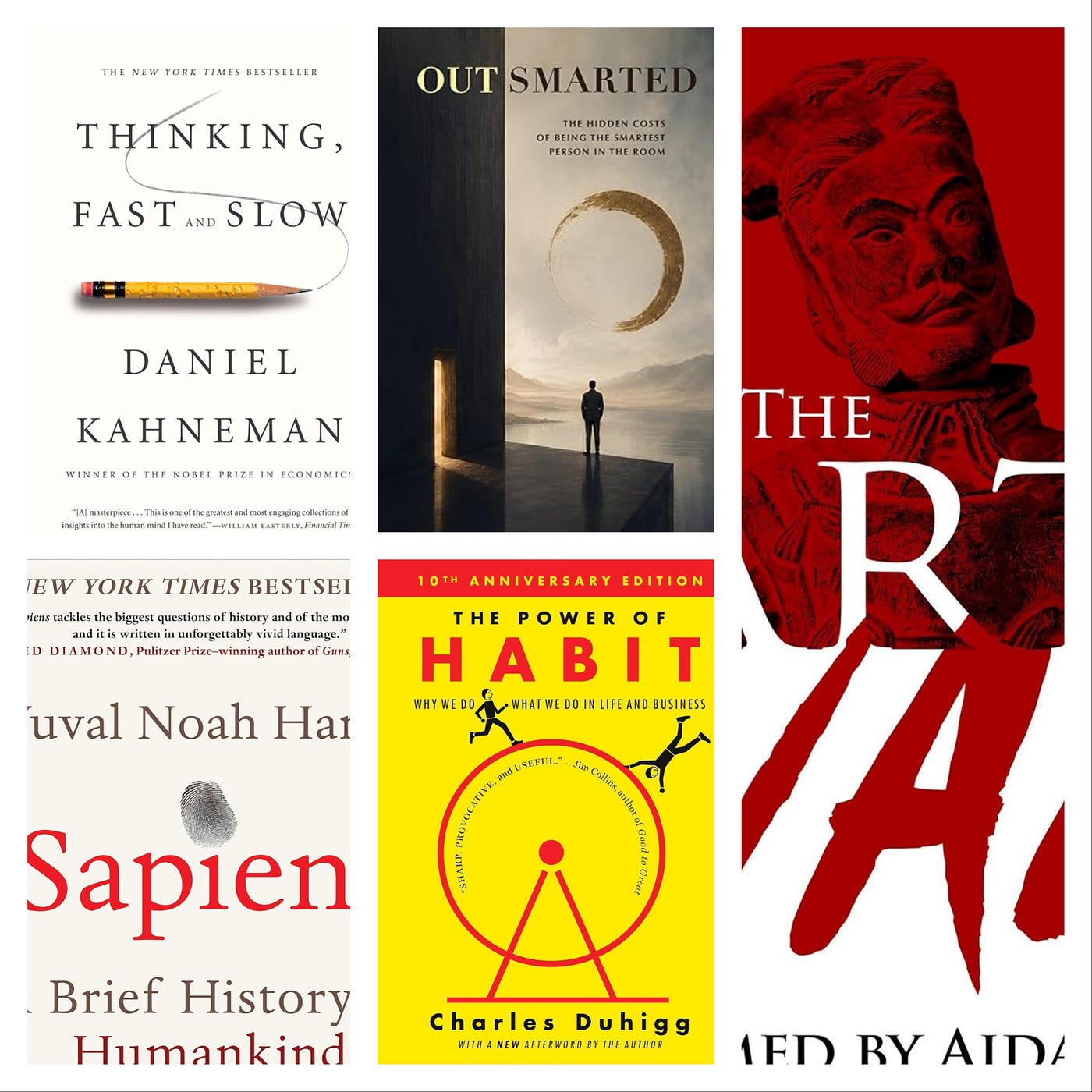
They span psychology, history, strategy, behavior change, and something we rarely talk about: the hidden burden of being highly intelligent. Together, they offer a surprisingly complete education in how humans think, act, succeed, and struggle.
1. Thinking, Fast and Slow
https://www.amazon.com/Thinking-Fast-Slow-Daniel-Kahneman/dp/0374533555
If I had to recommend one book to improve decision-making, this would be near the top of the list.
Daniel Kahneman, a Nobel Prize-winning psychologist, explains that our minds operate through two systems.
The first is fast, intuitive, and automatic. It helps us make quick judgments with little effort.
The second is slow, deliberate, and analytical. It engages when we solve difficult problems, challenge assumptions, or think critically.
The problem is that we often rely on the fast system when we should be using the slow one.
Kahneman walks readers through the many cognitive biases that influence our decisions, from overconfidence and loss aversion to the tendency to see patterns that do not exist.
After reading this book, it becomes difficult to trust your own first impressions without questioning them. That is not a bad thing. Better thinking begins with recognizing how flawed our thinking can be.
2. Sapiens
https://www.amazon.com/Sapiens-Yuval-Noah-Harari-audiobook/dp/B0741F3M7C
Most history books tell us what happened.
Sapiens explains why.
Harari takes readers on a journey from early hunter-gatherers to modern technological societies. Along the way, he argues that humanity’s greatest advantage is not intelligence alone, but our ability to cooperate around shared stories.
Money has value because we collectively believe it does.
Nations exist because enough people agree they do.
Corporations function because people trust legal fictions and systems of organization.
Whether or not you agree with all of Harari’s conclusions, the book forces you to zoom out and reconsider the assumptions underlying modern life.
You stop seeing society as inevitable and start seeing it as something humans constructed together.
That perspective is both humbling and liberating.
3. The Art of War
https://www.amazon.com/The-Art-of-War-Sun-Tzu-audiobook/dp/B00URW47O6
Written more than two thousand years ago, this short book remains astonishingly relevant.
Many people associate The Art of War with military tactics. In reality, it is a book about strategy.
It teaches the importance of preparation, self-awareness, adaptability, timing, and understanding the motivations of others.
Its most famous ideas endure because they apply far beyond battlefields.
Choose your battles wisely.
Do not let emotion dictate strategy.
Understand yourself and your environment before acting.
The strongest move is often the one that avoids unnecessary conflict altogether.
Whether you are leading teams, negotiating difficult situations, building a company, or navigating everyday challenges, strategic thinking remains an underrated skill.
4. The Power of Habit
https://www.amazon.com/Power-Habit-What-Life-Business/dp/B0FD49GYHN
We often imagine that transformation comes through motivation.
Duhigg argues otherwise.
Much of our lives are governed by habits operating beneath conscious awareness.
He introduces the concept of the habit loop:
Cue. Routine. Reward.
Once you understand this loop, you begin to see how habits shape your health, productivity, relationships, and performance.
The encouraging message is that habits can be changed.
Not through willpower alone, but by redesigning the systems that support behavior.
Small repeated actions compound over time.
Many of the outcomes we attribute to talent or discipline are actually the result of habits developed over years.
If you want lasting change, this book offers a practical roadmap.
5. Outsmarted: The Hidden Costs of Being the Smartest Person in the Room
https://www.amazon.com/Outsmarted-Hidden-Costs-Smartest-Person-ebook/dp/B0H3DJF4HP
Most books about intelligence celebrate its advantages.
This one asks a different question: What does intelligence cost?
Highly intelligent and high-achieving people are often viewed as fortunate. They excel academically, solve complex problems, and advance in demanding careers.
But intelligence can come with unexpected trade-offs.
Perfectionism. Isolation. Overthinking. Difficulty relating to others.
An identity built entirely around being “the smart one.”
The pressure to constantly perform.
The fear of failure because expectations have always been high.
Outsmarted explores these hidden struggles and challenges the assumption that intellectual ability automatically leads to fulfillment.
For engineers, scientists, academics, founders, and professionals whose self-worth has become intertwined with achievement, the book offers something rare: recognition.
It acknowledges that strengths can become vulnerabilities when taken to extremes.
Being gifted does not exempt someone from human struggles.
Sometimes, it amplifies them.
In a culture obsessed with optimization and success, this perspective feels both refreshing and necessary.
Final Thoughts
These books approach intelligence from very different angles.
- Thinking, Fast and Slow teaches you how your mind deceives you.
- Sapiens reveals the stories that shape civilization.
- The Art of War sharpens your strategic judgment.
- The Power of Habit shows how daily behaviors define long-term outcomes.
- Outsmarted reminds us that intelligence itself can carry burdens that are often invisible to others.
Reading does not automatically make us wiser.
But the right books expand our perspective, challenge our assumptions, and give us language for experiences we previously struggled to understand.
If I could recommend just five books to someone who wanted to better understand themselves and the world around them, these would be on the list.
What books changed the way you think?
메타데이터
- post_id
- e4c4a98d5ece
- slug
- 5-books-that-will-change-the-way-you-think-e4c4a98d5ece
- url
- https://medium.com/@dr.saeed.hashemi82/5-books-that-will-change-the-way-you-think-e4c4a98d5ece
- canonical_url
- https://medium.com/@dr.saeed.hashemi82/5-books-that-will-change-the-way-you-think-e4c4a98d5ece
- author_url
- https://medium.com/@dr.saeed.hashemi82
- status
- ok
- fetched_at
- 2026-06-20 20:29:01