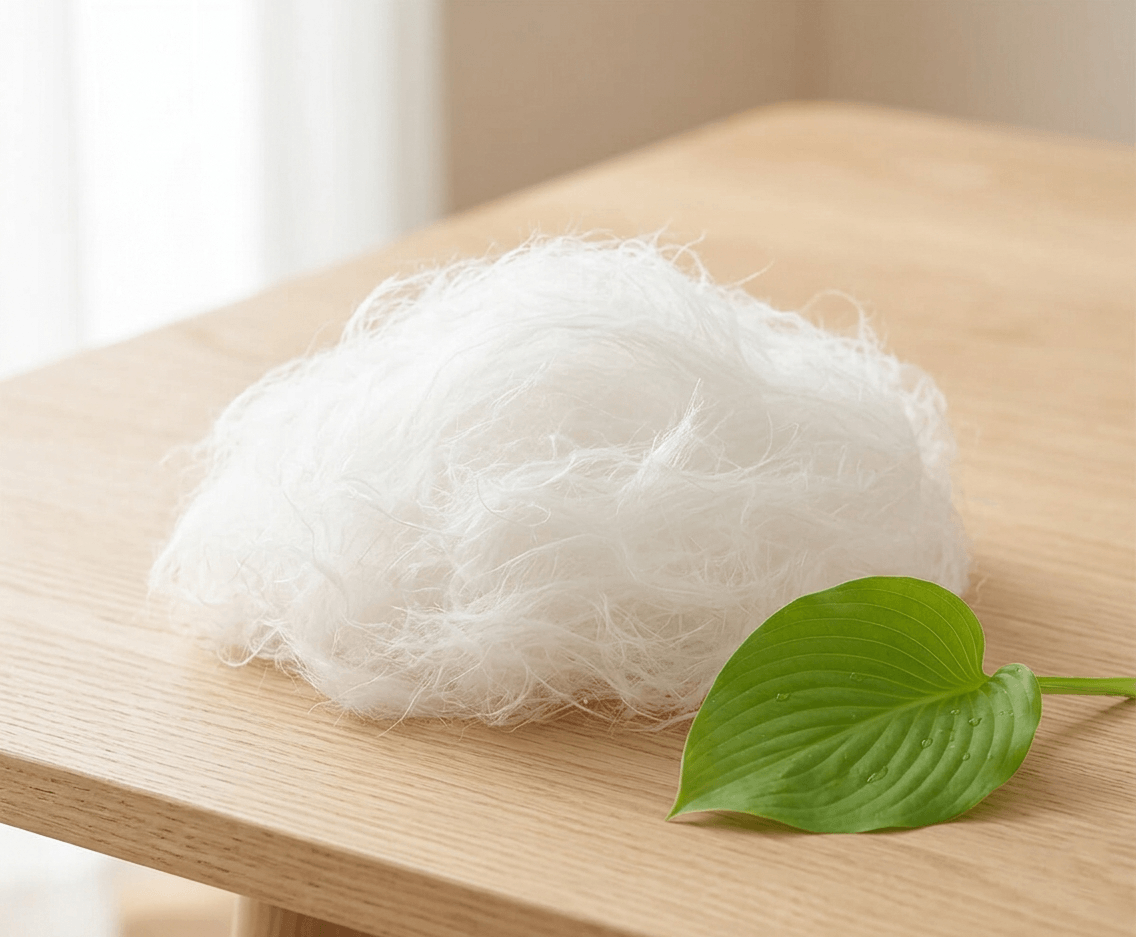
Why PLA Fiber Is Gaining Ground in Nonwoven Applications
The nonwovens industry has been changing gradually over the past few years, although the shift is not always evenly visible across regions…
Why PLA Fiber Is Gaining Ground in Nonwoven Applications
The nonwovens industry has been changing gradually over the past few years, although the shift is not always evenly visible across regions or application segments. On one side, regulations related to plastics and carbon emissions are tightening. On the other, manufacturers are still dealing with cost pressure and established production systems built around petroleum-based polymers.
In this gap between policy and reality, PLA fiber has started to appear more frequently — not as a sudden replacement, but as a material being tested, adjusted, and slowly integrated into existing systems.
PLA (polylactic acid) comes from renewable plant resources such as corn and sugarcane. That part is often mentioned first in most descriptions, but in practice, what matters more to manufacturers is how it behaves during processing and in final-use environments.
Where PLA Fits in Real Applications
In many nonwoven products, especially disposable ones, material selection is rarely about a single property. It is usually a compromise between softness, strength, processing stability, and cost efficiency.

PLA nonwovens are increasingly being used in areas such as hygiene products, medical protection materials, skincare substrates, and packaging materials. These are not new categories, but the pressure to reduce environmental impact is making material substitution more active than before.
A simple comparison helps explain why PLA is being considered more seriously in recent years:

What is important here is not that PLA “replaces” conventional fibers completely, but that it fits into specific product lines where environmental requirements are becoming harder to ignore.
Bicomponent Fibers: A Practical Engineering Direction
One area where PLA is gaining attention is bicomponent fiber design. In traditional nonwoven production, ES fibers or low-melting polyester fibers are often used as bonding materials. They are effective, but they come from fossil-based systems.

PLA bicomponent fibers are being explored as an alternative in certain structures. During thermal processing, they can contribute to bonding without relying heavily on additional chemical binders. This is especially relevant in disposable hygiene and medical-related materials, where both performance and safety expectations are high.
In practice, PLA bicomponent fibers are not used in isolation. They are usually combined with cotton, hemp, wool, or regenerated fibers such as viscose, Lyocell, Modal, and bamboo fiber. These blends are still being optimized across different manufacturers and product requirements.
There are also experiments combining PLA with other degradable polymers like PBAT and PBS. These combinations are not standardized yet, but they reflect an ongoing attempt to balance performance and degradability.
Industry Reality: Adoption Depends on Systems, Not Materials Alone
One thing that often gets overlooked in discussions about bio-based materials is that adoption is not determined by the material alone. It depends on whether the entire production system can support it — spinning, bonding, processing, and downstream converting all matter.
PLA already works across several nonwoven processes, including spunbond, meltblown, spunlace, air-through, and thermal bonding systems. However, each process still requires tuning, and in some cases, equipment adaptation.

At major industry exhibitions such as INDEX and Techtextil, PLA-based materials are increasingly visible. Not necessarily as dominant technologies, but as part of a broader set of sustainability-oriented solutions being tested in real industrial environments.
Companies like eSUN are part of this ecosystem, developing PLA fiber and nonwoven material systems across different application scenarios. Their presence in exhibitions reflects a wider trend rather than a single-company narrative.
Closing Thought
PLA fiber is probably best understood not as a final solution, but as part of a transition phase in the nonwovens industry.
The shift is still uneven. Some applications adopt it faster, others remain unchanged due to cost or technical constraints. But the direction is relatively clear: materials are being evaluated not only by performance anymore, but also by how they fit into longer-term environmental expectations.
That is where PLA is gradually finding its position — not everywhere, but in more places than before.
메타데이터
- post_id
- e4c6ca387bdd
- slug
- why-pla-fiber-is-gaining-ground-in-nonwoven-applications-e4c6ca387bdd
- url
- https://medium.com/@plafiber/why-pla-fiber-is-gaining-ground-in-nonwoven-applications-e4c6ca387bdd
- canonical_url
- https://medium.com/@plafiber/why-pla-fiber-is-gaining-ground-in-nonwoven-applications-e4c6ca387bdd
- author_url
- https://medium.com/@plafiber
- status
- ok
- fetched_at
- 2026-06-25 07:00:49