Affliction, Passing Through Death, & Enduring: Simone Weil’s Gravity & Grace…
French left libertarian philosopher, Christian mystic declined baptism and cheap grace, a gender rebel, she took on the weight of the…
Affliction, Passing Through Death, & Enduring the Weight of the World: Simone Weil’s Gravity and Grace
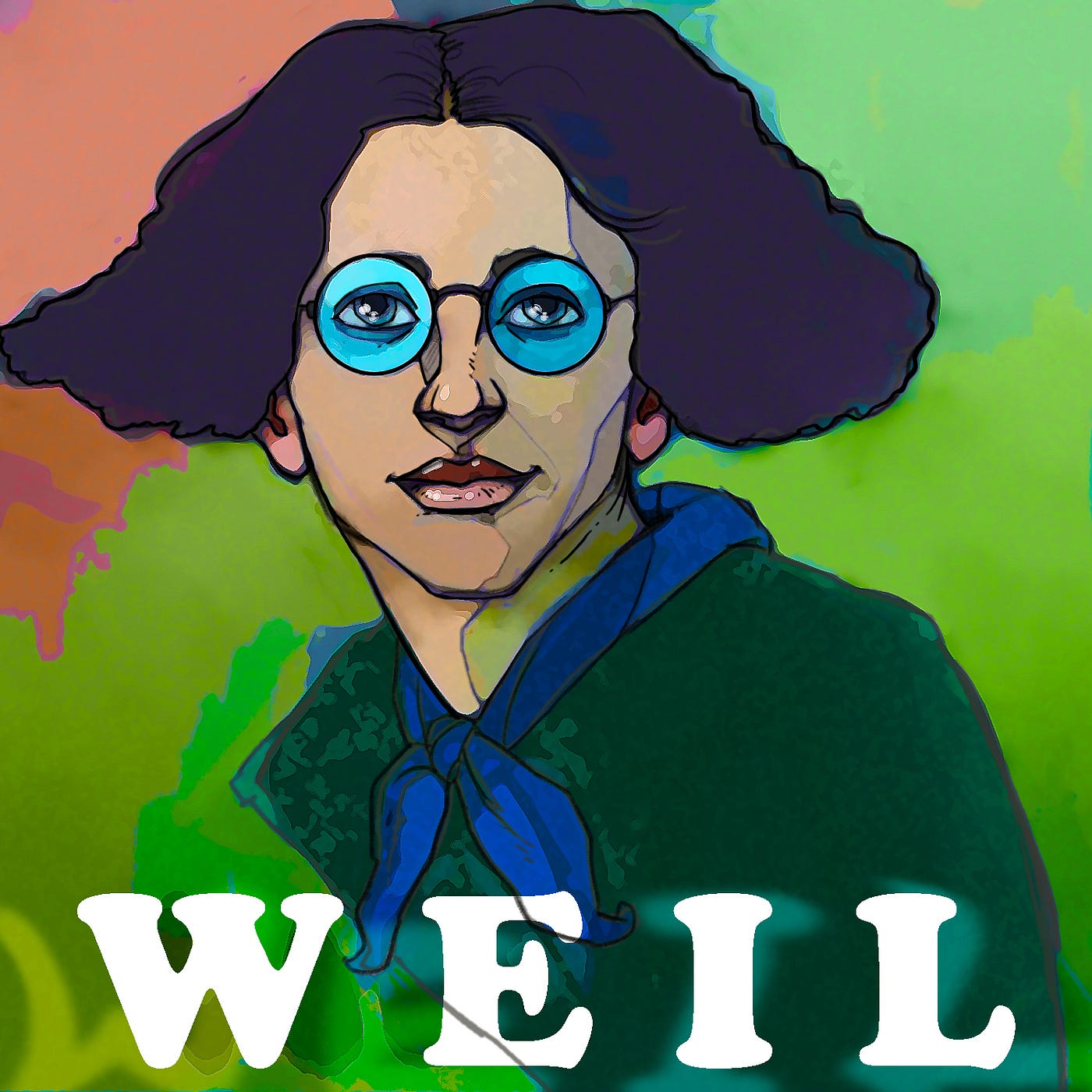
Thanks to our friends Ioanna and Yavor for teaching us about Simone Weil.
Simone Weil (1909–1943) was a French left libertarian political philosopher, a Christian mystic (attracted to Catholicism, she declined to be baptized), a factory worker, an ally of the Durruti Column in the Spanish Civil War, and someone proficient in Ancient Greek and Sanskrit. She organized against the military draft. A gender rebel, she was a critic of the famous feminist Simone De Beauvoir (they were generational peers).
Having known hunger, Weil believed her feminism should be informed by opposition to capitalism and the struggle for happiness. They should not be counter-posed, prioritizing one over the other. Weil was an anti-fascist organizer during Vichy France (the years of Nazi attack and occupation) and joined the Resistance.
Left-Libertarian Opponent of the Empire of Capital, Fascism, & Patriarchy
Weil was known by those closest to her as masking her beauty by wearing men’s clothes; she often sustained a male ascetic disposition of toil. Weil also lived a life of fragile health, facing tuberculosis, and died of cardiac arrest. It is unclear if she starved herself to death in solidarity with those she knew had been conquered.
Weil wrote perennially and many of her writings were translated for English-reading audiences first in the 1950s and 1960s. Waiting for God, The Need for Roots, On the Abolition of Political Parties, and Intimations of Christianity Among the Ancient Greeks are all impressive. Yet somehow Gravity and Grace captures her dynamic and creative qualities as a dialectical faith thinker who could convey profound wisdom about suffering. As with Friedrich Nietzsche, she wrote in short aphorisms or small paragraphs.
Beyond Anxiety: Grassroots Orientation & Abolition of Political Parties
The imperial cultural apparatus today is stained and weighed down by discourses on dread, pessimism, trauma, anxiety, suffering, and melancholia in the name of existentialism or the historical oppressive inheritance of women and people of color. These tropes have been up for sale regardless of personality or party in power above society. And yet grief is legitimate.
Still, there is a profuse array of apologies for evasion of responsibility for impending confrontation and necessary insurgent rebellion against authority — these in fact are the main currents of existentialism. We know the decadence of today is out of hand for how these narratives, that claim the right to rest and walk hand-in-hand with corporate wellness and imperial public health pretenses, allow too many to excel in professional development and gather social capital, and pose as worthy of ethical executive leadership. This, the purported search for ethics, is an impossibility where social equality and inclusion in decision making are sham-gods.
Beyond Sham-Gods: Responding to A Profuse Array of Apologies
Weil’s Gravity and Grace is a collection of genuine meditations of someone of a radical faith who sustains profound hopes in the midst of affliction and approaching death.
Weil viewed beauty as the harmony of chance and the good. Beauty captivates the flesh in order to gather permission to pass through to the soul. The beautiful is something we desire without wishing to devour it — we respect and desire that it should be. Just as we cannot approach God, distance is the soul of the beautiful. Waiting, not wishing and longing, corresponds to the beautiful. If God can only be present in creation, this is a form of absence — if we are creating through his will.
Patiently Taking the Weight of the World
In fact, Weil takes on the weight of the world, conveying sincere poetry underscoring the search for and maintenance of a wholeness that demands an active joy as parallel to constant fatigue. Weil says we must work (it can be like social death) while renouncing personal fruits from our action. If we cannot wait for the light of eternity, we cannot overcome the corruption (that comes from the search for individual and ill-gotten gains) and fear (oppression through lack of recognition).
We fear slavery and being conquered exactly as a result that we deprive ourselves of poetry which produces demoralization. Weil does not have in mind in particular a rhyming couplet, a sonata, or a Love Jones café where people perform their sassiness and call it a revolution. Rather a philosophy of history that has an eternal becoming within as its civilization-ethic and yet which understands God loves finite things, for they are all finite things. Therefore, poetry must touch and inform our arrangement of society’s institutions that we must directly govern. It cannot be a cultural activity in the sphere of civil society where we acknowledge professionals, experts, specialists, and madmen and women actually govern us like colonial trustees.
When Burdened by Impossibilities, Sustain Faith in Civilization-Ethics
We often feel that human life is impossible. But it is only affliction that makes us feel this. Good may be impossible. Desire may destroy its object.
Weil seems to challenge us with a proposition. To desire something is impossible; we must desire that which is nothing. What does this mean? When we place values on ourselves, we must learn not to wrap ourselves in rainbows that the mediocre of today delight. If we desire a new beginning, there will be a gap in how most understand what we are working for, until they experience some revelation.
There Is No Revelation Without Looking for What Most Cannot Recognize
There can be no revelation without first searching for what most in this world cannot fully recognize. Surely, the hungry should be fed, the homeless should be given homes, the sick need healthcare. But our immediate needs we cannot live by alone, or we will be exploited by those who monopolize power and things.
We have contradictions within. This is the basis of our ‘wretchedness’ and our ‘rootedness’ in reality. Weil underlines that we can knock on the ‘supernatural’s door,’ assuming this is a pathway to discovering a new heaven, a new earth. Yet we cannot ‘open the door’ on our own.
Many when considering death, whether social or physical, are disturbed by time, and consider a finality without an end. Yet if we have been striving not for necessity but some good, where we have placed values on ourselves, we can arrange the meaning of our own lives even under arduous circumstances.
Beyond ‘Open Up The Door and Let Me In’
It is striking how many who claim to know God personally become hysterical as their lives (or that of their loved ones) approach physical deterioration or death. Is this a result that few have discovered the secret of the human condition that their knowledge of God they repeatedly testify has revealed? Weil seems to believe there was a secret that could be revealed — but she was willing to wait, for a time.
Many of us, like Simone Weil, can explain (after reflection and study) why society is not arranged for the homeless and hungry to have their needs met. We can explain what to do and how to do it. We cannot permit what we actually know to fall into a mysticism as if revelation has not delivered proper insights.
Even Poetic Mysticism Cannot Obscure What Actually Has Been Revealed
If there is no present equality between the all too human and the gathering of forces that are both obviously evil and unethical, there are still things that cannot be explained. Why do young people die of cancer or another deadly disease? Why are some born without an arm or leg or an addiction before they had their own quixotic chance at self-mastery under adversity? There appears there is no revelation that can satisfactorily answer that.
Separate from how oppressive humans have arranged society, why are certain lives born at an extreme disadvantage? Sometimes we may discover dangerous chemicals in our water or the problem of electricity towers in a synthetic environment spreading carcinogens. The fact still remains that certain human groups have a proclivity for certain diseases or defects that hinder their self-expression before they even take a self-directed step physically or mentally.
Rejecting Cheap Grace, Understanding the Struggle for Happiness
It is difficult to say. Weil may have been satisfied, she had faith and could not have known, that she would reappear where those who suffer with great gravity, search for revelation beyond picking at their affliction, when taking on the weight of the world.
There is good reason not to permit or be dependent on one institution or personality to facilitate the revelations or grace we need. If God is in control (many like to assert this), if God will act, we must have the patience to wait. But we cannot wait convincing ourselves we are powerless or alternatively saved from the burdens in front of our nose. Simone Weil did not discover her faith in search of a false anointing, that she was God’s elect or vanguard. Imagine, many actually believe they can be personally saved and avoid the impending confrontation with oppressive institutions.
The Moment of Danger Behind a Promised Salvation
Rejecting ritual baptism means we understand the promises and perils ahead. We understand the gravity, the moment of danger of a promised salvation which we must take an active role. This danger includes we cannot allow our retreats to hide behind cheap and institutional rituals. That we cannot ‘open up the door’ and escape our time on earth or mystify (in the worst sense) the weight we must take, recommends that we search for a wholeness in the midst of constant fatigue. For from the time we are born, we are approaching death. And to share our sense of faith and wellness with those who conquer and kill (they might invite us to manage the process for them) is a grave error that can only be fundamental.
We Cannot Allow Ourselves to be Submerged in a Nightmare
Simone Weil argued: “Joy is the overflowing consciousness of reality. To suffer while preserving the consciousness of our reality is better. That is to suffer while not being submerged in the nightmare. Affliction compels us to realize what we do not believe is possible!”
Weil seems to suggest there is a bidirectional responsibility between God and humans; faith doesn’t happen without both. We wait for God. But waiting is time limited. Human activity can usher in a new beginning or heaven on earth. Something must happen; something must be done.
Waiting for God and Self-Directed Liberating Activity
When people die, or are burdened by tremendous suffering, grief is legitimate. Throughout our lives most humans know affliction and suffering (if indirectly through loved ones). People deal with these heavy loads in different ways.
Political projects, projects of liberation, are always bigger than ourselves. This doesn’t mean we lose our own individual personality within these projects.
And Those Who Came Before
We have known friends (and those who came before) with cancer, struggling with chemotherapy and chills, with knit hat and socks, sitting up in their hospital room editing their latest article in the advocacy journal they created.
We have known friends (and those who came before) elderly and blind, in reality the collective memory of the nation from the perspective of those who toil, that leave voice messages to be transcribed by associates so their vision may still get out to the world.
We have known friends (and those who came before) who previously relied on their physical presence who under adversity have found new ways to wield their weight in the world.
We have known friends (and those who came before) who work behind the scenes, knowing affliction, and are the wind beneath the wings of those who sometimes appear to fly.
We have also known friends (and those who came before) who made a big show of their reason and lack of faith (or alternatively their beliefs) and for long periods of time in apparently healthy body and mind, could produce no impact on the world. They did not even try despite much intellectual analysis and a culture of complaint.
Our Works and Faith Create Our Own Lives
For Simone Weil, oppressive and degrading forces (some whose explanation cannot be easily revealed) will infinitely exceed our powers if we don’t sustain our own work and faith by which we recreate our own lives. There is evidence that Weil may not have succeeded at or completed this self-avowed project. Some may wonder: was this a result that she declined to be baptized?
Weil not only rejected a cheap grace. She was self-aware in her struggle for happiness because she knew it was not an easy path having known everyday drudgery, fascist occupation, and civil war where the future popular self-directed socialist society appeared, disappeared and might reappear. If this is too much faith, mysticism, and revelation for some, even with great historical knowledge, nothing will reappear.
메타데이터
- post_id
- e4cb55e5df30
- slug
- affliction-passing-through-death-enduring-simone-weils-gravity-grace-e4cb55e5df30
- url
- https://medium.com/@questphd/affliction-passing-through-death-enduring-simone-weils-gravity-grace-e4cb55e5df30
- canonical_url
- https://medium.com/@questphd/affliction-passing-through-death-enduring-simone-weils-gravity-grace-e4cb55e5df30
- author_url
- https://medium.com/@questphd
- status
- ok
- fetched_at
- 2026-06-26 03:39:16