Chomsky’s Three Models of Language: The Birth of Modern Linguistics
How Transformational Grammar Revolutionized Our Understanding of Language Structure
Chomsky’s Three Models of Language: The Birth of Modern Linguistics
How Transformational Grammar Revolutionized Our Understanding of Language Structure
Noam Chomsky’s groundbreaking 1956 paper “Three Models for the Description of Language” fundamentally transformed how we understand human language, laying the groundwork for both modern linguistics and computational approaches to language processing. This seminal work introduced theoretical frameworks that continue to influence fields ranging from cognitive science to artificial intelligence, particularly in natural language processing.
Chomsky systematically examines three increasingly powerful models for describing language structure, demonstrating why simpler approaches fail to capture the full complexity of natural languages like English. His rigorous mathematical analysis proves that language requires more sophisticated theoretical frameworks than many of his contemporaries believed.
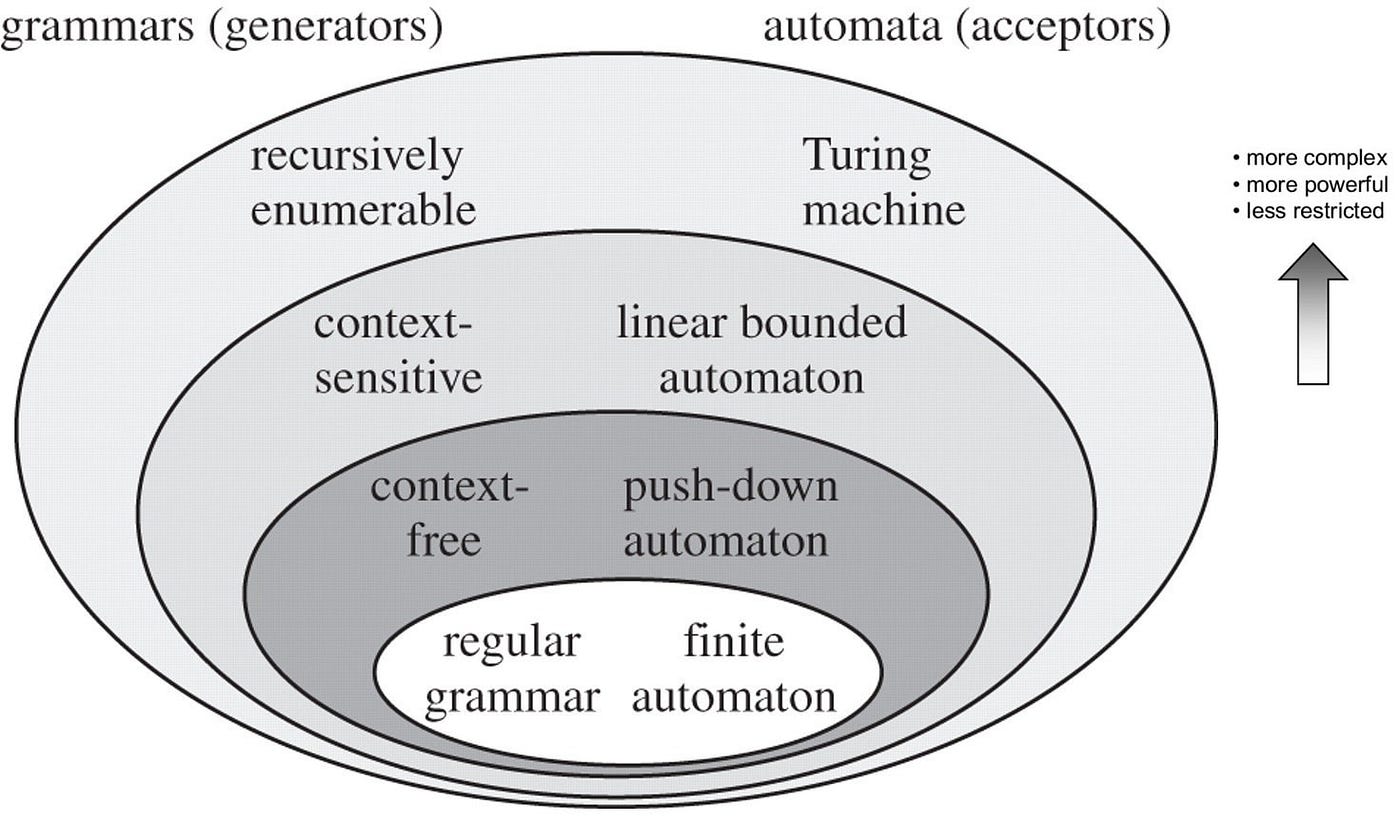
source: https://www.structural-learning.com/post/chomskys-theory
Table of Contents: We will cover the following
· The limitations of finite-state models · The power and limitations of phrase structure · The transformational model: A breakthrough · The far-reaching impact · Limitations and evolution · A blueprint for modern linguistics · References
The limitations of finite-state models
Chomsky begins by examining finite-state Markov processes, the simplest and most restrictive model for language description. These models, which produce symbols through transitions between states, were popular at the time for their mathematical simplicity.
However, Chomsky demonstrates a crucial insight: no finite-state grammar can adequately describe English or any natural language. He proves this by showing that English contains patterns with dependencies that extend beyond what finite-state models can capture. For example, in constructions like “If S₁, then S₂” or “Either S₃, or S₄,” where the interdependent words (“if”-”then”, “either”-”or”) can be separated by sentences of arbitrary complexity and length.
Chomsky introduces a formal proof concept called “dependency sets” to mathematically demonstrate why these models fail. He shows that sentences in natural languages can have dependency relationships with no fixed upper bound — something finite-state models inherently cannot handle.
Particularly compelling is his refutation of statistical approximation methods. Chomsky presents the now-famous example “Colorless green ideas sleep furiously,” demonstrating that grammaticality is entirely separate from statistical probability. This sentence, while grammatically correct, contains word combinations that would almost never appear together in a corpus.
The power and limitations of phrase structure
Having established the inadequacy of finite-state models, Chomsky introduces phrase structure grammars, which represent a significant advancement. These grammars, corresponding to what linguists call “immediate constituent analysis,” allow us to group words into phrases and these phrases into larger constituent phrases.
Phrase structure grammars operate through rules that rewrite strings, such as:
- Sentence → NP + VP
- VP → Verb + NP
- NP → the + man, the + book
- Verb → took
This approach proves far more powerful than finite-state models, enabling the representation of hierarchical structure in language. Chomsky shows that phrase structure grammars can handle the mirror-image properties of language that finite-state models cannot.
A significant insight emerges when Chomsky demonstrates how phrase structure naturally accounts for certain ambiguities in language. For example, “they are flying planes” can be interpreted as either “those specks on the horizon are flying planes” or “those pilots are flying planes.” The ambiguity arises naturally from different possible phrase structures.
However, even phrase structure grammars prove inadequate for fully describing English. Chomsky illustrates this through the analysis of verb phrases and passive constructions, showing that we need mechanisms beyond simple rewrite rules to capture the relationship between sentences like “The man ate the food” and “The food was eaten by the man.”
The transformational model: A breakthrough
Chomsky’s most significant contribution comes with the introduction of transformational grammar, which revolutionized linguistic theory. Transformational grammar supplements phrase structure with transformation rules that convert one sentence structure into another while preserving semantic relationships.
For passive constructions, rather than trying to generate both active and passive forms directly, Chomsky proposes a transformation rule: “If S is a sentence of the form NP₁+Auxiliary+V+NP₂, then the corresponding string of the form NP₂+Auxiliary+be+en+V+by+NP₁ is also a sentence.”
This elegant solution not only simplifies the grammar but explains the systematic relationships between different sentence forms. Chomsky further demonstrates that transformational grammar can explain subtle ambiguities that phrase structure alone cannot capture, such as in “the shooting of the hunters,” which can be interpreted with hunters as either subjects or objects.
The transformational approach leads to a tripartite structure of grammar:
- Phrase structure rules that generate the basic patterns
- Transformational rules that convert these patterns into more complex structures
- Morphophonemic rules that convert morpheme sequences into phonetic form
Crucially, this approach differentiates between “kernel sentences” (simple, active, declarative sentences) and “derived sentences” (more complex constructions created through transformations). This distinction provides insight into how we understand increasingly complex language.
The far-reaching impact
Chomsky’s analysis conclusively demonstrates that each more powerful model brings us closer to adequately describing natural language. The finite-state model proves too limited, phrase structure provides significant but still inadequate power, and transformational grammar achieves a substantive breakthrough.
What makes this paper remarkable is not just its technical arguments but its broader implications. Chomsky changed how we think about language, moving linguistics from a primarily descriptive discipline to one with explanatory power about the human mind. By showing that language has underlying mathematical and computational properties, he connected linguistics to formal systems theory and ultimately to cognitive science.
His work laid the foundation for formal language theory in computer science and directly influenced early work in computational linguistics and natural language processing. The formal hierarchy of languages and grammars that emerged from this work (now known as the Chomsky hierarchy) became a cornerstone of theoretical computer science.
Perhaps most profoundly, Chomsky’s argument that the ability to use and understand language involves mental processes that go beyond simple statistical learning challenged behaviorist psychology and helped spark the cognitive revolution. The paper’s careful attention to explaining not just how language works but how humans understand it pointed toward what would become Chomsky’s most enduring contribution: the idea that humans possess an innate language faculty.
Limitations and evolution
While groundbreaking, Chomsky’s early transformational model would undergo significant revisions in subsequent decades. Later research revealed complications in the transformational approach, leading Chomsky himself to develop more refined theories like Government and Binding Theory and the Minimalist Program.
The paper also largely limits its scope to syntax, with less attention to semantics, pragmatics, and the social dimensions of language. And while Chomsky argues convincingly against statistical approaches to language, ironically, modern computational linguistics has found great success with statistical and probabilistic methods, particularly when implemented through machine learning.
Nevertheless, the theoretical framework established in “Three Models” created the foundation upon which modern linguistics was built, providing powerful formal tools for describing the structure of language and analyzing how humans produce and comprehend it.
A blueprint for modern linguistics
Chomsky’s “Three Models for the Description of Language” represents one of the most important scientific papers of the 20th century. By systematically showing the limitations of simpler models and demonstrating the need for transformational grammar, Chomsky fundamentally changed how we understand language.
The paper’s framework for analyzing language structure continues to influence how linguists approach their field, how computer scientists think about language processing, and how cognitive scientists investigate the human mind. It stands as a monument to how formal, mathematical thinking can illuminate one of humanity’s most essential and mysterious abilities — the capacity for language.
References
- Chomsky, Noam. “Three Models for the Description of Language.” In IRE Transactions on Information Theory 2, no. 3 (1956): 113–124.
메타데이터
- post_id
- e4dcd1e2e255
- slug
- chomskys-three-models-of-language-the-birth-of-modern-linguistics-e4dcd1e2e255
- url
- https://medium.com/@generativeai.saif/chomskys-three-models-of-language-the-birth-of-modern-linguistics-e4dcd1e2e255
- canonical_url
- https://medium.com/@generativeai.saif/chomskys-three-models-of-language-the-birth-of-modern-linguistics-e4dcd1e2e255
- author_url
- https://medium.com/@generativeai.saif
- status
- ok
- fetched_at
- 2026-07-24 19:02:38