The Lost Art of Curiosity
What happens when a society stops asking questions?
The Lost Art of Curiosity
What happens when a society stops asking questions?
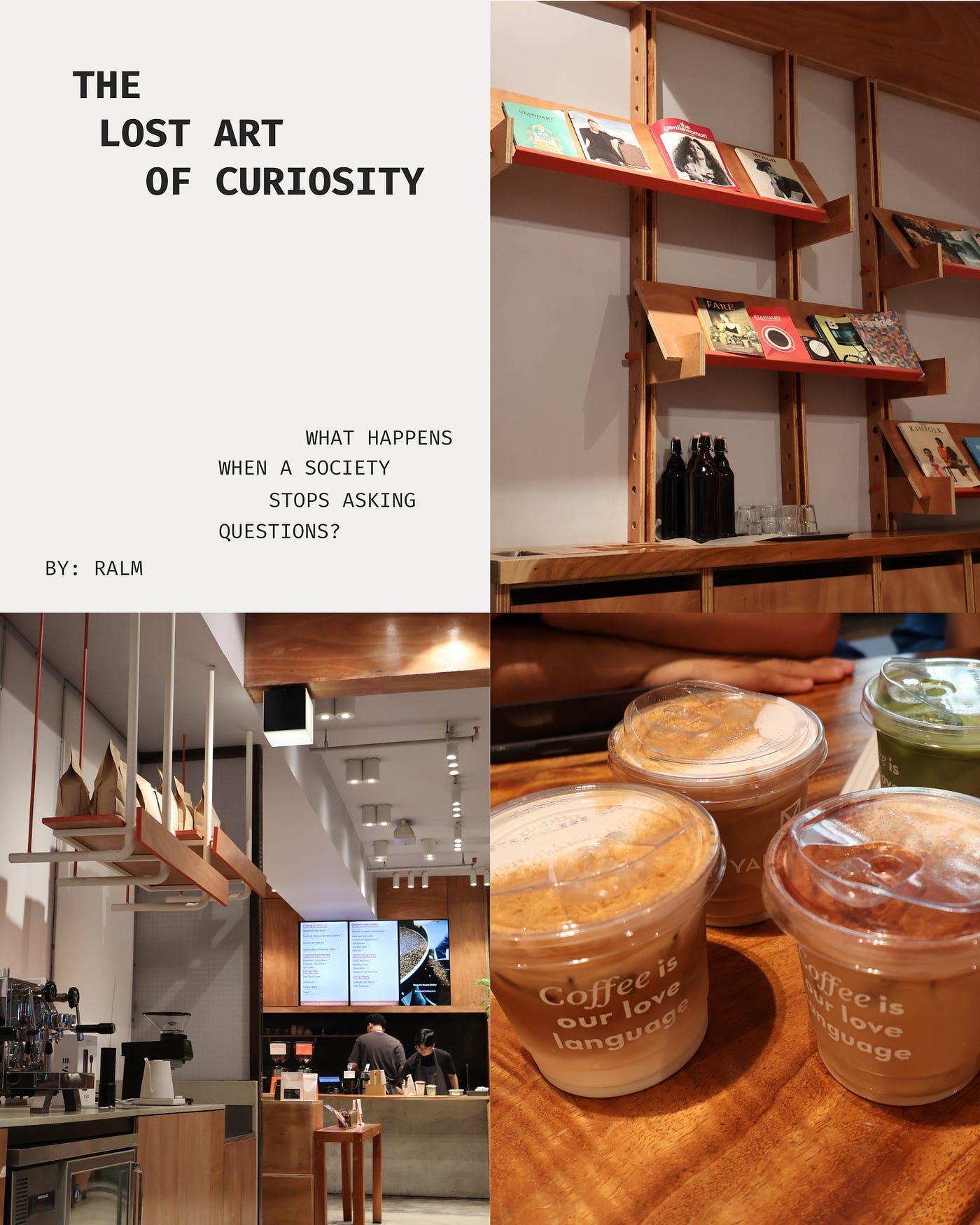
I am an Aquarius, which perhaps explains why I have always loved intellectual discussions. And do you know how rare those have become these days? Not the kind designed for social media nor the kind where everyone is trying to deliver the perfect comeback or say something podcast-worthy. I mean the kind where people sit over coffee (or liquor, let’s be honest, we’re millennials), walk home together after class or work, or spend a long commute talking about life. The kind of conversation where you’re not necessarily trying to understand each other, but the idea itself.
I realized this one night while doomscrolling. I have come to realized that social media made reaction look remarkably similar to opinion, and opinion look remarkably similar to expertise. And they are not the same.
A reaction is immediate, triggered by emotion, by an event, by something that happened two minutes ago. An opinion, on the other hand, takes time. It is formed and it is a synthesis of experiences, principles, ethics, and reflection. It is something you arrive at, not something you simply have. And even then, an opinion is still not expertise.
Democracy depends on public participation and public opinion, but it also depends on intellectual humility. We are all entitled to our reactions. We are all entitled to our opinions. But we should also know when to listen to people who have spent years building expertise, and then thoughtfully integrate that into our own understanding. To me, that is what critical thinking looks like.
What my skepticism look like
When I was studying at Bicol University, three of my favorite subjects apart from my major (I promise I really did love Physics and Chemistry) had nothing to do with my degree: Speech and Oral Communication, Debate and Argumentation, Human Philosophy. Looking back, those classes quietly shaped the person I am today. They taught me that ideas deserve to be challenged, not that they are wrong, but because they become stronger when tested.
I have always described myself as a skeptical person. Skepticism believes there is always more to understand. I still remember reading René Descartes and his idea of methodic doubt. The notion that questioning could itself be a pathway to truth fascinated me. It gave me permission not to settle too quickly for easy answers. And ever since, I have developed a habit that refuses to leave me, I ask questions (most often, difficult ones).
I’m genuinely curious and I acknowledge that I am a glass half full. I do ask questions because I have always believed there is a bigger truth hiding behind every story or concept. And also because context changes meaning, and perspective changes conclusions. That and, there is always a danger in believing a single story.
That habit has made me careful about what I believe. More importantly, it has made me a lifelong student of learning. To be honest, I simply just enjoy the process. I enjoy questioning what I know and I enjoy discovering that I was wrong. I enjoy realizing that an idea I held five years ago has evolved because I encountered new experiences, better arguments, or different people.
Of course, there is a danger in questioning everything. But questioning everything is not the same as believing nothing. Over the years, I have built a strong foundation of values and principles, my own ethos. It took years to build, and it began in childhood, with books, with people, with conversations, quiet moments of introspection, and giving myself permission to think.
So when I ponder on situations, curiosity did not make me uncertain about who I am. It made me more certain about how I want to learn.
Which brings me back to the “Lost Art of Curiosity”, the reason why I am writing all this. The art of being curious is also the art of being wrong, the art of asking foolish questions without the fear of looking foolish. There are spaces (most of the time not on social media) that discussions are not a form of humiliation, and arguments that are genuine and most probably not suited for all audiences (lol). There are conversations that begin with curiosity instead of certainty. (Even in today’s polarized social media landscape, I’ve never unfriended someone because of a difference in beliefs. I’d rather remain in conversation, curious about the ideas behind their opinions, even when that curiosity isn’t always reciprocated.)
I count myself incredibly fortunate because I have found (many) circles of people where I can still do exactly that, friends (and my family) who challenge my ideas, question my assumptions, and make me think harder without making me feel smaller. Those conversations have shaped me just as much as any experience ever did.
So maybe, this is my invitation to bring back the lost art of curiosity. Let’s take the conversations outside social media. The best ideas were never meant to fit inside a comment section, anyway. They were always meant to be shared with people who are curious enough to listen.
Coffee (or non-coffee) soon?
메타데이터
- post_id
- e4dfe68f2a9b
- slug
- the-lost-art-of-curiosity-e4dfe68f2a9b
- url
- https://medium.com/@rachelle-miranda/the-lost-art-of-curiosity-e4dfe68f2a9b
- canonical_url
- https://medium.com/@rachelle-miranda/the-lost-art-of-curiosity-e4dfe68f2a9b
- author_url
- https://medium.com/@rachelle-miranda
- status
- ok
- fetched_at
- 2026-08-07 12:24:30