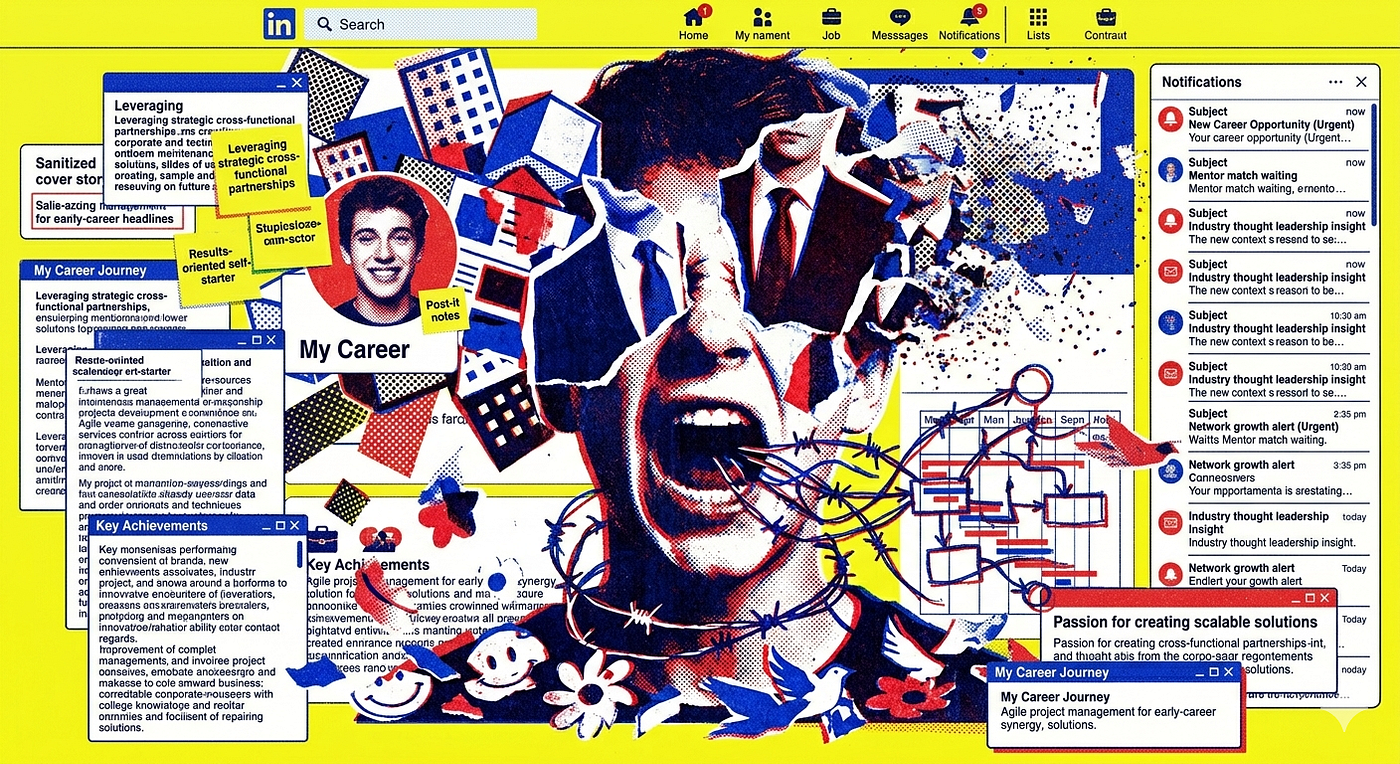
Why You Keep Running Into the Same Problem at Work
You’ve changed jobs. Maybe more than once. Different company, different team, different industry even.
Why You Keep Running Into the Same Problem at Work

You’ve changed jobs. Maybe more than once. Different company, different team, different industry even.
And yet — somehow — a familiar dynamic keeps showing up. The same type of conflict. The same point where things start to feel off. The same experience of putting in real effort and getting results that don’t quite match what you put in.
It’s easy to explain this away as bad luck, or difficult colleagues, or just the nature of the industry you’re in. But at some point, when the same pattern appears across different contexts, it stops being about the context.
It’s about the structure you’re bringing with you.
What Saju is actually looking at
Saju doesn’t tell you which job to take. It won’t tell you to quit, stay, or pivot. Those decisions involve too much that no framework can see from the outside — your values, your financial situation, the specific relationships involved.
What Saju does unusually well is show you the structural conditions that are already shaping how you work.
Not the job title. The underlying dynamics. Why certain environments consistently energize you while others drain you, regardless of the tasks involved. Why you function well under some kinds of pressure and struggle under others. Why collaboration feels natural in some configurations and exhausting in others.
Most personality frameworks get at some of this. But they’re working from how you describe yourself — which means your blind spots come along for the ride. Saju looks at the elemental composition of your chart, which exists independently of how you perceive yourself. It can describe tendencies that are operating even when you’re not aware of them.
What your element actually says about how you work
Different elemental makeups create fundamentally different orientations toward work. Here’s what each one tends to produce.
Wood people are builders. They’re energized by new initiatives, early-stage growth, creating things that didn’t exist before. They often find that the most exciting part of a project is the beginning — and that maintenance and routine drain them faster than they’d expect. They can struggle in environments that reward staying in place over moving forward.
Fire people run on connection and visibility. They do their best work when they can communicate, influence, and bring energy to a room. They tend to feel the cost of isolated, low-interaction work more than other types. Their challenge is often sustaining momentum through the quieter phases that don’t have the same charge.
Earth people are the ones who actually get things done. Reliable, practical, oriented toward the concrete. They’re often the person everyone counts on — which can become a pattern of carrying more than their share without quite knowing how it happened.
Metal people have high standards and a drive toward precision. They excel in environments where quality and exactness matter. They may find that loosely defined roles or constantly shifting priorities are genuinely draining in a way that’s hard to explain to colleagues who seem unbothered by the same ambiguity.
Water people process deeply before they act. They tend toward adaptability and internal complexity. They often do their best thinking outside formal structures — and can find highly rigid environments more constraining than others seem to notice.
None of these is better. All of them are pointing toward something specific about how you are likely to function — and where you’re likely to run into friction.
The element you’re missing matters just as much
Here’s something counterintuitive: the elements that are absent from your chart are often as revealing as the ones that dominate it.
An element that’s largely missing tends to represent an area of consistent challenge — not because you’re incapable, but because the structural support for that domain isn’t built into your chart. You’re working harder in that area than someone whose chart naturally supports it.
Someone with very little Earth, for example, may consistently struggle with follow-through and practical consolidation — not from laziness, but from a structural tendency toward ideas and abstraction that makes the grounding work genuinely more effortful.
Knowing this doesn’t make the challenge disappear. But it changes how you think about it. Instead of reading that friction as a personal failing, you can see it as a structural feature — something your chart asks more of you in that domain. Which means you can make more conscious decisions about how to build support for that gap, rather than just grinding harder against it.
The decade question nobody thinks to ask
Here’s the dimension of Saju’s career analysis that tends to surprise people the most.
Your chart isn’t static. The elemental conditions of your life shift across time — through ten-year cycles called luck pillars. Each decade has its own elemental character, and that character interacts with your natal chart in ways that can make the same effort feel very different depending on when you’re making it.
Some decades are naturally oriented toward expansion — new opportunities, growth, the right conditions for launching something. Others are better suited to consolidation — finishing what’s been started, deepening rather than widening. And some decades bring a kind of structural friction in specific areas that has nothing to do with how hard you’re working.
This matters enormously for career decisions. If you’ve been in a period where effort consistently isn’t producing proportionate results — and you’ve already ruled out the obvious external explanations — it may be worth looking at the elemental character of the decade you’re in.
It’s not an excuse to stop trying. It’s information about the terrain. And knowing the terrain changes how you navigate it.
The question that actually moves things forward
Most career advice focuses on the question: what should I do?
Saju is more interested in a different question: what patterns am I already working with — and are they serving me?
If you’ve changed contexts multiple times and the same dynamic keeps appearing, the answer isn’t likely to be found in another job change. It’s in understanding the structure you’re bringing into every context you enter.
That’s what a Saju reading can show you. Not where to go. But what you’re actually working with right now — the elemental composition that’s been shaping your experience of work since before you had a name for it.
Once you can see it clearly, you can start working with it instead of against it.
Kairo translates Korean Saju into English for people who think carefully about their lives. Korean Saju, translated for modern life.
메타데이터
- post_id
- e4e23a876bef
- slug
- saju-and-career-what-your-elemental-structure-says-about-your-right-work-e4e23a876bef
- url
- https://medium.com/@askkairo/saju-and-career-what-your-elemental-structure-says-about-your-right-work-e4e23a876bef
- canonical_url
- https://medium.com/@askkairo/saju-and-career-what-your-elemental-structure-says-about-your-right-work-e4e23a876bef
- author_url
- https://medium.com/@askkairo
- status
- ok
- fetched_at
- 2026-06-17 08:20:12