The Seventies We Don’t Remember
How media distortion shaped a decade — and why it still matters

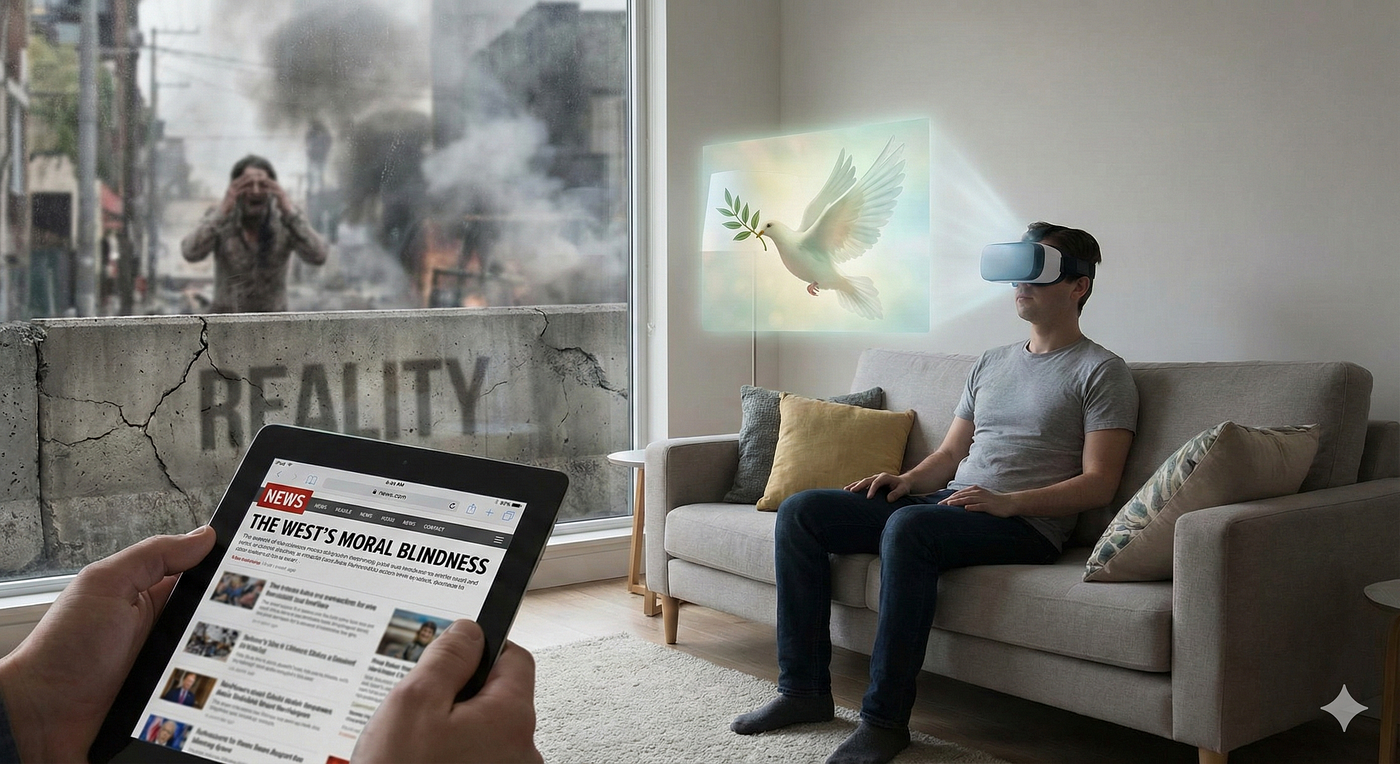
Image created with Google Gemini
The Seventies We Don’t Remember
How media distortion shaped a decade — and why it still matters
Say “the Seventies” and most people picture disco balls, bell-bottoms, and ABBA. That image is wrong.
Ask people who actually lived through the decade as adults and you get a different answer. Anxiety. A pervasive feeling that things were falling apart and nobody was in charge. In the United States, the optimism of the moon landings gave way to Watergate, stagflation, gas lines, and a president who told Americans their problems were essentially spiritual. In Italy, the Anni di piombo brought near-daily kidnappings and political murders. In Britain, garbage piled up in the streets during the Winter of Discontent.
The Seventies were not fun. They were dark, confused, and frightening — and a significant part of that fear was manufactured. Not invented from nothing; real things happened. But the gap between what actually occurred and how it felt to live through it was enormous. That gap was filled by media.
Two cases from the 1970s show what happens when journalists let ideology override analysis: the Red Army Faction in Germany and the Islamic Revolution in Iran. Different events, same root failure.
Germany and the RAF: Making an Elephant Out of a Mosquito
The Red Army Faction — the Baader-Meinhof group — killed 34 people over nearly three decades. Its hard core never exceeded 20 to 30 members. By any rational measure, this was a small criminal gang with political pretensions.
Yet for most of the 1970s, the RAF dominated German public life. It sat on the front page of every major newspaper, week after week. Politicians framed it as a battle for the survival of the democratic order.
The historian Hanno Balz, in his study Von Terroristen, Sympathisanten und dem starken Staat, documented how the media created a self-reinforcing cycle of anxiety and sensationalist coverage — shaping the image of the terrorist and fueling the notion that anyone could become a victim. Rumors were amplified: at one point there was serious press discussion about whether the RAF might acquire nuclear weapons. This group of perhaps twenty people.
The media researcher Andreas Elter showed something equally striking: the Revolutionary Cells — a parallel West German terrorist group that carried out 186 attacks between 1973 and 1995 — received a fraction of the coverage the RAF got. The coverage bore no relationship to actual threat levels. Something else was driving it.
Two things, specifically. First, ideology. Surveys of German journalists have consistently shown a heavy lean to the left — a pattern stable across decades. In the 1970s, many journalists were ideologically adjacent to the milieu from which the RAF emerged: the radical fringe of the 1968 student movement. This proximity made the RAF inherently more interesting to them than the facts warranted. Second, economics. Terrorism sells newspapers. A small gang of bank robbers on page three does not. A fundamental challenge to the democratic order on page one does.
The rational response to the RAF would have been to treat it as a criminal matter: investigate, arrest, prosecute. Police work, not national soul-searching. Instead, it was elevated into a symbol of everything wrong with the republic. Conservatives used it to discredit the entire left. Left-leaning journalists, fascinated by the political questions it raised, gave it intellectual oxygen it didn’t deserve. Both sides had incentives to keep the story as large as possible.
The result was a decade of unnecessary fear, political polarization, and civil liberties restrictions — all centered on a group that should have been handled by a competent criminal investigation unit.
Iran 1979: The Revolution That Intellectuals Wished Into Being
The Iranian case is not about sensationalism. It is about an educated class that had all the evidence it needed and chose to ignore it.
Start with a fact that historians find striking: the Iranian Revolution is considered one of the most unexpected in modern history — not because conditions were terrible, but because they weren’t. Iran in the 1970s was experiencing substantial economic growth from oil revenues. The Shah’s regime was repressive but not catastrophically so. Unlike France in 1789 — feudal, starving, fiscally collapsed — or Russia in 1917 — destroyed by war and famine — Iran had no overwhelming structural crisis that made revolution inevitable. Scholar Crane Brinton noted that the sharp economic contraction of 1977–78, coming after years of growth, produced frustration disproportionate to the actual hardship: people resent losing what they had more than never having had it. That frustration was real, but it was manageable. The revolution happened anyway, driven less by objective conditions than by the ideas people chose to believe.
Among those ideas was the Iranian left’s conviction that their revolution would be different. These were not only naive students — but also politically educated people who knew their 20th century history. The Soviet Union was not a secret. The show trials, the purges, the systematic elimination of every faction that helped make a revolution but wasn’t part of the winning group — all documented, all known. They had watched the same pattern repeat across dozens of countries.
And yet they were certain this time would be different. Khomeini’s own book Velayat-e Faqih, available since 1970, laid out his vision of theocratic rule in plain detail. The left dismissed it. They were convinced the clergy couldn’t govern a modern state — that the mullahs would serve as useful idiots, then step aside. This wasn’t a mistake born of insufficient information. It was a mistake born of self-regard: the belief that their own sophistication would determine the outcome.
Western intellectuals made the same error from a greater distance. Sympathetic to any movement declaring itself anti-imperialist, they amplified Khomeini’s Paris image — spiritual guide, not theocrat — without scrutiny. Studies later documented how Western leftists continued defending him even as he liquidated his former allies, because ideological identification overrode what was plainly in front of them.
The result was entirely predictable. By 1982, every faction that had helped make the revolution except Khomeini’s own was crushed, imprisoned, exiled, or killed. Historian Ervand Abrahamian estimates around 8,000 political opponents executed between 1981 and 1985; thousands more in the 1988 prison massacres, classified by the UN Special Rapporteur in 2024 as crimes against humanity. The people who made the revolution were its first victims — exactly as history had shown they would be, repeatedly, in every comparable case before.
They did not walk into this blindly. They walked in with their eyes closed, because opening them would have meant confronting the bankruptcy of their own ideology.
What Connects These Cases
The two cases differ in scale but share the same pattern: in both, journalists and intellectuals let ideology drive their analysis rather than the evidence in front of them.
German journalists inflated the RAF into an existential threat. Iranian and Western leftists backed a revolution whose likely outcome was predictable. In both cases, ideology gave people reasons to avoid the conclusions the evidence supported.
The German left’s response to the Iranian Revolution was not coincidental. The two were connected by a specific event twelve years earlier.
When the Shah visited West Berlin in June 1967, protests outside the Deutsche Oper turned violent. A student, Benno Ohnesorg, was shot and killed by a plainclothes police officer, Karl-Heinz Kurras. The killing radicalized the West German student movement and contributed to the climate from which the RAF later emerged. In 2009, STASI archives showed that Kurras had been an East German informant while serving in the West Berlin police — unknown at the time. The Shah had by then become fixed in West German left-wing memory as a symbol of CIA-backed repression; SAVAK, Shahs secret police, gave that image solid grounding.
When Khomeini toppled the Shah in February 1979, much of the West German left read it through this existing frame: a US client regime had fallen, an anti-imperialist movement had won. The clerical nature of that movement was noted but not taken seriously as a problem.
That view was wrong. By 1981, the Islamic Republic was moving against its former partners. The Tudeh Party, the Mojahedin, the Fedayeen — the secular and leftist organizations that had helped make the revolution — were crushed. Many ideological twins of the German left were shot in Evin Prison in Tehran. For the Iranian left the game was over by 1983.
The German left did not revisit its 1979 position. Coverage of Iran shrank. The question of what the “anti-imperialist” framework had gotten wrong, and why, was not asked. The events after 1979 directly challenged that framework. The challenge was ignored and became a conceptual black hole for the German left movement, as with all events that did not fit the leftist narrative. This is a known pattern, with the Gulag and the Cultural Revolution being other even more prominent examples, since these atrocities were performed directly by the left itself.
This essay references the work of Hanno Balz (Von Terroristen, Sympathisanten und dem starken Staat) and Andreas Elter on RAF media coverage, historian Ervand Abrahamian on the Iranian Revolution, and the UN Special Rapporteur’s 2024 report on crimes against humanity in Iran.
메타데이터
- post_id
- e4e359b1eeba
- slug
- the-seventies-we-dont-remember-e4e359b1eeba
- url
- https://medium.com/@michael.raz/the-seventies-we-dont-remember-e4e359b1eeba
- canonical_url
- https://medium.com/@michael.raz/the-seventies-we-dont-remember-e4e359b1eeba
- author_url
- https://medium.com/@michael.raz
- status
- ok
- fetched_at
- 2026-07-27 01:40:07